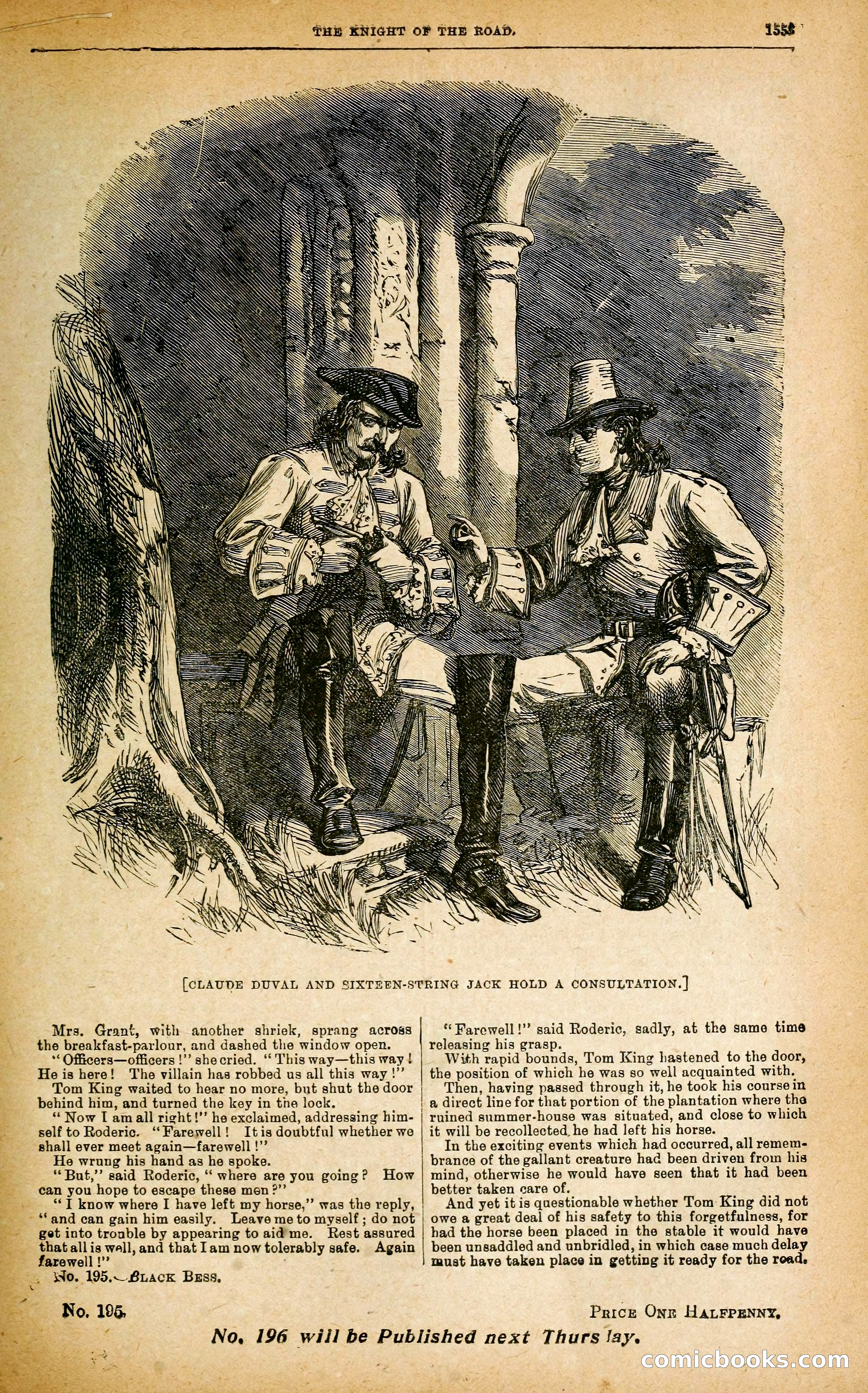
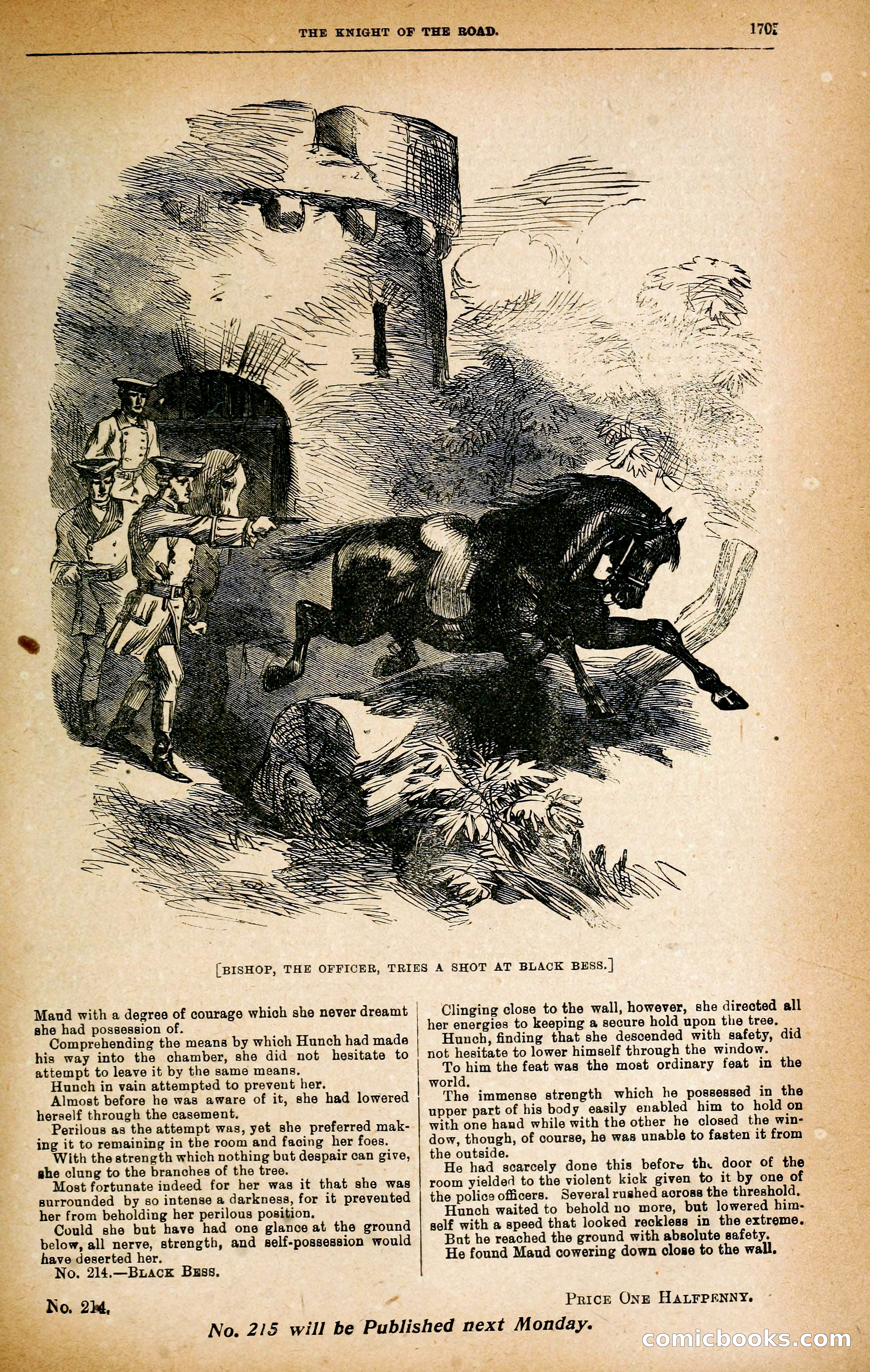
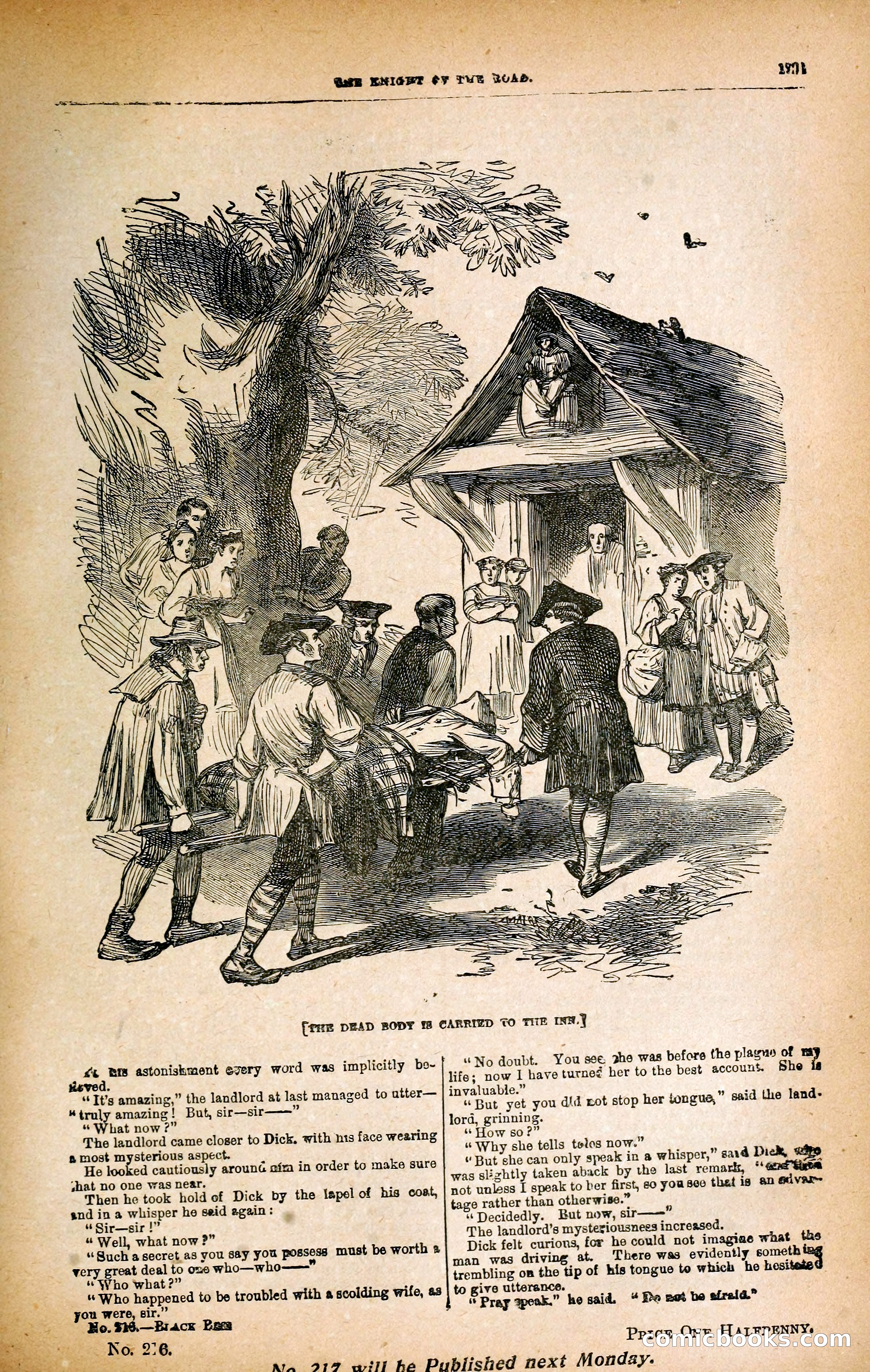
A complete issue · 400 pages · 1866
Black Bess; or, the Knight of the Road
This page contains a library bookplate from the Library of the University of Illinois, featuring an architectural illustration of three arched doorways with ivy or climbing plants. Below the illustration is the call number "823 V71b v.3," indicating this is volume 3 of a catalogued work. At the top of the page, handwritten text reads "Collated sound complete," suggesting this is a note about the physical condition or completeness of the bound volume. The OCR text appears largely garbled, likely due to the quality or format of the source material. This is an endpaper or front matter page rather than actual story content.
This is a title or cover page from a digitized Victorian penny dreadful. The image shows a classical building facade with four columns and a triangular pediment—a common architectural motif used on such publications. The visible text consists entirely of metadata from the Internet Archive, indicating this work was digitized in 2010 with funding from the University of Illinois Urbana-Champaign. The URL references "blackbessorknigh03vile," suggesting this is the third volume of a serial work, though the complete title remains unclear. No plot content or running narrative is visible on this page.
# Analysis This page appears to be a **blank or nearly blank back cover/endpaper** of a Victorian penny dreadful publication. The image shows a lightly textured, aged paper surface with subtle watercolor-like variations in pale blue, cream, and green tones—typical of period printing or aging. The only visible text is "comicbooks.com" in the lower right corner, which appears to be a modern watermark added by the website hosting the digitized image, not original to the Victorian publication. No actual content from the penny dreadful itself—no title, illustration, prose, or advertisement—is legible on this page. It represents either the inside back cover or an endpaper section of the original publication.
# This Page: Running Prose from a Victorian Penny Dreadful This page contains dense running prose from what appears to be *Black Bess*, a serialized Victorian sensation novel (indicated by the header "BLACK BESS; OR" at top). The text depicts a tense conversation between a character named Claude (apparently disguised as "Master Jack") and an old man. Claude is attempting to deceive the old man into helping him enter a house quietly to confront his cousin, while concealing his true identity. The dialogue reveals Claude's anxiety about maintaining the deception and his plan to access his father's chamber secretly rather than entering boldly.
# This Page: Running Prose from a Victorian Penny Dreadful This page contains dense running prose narrative from *The Knight of the Road*, a Victorian sensation story. The text depicts a dramatic deathbed scene in which a young man (Claude) attempts to force an elderly, dying man to sign a document, then forges the signature when the old man apparently expires. The scene is interrupted by the arrival of the heir, Ralph Davids, whose unexpected return at this critical moment threatens to expose Claude's villainy. The narrative emphasizes melodramatic tension, moral corruption, and the scheming of the villain protagonist.
# Page Content Description This is a page of running prose from a Victorian penny dreadful serial (page 1380). The text depicts a dramatic scene in which Ralph Davids, confronted by gentlemen who attempt to arrest him, escapes through a window and disappears into darkness, while simultaneously a dying nobleman is revived by a physician and reconciles with his son before expiring. The passage includes Chapter DCCCXLI and concludes with the aged man closing his eyes in death.
# This Page from "The Knight of the Road" This is a page of running prose from a Victorian penny dreadful serial. The text describes Claude hiding in a secret compartment behind bookshelves while officers search the building. His protector has helped him evade arrest by bribing the police and handing over someone named Ralph Davids on a forgery charge instead. Claude is advised to remain hidden until nightfall before attempting escape. The narrative emphasizes the suspense of the concealment, the "oppressive silence," and the narrow escape from discovery.
# Victorian Penny Dreadful Page This is a page of **running prose text** from a Victorian penny dreadful (appears to be titled *Black Bess*). The narrative concerns Claude's return to find the mysterious highwayman captain missing; his horse, Black Bess, has arrived alone at the door, wet and bearing only a cryptic note saying "All's well—fear not for me. Back soon." Claude and the assembled characters—including the highwaymen Tom King and Sixteen-String Jack, and a woman named Maud—discuss the captain's unexplained absence. Tom King attempts to redirect conversation away from the captain's disappearance by offering to recount his own adventures, while Maud displays visible distress at the situation.
# The Knight of the Road (Page 1383) This is a page of running prose text from a Victorian penny dreadful serial. The narrative, presented as dialogue and first-person account, concerns a widow named Charlotte Chadwick explaining to an unnamed listener the complicated affairs of her niece Lillian. She describes her step-brother William Aldis as a villain who serves as Lillian's guardian, has misappropriated her wealth, and is pursuing an unwanted marriage with the girl—who remains true to her absent lover. The text establishes a melodramatic plot of financial villainy, coercion, and moral virtue under threat.
This page contains running prose from Chapter DCCCXLIV of a penny dreadful titled *Black Bess; Or,* dated 1884. The text describes a narrator and an old lady arriving by carriage at a residence to rescue someone named Lillian, whom they discover standing at a table holding a knife in a threatening manner, locked in confrontation with an unseen man—the narrative building suspense through their clandestine entry via a side door.
# Description of Page This is a page of running prose from a Victorian penny dreadful (1886), presenting narrative dialogue between highwaymen characters. The page contains two connected sections: the conclusion of Tom King's account of an adventure involving his encounter with a woman and subsequent arrest, followed by the beginning of Chapter DCCCXLV, where Sixteen-String Jack begins his own tale of a recent exploit on the North Road. The text focuses on criminal adventures and highway robbery, typical of the sensational crime fiction genre these serials featured.
# Page from Victorian Penny Dreadful: "Black Bess; or, The Knight of the Road" This page consists of running prose—two columns of text continuing a serialized narrative. The visible text depicts a conversation between Tom Davis (an innkeeper) and a newsvendor discussing Dick Turpin's imprisonment in Newgate prison. The newsvendor reports rumors that Turpin and his highwayman gang operate a secret roadside inn where visitors disappear. Tom Davis reacts with apparent surprise, though the narrator notes his expression undergoes a "very great and striking alteration" once alone, suggesting he is secretly connected to Turpin's criminal enterprise.
# Page Analysis: Victorian Penny Dreadful This is a **page of running prose** from a serialized Victorian penny dreadful (page 1390, mid-narrative). The text depicts a heated confrontation between Sir George, Sir Marmaduke, and huntsmen over the custody of Dick Turpin, who appears to be a prisoner. Sir Marmaduke insists on summoning police officers to Newgate, while Sir George refuses to leave Turpin unguarded, fearing an escape. The page ends with Sir Marmaduke dispatching his gamekeeper Robert on horseback to fetch police officers, while Dick Turpin observes this development with mysterious calculation. The chapter heading indicates Turpin's subsequent "handcuffing by police officers" and journey to Newgate.
# Page from "Black Bess; Or" (penny dreadful serial) This is a page of running prose text from Chapter DCCCL of a Victorian penny dreadful. The narrative describes a sudden rainstorm forcing Sir Marmaduke, Sir George, and officers escorting the prisoner Dick Turpin to seek shelter. They spot the Bag of Nails Inn through the mist. Turpin, silent throughout, secretly welcomes the storm as an opportunity to escape, seeing the forced stop at the inn as a favorable chance. The officers discuss accommodations while Turpin calculates his advantage, his mind occupied with devising means of release from his captors.
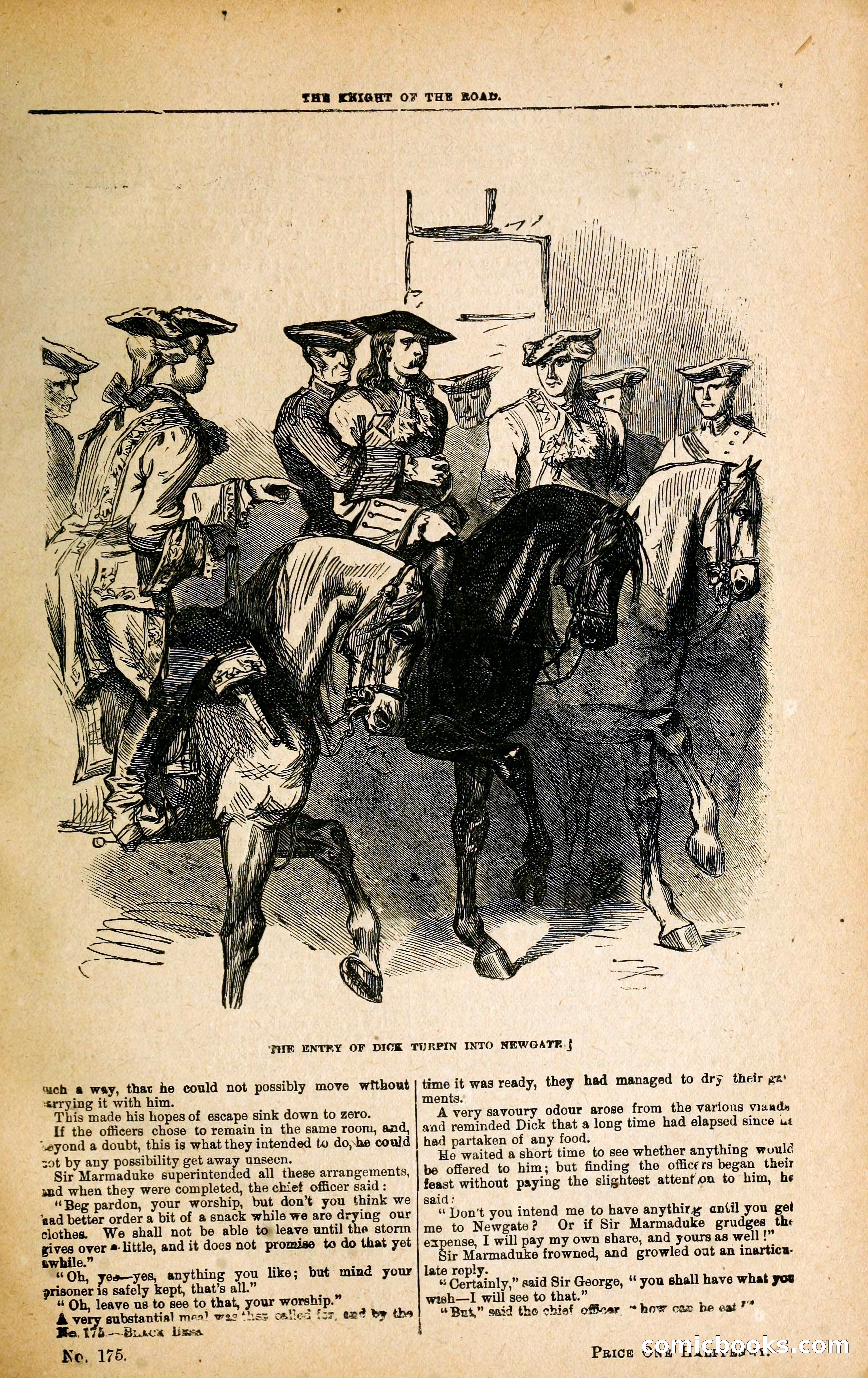
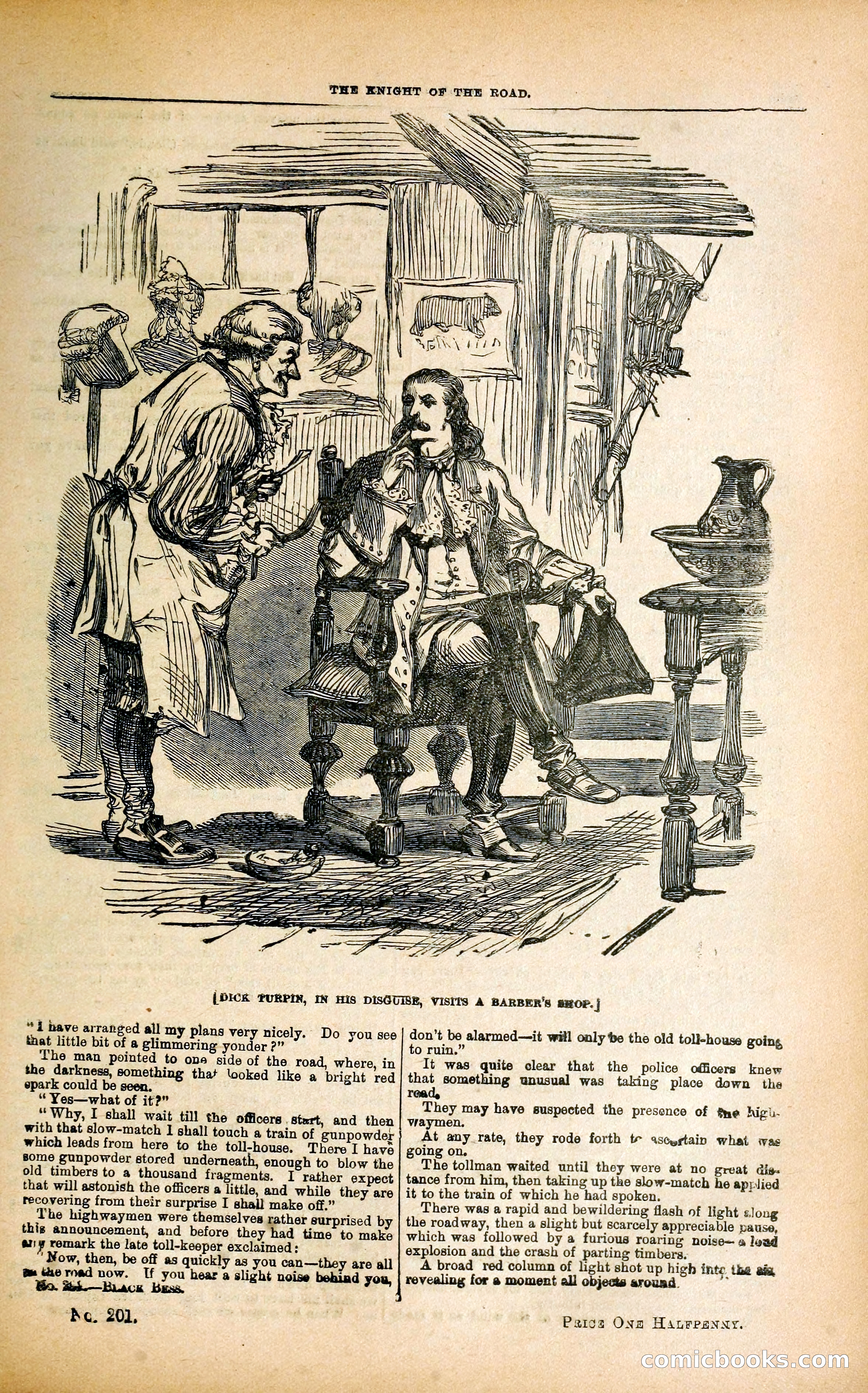
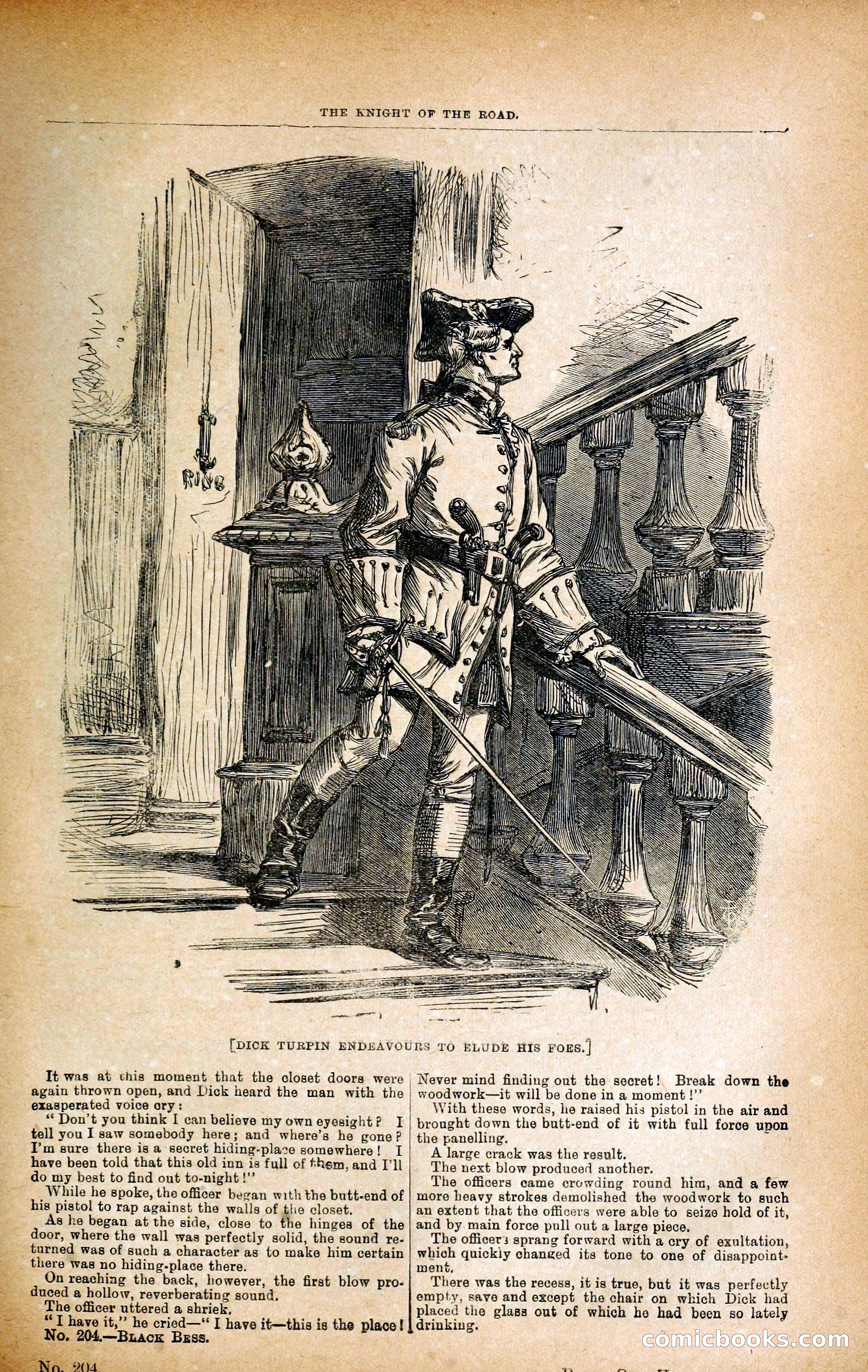
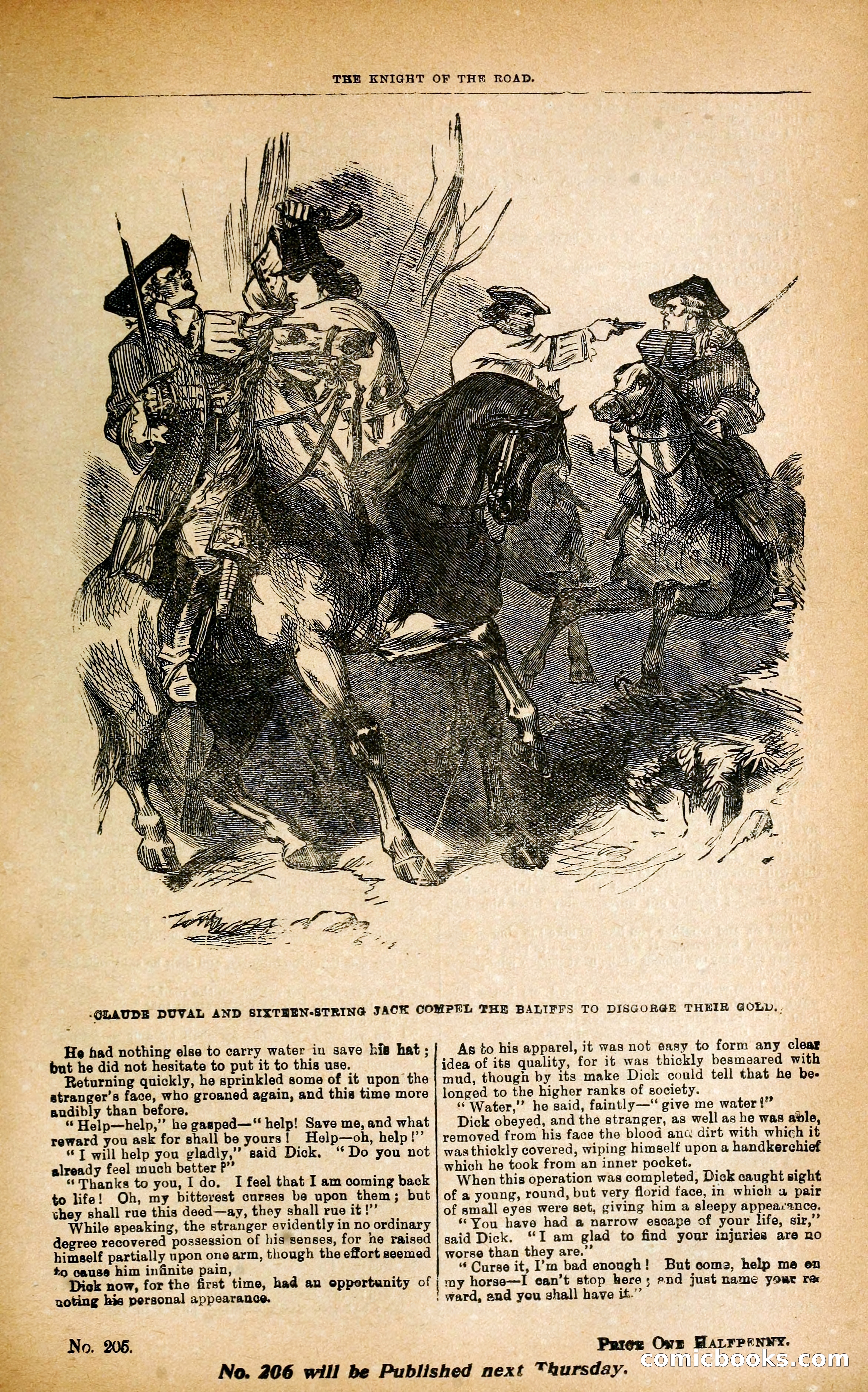
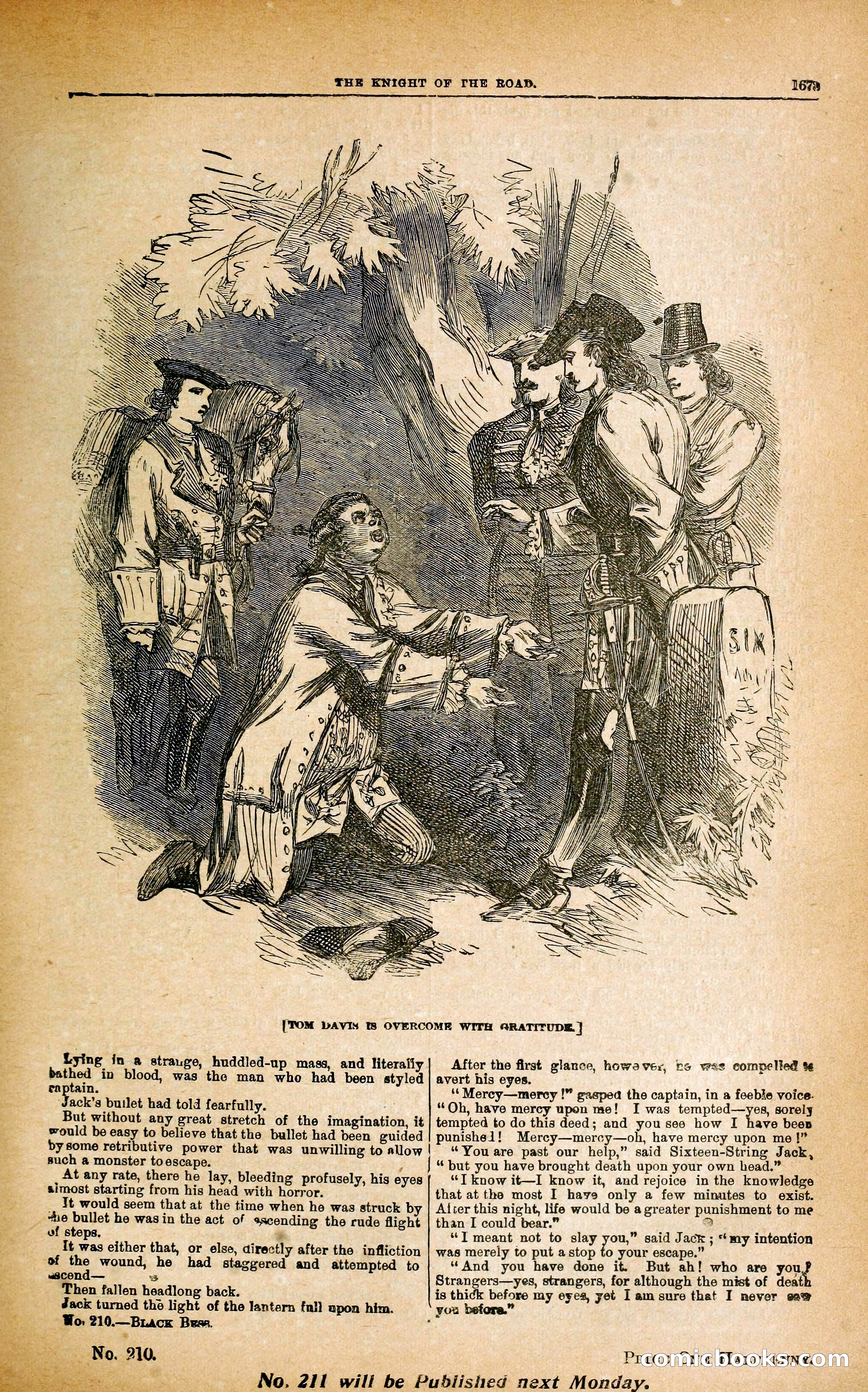
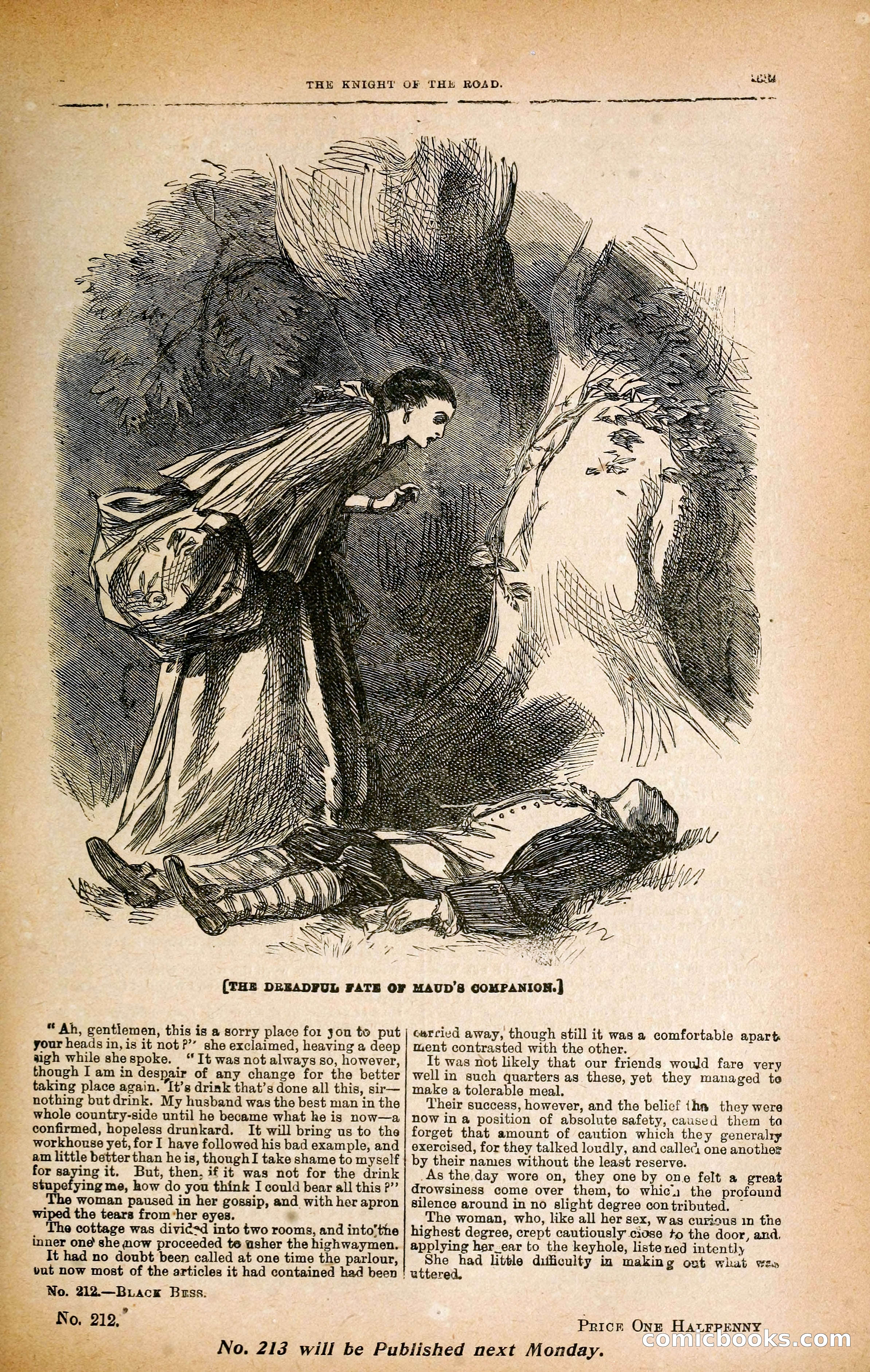
# Page Description This page contains an illustration with running prose text from a Victorian penny dreadful titled "The Knight of the Road." The engraving depicts "The Entry of Dick Turpin into Newgate," showing a mounted figure surrounded by several men in period dress, apparently depicting the famous highwayman's arrival at the prison. Below the image runs dialogue and narrative prose describing characters drying garments and discussing arrangements regarding a prisoner, with mentions of Sir Marmaduke and references to paying one's own share. The page is numbered 175 at the bottom.
# Page Content Description This is a page of running prose from a Victorian penny dreadful novel. The visible text depicts a scene where Dick Turpin, apparently a famous highwayman prisoner, is being transported to London under guard. The passage describes how officers debate whether to remove his handcuffs to allow him to eat, Sir George insisting they do so despite warnings from the chief officer. Turpin eats with apparent calm while secretly assessing his situation and prospects for escape. A new chapter begins midway down the page, continuing the narrative of the officers' journey to London with their captive.
# Page Analysis This is a page of running prose text from a Victorian penny dreadful, numbered 1396. The narrative depicts Dick Turpin's arrival at Newgate Prison, where Sir Marmaduke Braham, a magistrate, presents him to the Governor. The text describes the Governor's obsequious behavior toward authority figures and his tyranny toward prisoners. The scene culminates when Dick Turpin, overhearing himself called a "notorious rascal," kicks the Governor in retaliation. The chapter heading visible at bottom indicates this section concerns "Dick Turpin Enrages Sir Marmaduke, But Makes Friends With The Governor Of Newgate."
# Victorian Penny Dreadful Page Analysis This is a page of running prose from a Victorian penny dreadful serial, dated 1898. The text depicts Chapter DCCCLIV, in which the notorious criminal Dick Turpin, imprisoned in Newgate, cleverly manipulates the prison Governor into granting him privileges by flattery. After the Governor leaves, Turpin retrieves a locket he has hidden in his mouth and attempts to open it, discovering it contains two small portraits—one male, one female—though the text cuts off before revealing their significance. The narrative emphasizes Turpin's cunning and the Governor's self-congratulatory folly.
# What This Page Contains This page consists of running prose—dense, double-columned Victorian typography with no illustrations. It appears to be from the middle of a serialized narrative (page 1402). The text depicts a conversation between Tom Davis and a barber. Tom has just had his hair cut and is now having it dressed. When Tom asks what news is happening, the barber leaves to gather information, returning to report that police are searching the White Horse inn for a man suspected of committing mysterious murders. The landlord, old Matthew, denies the man is present, though the officers doubt him. Tom finds this character "remarkable" and expresses great interest in the situation.
# Analysis of Page This is a page of running prose text from a Victorian penny dreadful, specifically from *The Knight of the Road* (visible in the header). The page contains dialogue between characters discussing the news that Dick Turpin, apparently a highway robber, has been captured and imprisoned in Newgate. Old Matthew and Tom Davis converse about whether this report is credible, with Tom recounting recent events involving Turpin's disappearance and the police searching Matthew's house. The text explores their doubts about Turpin's arrest, given his supposed vow never to surrender. At the page's bottom, a new chapter heading ("Chapter DCCCVIII") indicates a shift in narrative focus to Dick Turpin making himself "very comfortable in Newgate."
This is a page of running prose from a Victorian penny dreadful (page 1404). The text depicts a conversation between old Matthew and Tom Davis regarding a prisoner in Newgate jail—apparently someone important whose release they are plotting to secure using a locket as leverage with the King (currently at Windsor). The dialogue concerns delayed letters, the need for secrecy from an inquisitive barber neighbor, and arrangements for future clandestine meetings to effect the prisoner's escape.
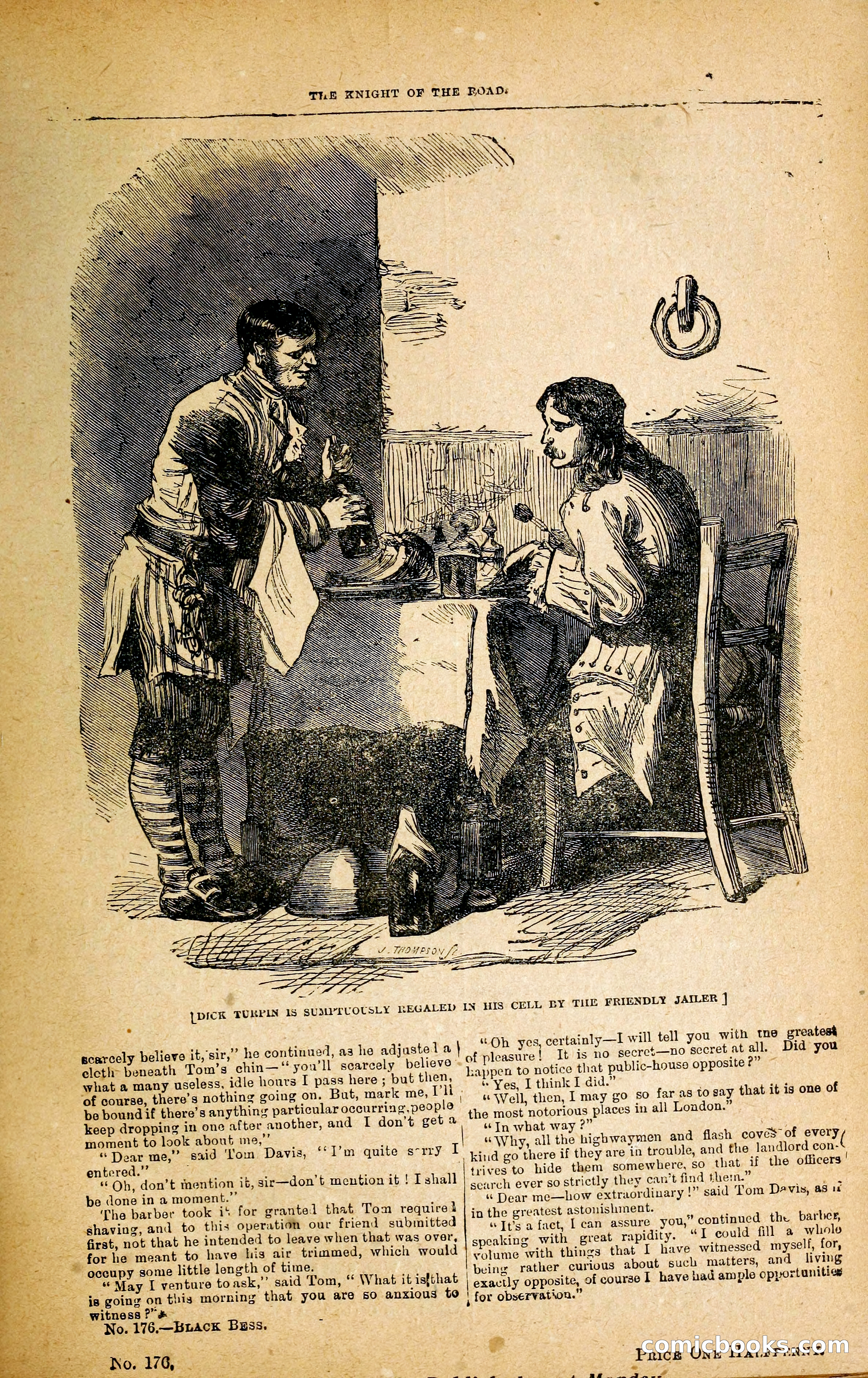
# Victorian Penny Dreadful Page Analysis This is a page of **running prose** from a serialized Victorian penny dreadful, showing two scenes. The first depicts Dick (a prisoner at Newgate) dining convivially with a turnkey, sharing wine and food in his cell. The second scene, beginning "Chapter DCCLIX," shows the Governor, Mr. Bradbury, arriving unexpectedly at the cell, discovering the prisoner's comfortable circumstances. The Governor expresses surprise at Dick's contentment and reminds him of his promise not to escape, while Dick cheerfully offers to share wine. The text emphasizes melodramatic dialogue and the tension of the Governor's intrusion upon the prisoner's comfort.
# Page Content Analysis This page contains **running prose text** from the middle of a Victorian penny dreadful narrative. The visible text depicts a prisoner (Dick) in his cell, anxiously awaiting news of a rescue plan involving a magical locket. Dick has slept through the night and awakens to find it is daylight; a turnkey brings him breakfast and departs. The passage focuses on Dick's internal anxiety about whether his comrades (particularly Tom King) have successfully obtained the locket that will secure his liberation. At the bottom, a new chapter begins titled "Tom King, Claude Duvall, and Sixteen—" (incomplete). The narrative emphasizes suspense, emotional turmoil, and the impending fate of the imprisoned protagonist.
# Page Analysis This is a page of running prose text from a Victorian penny dreadful. The visible text depicts Tom King and his companions (Claude and Jack) planning a robbery or raid on Windsor Castle. Tom King has resolved to lead an expedition across the Thames toward the castle, moving rapidly to avoid police patrols. The group stops briefly at a roadside inn for water and provisions before continuing toward Windsor Castle under moonlight, with Tom expressing caution about the lack of prior reconnaissance of their target.
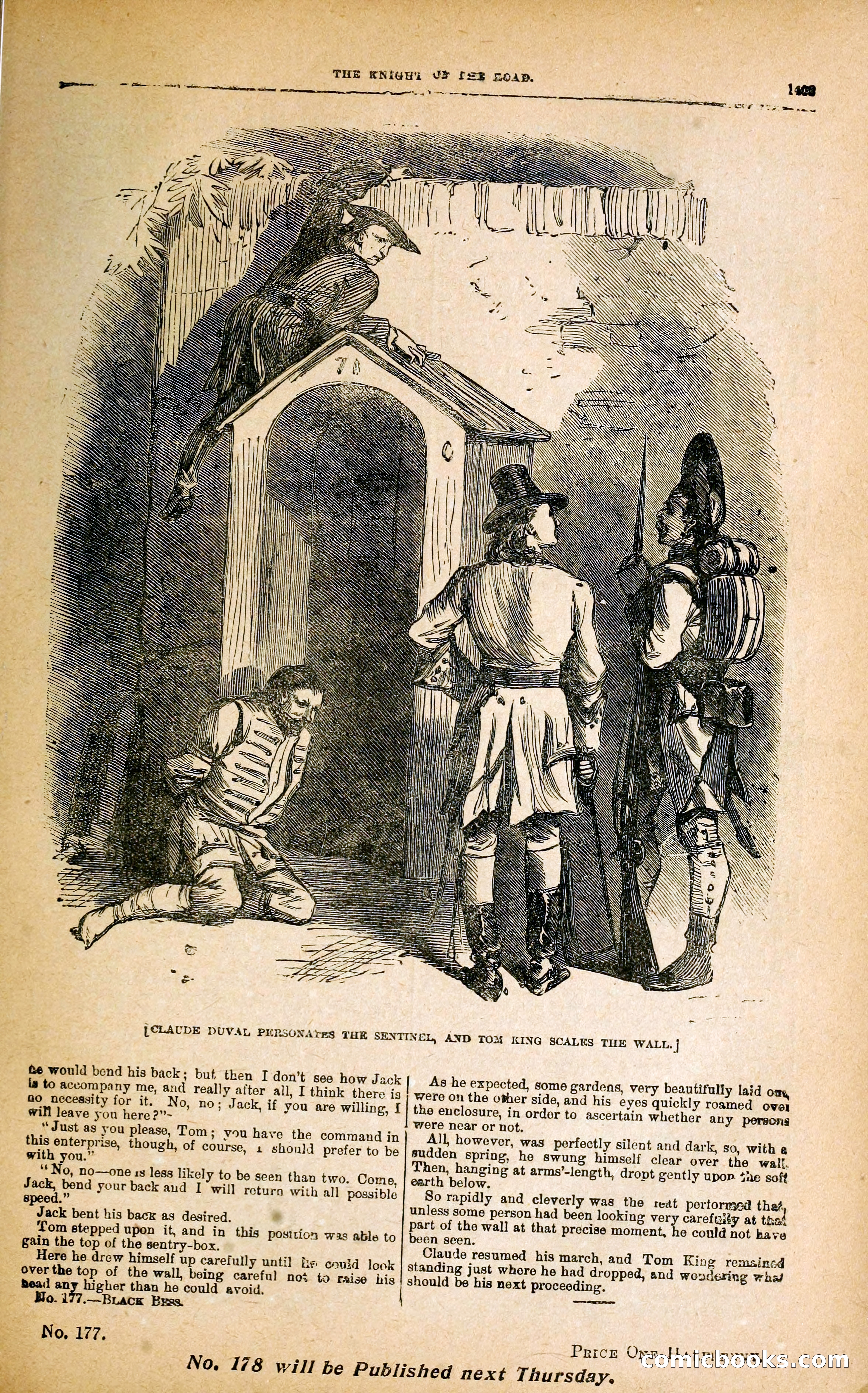
# Page 1408 from "Black Bess; Or..." This is a page of running prose from a Victorian penny dreadful. The text depicts a scene in which three highwaymen—Claude, Jack (Sixteen-String Jack), and Tom King—spy on a military sentry and plan to overpower him to escape over a wall. They observe the changing of the guard, debate their strategy, and ultimately decide to seize the soldier during his next patrol, using stealth to avoid alarming other sentinels. The passage emphasizes their caution and coordination as they prepare to execute their plan.
# Page Description This is a page of running prose text from a Victorian penny dreadful. The page is numbered 1419 and shows Chapter DCCCLXII (862) of a work titled "Black Bess; or," with the chapter heading "Tom King Finds His Perils and Difficulties Increase at Every Step." The text describes Tom King approaching a castle at night, observing illuminated windows and hearing music. Seeing elegantly dressed guests emerging into the gardens, he considers whether to remain hidden or mingle with the crowd to avoid detection. The narrative is typical penny dreadful fare: suspenseful, melodramatic adventure involving a protagonist navigating dangerous circumstances.
# Page Description This is a page of running prose from a Victorian penny dreadful, presenting Chapters DCCCLXIII (continuing from an earlier section). The text describes Tom King's encounter with the King's private secretary, to whom Tom refuses to disclose his confidential business. When Tom insists on speaking only to the King himself, the secretary becomes suspicious, accuses Tom of plotting assassination, and calls for guards. Tom then barricades the door with a brass bolt as guards approach. The page contains no illustrations, only dense Victorian narrative text in two columns.
# Page from Victorian Penny Dreadful This is a page of running prose text from a serialized Victorian penny dreadful. The narrative follows a character named Tom (apparently Tom King) as he attempts to evade soldiers searching for him in castle gardens. He discovers people approaching on a path, retreats toward a conservatory for concealment, enters it, and spots a large shrub that might offer hiding. The text emphasizes suspense and danger, with Tom calculating his options for escape. A new chapter begins partway down the page ("Chapter DCCOLXIV"), in which Tom overhears a conversation involving royalty—the King, Queen, and Prince of Wales are apparently present in the conservatory.
# Page Description This is a page of running prose text from "The Knight of the Road," a Victorian penny dreadful. The visible text depicts a dramatic domestic confrontation between the King, Queen, and Prince Frederick in a conservatory, where the royal parents urge the Prince to abandon his disreputable companions. The scene culminates in an unexpected reconciliation between father and son, interrupted by soldiers searching the grounds for a fugitive (apparently Tom King, who is hiding among the plants). The page concludes with Chapter 95 beginning ("Tom King's Strange Interview with His Majesty in the Conservatory").
# Page Analysis This is a **page of running prose** from a Victorian penny dreadful titled *Black Bess; Or*. The text depicts a dramatic interrogation scene in which a King questions a young man named Tom about his connection to the criminal Dick Turpin and a mysterious locket containing a woman's portrait. The King becomes agitated upon hearing Turpin's name and recognizing the locket, while Tom struggles with how much to reveal about his relationship to the desperado. The dialogue focuses on Tom's identity, his knowledge of a letter bearing a bloodstain, and his apparent past connection to the King.
# Page Analysis This is a page of running prose from a Victorian penny dreadful novel. The visible text depicts a tense conversation between Tom King (a highwayman) and an unnamed King, wherein Tom seeks safe passage from a castle. The King tests Tom's resolve by commanding him to halt as he leaves, then praises his bravery and orders a servant named Willis to escort him to the castle gates. The chapter heading indicates this is Chapter DCCCLXVI, and Tom King is attempting to rejoin his criminal associates Claude Duval and Sixteen-String Jack. The narrative emphasizes melodramatic dialogue and character devotion typical of the genre.
# Description of Page This is a page of running prose from a Victorian penny dreadful titled "Black Bess; Or," containing two chapters. Chapter DCCCLXVII begins midway down the page. The text describes Tom King's reconnaissance around Windsor Castle at night, searching for comrades but finding an unfamiliar soldier at a sentry-box instead. The narrative then shifts to explain how Claude Duval and Sixteen-String Jack overpowered and imprisoned the original sentinel, with Claude disguising himself as a replacement guard. The passage culminates in an alarm being raised, suggesting Tom's discovery as an intruder in the castle.
# Page Description This is running prose from Chapter DCCCLXVIII of a Victorian penny dreadful. The page depicts highwaymen (Claude, Jack, and Tom) discussing their dangerous scheme involving the King and a prisoner named Dick. Tom has apparently secured the King's word that Dick will be freed. The men debate whether to trust the King's promise, expressing fears of betrayal, before riding back to their inn at dawn. The narrative emphasizes suspense and danger throughout.
# Page Description This is a page of running prose text from a Victorian penny dreadful serial. The content shows Chapter DCCCLXIX, continuing a narrative in which Tom King and fellow highwaymen have secured a promise from the King to liberate their imprisoned comrade Dick. Maud, Dick's anxious companion, waits at an inn watching for his return. As the day passes with no sign of Dick's arrival, the men grow increasingly doubtful and resolve to ride toward London at nightfall to investigate, fearing the execution may proceed as scheduled. The passage emphasizes mounting suspense and the characters' growing anxiety about whether their plans will succeed.
# Victorian Penny Dreadful Page Analysis This is a page of running prose from a serialized Victorian penny dreadful. The text depicts a confrontation in what appears to be a prison cell between a character named Dick and a pushy portrait painter called Septimus Gibbon, who has gained access to paint Dick's portrait without his consent. Despite Dick's firm refusal, Gibbon continues attempting to paint while ostensibly apologizing, leading to an apparent physical confrontation as Dick moves to stop him. The dialogue captures the melodramatic tone typical of the genre, with earnest declarations and theatrical language throughout.
# Page Content Analysis This is a page of **running prose** from a Victorian penny dreadful titled "The Knight of the Road." The text depicts a prisoner named Dick in his cell receiving visits from a jailer, an Ordinary (prison chaplain), and a turnkey. The chaplain informs Dick that his execution is scheduled for noon the following day, but Dick insists he will not be executed, expressing mysterious confidence in his escape or rescue. The prose captures the dramatic tension of Dick's imprisonment and his peculiar certainty of deliverance, typical of the sensational melodrama characteristic of penny dreadfuls.
# Page Analysis: Running Prose from a Victorian Penny Dreadful This is a page of running prose text from *The Knight of the Road*, a Victorian penny dreadful. The narrative describes Tom King and his companions discovering a wounded royal messenger on the roadside. After seizing a second man at the scene and retrieving a leather dispatch bag bearing the royal arms, Tom shoots the fleeing stranger. The text suggests the second man had ambushed the messenger, though the full circumstances remain unclear. The page breaks mid-sentence, continuing the serialized adventure typical of this popular genre.
# Page Description This is a page of running prose from a Victorian penny dreadful titled "Black Bess; or," showing continued narrative text in two columns. The passage depicts Tom and his companions on horseback investigating an assassination attempt. They discover bloodstains and torn clothing at the scene, then continue their journey toward London. The text describes their decision to head to the White Horse inn by back roads to avoid detection, and their subsequent arrival at Tyburn—the notorious execution site—where they observe the gallows mysteriously illuminated by fire at night, its usual grim burden apparently absent. The three riders pause, puzzled and unsettled by this strange occurrence, before deciding to approach closer for investigation.
# Page from a Victorian Penny Dreadful This is a page of running prose text from what appears to be mid-serialization. The narrative concerns a meeting of highwaymen in a private room behind a bar, where the character Tom relates recent events (including an assassination) to old Matthew. Matthew has a concealed clock mechanism in the wall that alerts him to visitors; during their conversation the clock hand moves, suggesting someone has entered the premises, causing alarm, though the hand soon returns to indicate the visitor has left. The text deals with criminal conspiracy, detection anxiety, and the mechanics of their hidden refuge.
# Description of Page Content This page contains running prose from a Victorian penny dreadful serial. The visible text depicts a dramatic dialogue scene where Tom King insists on personally delivering a dangerous letter despite warnings from Matthew, Claude, and Jack, who eventually agree to accompany him. The narrative then transitions into Chapter DCCCLXXXIII, which promises to explain the assassination of the King's messenger and introduces Lord Spindelow as a character who sought possession of a mysterious letter through cunning stratagem. The page is numbered 1427 and printed in dense two-column Victorian typography.
# Page Description This is running prose from a Victorian penny dreadful titled *Black Bess*. The page contains two chapters: the conclusion of one describing a nobleman's death (he dies after drinking water, having been apparently shot or injured), and the beginning of Chapter DCCCLXXIV, in which Tom and Matthew discuss whether Tom should immediately deliver an important leather bag or wait. Matthew urges caution and early departure, but Tom is determined to proceed with his plan despite the risks. The narrative establishes tension around a stolen letter-bag and its delivery.
# Victorian Penny Dreadful Page Analysis This is a page of **running prose text** from a Victorian penny dreadful, numbered 1433. The narrative concerns a police chief interrogating an old man named Matthew about hidden criminals. After officers report finding no one concealed in the house despite thorough searching, the chief privately propositions Matthew: deliver the fugitive highwaymen in exchange for seven hundred pounds reward and immunity from prosecution for his own past crimes. Matthew is being tempted to betray those he has apparently been sheltering. The text captures the melodramatic tension typical of the genre, with dialogue advancing a plot about crime, loyalty, and moral compromise.
# This Page of a Victorian Penny Dreadful This is running prose from the middle of a serialized story. The visible text continues a conversation between Matthew (an apparently cunning older man) and Tom, one of several highwaymen he has hidden. Matthew has just released the criminals from a secret hiding place behind the fireplace and is now discussing their escape route with them. The chapter heading indicates Matthew will show the highwaymen "a new mode of leaving the premises." The dialogue concerns keeping watch, the discomforts of the hiding place, and Matthew's cleverness in constructing it secretly.
# A Page of Victorian Penny Dreadful Prose This is a page of running prose from a Victorian penny dreadful (page 33), containing no illustrations. The text depicts a suspenseful scene in which several men—apparently criminals or fugitives—escape from an empty house under cover of darkness. They carefully descend from a window, enter the building through a back door, and emerge onto the street, only to be suddenly confronted by a watchman with a lantern who demands to know where they have come from. The passage emphasizes atmospheric tension: darkness, silence, caution, and the narrow escape from discovery when a passing watchman nearly catches them mid-emergence.
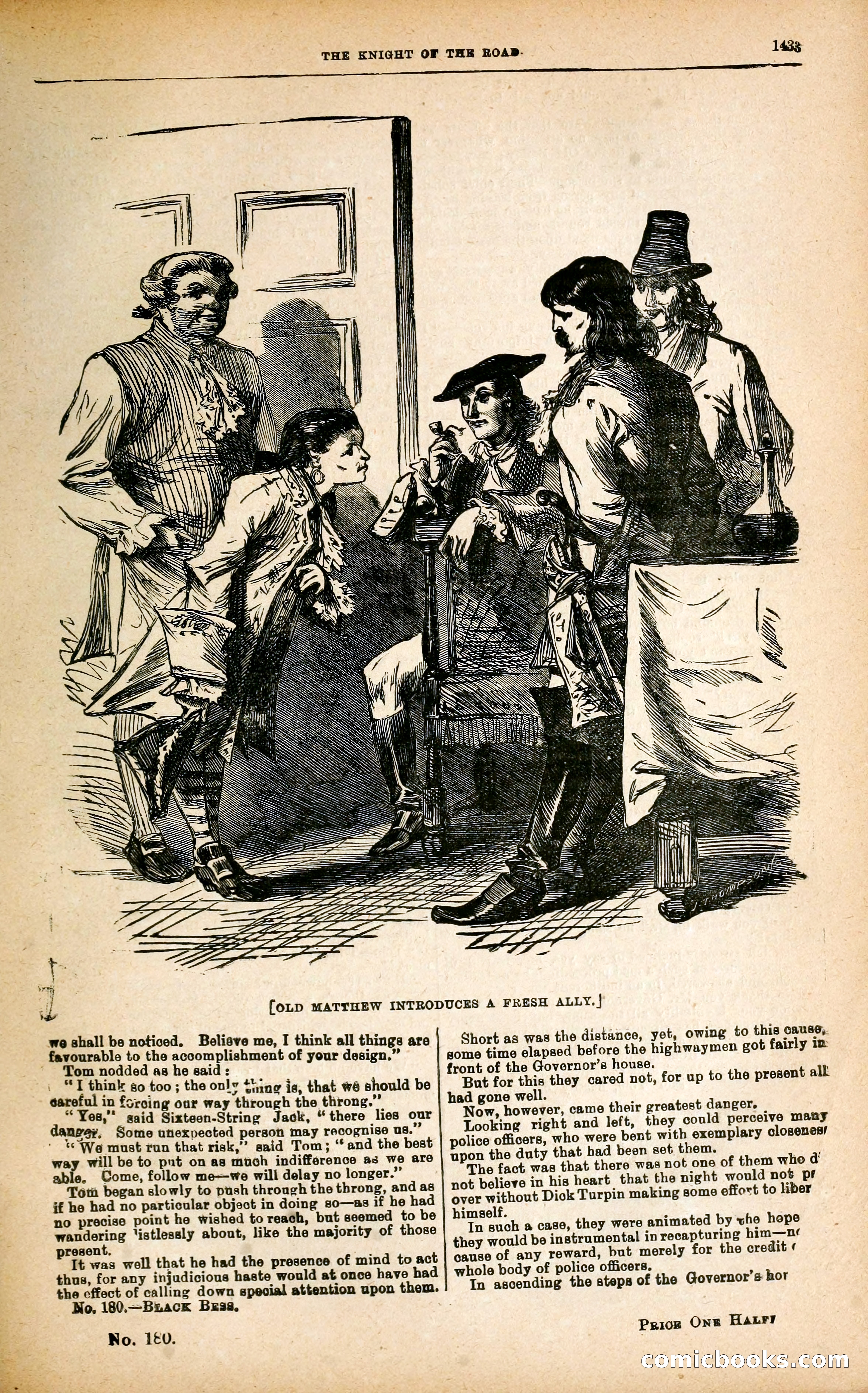
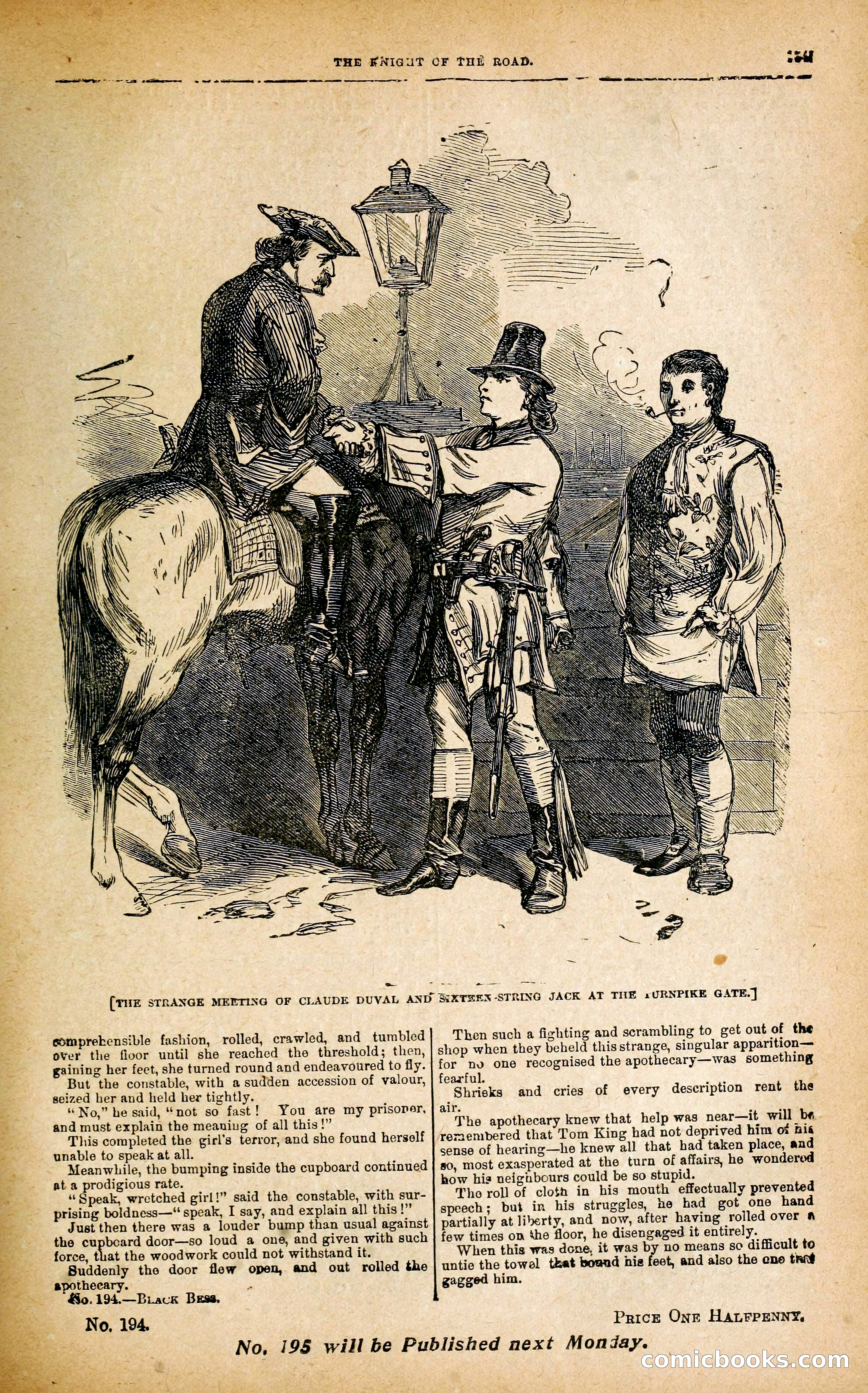
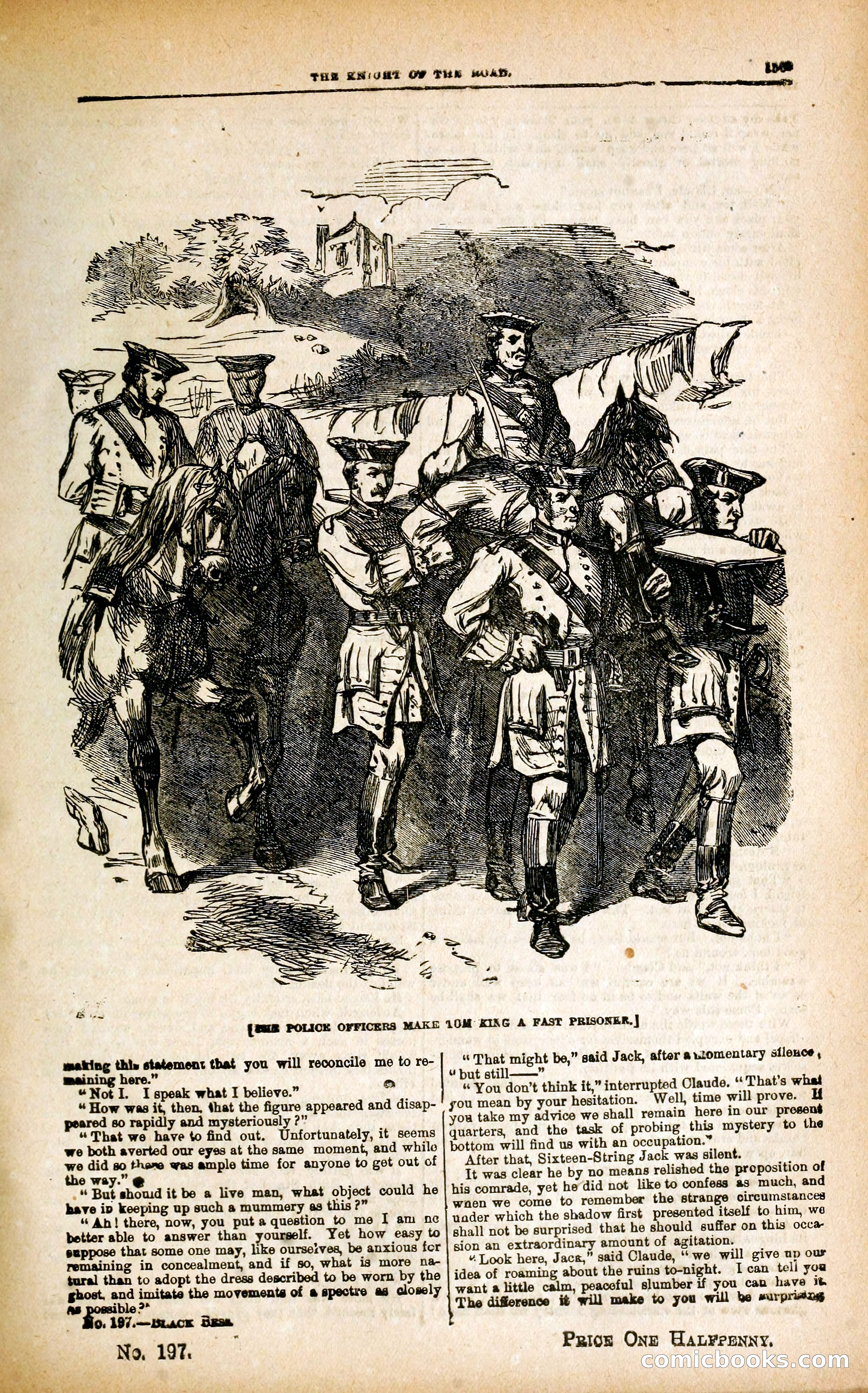
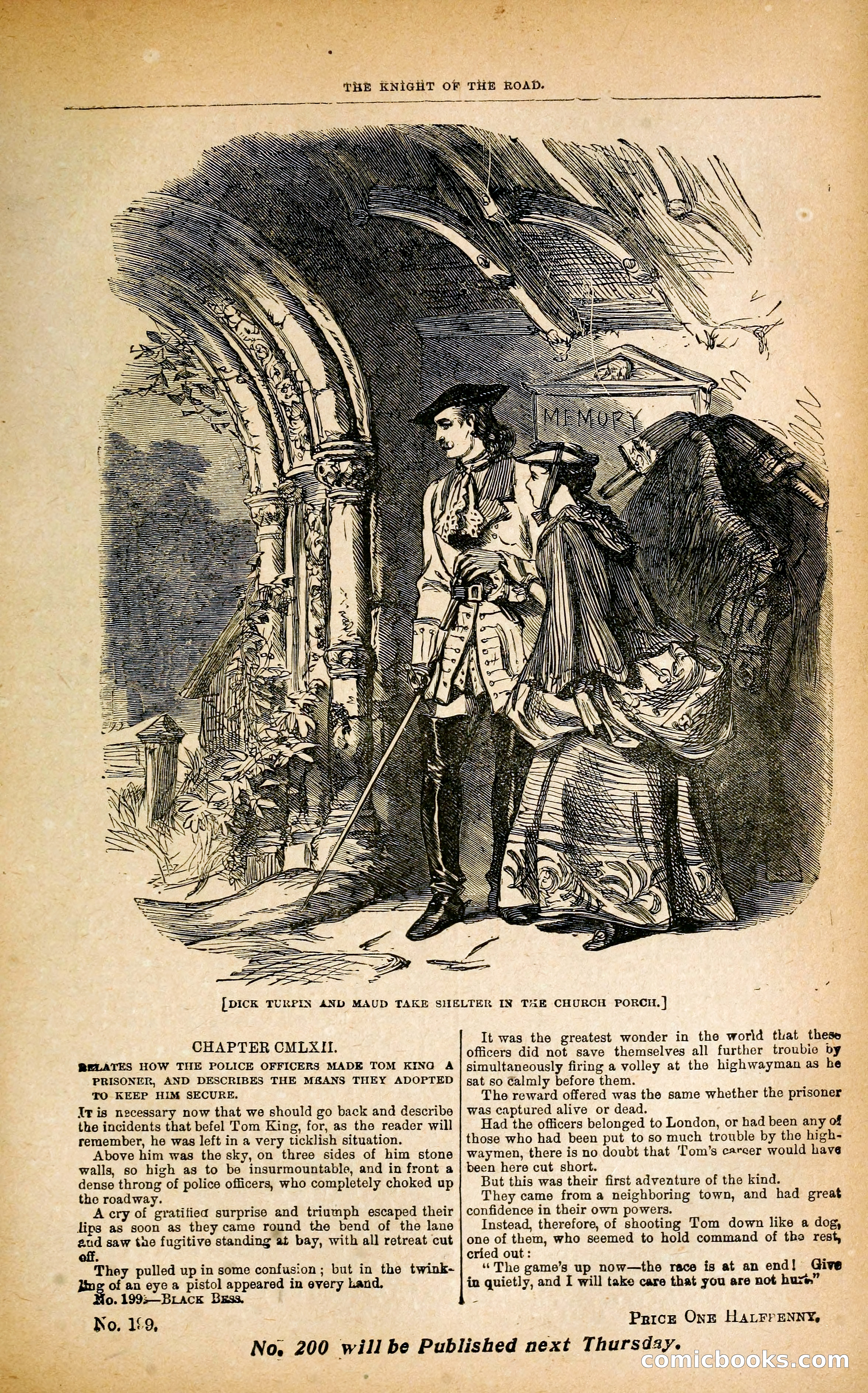
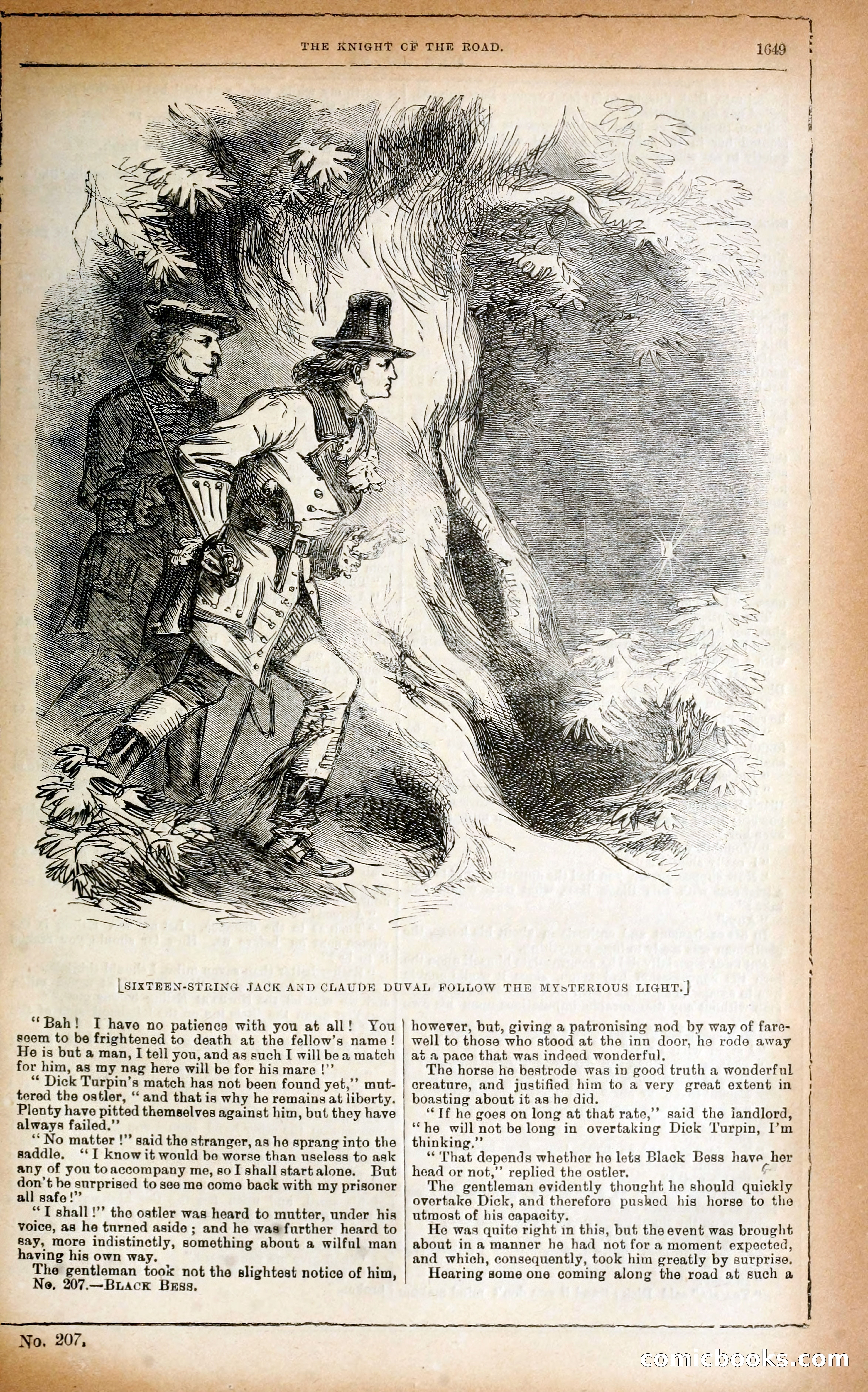
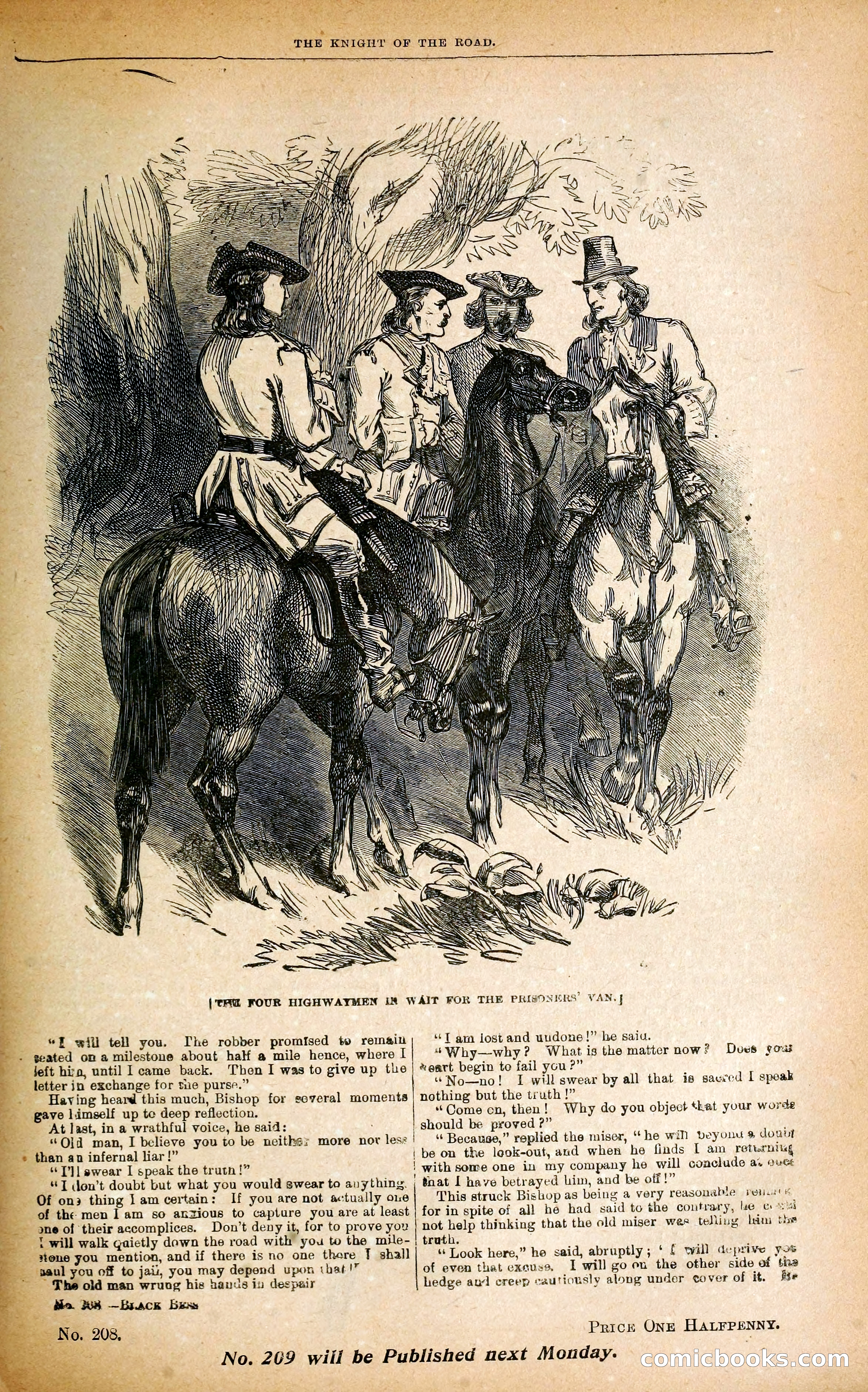
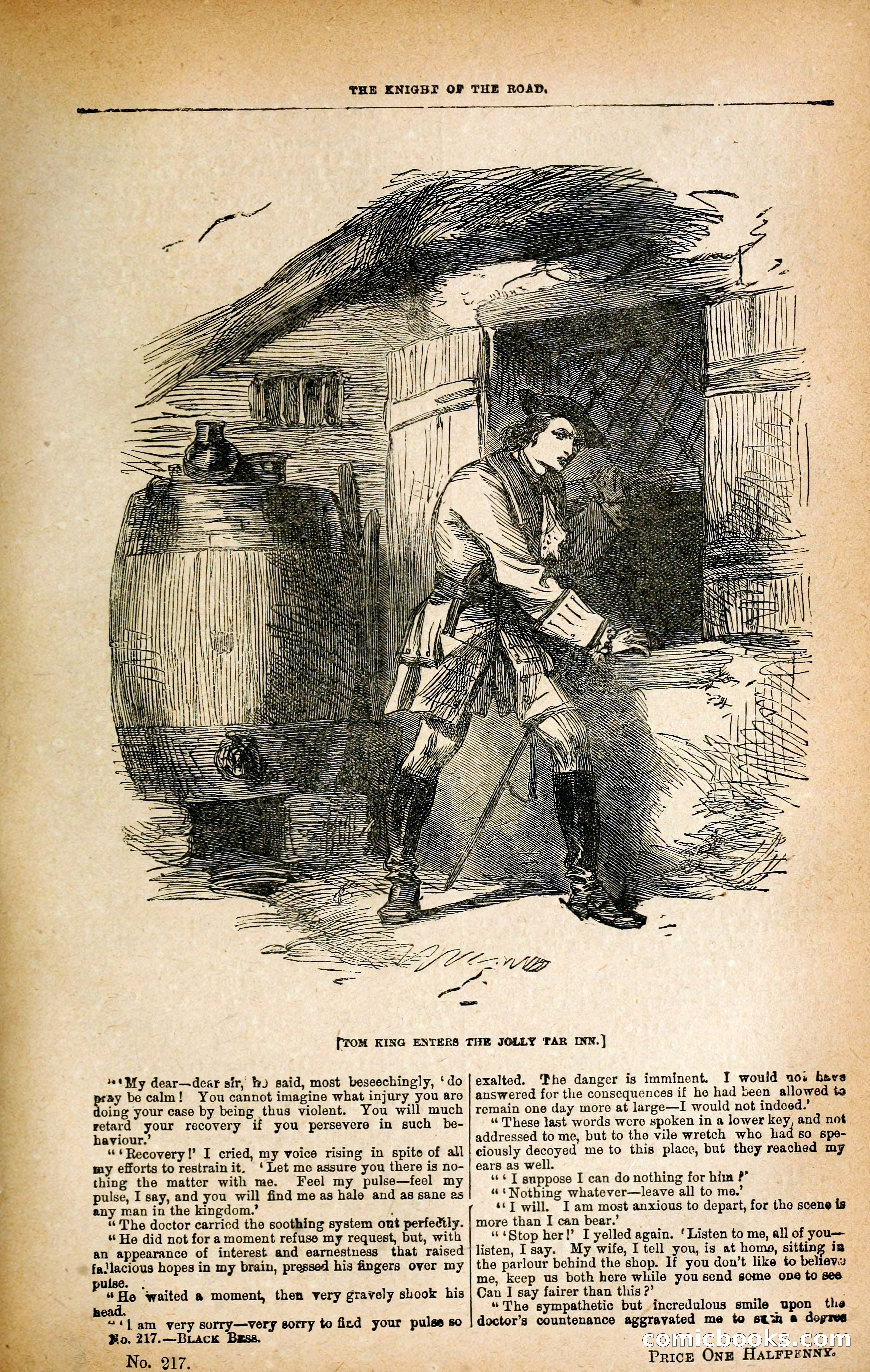
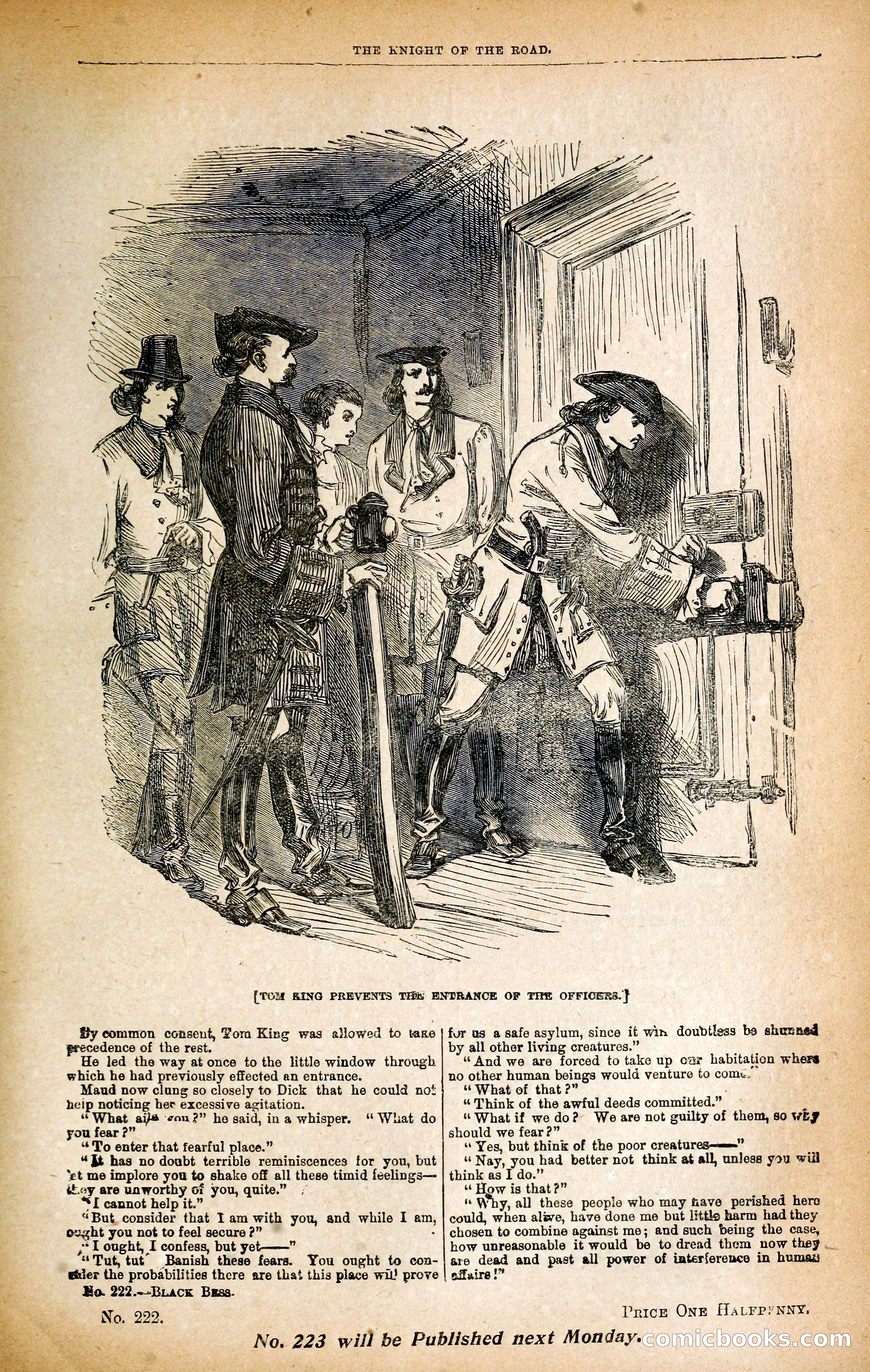
# Page Description This is an illustration page from a Victorian penny dreadful titled *The Knight of the Road*. The page features a wood-engraved illustration captioned "[Old Matthew Introduces a Fresh Ally]" depicting several men in period dress gathered in what appears to be a doorway or interior space. Below the illustration runs prose text describing a scene where characters—apparently highwaymen including someone named Tom and "Sixteen-String Jack"—discuss moving through a crowd toward the Governor's house while avoiding detection by police officers. The text emphasizes the need for cautious, indifferent behavior to escape notice.
# Page Content Summary This is running prose text from a Victorian penny dreadful serialization. The page depicts Tom King attempting to gain entry to Newgate Prison by delivering what he claims is a message bag from the King to the Governor. Tom deceives the doorkeeper and Governor, claiming a royal messenger gave him the bag after an accident. The Governor accepts the bag and dismisses Tom, who leaves quickly. The page ends noting that a street fight nearby diverts public attention from Tom's departure, allowing him to escape unnoticed. The narrative concerns Tom's dangerous scheme to infiltrate or interact with the prison authorities.
# What's on This Page This is a page of running prose from the middle of a Victorian penny dreadful titled *The Knight of the Road*. The text describes highwaymen (Tom, Claude, and Jack—apparently associates of a imprisoned "captain" named Dick) watching Newgate Prison from a crowded street. They discuss their failed expectations that the King would secure Dick's release, debate whether to take action, and eventually decide to split their efforts: Claude will visit Dick's family, Tom will watch the prison, and Jack will go to Drury Lane to consult someone named Matthew. The scene captures the melodramatic tension and criminal plotting typical of the genre.
This is a page of running prose from a Victorian penny dreadful serialized fiction. The text depicts a crowd gathering at what appears to be an execution site (Tyburn is mentioned), with highwaymen and spectators growing increasingly anxious as the appointed hour approaches. The narrative then shifts to follow the character Claude Duval as he searches through London locations—the Jew's Harp in Hanging Sword Alley and the Three Tuns in Seven Dials—seeking assistance, only to learn that a criminal organization has been dispersed and that a captain figure is doomed to hang. The page ends as Duval arrives at Matthew's residence in Drury Lane.
# A Page of Victorian Penny Dreadful Serial Fiction This is a page of running prose from *The Knight of the Road*, a Victorian penny dreadful (serialized crime fiction). The text describes a crowd gathered outside a prison, growing restless as an execution fails to occur at the appointed time. A rumor spreads rapidly through the mob that the notorious criminal Dick Turpin has escaped. Characters including highwaymen and an older man named Matthew discuss whether to believe this news, with Matthew attempting to push through the crowd to investigate. The page contains no illustrations, only densely printed text in the sensational melodramatic style typical of cheap Victorian serial publications.
# Page Analysis This is a page of running prose from a Victorian penny dreadful serial. The text depicts a conversation among characters (Tom, Old Matthew, and others) discussing the mysterious escape of Dick Turpin from prison. Matthew theorizes that the King secretly ordered Turpin's release through a covert letter to the Governor of Newgate, and the men discuss traveling to Ealing to investigate. The page ends with Matthew discovering the exhausted men asleep and choosing to let them rest undisturbed. The narrative concerns itself with intrigue, suspense, and the movements of notorious criminal characters.
This page contains running prose from Chapter DCCCLXXXL of what appears to be a Victorian penny dreadful. The text depicts a conversation between highwaymen (Tom King, Claude Duval, and Jack) and an older man named Matthew regarding a messenger boy whom Matthew has sent to fetch horses. Tom King expresses suspicion about the boy's trustworthiness, warning Matthew that the messenger may betray them, while Matthew defends the boy's loyalty, mentioning his deceased father whom Matthew had helped. The chapter concludes with the men preparing to depart and meet their associate Manuel on the road.
# Page Description This is a page of running prose from a Victorian penny dreadful, numbered 3440. The text describes three highwaymen (Tom King, Tom Davis, and Claude Duval) evading police pursuit on horseback, then arriving at a location called the Three Spiders. Upon entering, they encounter Maud, who surprises them by claiming a man (apparently named Dick) has already arrived—contradicting the highwaymen's expectation that he was elsewhere. The page ends mid-sentence and transitions to "Chapter DCCCLXXXII," which promises to describe "an extraordinary interview" between Dick Turpin and the Governor of Newgate.
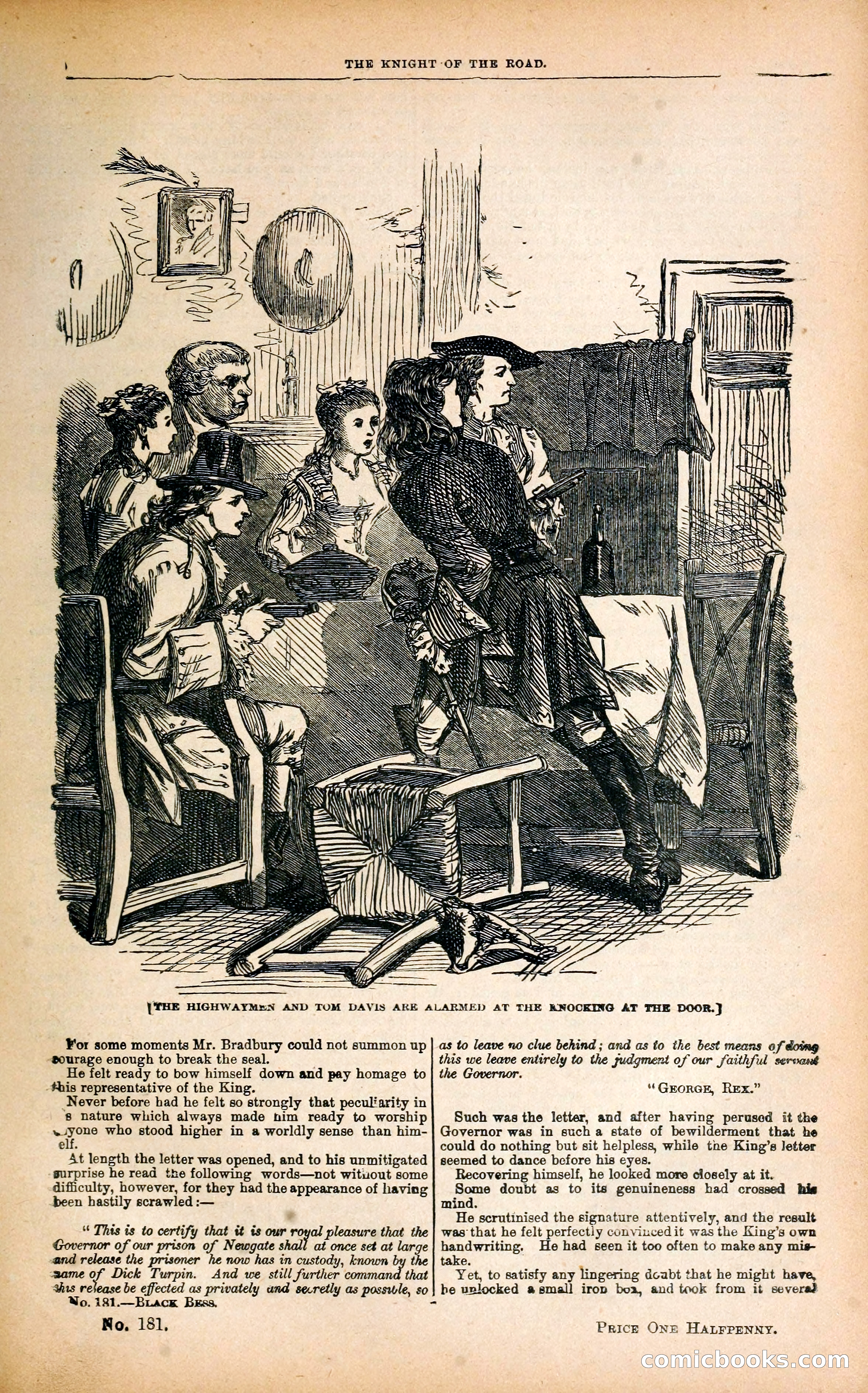
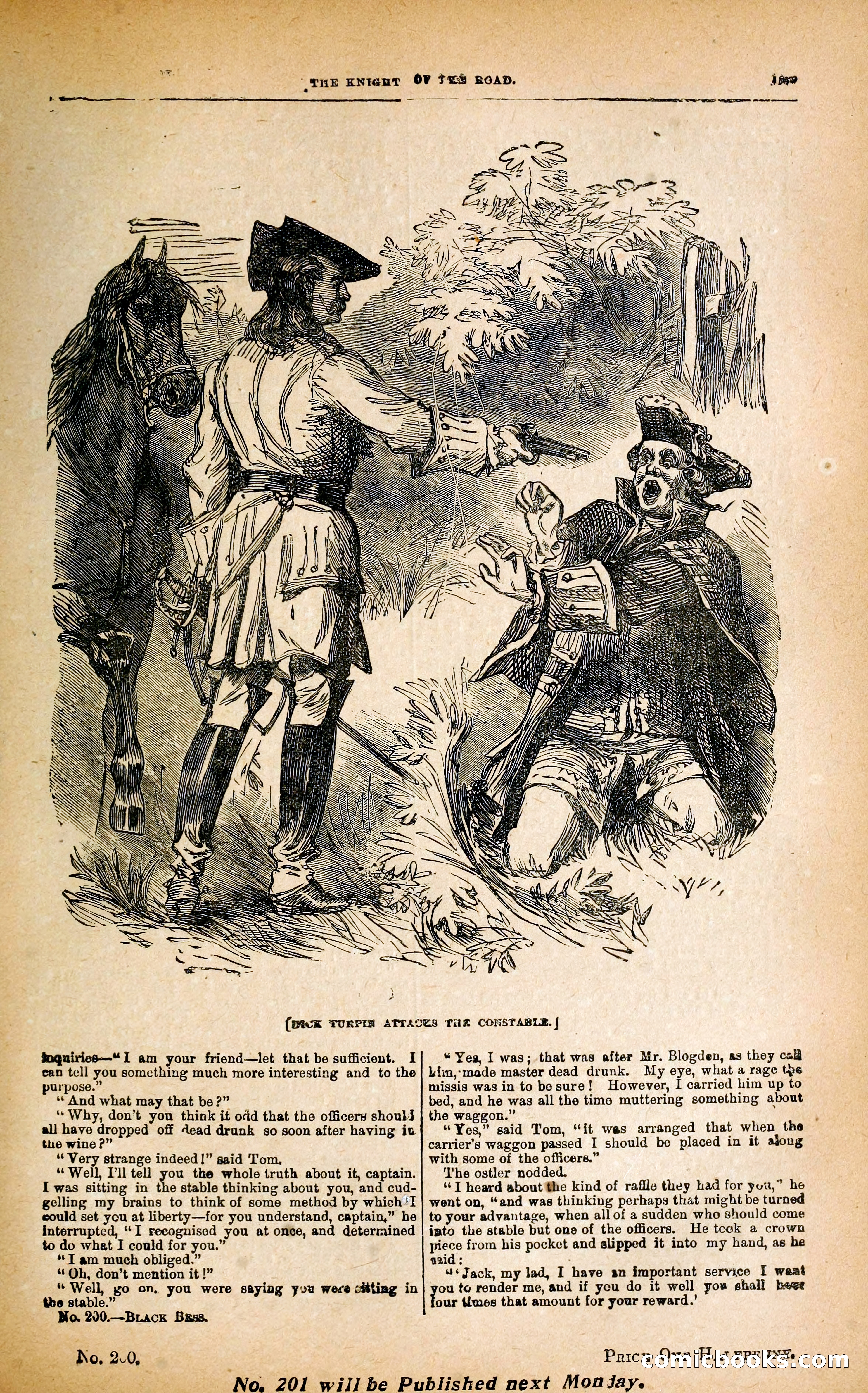
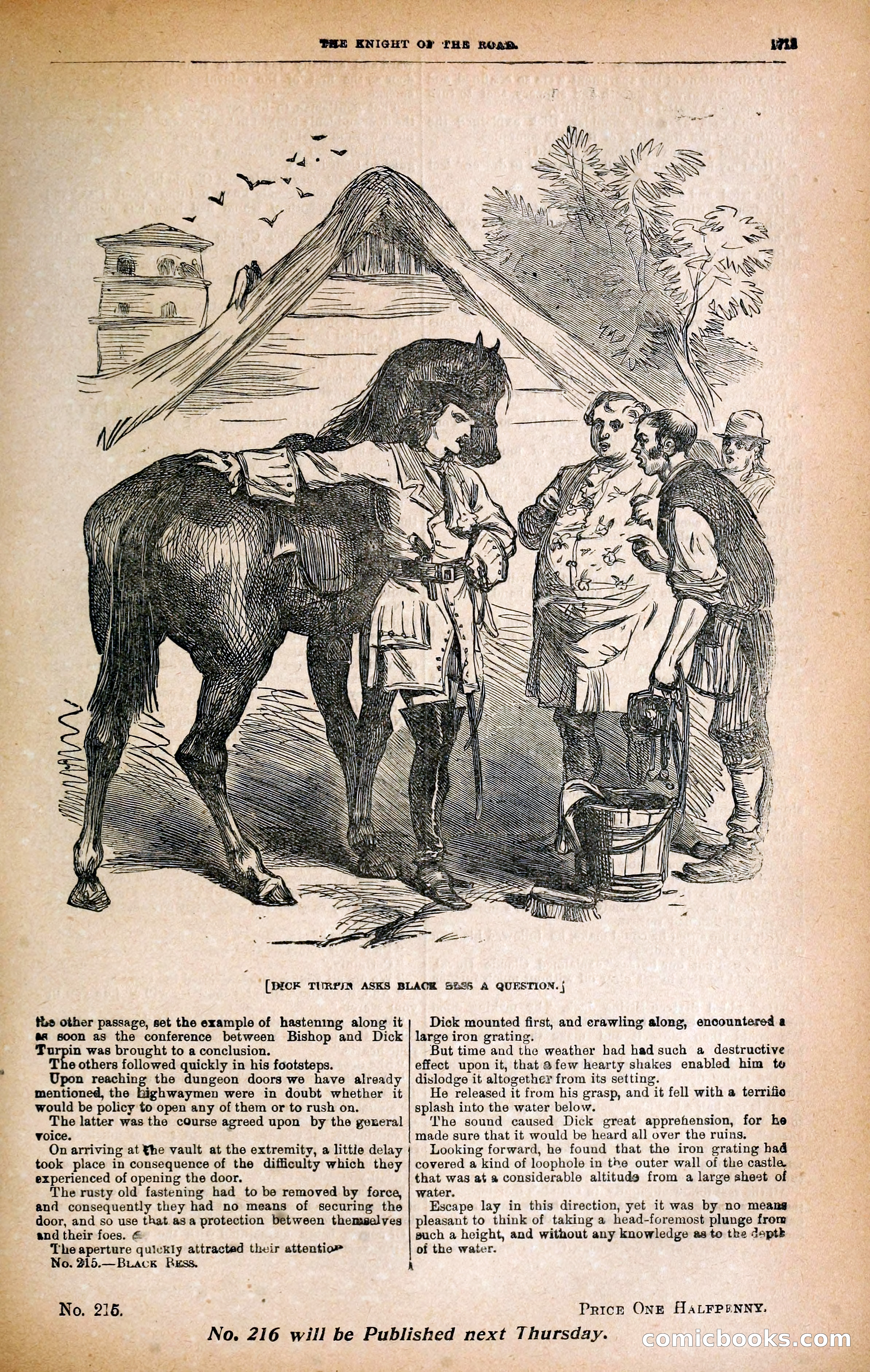
# The Knight of the Road, No. 181 This page combines an engraved illustration with serialized prose narrative. The illustration, captioned "The Highwaymen and Tom Davis are Alarmed at the Knocking at the Door," depicts several figures in a room reacting to an apparent disturbance. The text below describes Mr. Bradbury's emotional response to receiving a letter from the Governor regarding the prisoner Dick Turpin, and his subsequent examination of the letter's contents, which appears to authorize Turpin's release. The page concludes mid-narrative. Published as penny dreadful No. 181 at one halfpenny.
# Page Content Analysis This is a page of **running prose text** from a Victorian penny dreadful, appearing mid-narrative. The text depicts a dramatic scene in which a prison Governor has received a mysterious letter bearing the King's signature that will secure the release of the criminal Dick Turpin from Newgate prison. The Governor, initially suspicious but now convinced of its authenticity, visits Turpin's cell to inform him of his impending freedom. Turpin reveals that the letter originated from a royal lady whom he once helped, and who gave him a locket as insurance against danger—a device the Governor finds remarkable and suspicious.
This page contains running prose from a Victorian penny dreadful serial. It is Chapter DCCCLXXXIII, titled "Dick Turpin and the Governor of Newgate Hold a Deeply-Interesting Conference." The text depicts a conversation between the notorious criminal Dick Turpin (imprisoned in Newgate) and the prison Governor, as they debate methods for Turpin's escape. Turpin initially proposes using a hackney-coach, but the Governor rejects the plan as impractical given the heavy police surveillance surrounding the prison. Turpin then cryptically suggests an alternative strategy, hinting that he will "remain where I am" while appearing to have escaped—though the page ends before his full explanation is revealed.
# Page Analysis This is a page of running prose from a Victorian penny dreadful serial. The text depicts a dramatic escape scene: Dick (apparently a prisoner) is being helped by the Governor of Newgate prison to flee his cell. The Governor has cleverly sent the other turnkeys away on false errands, creating an opportunity for Dick to slip out. The passage describes Dick entering a dark corridor, hiding in recessed doorways, and hearing approaching footsteps and voices—suggesting the escape attempt may be about to be discovered or complicated. The dialogue emphasizes secrecy, urgency, and suspense typical of sensation fiction.
# Analysis of Page Content This is a running prose page from a Victorian penny dreadful novel titled *The Knight of the Road*. The text depicts Dick Turpin, apparently imprisoned, secretly following the Governor through prison corridors to a private room where they discuss strategy. The Governor reveals satisfaction that prisoners have broken a bottle of liquor, believing this gives him power over them. The page ends with the Governor and Turpin discussing where Turpin should hide until nightfall, suggesting an escape plan is underway. The narrative emphasizes suspense, stealth, and criminal intrigue typical of penny dreadful serialization.
# This Page: Running Prose This page of dense Victorian penny dreadful text shows a dramatic scene where Dick Turpin and the Governor discover an old map of Newgate Prison hidden between the pages of a book. Turpin then requests to see his execution warrant, which the Governor produces and begins reading aloud. As the Governor reads, he becomes visibly shocked and amazed by something in the document's contents, leaving the reader in suspense about what has alarmed him.
# Page Summary This is running prose from a Victorian penny dreadful serialized fiction. The page depicts Dick Turpin and the Governor discussing a warrant mistakenly issued against Turpin under an accomplice's name rather than his own. Turpin vows secrecy about the error and prepares to enter the prison vaults of old Newgate with the Governor's assistance. A new chapter begins mid-page announcing Turpin's admission to a restricted section of the jail. The text emphasizes suspenseful dialogue and melodramatic plotting typical of the genre.
# Page Description This is running prose—a chapter from a Victorian penny dreadful. The page contains the conclusion of Chapter DCCCLXXXVI and the beginning of Chapter DCCCLXXXVII (numbered in Roman numerals). The visible text describes Dick Turpin and a Governor forcing open a locked, rusted door in what appears to be Newgate Prison. Foul air rushes out; they ventilate the passage. Dick then enters alone with a lamp through the threshold into darkness and silence, experiencing a sensation "as though...he had stepped from life to death." The narrative emphasizes gothic atmosphere and suspense.
# Victorian Penny Dreadful Page Analysis This is a page of running prose from what appears to be the middle of a serialized narrative titled "Black Bess; or," (full title unclear from this page). The text depicts the discovery that a prisoner—apparently the criminal Dick Turpin—has mysteriously escaped from his cell. A Governor, two sheriffs named Mr. Moses Moses and Mr. Lupin, and a turnkey discover the cell empty when they arrive to inspect it before the prisoner's execution. The passage details their shock and confusion at finding no trace of how Turpin departed, with accusations flying about negligence and threats of arrest. The tone is dramatic melodrama typical of penny dreadful crime fiction, emphasizing sensational dialogue and urgent plot developments.
# What's on This Page This is running prose from Chapter DOCCLXXXVIII of a Victorian penny dreadful. The text describes Dick Turpin's mysterious disappearance from his cell in Newgate Prison and the subsequent search conducted by the Governor, sheriffs, and turnkeys through the prison's vaults, corridors, and roof. Though they search extensively, they find no trace of the prisoner, and eventually the news of his escape circulates among crowds outside the Old Bailey courthouse. The narrative explores both the officials' fruitless efforts and Turpin's precarious situation as he remains hidden somewhere within the prison building.
# Page Analysis This is a page of running prose from a Victorian penny dreadful featuring the character Dick Turpin. The text describes Turpin exploring the corridors of old Newgate prison, where he discovers a small gold locket and chain containing a portrait of a young woman in modern dress—a discovery that puzzles him greatly since the passage has supposedly remained sealed and unvisited for nearly a hundred years. The narrative then transitions to Chapter DCCCLXXXIX, in which Turpin continues his exploration and enters a large chamber, where he makes another startling discovery on the ground, causing his expression to change suddenly.
# Page Description This is running prose text from a Victorian penny dreadful titled *The Knight of the Road* (page 1453). The visible text depicts a scene where Dick, imprisoned in darkness, falls asleep and is awakened by the Governor arriving with a lamp. They discuss Dick's escape: the Governor expresses anxiety about removing him secretly from prison, fearing police surveillance and noting that his instructions require absolute secrecy. Dick reassures him that secrecy is essential to their plan's success. The dialogue concerns the logistics and dangers of an imminent escape attempt.
# This Page from a Victorian Penny Dreadful This is a page of running prose text (page 1454) from the middle of a serialized story. The narrative concerns a prisoner named Dick conversing with a Governor about escaping from Newgate prison. The Governor advises Dick to flee tonight before a thorough search of the prison occurs, warning of danger if he remains. After the Governor departs, Dick reflects on a mysterious locket and chain he has discovered, examining a young girl's portrait within it. He then resolves to investigate a peculiar sign he noticed on the floor of an irregularly-shaped chamber, climbing toward the ceiling to examine it more closely.
# Page Content Description This is a page of running prose from a Victorian penny dreadful serial titled *The Knight of the Road*. The text depicts Dick Turpin discovering an unconscious stranger who has apparently fallen from a great height, reviving him with brandy, and beginning to extract his story. The stranger hints at a mysterious past involving a lost friend named Leonard and a woman he loved, while Turpin expresses intense curiosity about how the man came to be in this remote location. The narrative focuses on dialogue and melodramatic revelation of backstory rather than action.
# Analysis of This Page This page contains **running prose text** from a Victorian penny dreadful. It presents a lengthy monologue from a young man explaining to a character named Dick how he came to search London for his mysteriously disappeared friend—a young sailor whom he believes was murdered after being "decoyed into" one of London's criminal establishments. The narrator describes his fruitless efforts with police, his subsequent solo investigations in disguise throughout London at night, and his determination to find the place of his friend's death. The passage concludes with the narrator promising to relate "the strangest and most fearful portion" of his narrative, with a chapter heading below indicating the story's connection to Newgate (likely the famous prison).
# Analysis of Page 1258 This page contains running prose—specifically, dialogue between two characters identified as Dick (apparently "Turpin") and a young stranger. The text depicts a dramatic conversation in what appears to be an ancient prison's vaults. Dick reveals he is hiding there after offending against the law, while the stranger recounts being lured into a deadly trap by a young woman. Dick theorizes the stranger is a victim of a systematic murder scheme targeting unsuspecting men, and mentions discovering blood at the scene. The passage builds suspense through their discussion of escaping the trap and discovering the fate of the stranger's missing friend, suggesting this is mid-narrative in a serialized melodrama involving crime and danger.
# Page Content Analysis This is a page of **running prose** (body text) from a Victorian penny dreadful. The text depicts a dramatic scene in which a character named Dick has discovered a locket belonging to a missing man named Lucy's lover. Upon examining the locket, the young stranger confirms his friend's death. The scene escalates when a mysterious rumbling noise interrupts their conversation, drawing their attention to a trap door opening in the ceiling above them, from which a ladder descends into darkness. The narrative builds suspense through dialogue and environmental detail typical of sensational Victorian fiction.
# Page Content Analysis This is running prose from a Victorian penny dreadful serialized in installments. The visible text consists of dialogue and narrative describing Dick Turpin and a companion's escape from a house. After descending a staircase, they hear music from a harpsichord and pause to investigate, suspecting another drugged victim may be present in the adjoining room. The page includes Chapter DCCCXCIV's heading, indicating this is mid-narrative in a lengthy serial. The text emphasizes suspense, danger, and melodramatic tension typical of the sensation fiction genre.
# Page Analysis: Victorian Penny Dreadful This is a page of running prose text from a Victorian penny dreadful, containing no illustrations or title elements. The narrative concerns Dick (apparently the notorious criminal Dick Turpin, recently escaped from Newgate prison), who stops a passing cart to request a ride from its driver toward the "Truss of Hay" inn. The cart driver, unaware of Dick's true identity, readily agrees and engages Dick in conversation about Turpin's recent escape, speaking disparagingly of Turpin as a villain—causing Dick to start noticeably, though he quickly recovers. The page ends mid-conversation as Dick attempts to conceal his reaction.
# THIS PAGE This is a running prose page from a Victorian penny dreadful titled "Black Bess; Or," continuing a serialized narrative. The text depicts dramatic action: Dick (apparently a captain) arrives at an inn, demanding entry while Tom Davis and highwaymen hide in secret cellars below. Tom initially fears Dick is a police officer, but recognizes his voice and admits him. Ellen reacts with surprise and joy upon hearing Dick's voice. The passage emphasizes melodramatic tension—confusion, fear, revelation, and emotional reunion—typical of penny dreadful sensationalism. No illustrations appear on this page; it is purely typeset text.
# This Page: Running Prose from a Victorian Penny Dreadful This is a page of running prose text from a Victorian penny dreadful, containing two chapters. The narrative describes Dick Turpin and his criminal associates making their escape through a secret passage after a false alarm, then shifts to following police officer Jack Marshall and his officers in pursuit. The text recounts how Marshall learns of the highwaymen's flight westward and, while investigating at a roadside inn called the Truss of Hay, nearly encounters Turpin himself passing through a hidden passage below.
# Page Description This is a page of running prose from a Victorian penny dreadful, showing **Chapter DCCCCVII** (appearing to be part of a serialized narrative about crime and police pursuit). The text describes Jack Marshall, a police chief, being violently thrown from his horse during a chase. A subordinate officer named Roberts kicks the unconscious Marshall in vengeful rage. Marshall eventually regains consciousness in severe pain, curses his men and horse in fury, then collapses again before ordering himself taken back to an inn. The narrative emphasizes melodramatic violence, officer discord, and Marshall's suffering, typical of sensation fiction. The page contains no illustrations—only dense Victorian-era printed text in two columns.
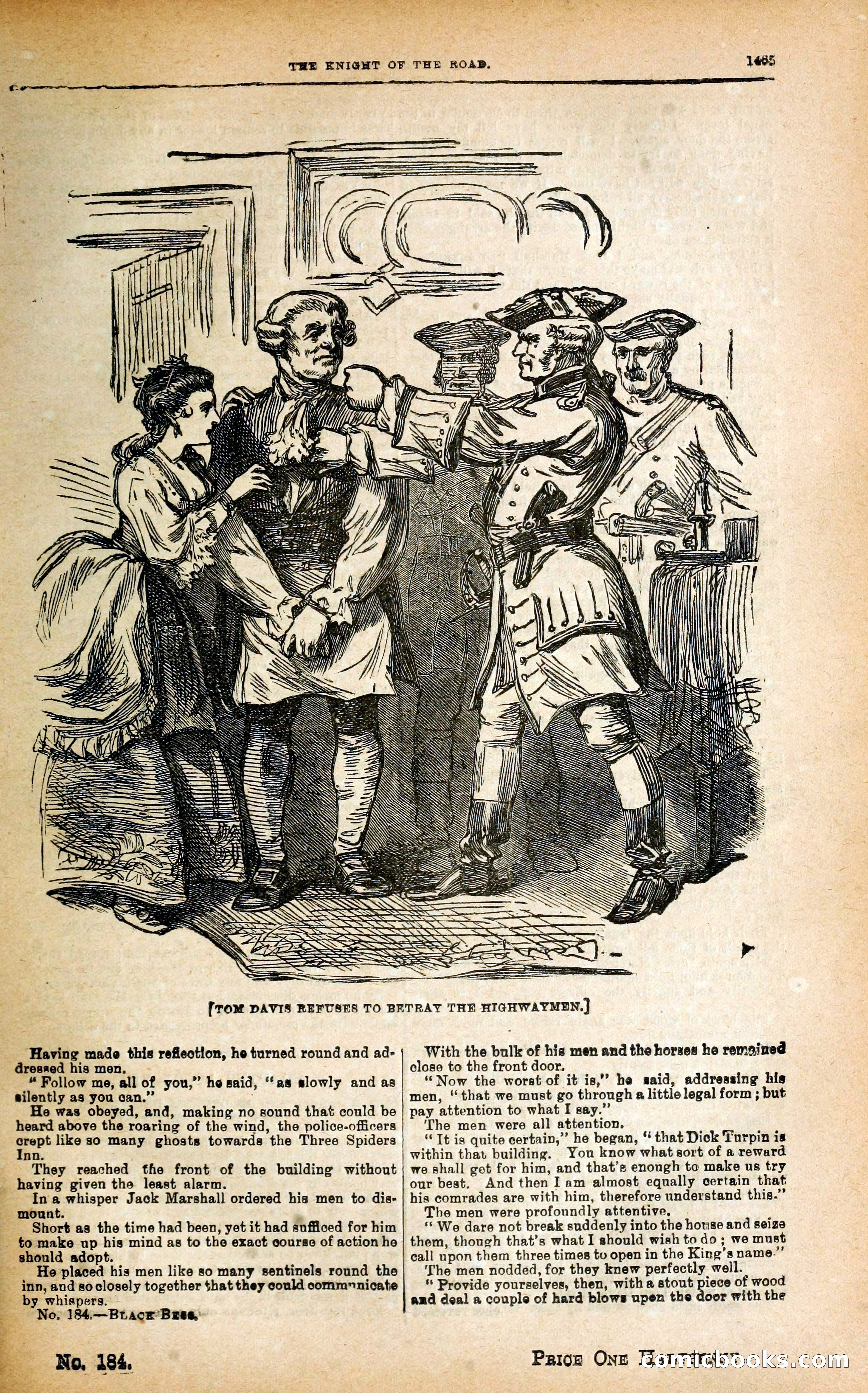
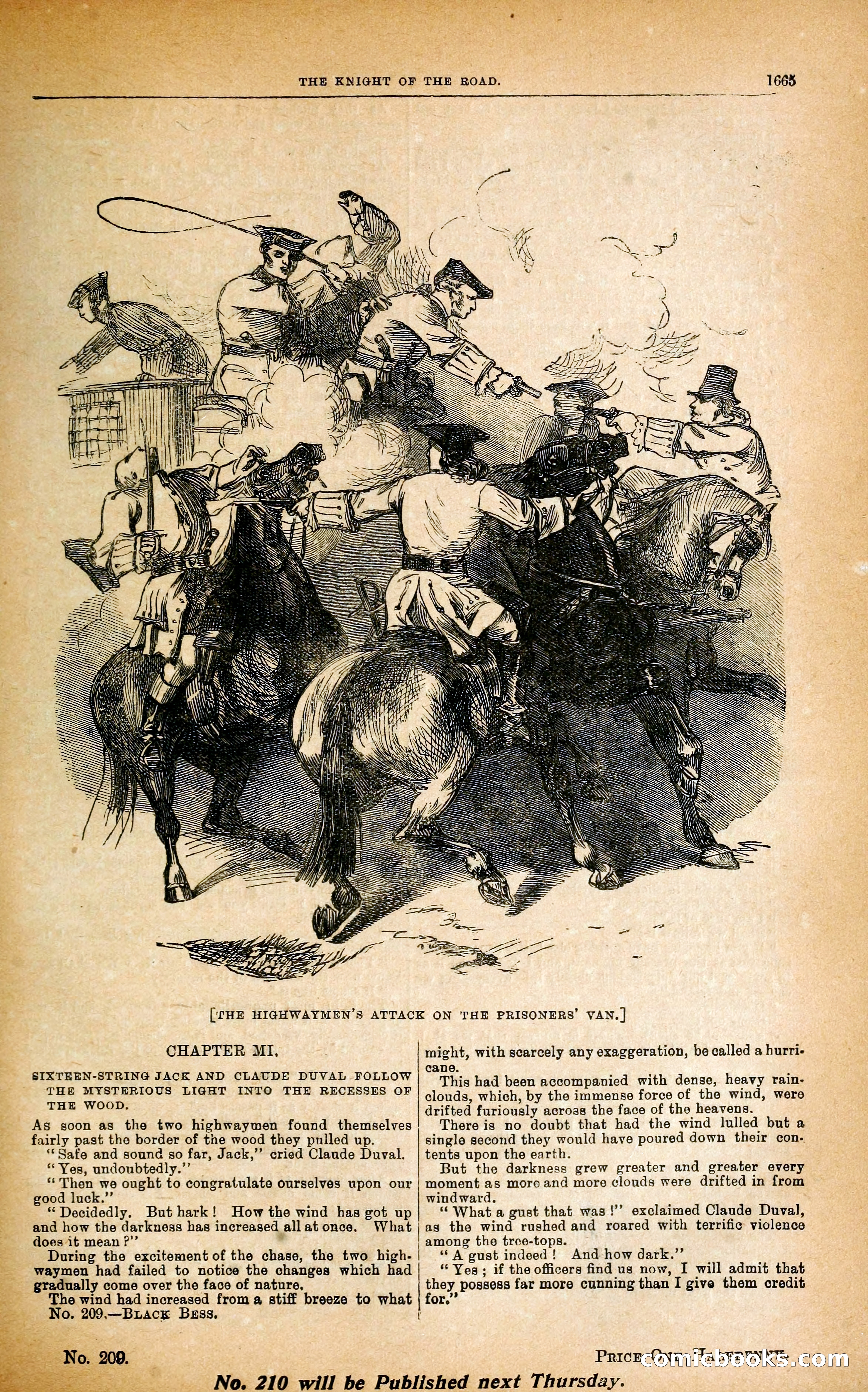
# Victorian Penny Dreadful Page Analysis This is an **illustrated story page** from a penny dreadful serial. The image shows a wood engraving depicting a confrontation scene, captioned "[TOM DAVIS REFUSES TO BETRAY THE HIGHWAYMEN.]" The text describes police officer Jack Marshall positioning his men around an inn to capture the highwayman Dick Turpin, who Marshall believes is inside. Marshall instructs his men to follow legal procedure by calling upon those within to surrender in the King's name before breaking down the door—mixing melodramatic urgency with procedural formality typical of the genre.
# What is on this page: This page contains running prose from a Victorian penny dreadful novel. It depicts a dramatic scene in which Jack Marshall, apparently a law enforcement officer, directs his men in a violent assault on a door—battering it repeatedly with a tree trunk while issuing formal summons to surrender "in the King's name." The passage describes the door's resistance, the men's failed attempts, and Marshall's increasingly angry exhortations for harder blows. The scene concludes with a comedic interruption when a man named Tom Davis appears at an upper window in nightcap, crying "murder" and "thieves," prompting Marshall to indignantly protest that they are the King's officers.
# This Page This is a page of running prose text from a Victorian penny dreadful, displaying dense columns of serialized fiction. The narrative concerns a chief officer (Jack Marshall) interrogating a prisoner named Tom Davis about the whereabouts of a cellar door key. When Davis refuses to cooperate, Marshall orders his men to break down the door. A subordinate officer named Saunders then suggests—as if it were a new idea—that they should secure the horses in the stables to prevent the prisoners' escape, which Marshall pretends he had already planned. The scene ends with Marshall instructing his men to search the yard and maintain vigilance.
# Page Content Description This is a page of running prose from a Victorian penny dreadful titled "The Knight of the Road." The text depicts a dramatic scene in which characters—including Tom King, Dick Turpin, Claude Duval, and Sixteen-String Jack—escape through a secret underground passage they have constructed. As they flee, they debate whether to collapse the passage behind them to prevent pursuers from following. Tom King decides to pull down a supporting post, triggering a cave-in. The page ends mid-sentence as tons of earth begin falling, creating a cliffhanger moment typical of serialized sensation fiction. The narrative emphasizes danger, criminal cunning, and melodramatic suspense.
# Page Description This is a page of running prose from a Victorian penny dreadful serial. The visible text concerns a group of criminals—including characters named Dick, Turpin, Tom King, and Maud—planning to separate and lie low after some unspecified disturbance. They agree to meet again in nine days at Hampstead Heath. Maud proposes they flee England entirely, but Dick refuses, citing the need to help imprisoned companions Tom Davis and Ellen. The passage ends with the criminals departing one by one into the night, leaving Dick and Maud alone together. A new chapter ("Chapter CM") begins partway down the page.
# What This Page Contains This is running prose from a Victorian penny dreadful titled "The Knight of the Road," page 1471. The text follows Dick (apparently a highwayman) and his companion Maud as they travel by horseback through the early morning, seeking to avoid detection. Upon spotting a roadside inn called the Wood Pigeon, they decide to stop and rest, despite Dick's momentary unease at the landlord's name being Marshall. The landlord appears and welcomes them, offering accommodation. The narrative focuses on dialogue and description of their journey and decision to lodge at the inn.
# Page Analysis This is a page of running prose from Chapter CMII of a Victorian penny dreadful. The text describes Dick Turpin witnessing a violent confrontation at an inn: a stern-looking man (apparently the young girl's father) arrives on horseback, discovers his daughter has married the young man already present, and draws his sword. A duel ensues between the father and the young husband. Despite Dick's attempt to intervene, the angry father fatally wounds the young man, driving his rapier through the young man's chest. The action is melodramatic and bloody, typical of sensation fiction meant to thrill penny-dreadful readers with lurid violence and domestic tragedy.
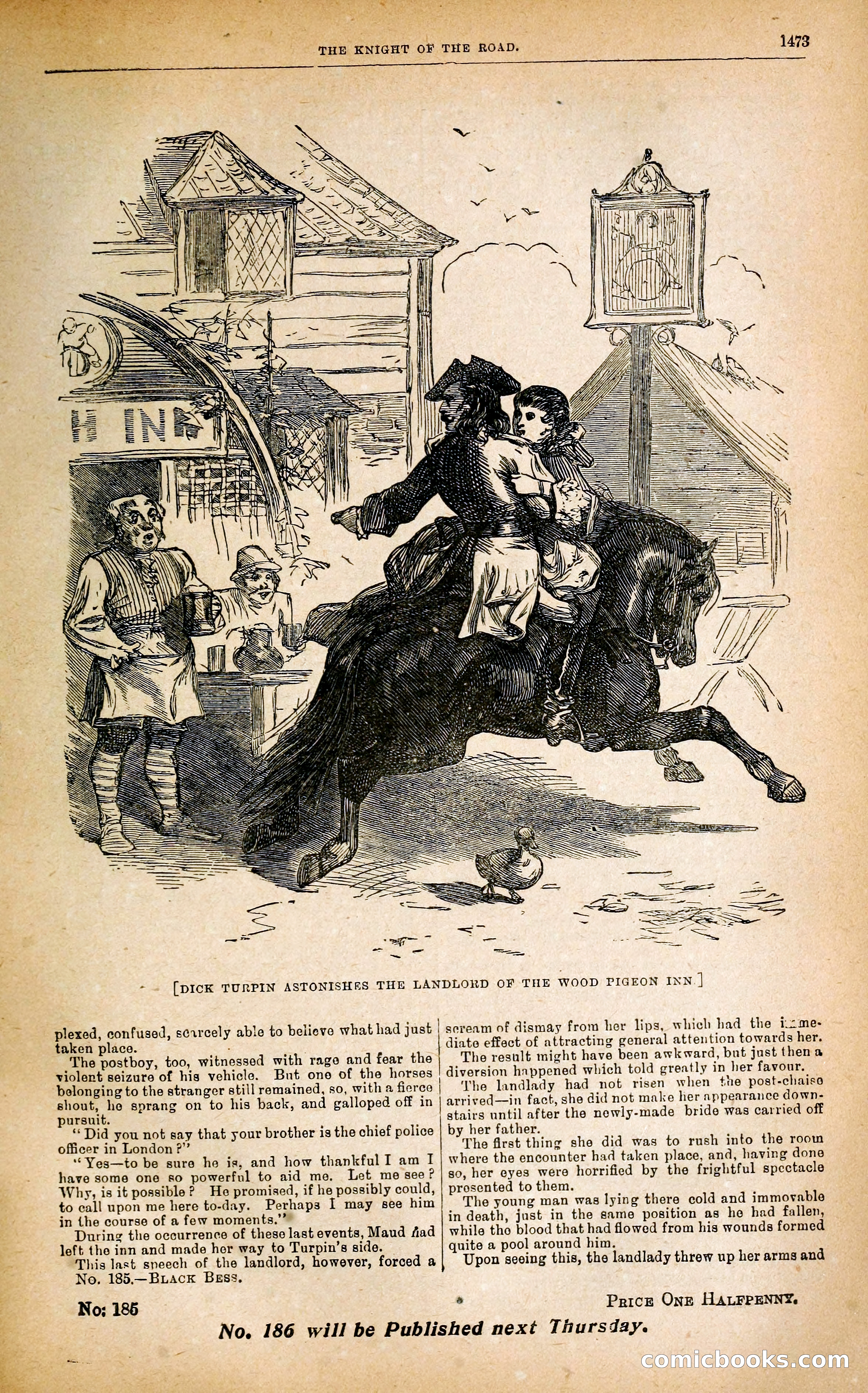
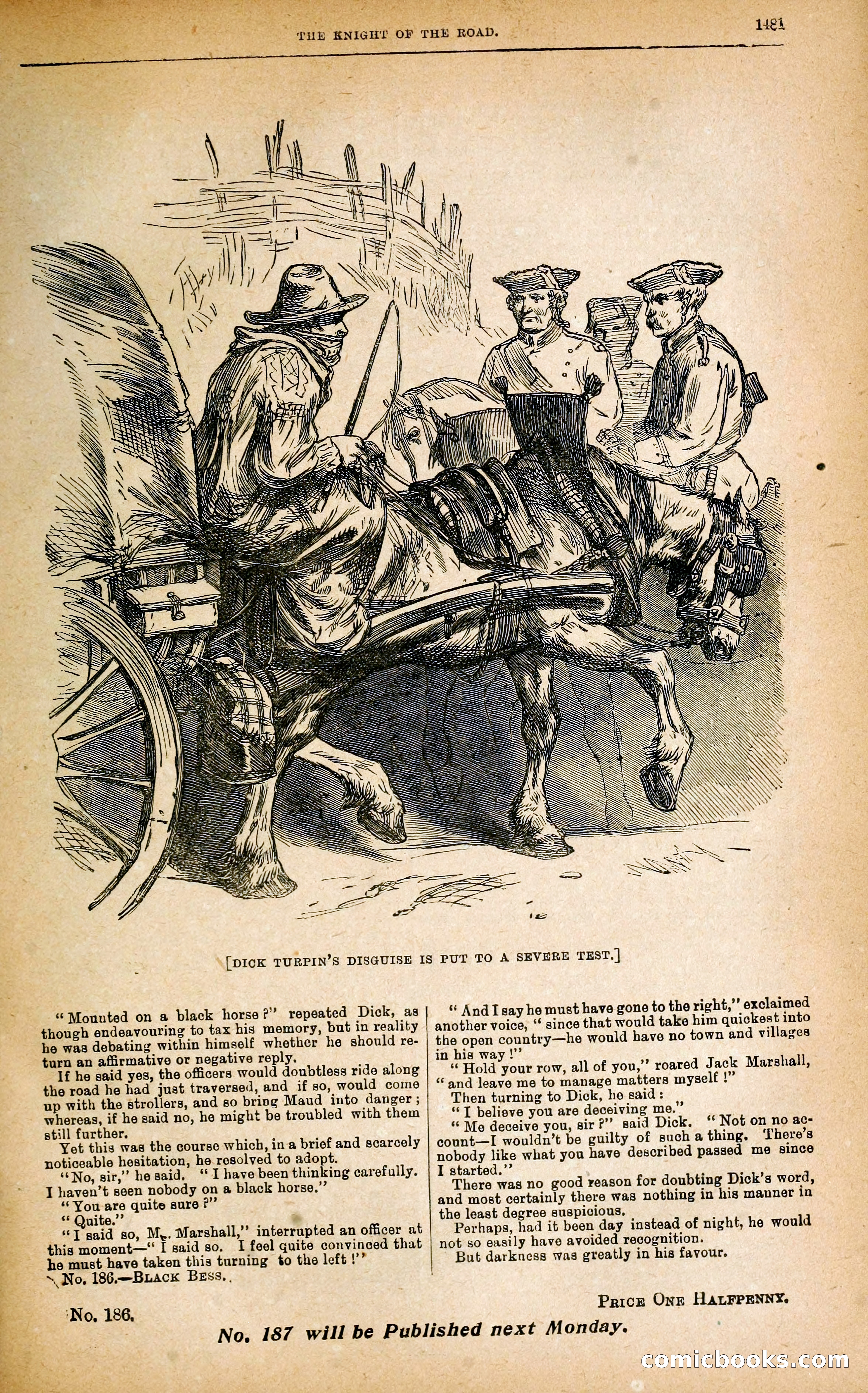
# Page Analysis: "The Knight of the Road" (No. 185) This is a serialized story page from a penny dreadful featuring both an illustration and running prose text. The engraved illustration shows Dick Turpin on horseback at an inn, astonishing the landlord while a woman (apparently named Maud) observes. The accompanying text describes the violent seizure of a vehicle, a postboy's pursuit, and a woman's discovery of a dead young man in a bedroom—all apparently connected to Turpin's robbery. The page ends mid-installment, with No. 186 promised for the following Thursday at one halfpenny.
# A Page from a Victorian Penny Dreadful This is a page of running prose text from a serialized story titled "Black Bess: Or," with a chapter heading visible ("CHAPTER CMIII. DICK TURPIN LEAVES THE WOOD PIGEON INN, AND HAS AN ADVENTURE ON THE ROAD"). The text describes Dick instructing the anxious Maud to flee the inn separately while he prepares their horse Black Bess for escape, as police officers pursue them. After saddling the horse and meeting Maud in the yard, Dick rides at dangerous speed to evade capture, eventually slowing when confident they've achieved sufficient distance from their pursuers. The narrative emphasizes danger, urgency, and romantic tension between the protagonists.
# Victorian Penny Dreadful Page Analysis This is a page of running prose text from a Victorian penny dreadful serial. The passage depicts a confrontation on a road between the protagonist Dick (riding his horse Black Bess) and a well-dressed military officer. Maud, apparently Dick's companion, has been left behind in distress. Dick deliberately stops the officer's horse and addresses him respectfully, claiming the officer is uniquely positioned to help him out of a difficulty. The text emphasizes Dick's composure and cunning despite being unarmed, and establishes tension through dialogue between the two men as the officer grows curious about Dick's mysterious request.
# Victorian Penny Dreadful Page Analysis This is a page of running prose narrative from what appears to be a serial installment of *Black Bess*, a Victorian penny dreadful featuring the notorious highwayman Dick Turpin. The text describes a sword duel between Dick Turpin and a stranger (an officer), fought with skilled parrying and thrusts. Maud, a woman accompanying Turpin, witnesses the combat from a distance and rushes to his aid in alarm. After Turpin wins the bout with three decisive touches, he retrieves a purse and identifies himself to the defeated officer, who departs in astonishment and humiliation upon learning his opponent's notorious identity.
# Page Analysis This is a page of running prose text from a Victorian penny dreadful. The visible narrative concerns Dick Turpin, a notorious highwayman character, discussing with a woman named Maud his promise to leave money buried near Hampstead Heath for the Governor of Newgate. After deliberating on how to obtain sufficient funds despite his current poverty, Dick and Maud hear laughter in a lonely lane and investigate, discovering a cart piled with miscellaneous articles surrounded by people on a heath, apparently engaged in amusing antics. The page advances the melodramatic plot through dialogue and descriptive narrative.
# Page from a Victorian Penny Dreadful This is a page of running prose text (numbered 1478) from the serialized narrative "Black Bess; Or," a Victorian penny dreadful. The visible text depicts Dick's interactions with a traveling circus troupe he encounters while fleeing with the character Maud. After sharing a meal, Dick becomes overwhelmed by drowsiness and sleeps. Upon waking as darkness falls, he considers his desperate situation—specifically how to obtain money needed for a promise made to the Governor of Newgate—and suddenly conceives a plan involving visiting someone named Matthew at Drury Lane to secure a loan. The passage emphasizes melodramatic tension and the protagonists' precarious circumstances.
# What's on This Page This is a page of running prose from a Victorian penny dreadful novel. The visible text shows Chapter CMVI, titled "Dick Turpin Assumes His Disguise and Sets Out for London." The passage depicts Dick Turpin (a notorious highwayman) confiding in Smithini, a stroller (traveling performer), and asking him to care for Maud (Turpin's wife) while Turpin travels to London on urgent business. Smithini expresses concern about the journey's danger, but Turpin declines his advice. They arrange to meet again, with Smithini planning to halt at a town called S——field about a dozen miles away.
# Victorian Penny Dreadful Page Analysis This page contains running prose narrative from a Victorian penny dreadful, appearing to be from Chapter CMVII of a serialized story. The text describes Dick Turpin's elaborate disguise—he is painted white in patches to alter his appearance, dressed in old clothes and a large felt hat with a muffler around his neck. The narrative details his emotional farewell to a woman named Maud before departing in a covered cart with a slow horse. The chapter heading indicates his disguise will soon face a severe test. This appears to be mid-adventure melodrama featuring the famous highwayman character.
# Page Content Description This is a running prose page from a Victorian penny dreadful titled *Black Bess; Or,* (partially visible at top). The text continues a narrative about Jack Marshall, an officer, who stops a cart and searches it, finding only straw. The driver (Dick, a highwayman in disguise) escapes successfully. The page then describes Dick continuing his journey on horseback when he suddenly hears rapid hoofbeats approaching and recognizes the approaching rider. The narrative focuses on suspense, narrow escapes, and the disguised protagonist's evasion of law enforcement—typical elements of this genre of sensational crime fiction.
This is a page of running prose from a Victorian penny dreadful. The text depicts Dick, apparently a highwayman or criminal, conversing with officers of the law after some incident involving a Captain who "went down." Dick manipulates the officers into riding away to search elsewhere, then tends to his exhausted horse and resumes his journey toward Drury Lane, anxious about reaching it before daybreak and worried that his companion Tom may have fallen into danger with someone named Jack Marshall. The narrative is melodramatic and action-focused, typical of sensational Victorian serial fiction.
# Victorian Penny Dreadful Page Analysis This is a page of running prose text from a Victorian penny dreadful, numbered 1484. The narrative follows a character named Dick (apparently a highwayman in disguise) as he enters an inn and encounters a deaf-and-dumb boy who serves him brandy-and-water. Dick recognizes the boy as a traitor connected to the landlord, old Matthew, and becomes frustrated that he cannot easily access Matthew. Another man then enters the inn whose face Dick recognizes from a previous encounter, though Dick believes his current disguise has not been penetrated. The text is dense with melodramatic plotting and criminal intrigue typical of the genre.
# Page Description This is a page of **running prose** from a Victorian penny dreadful titled "The Knight of the Road." The text consists entirely of dialogue between two characters—Dick (apparently a fugitive or criminal) and Matthew (a landlord)—discussing recent arrests at Bow Street. Dick has secretly visited Matthew's establishment and warns that their associates Ellen, Tom Davis, and his wife have been arrested and committed to trial at the assizes within eight or nine days. The conversation concerns what can be done to help them and why Dick risked returning despite his earlier escape. The page contains no illustrations or advertisements.
# Page Analysis: Victorian Penny Dreadful This is a page of running prose narrative text (page 2486) from a Victorian penny dreadful, likely titled *Black Bess*. The passage depicts a conversation at the White Horse Inn between Dick (apparently a highwayman) and old Matthew (the landlord), in which they discuss rescuing someone named Tom Davis from transportation. After Matthew leaves to fetch money, a deaf boy emerges from an inner room and appears to eavesdrop; as he passes Dick, Dick deliberately trips him. The text emphasizes melodramatic tension, moral conflict, and criminal intrigue typical of the genre.
# Description This is a page of running prose from a Victorian penny dreadful novel. The text shows a dialogue between characters named Dick (apparently Dick Turpin, a famous criminal), Old Matthew (an innkeeper), and others. They discuss whether police officers are lurking nearby and whether a suspicious man outside—a dismissed police officer who holds a grudge against Matthew—poses a threat to their safety. The passage includes a chapter heading ("DICK TURPIN HAS HIS REVENGE UPON THE SPY") and concerns itself with evasion, espionage, and criminal intrigue typical of sensation fiction.
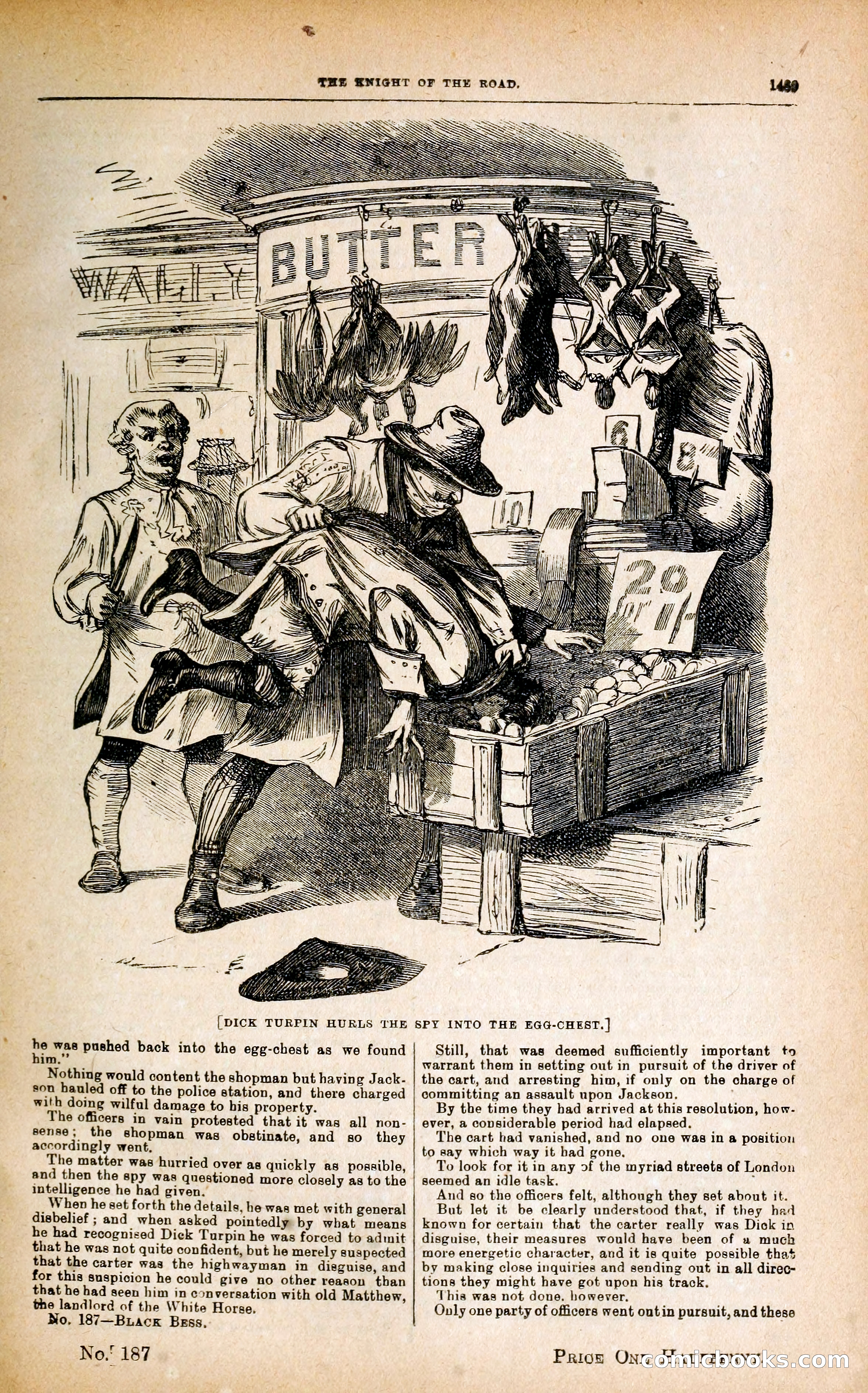
# Page Content Analysis This is a page of **running prose text** from a Victorian penny dreadful, containing two chapters of serialized fiction. The visible text depicts Dick Turpin, a highwayman character, encountering a spy who has been following him. After a tense confrontation in a street, Turpin violently seizes the spy by the neck and "seat of his breeches" and hurls him into a large box of eggs displayed outside a provisions shop, where the man crashes through and disappears into the eggs. The narrative emphasizes melodramatic action and physical comedy typical of the genre.
# Page Description This is an illustrated page from a Victorian penny dreadful featuring both an engraving and running prose text. The illustration depicts a scene in a butter shop where Dick Turpin (a famous highwayman, appearing to be in disguise) hurls a spy into an egg-chest. The accompanying text describes the aftermath: Jackson the shopman has the man arrested for property damage; a police spy is interrogated about recognizing Dick Turpin and mentions seeing him speak with the landlord of the White Horse; and officers begin a pursuit of a cart driver, though their search efforts prove largely ineffectual amid London's streets.
# Black Bess; or, The Knight of the Road This page contains running prose narrative from a Victorian penny dreadful. The text describes Dick's escape through London after a crime, noting how he passes Drury Lane Theatre (where the King attends a performance) and navigates through crowded streets unnoticed. The narrative then follows his internal deliberation about whether to bury a bag of gold he possesses before meeting Maud, ultimately deciding to journey toward Hampstead Heath to hide the money. The prose focuses on Dick's scheming thoughts and his difficult passage through a dark, muddy lane toward a specific tree where he plans to bury his stolen wealth.
# Description This is a page of running prose from a Victorian penny dreadful novel. The text depicts a dramatic nighttime encounter in which Dick surprises a man digging near a tree and seizes him, only to discover the man is the Governor. They discuss treasure buried at the spot, Dick's recent escape from danger, and commotion at Newgate prison. The passage ends with the beginning of "Chapter CMXV," which promises to describe "the strange adventure that Dick met with on his way to Somefield." The narrative is typical sensation fiction: suspenseful, melodramatic, and preoccupied with crime, treasure, and narrow escapes.
# This Page: Running Prose from a Penny Dreadful This is a page of continuous prose narrative from what appears to be mid-story in a Victorian penny dreadful. The text describes a character named Dick on horseback traveling along an English road at dawn, passing through a misty valley. The passage culminates in Dick spotting two figures on horseback at the hill's crest—his old comrades "Sixteen-String Jack" and "Claude Duval"—though they appear strangely unreal or phantom-like to him. Dick attempts to shout to them to make his presence known. The narrative emphasizes atmospheric description alongside mysterious, unsettling circumstance.
# A Page of Running Prose from a Victorian Penny Dreadful This is a text-only page of running prose (no illustration or title page) from Chapter CMXVI of what appears to be a serialized story. The visible text concerns a character named Dick, who has just witnessed a supernatural encounter and now finds himself in danger as police officers approach on horseback. Dick debates whether to flee or attempt to pass through disguised as a cart-driver. The officers, riding toward him, begin discussing whether they recognize both Dick and his cart from a previous encounter, suggesting Dick may be the "rascal" they seek. The page ends mid-conversation as one officer references someone called "Tom King."
# Page Analysis: *Black Bess; Or, The Knight of the Road* This is a page of running prose from a Victorian penny dreadful. The page contains two sections: the conclusion of a dialogue in which Dick Turpin (disguised as a carter) confesses to giving false information to police officers out of fear for his life, and Chapter CMXVIII, titled "Dick Turpin is Carried Before Squire Bartlett, and Committed." The text describes how officers plan to take the captured Turpin before a country magistrate rather than to London, and reflects on why Turpin's disguise has successfully fooled them—they cannot imagine the notorious highwayman would be traveling as an ordinary laborer.
This is a page of running prose from a Victorian penny dreadful serial. The text depicts a magistrate conducting a hasty, dismissive proceeding against a prisoner named Dick, who appears to be falsely accused. The magistrate, roused from bed and irritable, commits Dick to custody with minimal examination despite Dick's protests of innocence. The chapter concludes with Dick being escorted by police officers to an unknown destination, wondering where he will be confined. The prose emphasizes the injustice and arbitrary nature of the proceedings.
# This is Running Prose from a Victorian Penny Dreadful This page contains Chapter CMXIX of what appears to be *Black Bees* (title visible at top). The text describes Dick being arrested by a constable after an incident involving a thrown staff. The constable, enraged, marches Dick through a village street toward the local round-house (jail), where Simon retrieves a large, ancient blunderbuss as a precaution. The narrative focuses on Dick's thoughts during his arrest and his assessment of his captors and surroundings, establishing tension about his impending confinement.
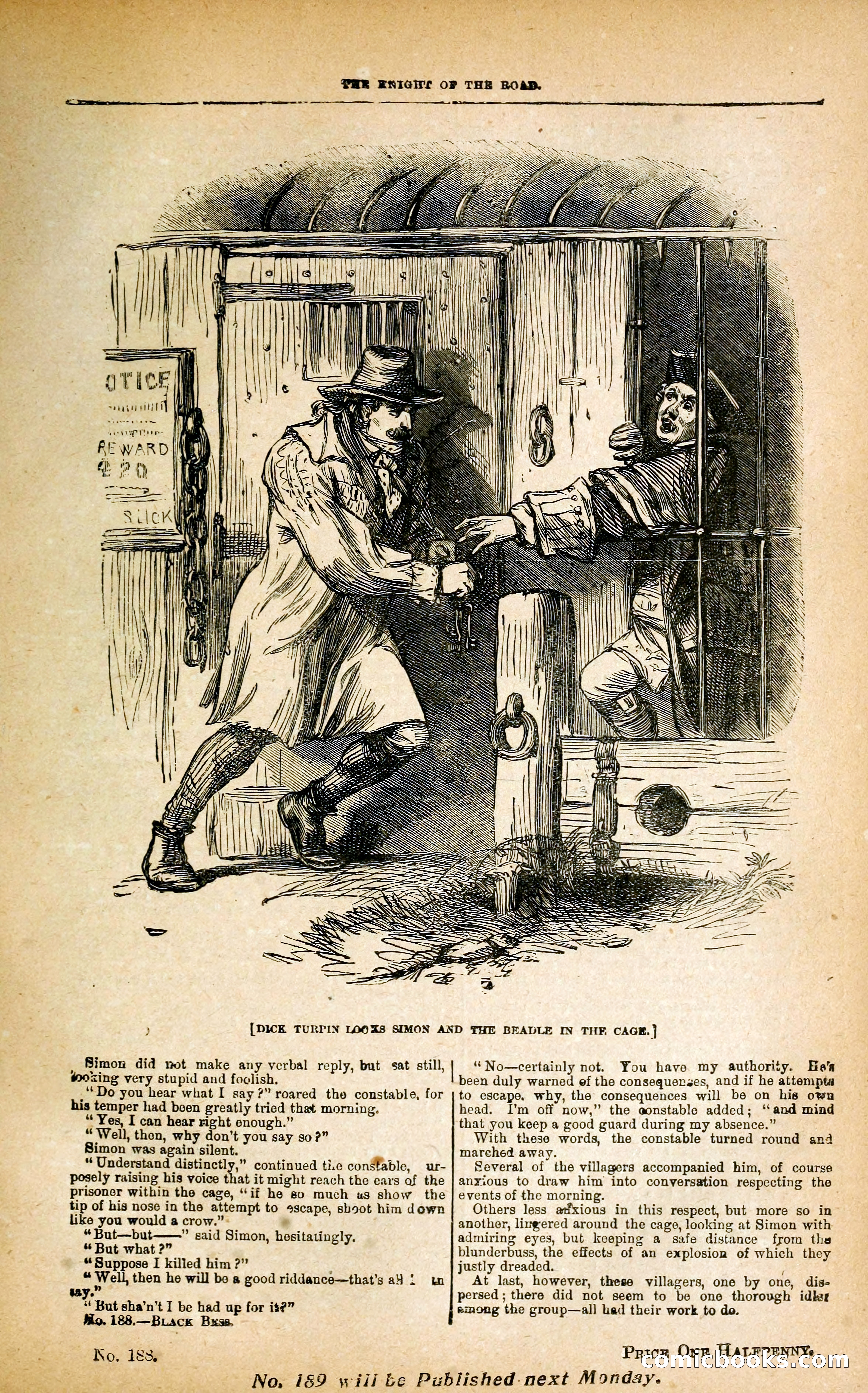
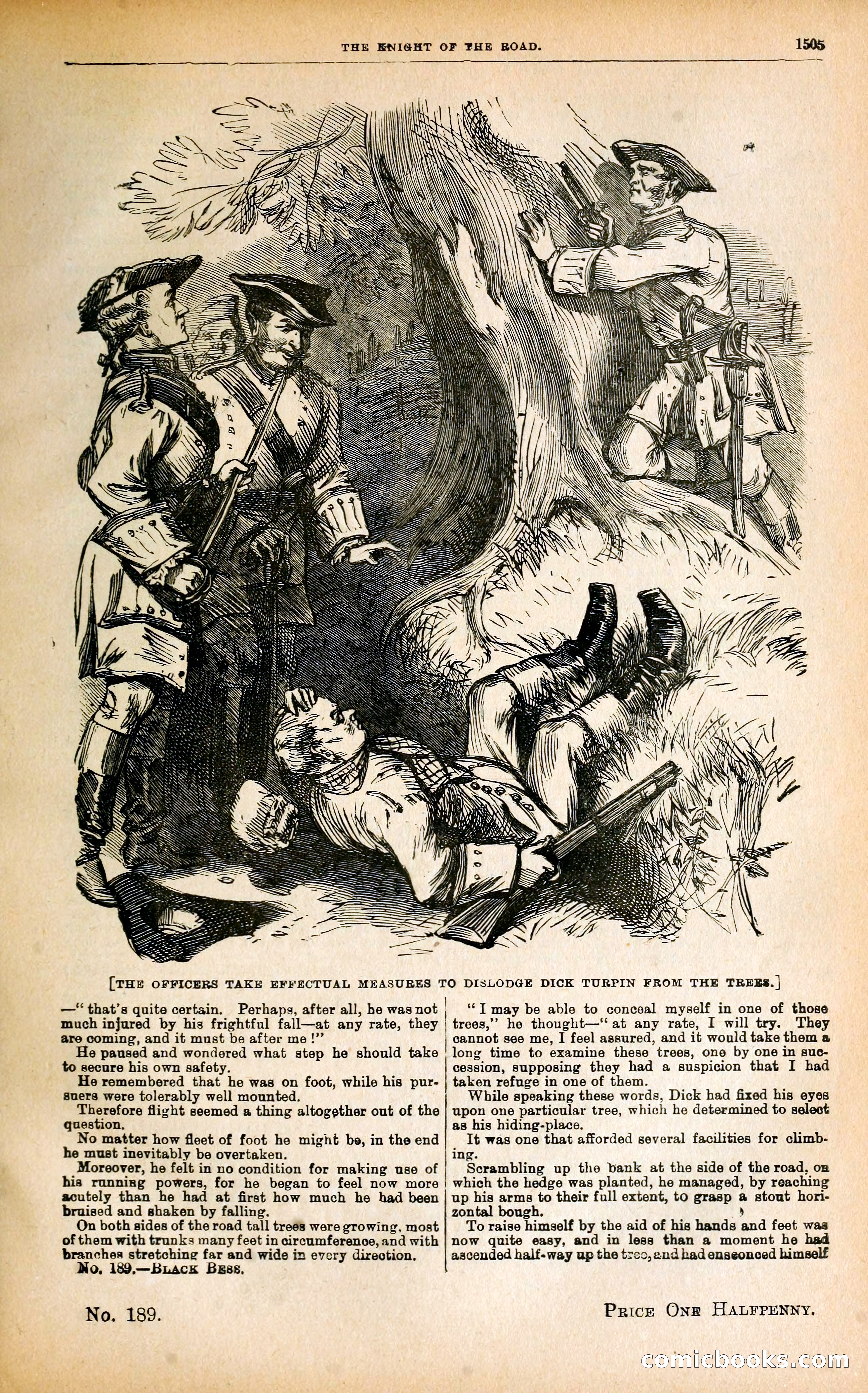
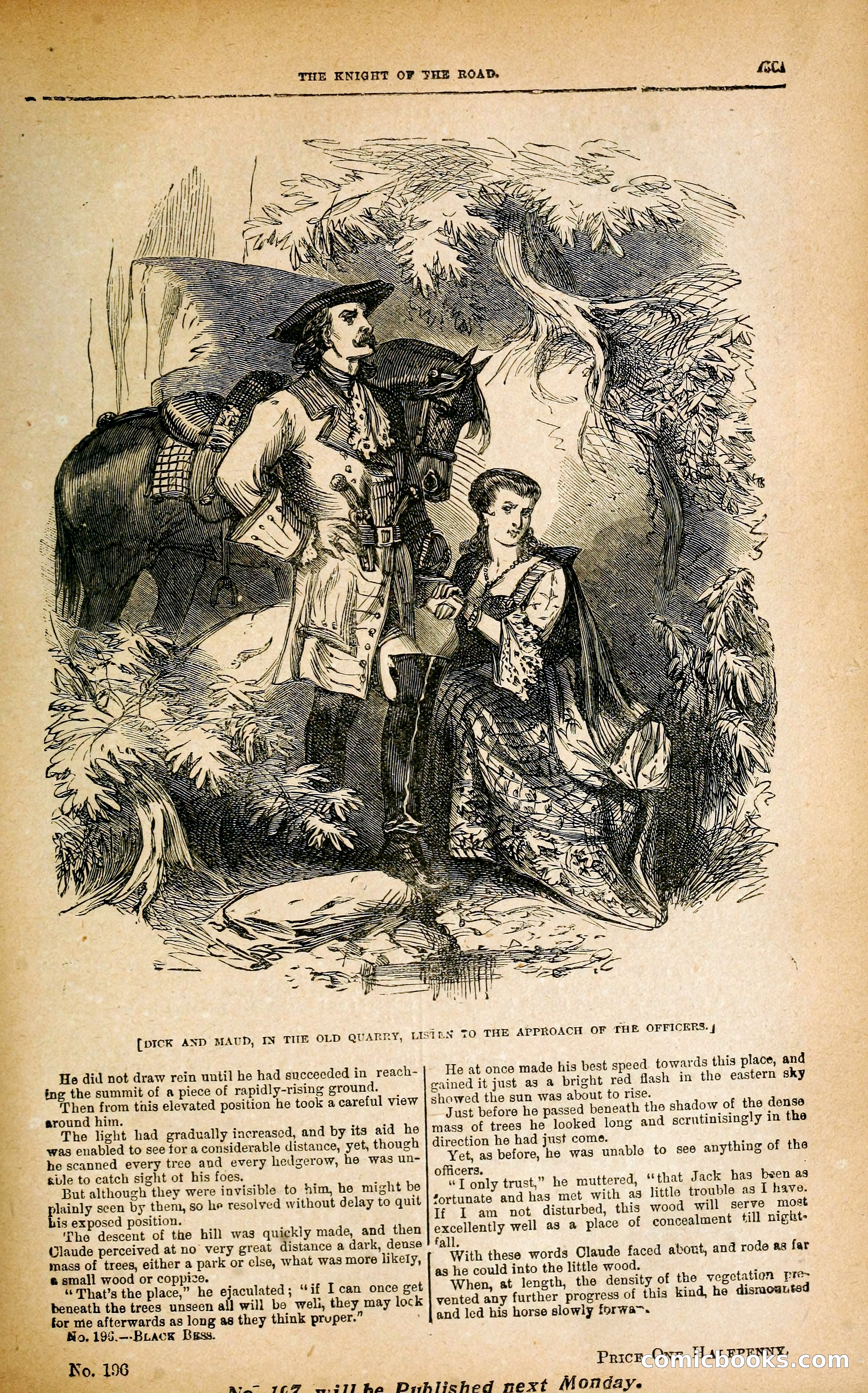
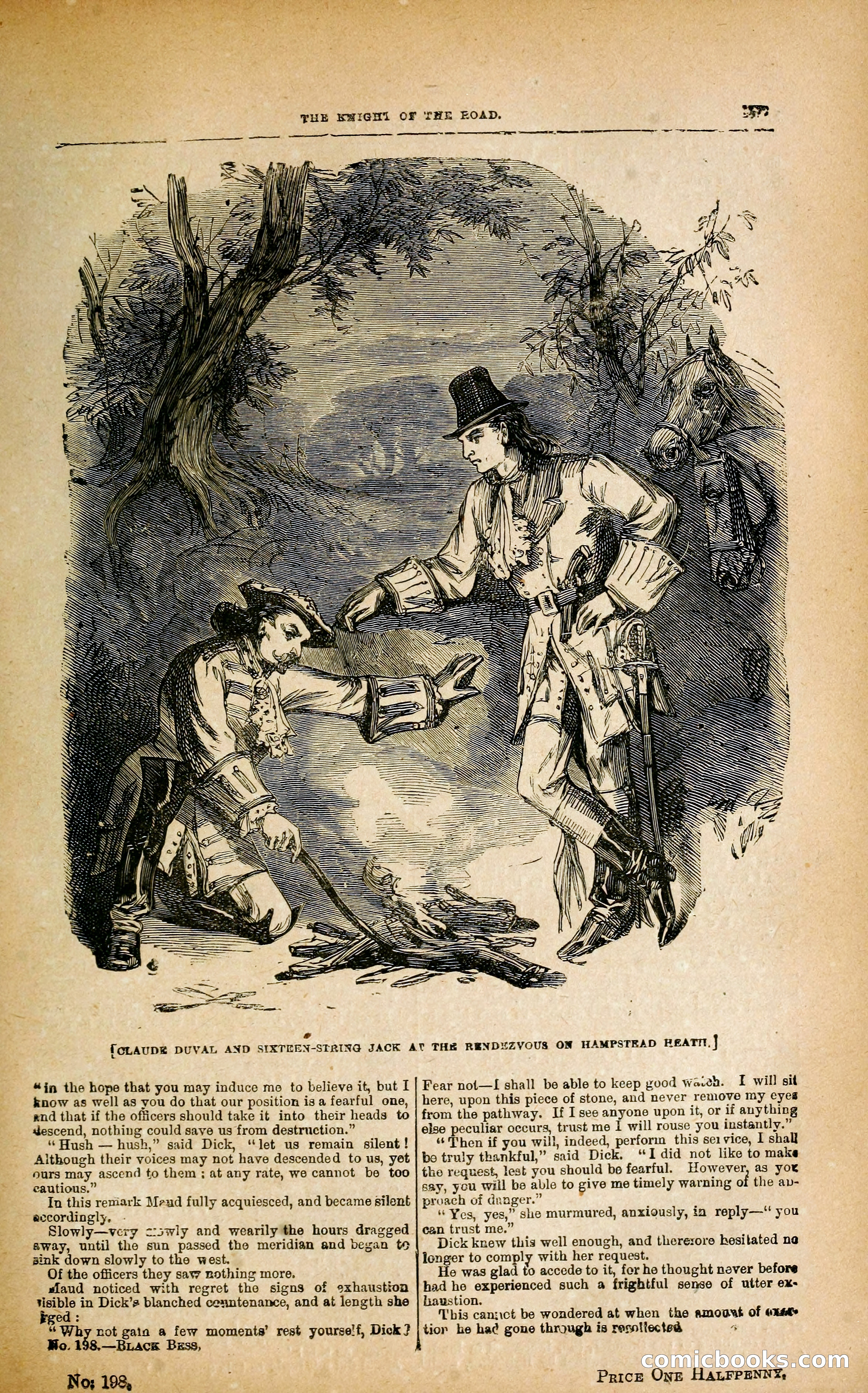
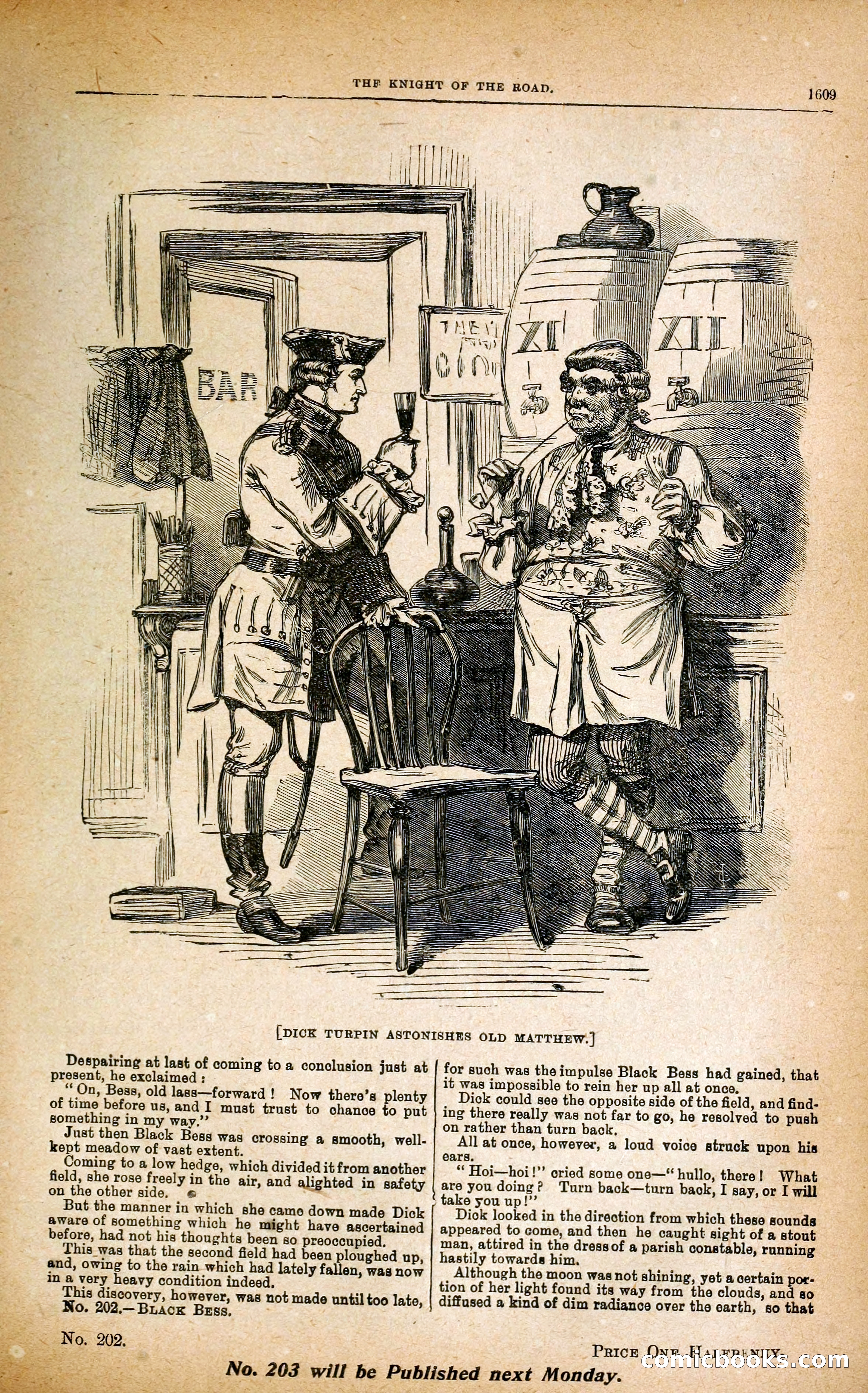
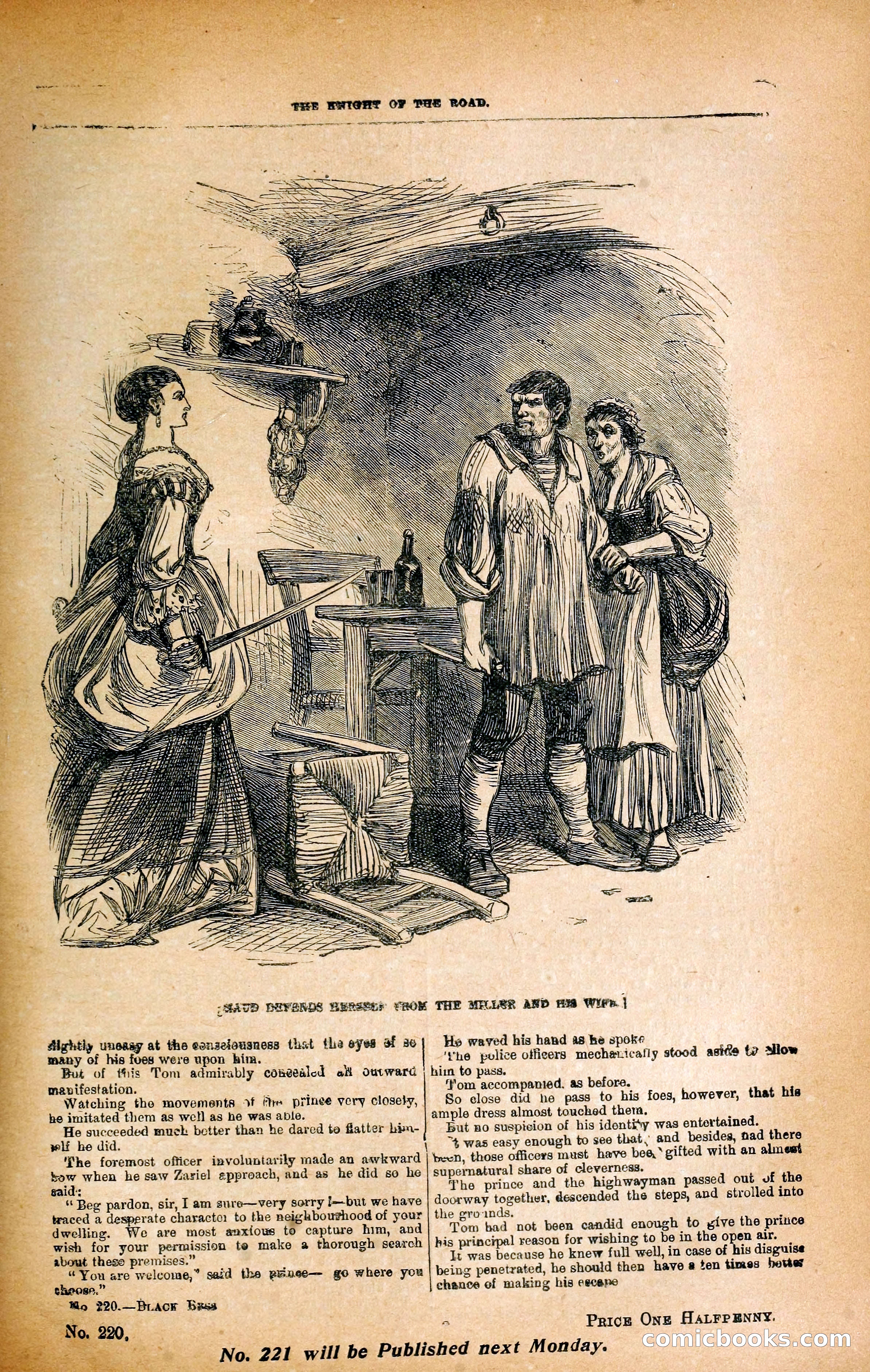
# Analysis This is a **page of running prose with an illustration** from a Victorian penny dreadful serial. The page shows Dick Turpin (a famous highwayman character) observing Simon and a beadle in a cage. The text depicts dialogue between a constable and Simon, in which the constable orders Simon to guard a prisoner and threatens to shoot him if he attempts escape. Simon makes hesitant objections, then the constable departs with villagers while others linger around the cage watching Simon. The page is numbered 183 and advertises that "No. 189 will be Published next Monday," indicating this is mid-serial installment.
# This Page from "Black Bess; or" This is a page of running prose text from a Victorian penny dreadful serial. The narrative follows a prisoner named Dick, who is confined in a round-house (lockup) guarded by a man named Simon. After the constable departs, Dick resolves to escape by removing his handcuffs through painful effort, successfully freeing his left hand by squeezing and tearing the skin from his hand to slip it through the steel manacle. The text describes his determination, physical suffering, and growing impatience for freedom.
This is a page of running prose from a Victorian penny dreadful. The text depicts a tense scene in which a constable and a man named Simon prepare to open a cage or cell to check on a prisoner. Simon is reluctant and fearful, the constable persuades him with difficulty, and as they approach the locked door, a faint cry—seemingly from the prisoner—emanates from within, startling them both. The narrative emphasizes suspense and melodramatic emotion throughout.
# Page Content Description This is a page of running prose from a Victorian penny dreadful novel. The text depicts an action sequence in which the protagonist Dick escapes from a roundhouse (jail) by startling a constable, causing a blunderbuss to discharge through the roof. Dick then locks the constable inside, disposes of his disguise by throwing it weighted with a stone into a body of water, and flees rapidly across the countryside toward his destination, congratulating himself on having earlier given away gold that might have incriminated him if he'd been captured by police.
# This Page: Running Prose from a Victorian Penny Dreadful This is a page of running prose text from a serialized penny dreadful, numbered 1502. The visible text concludes Chapter CMXXII, titled "DICK TURPIN FINDS HIS PATH STILL BESET WITH DIFFICULTIES." The passage depicts Dick Turpin listening to a landlord recount a tragic tale of a young woman (Miss Danville) forced into an unwanted marriage, who apparently attempted suicide by drowning. The landlord and other patrons express sympathy for the lovers involved. Turpin, having eaten and dried himself by the fire, now prepares to continue his journey as midnight approaches. The narrative focuses on dialogue and melodramatic plot exposition typical of the sensation fiction genre.
This is a page of running prose from the middle of a Victorian penny dreadful narrative. The text depicts Dick Turpin (a famous highwayman character) meeting a prize-fighter at an inn who offers him a ride in his gig. After some conversation and shared drinks, they depart together in the prize-fighter's fast pony and carriage. The passage includes dialogue establishing their acquaintance and the prize-fighter's mention that he is retiring from fighting. A chapter heading visible on the right ("CHAPTER CMXXIII") indicates this is part of a serialized story.
# Page from Victorian Penny Dreadful: "Black Bess; Or" This is a page of running prose text from what appears to be a serialized Victorian penny dreadful. The narrative describes an intense struggle between Dick Turpin (a highwayman) and a prize-fighter aboard a moving gig. Dick fights to prevent his antagonist from throwing them both from the vehicle into the roadway as they race through town. The passage culminates when Dick, desperate to save himself, releases his grip and strikes the prize-fighter repeatedly until the man loses his grasp and falls over the wheel of the gig into the road. A chapter heading ("CHAPTER CMXXIV") is visible mid-page, introducing a new section where Dick Turpin finds refuge in a tree.
# Page Content Summary This is a page of **running prose text** from what appears to be a Victorian penny dreadful serial. The visible text depicts a dramatic nighttime encounter on a road: mounted police officers have discovered a wrecked gig and are questioning the driver of a mail-cart about whether he's seen a man on horseback. The officers reveal they are pursuing the notorious highwayman **Dick Turpin**, who robbed a gentleman, threw him from the gig, and fled in the vehicle before crashing it. The mail-cart driver reports seeing an empty pony with dangling shafts nearby. The officers speculate about Turpin's whereabouts while the driver and guard express alarm at learning the famous criminal is in the area.
# Page Analysis This is a page of running prose from a Victorian penny dreadful titled "The Knight of the Road" (page 1507). The text describes an intense scene where officers are firing a carbine repeatedly at trees, searching for a highwayman. A character named Dick is hidden in one of the trees, increasingly anxious as the officers methodically shoot at each tree in sequence, moving closer to his hiding place with each attempt. The passage details the guard's repeated loading and firing of the weapon, his falls from recoil, and Dick's growing fear as the danger draws nearer.
# Page Analysis: Running Prose from a Victorian Penny Dreadful This is a page of continuous narrative text (page 1508) from a penny dreadful serial. The visible prose depicts Dick Turpin, a famous highwayman character, hiding in a tree while police officers pursue a horseman they mistake for him—who is revealed to be Tom King, Turpin's comrade. The passage describes the officers' discovery of their quarry, their rapid mounted chase through a meadow, Turpin's relief and concern for King's safety, and concluding with dialogue between a mail-cart guard and driver. The text is dense, double-columned Victorian printing with period melodramatic language ("dreadful death," "astounded," "redouble").
# Victorian Penny Dreadful Page Analysis This is a page of running prose from a serialized Victorian penny dreadful titled *The Knight of the Road*. The text continues Chapter OMXXVI, in which the narrative shifts from the protagonist Dick Turpin to two other characters, Maud and Black Bess, left in the care of a circus proprietor. A travel-worn man named Joe arrives at the circus encampment and, after sharing a meal with Smithini (apparently the circus owner), reports that he was recently stopped and questioned by police officers pursuing a highwayman and a female companion in the area. This news visibly disturbs Smithini, though he attempts to conceal his concern.
# Page Description This is a page of running prose from a Victorian penny dreadful serial (numbered 1510). The text describes a plan by characters named Maud and Smithini to have Maud perform circus tricks while masked and riding a horse called Black Bess (apparently the famous steed of the highwayman Dick Turpin). They hope the disguise will allow her to perform publicly without being recognized, despite the considerable danger involved. The passage details their hesitation, preparations, and the eventual performance before an audience.
# Page Content Analysis This is a page of **running prose** from Chapter CMXXVI of *The Knight of the Road*, a Victorian penny dreadful. The text depicts Dick Turpin discovering his companion Maud has survived a circus disaster, rescued by his horse Black Bess. After their emotional reunion, Smithini arrives with bad news that circus money receipts have been stolen by the mob. The chapter concludes with Dick spotting police officers approaching and realizing he must flee. The page contains dense narrative text typical of serialized Victorian sensation fiction, focusing on action, melodrama, and narrow escapes.
This is a page of running prose from a Victorian penny dreadful. The text describes Dick, a highwayman, riding Black Bess at full gallop while pursued by police officers. Maud clings to him as they flee across meadows and hedgerows through a moonlit night. Dick skillfully evades two approaching troops of mounted officers by changing direction and pushing his horse to great speed, eventually losing them in darkness and distance. The narrative emphasizes the danger, the horse's remarkable endurance, and Dick's resourceful horsemanship.
# Analysis of Page This page is **running prose text** from a Victorian penny dreadful, continuing a dramatic narrative scene. The visible text depicts a highwayman named Dick and a woman named Maud riding on horseback through darkness when their horse Black Bess suddenly stops and refuses to advance. Dick dismounts to investigate on foot while the moon begins breaking through clouds, at which point both characters cry out in horror upon seeing something on the ground—though what they've discovered remains unrevealed. The passage emphasizes suspense and Gothic atmosphere typical of the genre.
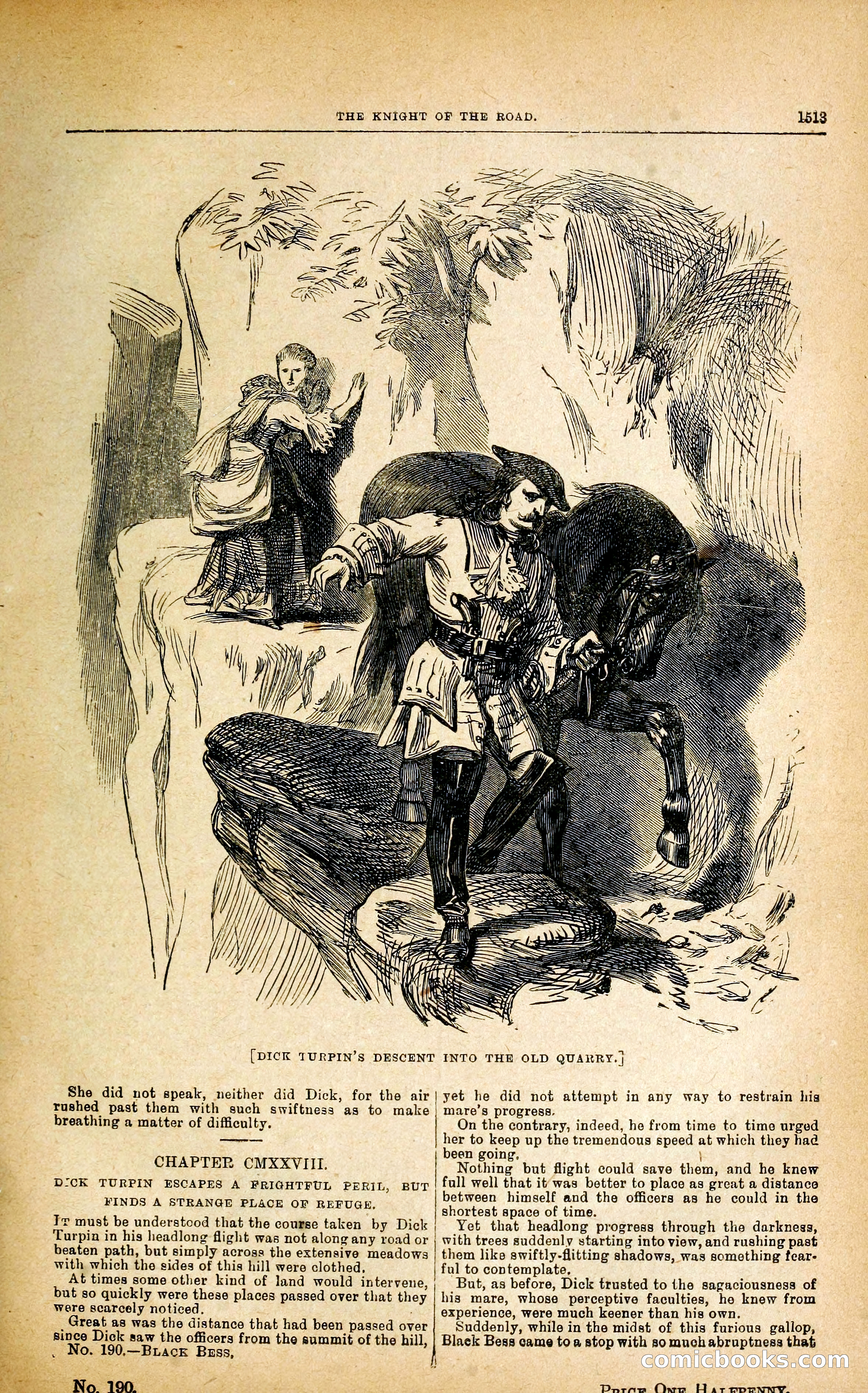
# What is on this page: This is a page of running prose from a Victorian penny dreadful titled "The Knight of the Road." The text describes Dick and a woman named Maud discovering a vast, abandoned stone quarry where they hope to hide from pursuing police officers. Dick searches the quarry's edge for a descending path, eventually finding a narrow, overgrown route down into the depths. The narrative emphasizes the dramatic landscape and their precarious situation as fugitives seeking refuge in this desolate location.
# Page Analysis: Victorian Penny Dreadful This is a **running prose page** from a serialized Victorian penny dreadful titled *Black Bess; Or, The Knight of the Road*. Chapter CMXXIX depicts Tom King's escape on horseback from pursuing police officers. The text describes King fleeing across fields and along a turnpike road, attempting to evade capture by passing through a toll-gate and jumping hedges. The prose emphasizes the dramatic chase, the quality of King's horse, and his tactical maneuvers to outdistance his pursuers. This appears to be an action-heavy installment typical of penny dreadful crime fiction.
# What is on this page: This is a page of running prose from the middle of a Victorian penny dreadful narrative. The text depicts a character named Tom evading pursuing officers on horseback through parkland and woodland. After successfully eluding them, his horse suddenly stumbles—apparently striking something hidden in the dark—triggering a flash and loud report (seemingly a gunshot or trap). The passage alternates between Tom's internal thoughts and external action, maintaining the breathless pace typical of serialized sensation fiction.
# Page from "Black Bess Or" This is a page of running prose (text only, no illustrations) from what appears to be the middle of a serialized story. The visible text describes Tom King's encounter with gamekeepers who have caught him trespassing. Tom attempts to bribe the six gamekeepers with guineas to let him go, but discovers he lacks sufficient money. When he offers his word of honor to pay them later, the gamekeepers refuse and threaten him with their guns, forcing him to proceed as their prisoner toward what appears to be Sir Thomas's residence. The passage emphasizes Tom's bitter regret at his capture and his loss of freedom.
# Analysis of This Page This is a page of running prose from Chapter CMXXXI of a Victorian penny dreadful. The text describes the protagonist, Tom King, escaping from what appears to be a locked tower or prison room. He pulls himself through a narrow window opening by gripping an iron bar, then climbs onto a slanted roof, where he slides down among loose tiles into a gutter. The narrative follows his desperate descent from a great height, his fear and determination, and his efforts to escape undetected. The page ends mid-sentence, indicating this is the middle of a serialized story rather than a complete installment.
# Victorian Penny Dreadful Page Analysis This is a page of **running prose** from a serialized Victorian penny dreadful (page 1520). The text depicts Tom King, apparently a highwayman, escaping on horseback from Sir Thomas's estate after some kind of criminal activity. He navigates past walls and gates, pursues an easy pace on a country road, and reaches a fork in the road where a stranger suddenly emerges from behind a hedge and fires a pistol at him. Tom is uncertain whether the shot was intentionally aimed or a mistake, and considers whether the man was posted there waiting for someone else entirely. The narrative emphasizes suspense and action typical of the sensation fiction genre.
# Victorian Penny Dreadful Page Analysis This is a page of running prose from the middle of a serialized Victorian penny dreadful, numbered 1523. The text continues the dramatic narrative of Tom King assisting an injured stranger who has fallen from his horse after being shot. Tom offers aid, bandages the man's wound, helps him onto his horse, and leads him toward the stranger's nearby house. As they arrive at the lodge gates, the stranger collapses to the ground. The page includes Chapter CMXXXII, indicating this is part of a lengthy serial narrative focused on crime, suspense, and melodrama typical of the genre.
# Page Analysis This is a page of running prose from a Victorian penny dreadful titled *The Knight of the Road* (visible at page top, numbered 1523). The text depicts a weary traveler on horseback who, after a long journey, discovers a remote half-farm, half-inn and decides to stop despite his earlier resolve to avoid being seen. He converses with the elderly landlord about lodging, stabling his horse, and the isolation of the location—apparently significant because the traveler seems to be fleeing from pursuers. The narrative is written in third-person melodramatic style typical of the genre.
# Victorian Penny Dreadful Page Analysis This is a page of **running prose text** from Chapter CMXXXIII of what appears to be a serialized penny dreadful novel. The page depicts Tom King waking in a parlor after sleeping all day, discovering voices from an adjacent room through a wooden partition. He hears rough men ordering rum punch and becomes curious about who they are. Tom then secretly locates a small door in the partition wall at ceiling height and carefully climbs onto furniture to peer through it without alerting the occupants in the next room. The narrative focuses on Tom's espionage and growing intrigue about these mysterious visitors who have arrived at what appears to be a public house or inn.
# Page Analysis This is running prose text from a Victorian penny dreadful novel titled "Black Bess; Or," presented across two columns. The visible text depicts an action sequence in which Tom King, apparently a highwayman being pursued by police officers, attempts to escape by cutting through hedges and fields. The officers pursue doggedly, cutting through obstacles and taking shortcuts to intercept him. The passage emphasizes the chase's relentless nature and Tom King's growing anxiety as his pursuers match his speed and strategic movements. A new chapter heading ("Chapter CXXXV") is visible at the bottom, beginning another scene where Tom King encounters someone.
# What's on This Page This page contains running prose from a Victorian penny dreadful titled *The Knight of the Road*. The text describes a highwayman named Tom King fleeing pursuers on horseback down a hill. After nearly being thrown from his horse, he encounters a stranger who recognizes him from a previous meeting and offers shelter. Tom reveals he is being chased by police officers and is in immediate danger. The narrative emphasizes action, suspense, and melodramatic dialogue typical of the genre.
# Page Analysis This is a page of running prose from a Victorian penny dreadful. The text depicts a scene where police officers pursue a highwayman (Tom King) through a dell. Jack Marshall, apparently leading the search, instructs half the officers to remain behind while he pursues further. A gipsy (Romani) character, who has befriended Tom King, overhears this conversation and deliberately creates a commotion—striking camp noisily with horses and wagons—to mislead the remaining officers into believing the fugitive has escaped with the main group. The passage emphasizes the tactical maneuvering between pursuers and pursued, with the gipsy's cunning intervention proving crucial to Tom King's safety.
# A Page from a Victorian Penny Dreadful This is a page of running prose (text only, no illustrations) from what appears to be mid-narrative. The page depicts an escape scene: a man named Tom, apparently a fugitive, is being helped to flee by a gipsy who will hide him from pursuing police officers. Tom suffers a gunshot wound to his left arm during his escape on horseback and attempts to staunch the bleeding with a handkerchief while riding at speed. The text emphasizes the action, danger, and melodramatic tension characteristic of penny dreadful fiction—Tom is wounded, bleeding profusely, pursued by mounted officers, yet determined to flee into the open countryside.
# Page Analysis: *The Knight of the Road* This is a page of running prose from a Victorian penny dreadful serial (page 1531). The text describes a highwayman named Tom King attempting to escape pursuing police officers by leaping his horse over a barricaded wagon. After successfully clearing the obstacle while the officers cannot, Tom mocks them, they fire ineffectually at him, and he uses their ensuing frustration and the time needed to reposition the wagon to make his escape. The passage then shows Tom reining in his horse to rest and assess his situation, having successfully evaded capture.
# This Page: Running Prose from a Penny Dreadful This is a page of running prose text from Chapter CMXXXVII of what appears to be a Victorian penny dreadful serial. The text depicts a highwayman, Tom King, attempting to rob a carriage. Tom has stopped the vehicle and demands money from its occupants while brandishing a pistol. A dialogue ensues between Tom and passengers inside—a young woman pleading with her father to comply, and her father refusing to surrender valuables. The scene escalates when Tom discovers an unexpected threat: the footman on the carriage is preparing to resist, forcing Tom toward violence. The page contains no illustrations, only dense columns of Victorian sensational fiction prose.
# Victorian Penny Dreadful Page Analysis This is a page of **running prose text** from a Victorian penny dreadful serial. The passage describes a wounded man (appears to be named Tom King) recovering from blood loss and an arm injury in a meadow. He struggles to remount his horse, then rides to a hilltop where he spots an ancient, ivy-covered mansion. Despite a strange presentiment drawing him toward it, he deliberately turns his horse away and heads instead toward a narrow, well-kept road bordered by a thick hedge. The narrative emphasizes his physical weakness, desperation for shelter and medical aid, and mysterious compulsion regarding the grand house.
# Page Content Description This is a page of running prose from a Victorian penny dreadful novel. The text follows Tom King, who has dismounted after a mysterious man on horseback has ridden away. Tom discovers a small letter that the man dropped near a hedgerow. The letter is addressed to "Sir Ralph Cromer, Wildfirs Cross." Tom decides to improve his disheveled appearance and resolves to deliver the letter to what he believes is a nearby mansion, hoping to gain shelter and aid as reward for his service. The narrative suggests Tom sees this chance discovery as a fortunate opportunity.
# Analysis of Page from "Black Bess" This is a page of running prose from a Victorian penny dreadful. The text depicts a confrontational scene in which Tom King, seeking private audience with the elderly baronet Sir Ralph, is challenged by the baronet's domineering wife. The lady demands to know Tom's business and refuses to leave the room, asserting her complete control over her husband's affairs. Tom observes troubling details—the lady's resemblance to a suspicious man he'd previously seen, the young girl Ellen's sadness, and the baronet's apparent subjugation to his wife. The tension mounts as the lady grows angry at Tom's refusal to speak openly before her.
# Analysis of This Page This page from a penny dreadful titled *The Knight of the Bead* combines an illustration with running prose text. The engraving depicts "The Assassination in the Wood at Wilsing Cross"—a nighttime woodland scene showing figures in period dress, with one appearing to attack another beneath a full moon. Below the illustration, the readable text shows dialogue between characters including an old man and someone named Tom, discussing a murder witnessed "a short time ago" and debating the narrator's duty regarding what he has seen. The page costs one halfpenny and is numbered 193 by "Black Bess," indicating this is mid-serialization of a sensational crime narrative.
# Page 1585 of "Black Bess" This is a page of running prose from a Victorian penny dreadful serial. The text depicts a scene in which Tom King, a highwayman, has presented a mysterious letter to an elderly baronet. As the baronet reads the letter, his emotional state shifts dramatically—his face brightens with joy, then falls into melancholy as he recalls something painful. Tom then requests shelter due to a broken arm from a horse fall, but the baronet refuses, citing his wife's objections. Tom responds by chastising the baronet for allowing a woman to rule him and diminish his character.
# What's on This Page This is a page of running prose from a Victorian penny dreadful titled *The Knight of the Road*. The text depicts a dramatic dialogue between Tom (a visitor) and an old baronet, discussing the baronet's estranged son, a disinherited heir, and the baronet's wife who apparently controls his will. The baronet expresses remorse for disowning his son and desires reconciliation, but fears his wife's influence. The scene culminates with "her ladyship" suddenly entering the room, whereupon the baronet visibly weakens under her presence, suggesting her considerable power over him.
# Page Analysis This page contains running prose text from Chapter CMXLI of a Victorian penny dreadful. The narrative depicts a conversation between Tom King and a baronet regarding a mysterious letter and a man employed in the baronet's household. Tom, who has been injured in a riding accident, offers to help recover something of importance to the baronet. The dialogue reveals tension around correspondence from someone named Roderic and suggests that a servant employed by the baronet's wife has acted suspiciously. The text emphasizes melodramatic elements typical of the genre—secrets, wounds, emotional distress, and hints of conspiracy among household staff.
# Page Analysis: Victorian Penny Dreadful This is a text page from the running narrative of a penny dreadful serial. The page presents prose from "The Knight of the Road" (visible in the header), continuing Tom King's story as he leaves a mansion after a confrontation with its mistress. Tom departs, overhears a suspicious conversation between a man named Ernest and a woman near the plantation, then discovers a mysterious servant in the stables polishing an unusual firearm. When the servant spots Tom in the doorway, he reacts with alarm and conceals the weapon in a corn-bin. The page ends mid-action as the servant recovers from his startled surprise, maintaining dramatic tension typical of the sensation fiction genre.
# Page Analysis: Victorian Penny Dreadful This is a **page of running prose text** (numbered 1542) from a serialized Victorian sensation story. The narrative follows Tom King, an apparent criminal or highwayman, who arrives at a remote village apothecary's shop seeking medical treatment for an arm wound. Tom discovers wanted posters offering a reward for his capture but enters anyway. He encounters Mr. Coles, a thin, grey-haired apothecary who is pious and evangelical, offering to treat Tom's injury while attempting to convert him to religious belief. Tom feigns religious devotion to secure treatment, though he privately dislikes the apothecary's sanctimonious manner.
# Analysis of Page from "The Knight of the Road" This is a page of running prose from what appears to be the middle of a serialized story. The text describes Tom, apparently a highwayman or criminal, overpowering an apothecary by force, gagging and binding him with towels, then discovering a human skeleton displayed in a cupboard—which Tom then uses to further intimidate his captive by placing it in the apothecary's chair and wrapping it in a cloak. The narrative emphasizes gothic horror elements (the skeleton's "ghastly look") alongside violent melodrama, typical of penny dreadful sensationalism.
# Page Summary This page contains running prose from a Victorian penny dreadful serial (page 1644). Chapter CMXLIII describes the chaotic scene in a village after Mrs. Coles, the apothecary's wife, discovers what appears to be a dead servant girl and a skeleton in her parlor, shrieking "Murder!" Neighbors gather in alarm, including the alehouse landlord, a blacksmith, and the parish constable Mr. Peters. Mrs. Coles implores them to enter the house and investigate, but the villagers hesitate, insisting that Mr. Peters, as constable, should enter first—a responsibility he appears reluctant to accept. The narrative emphasizes the confusion, fear, and somewhat comic cowardice of the assembled crowd.
# Page Analysis: Victorian Penny Dreadful This is a page of running prose from a Victorian penny dreadful serial (page 1546). The text describes Mr. Coles, an apothecary, frantically pursuing a figure named Tom King after some violent incident at his shop. After the village empties in panic, Coles encounters mounted police officers and urgently claims a reward for information about Tom King's whereabouts, insisting the criminal escaped on horseback moments ago. The officers express surprise, having seen no sign of him despite patrolling the area. The narrative continues with dialogue between Coles and the police commander.
# Victorian Penny Dreadful Page Analysis This is a page of **running prose text** from "The Knight of the Road," a Victorian penny dreadful serial. The narrative follows a character named Tom King as he approaches a country hall on horseback, moving through dense woodland to avoid detection. The text describes his passage through ancient forest, a neglected plantation, and overgrown shrubbery as he seeks a concealed vantage point near the building. Tom secures his horse and begins reconnaissance, apparently engaged in some form of clandestine activity—suggesting a crime or melodramatic plot typical of the sensation fiction genre.
# Page from a Victorian Penny Dreadful This is a text page of running prose from a serialized story. The narrative concerns a conversation between a young couple (Ernest and a young woman) discussing family objections to their relationship, overheard by Tom King, who has hidden himself nearby. After the couple departs, Tom emerges from hiding, checks his weapons, and prepares to follow them on horseback. As he moves through the woods, he hears footsteps approaching and recognizes an unnamed man—apparently someone he has previously encountered "tampering" with something, though the page cuts off before revealing the man's identity or purpose.
# A Page from a Victorian Penny Dreadful This is a page of running prose text from *The Knight of the Road*, a Victorian penny dreadful. The narrative describes a dramatic confrontation: Tom, having shot a murderer, discovers the victim's identity by moonlight. The under-steward, recognizing the fallen young man as his own son "Alfred," experiences a horrified breakdown—struggling to speak, crying out in anguish, and desperately attempting to revive the apparently lifeless body. The passage emphasizes melodramatic emotion and sensational crime, typical of the genre's appeal to working-class Victorian readers seeking cheap thrills and moral drama.
# Page from Victorian Penny Dreadful This is a page of running prose text (page 1550) from a serialized Victorian melodrama. The visible text depicts a pivotal confession scene: Peterson, revealed as the stepmother's former husband, admits to Roderic that he attempted murder using an air-gun, mistakenly killing his own son Alfred instead of his intended target. Peterson confesses the stepmother's scheme to defraud Roderic of his inheritance and marry him to her daughter. After this emotional revelation, Roderic mercifully allows the guilt-stricken Peterson to depart unmolested. The passage emphasizes sensational crime, family secrets, and moral redemption typical of penny dreadful melodrama.
# Page Analysis This is a page of running prose from the middle of a serialized narrative. The text depicts a dramatic confrontation in which Tom King confronts a woman (Mrs. Peterson) with knowledge of her criminal conspiracy, forcing her to retreat from a rooftop. Tom then delivers news of a death to an elderly baronet (Sir Ralph), who faints upon learning his son has arrived. The passage involves accusations of assassination, family revelations, and emotional turmoil typical of Victorian melodrama. The narrative focuses on dialogue and interior action rather than external events.
# Victorian Penny Dreadful Page Analysis This is a page of running prose from a Victorian penny dreadful. The text shows Mr. Grant recounting to assembled company a dramatic incident from the previous night: he was stopped by a highwayman on the road who robbed him at gunpoint, demanded one of his horses, and escaped. During the altercation, Grant's servant Thomas fell from the coach roof, and pursuing police officers chased the villain away on Grant's stolen grey horse. The narrative explains why Mr. Grant's arrival at his destination was delayed—his wife fainted repeatedly, and his injured servant Thomas required aid from a friend's house before they could continue their journey.
# Description of Page This is a page of running prose from a Victorian penny dreadful. The text depicts Tom King's escape on horseback from pursuing police officers after being spotted at a country estate. The narrative describes his flight through shrubbery and thicket to where he has concealed his horse, his rapid escape into the open countryside, and subsequent details about the officers' pursuit—including their earlier fruitless search of the area and their acquisition of fresh mounts. The passage emphasizes Tom's confidence in his grey horse's superior qualities and the officers' determination to apprehend him.
# Black Bess; Or... [Page from a Victorian Penny Dreadful] **Page type:** Running prose (columned text, no illustrations visible) **Content:** This page depicts a scene in which a fugitive named Jack, pursued by officers, rides to a toll-gate near Tyburn and attempts to bribe or persuade the tollkeeper to let him pass. Jack recognizes the keeper as someone who previously helped a friend (Tom King) and appeals to this connection, offering money and promising reward. The dialogue reveals Jack is fleeing mounted pursuers and seeks the tollkeeper's aid to obstruct their pursuit.
# Description of Page This page contains running prose—dialogue-heavy narrative from a Victorian penny dreadful. The text depicts an exchange between police officers and a tollkeeper regarding a man on a bay horse. The officers are investigating (apparently for a crime), while the tollkeeper recounts his recent encounter with a mounted stranger who demanded the gate be opened. The scene is comedic in tone, with the tollkeeper's cheek and humor frustrating the chief officer. The page ends mid-scene, transitioning to Chapter CMXLIX, which announces that "Sixteen-String Jack meets rather suddenly and unexpectedly with his old comrade Claude Duval."
# Victorian Penny Dreadful Page Analysis This page contains running prose (no illustrations or title page). It depicts a dialogue between a highwayman character and a tollkeeper following what appears to be a successful robbery or escape. The text shows the highwayman (identified as "Sixteen-String Jack") preparing to leave the tollgate while rewarding the keeper for his assistance. The passage ends with the tollkeeper alerting Jack to the approach of an armed horseman, creating narrative tension as Jack prepares to depart before potential pursuers arrive.
# What This Page Contains This is running prose from the middle of a Victorian penny dreadful serial, "The Knight of the Road" (page 1559). The text depicts a dialogue between two highwaymen—Sixteen-String Jack and Claude Duval—who have reunited on the road. They discuss their recent escape from pursuit, agree to stay together, and resolve to commit robbery to reward a tollkeeper and obtain funds, demonstrating the casual criminality typical of sensation fiction aimed at working-class Victorian readers.
# Page Description This is a page of running prose from a Victorian penny dreadful, likely from a serialized story about highwaymen. The text depicts a robbery scene in which two highway robbers—Jack (called "Sixteen-String Jack") and Claude Duval—accost a traveller in a gig and demand his valuables. After initial resistance, the traveller surrenders his purse and watch. The robbers then depart with their stolen goods, and Jack and Claude discuss finding shelter as daylight approaches, with Claude mentioning the sound of approaching horsemen, though Jack cannot hear them above the wind.
# This Page from a Victorian Penny Dreadful This is a page of running prose from Chapter CMLI of a penny dreadful serial. The text follows Claude Duval as he flees pursuit, stopping to rest in woodland, then growing hungry and seeking shelter at a roadside inn. Just as he arrives at the dwelling, police officers suddenly emerge from the building armed with pistols. The page depicts mounting suspense typical of the genre—a fugitive protagonist encountering unexpected danger—with melodramatic pacing and cliff-hanger construction designed to compel readers to purchase the next installment.
# What This Page Contains This is a page of running prose from a Victorian penny dreadful titled "The Knight of the Road." The text continues a narrative about Claude, a highwayman who has just aided a cottager and his wife, warning them that police officers are pursuing him. After fleeing on horseback across the countryside to evade capture, Claude now finds himself exhausted and seeking shelter. The page shows typical serialized melodrama: thrilling action, moral ambiguity (the criminal as protagonist), and suspenseful pursuit across rural England. The narrative ends mid-sentence as Claude spots what appears to be a barn for refuge.
# Page Analysis This is running prose from Chapter CMIII (153) of what appears to be *Black Bess; Or, The Knight of the Road*, a Victorian penny dreadful. The page depicts Claude (a highwayman) secretly observing from attic beams a gathering of poor, ragged strangers—possibly Romani people or beggars—who have assembled around an elderly, dying man on straw. The text emphasizes Claude's curiosity and the group's apparent grief, as the old man attempts to speak while the others fall into profound silence awaiting his words.
# Page Content Analysis This is a page of running prose from a Victorian penny dreadful titled "The Knight of the Road" (visible at page top, numbered 1565). The text depicts a conversation between Claude (a highwayman) and Bamfylde, a young man who reveals he is the grandson of the famous criminal Bamfylde Moore Carew. Bamfylde offers Claude membership in a secret fraternity of outlaws, teaching him a secret sign that will command their aid. After declining to stay longer, Claude departs to search for his missing companion, Sixteen-String Jack, riding through the night without success—leaving him increasingly anxious about Jack's fate by dawn.
# What This Page Contains This page is running prose from the middle of a serialized narrative, likely from a Victorian penny dreadful. The text depicts Claude and Sixteen-String Jack (a famous historical highwayman) arriving at a remote inn, settling their horses, and discussing whether to depart that evening. Jack argues for remaining hidden due to police patrols on the roads; Claude prefers to leave at dusk. The passage ends with them departing on horseback into nearby bushes as Claude urgently commands Jack to "stoop down," suggesting impending danger or pursuit. The narrative emphasizes suspense, criminal evasion, and melodramatic tension typical of the genre.
# Description of Page This is a page of running prose from a Victorian penny dreadful titled "The Knight of the Road." The text depicts a dialogue between two highwaymen, Claude and Jack, who discuss evading pursuing officers by hiding in the ruins of an old castle near a village called Nealham. As they ride their horses across the countryside at night, they debate the feasibility of their plan and the distance to the ruined structure, which Claude claims to remember from years past. The passage emphasizes their need for a safe, remote hiding place and their concern about being spotted by authorities.
# Victorian Penny Dreadful Page Analysis This is a page of running prose from a Victorian penny dreadful titled "Black Bess; Or," likely from mid-serialization. The text depicts dialogue between characters named Jack and Claude Duval, who appear to be highwaymen concealing themselves in old ruins. They discuss local legends of a ghostly monk haunting the location, and Claude dismisses supernatural explanations while cleaning his pistol. Jack grows increasingly nervous about their hiding place as moonlight illuminates the ruins. The narrative emphasizes Gothic atmosphere and suspenseful tension as the men prepare to examine their surroundings more thoroughly.
# Page Analysis This is an illustrated page of prose narrative from a Victorian penny dreadful titled "The Knight of the Road." The page features a wood-engraved illustration showing police officers apprehending a man on horseback, with additional figures in military dress standing nearby. Below the illustration runs dialogue between characters named Jack and Claude, in which they discuss a mysterious figure that appeared and disappeared mysteriously. Claude argues for remaining in their current quarters to investigate the mystery, while Jack expresses reluctance and agitation about the proposal. The text references "Sixteen-String Jack" and suggests supernatural or criminal intrigue. The price is listed as one halfpenny.
# Page Analysis This page contains **running prose text** from a Victorian penny dreadful serial. The narrative depicts two fugitives—Claude and Sixteen-String Jack—taking refuge in the ruins of an old castle. After Jack sleeps, Claude keeps watch; upon waking, Jack recounts a vivid dream. The men then cautiously explore the ruins together, examining the crumbling walls and the keep, finding no signs of other human presence. The text focuses on their dialogue and movements as they assess their hiding place and plan their next actions.
# This is a page of running prose from a Victorian penny dreadful The text depicts two highwaymen, Claude and Jack, entering a country inn and observing the warm interior from outside before deciding to join the assembled patrons for food and drink. After they settle in a dark corner, a mysterious military-looking stranger arrives, also seeking warmth and refreshment by the fire. The prose describes the scene's atmosphere and dialogue as the characters interact, with the narrative building suspense around this newcomer's arrival and identity.
# Page Description This is a page of running prose from a Victorian penny dreadful titled "Black Bess; Or," containing continuous narrative text. The landlord recounts a ghost legend connected to the ruined castle: a proud lord killed his father confessor, was cursed by the dying monk to see his castle ruined and himself turned to dust, and since then a spectral figure—an aged monk in a gray cloak—has appeared to various villagers, each of whom died within nine days of seeing it. The passage ends with the narrator noting that the two friends who witnessed the figure are now deeply affected by learning this legend, wondering if there might be truth to the supernatural tale.
# Page Content Description This page contains running prose from the middle of a Victorian penny dreadful narrative. The text depicts two characters, Claude and Jack (apparently highwaymen), discussing a mysterious apparition they have witnessed and planning to investigate it further at midnight ruins. They debate whether the figure is supernatural or human, decide to follow it closely, retrieve their horses, and then stake out the castle ruins at midnight to observe the ghostly apparition as it approaches them through the courtyard. The chapter ends abruptly mid-sentence. No illustrations appear on this page.
# Page Analysis: The Knight of the Road This is a page of running prose text from what appears to be the middle of a Victorian penny dreadful serial. The visible text depicts a conversation between two characters, Sixteen-String Jack and Claude, discussing the discovery of an alchemist's dead body in some kind of underground vault. Claude explains the death resulted from a chemical explosion during alchemical experiments, and proposes they use this concealed location as a safe refuge from pursuers, arguing it offers the security they need. Jack initially hesitates but gradually becomes convinced of the plan's merit.
# Page Analysis: *Black Bess* Penny Dreadful This is a text page of running prose from Chapter CMLVIL (947) of a Victorian penny dreadful. The narrative returns to the fugitive Dick Turpin and his companion Maud, who have taken refuge in an old, moss-grown quarry. Dick attempts to reassure Maud about their safety despite the danger posed by pursuing officers, while Maud, exhausted and fearful, eventually falls asleep wrapped in Dick's cloak. The passage depicts their tense hiding situation with gothic atmosphere—the quarry described as a picturesque but precarious sanctuary with cascading water and overgrown vegetation.
# Page Analysis This is a **page of running prose** from a Victorian penny dreadful serial titled *Black Bess; Or,* (the full title is cut off). The page number is 1578, indicating this is mid-serial. The text depicts a scene where Dick, having rested in a quarry, awakens and discusses with his companion Maud obtaining food. Dick proposes venturing out to find provisions from a nearby dwelling, despite Maud's expressed fear of danger. As they converse, an approaching thunderstorm becomes apparent—distant thunder is heard, and a dark cloud begins to discharge rain overhead. The passage emphasizes suspense and mounting atmospheric tension through dialogue and narrative description of the gathering storm.
# Page Analysis This is a page of running prose from "The Knight of the Road," a Victorian penny dreadful. The text depicts a dramatic nighttime scene where Dick (a highwayman) and his companion Maud observe a mysterious stranger descending a dark pathway during a thunderstorm. Dick decides to creep closer to investigate the stranger's identity and motives, while Maud remains behind with their horse. The passage emphasizes suspense, danger, and romantic tension as they cautiously watch the stranger's perilous descent in intermittent lightning flashes.
# This Page: Running Prose from a Victorian Penny Dreadful This page contains running prose text from *Black Bess; Or* (a penny dreadful serialization), with no illustrations. The narrative concerns a character named Dick Turpin trapped in a dark cavern after a stranger he was observing attempted to move a rock. When Turpin warns the stranger that "the support of the cavern is falling in," a shriek and mocking laugh sound—then the cavern entrance collapses entirely, trapping Turpin in total darkness. The text shows Turpin struggling with panic and attempting to find an exit by feel, unsure whether other passages exist.
# A Page from a Victorian Penny Dreadful This is a page of running prose text from "The Knight of the Road," a serialized penny dreadful. The narrative describes Dick's escape from a cavern and his reunion with a character named Maud. He recounts discovering recent footprints in the passage, successfully finding his way out into open air, and then being confronted by Maud, who demands to know what happened. Dick reveals his horrifying discovery: a stranger has apparently hidden a murder victim in the cavern and has now become trapped there himself. Maud reacts with shock and distress to this gruesome revelation.
# What is on this page: This page contains running prose—specifically two columns of dense Victorian text from a penny dreadful serial titled "Black Bess." The visible narrative concerns Dick (apparently a criminal or highwayman) who gives money to an impoverished farmer in gratitude for past kindness. The farmer's son, Jack, learns that Dick Turpin the notorious highwayman is hiding nearby and resolves to betray him for the reward, despite his father's protests about Turpin's generosity. Jack retrieves a loaded horse pistol, defies his father's moral objections, and moves toward the door with murderous intent. The passage depicts a conflict between filial ingratitude and paternal compassion in melodramatic terms characteristic of the genre.
# Analysis of Page This is a **running prose page** from the middle of a serialized narrative, numbered 1383. The text describes Dick and Maud sheltering in a quarry after Maud's collapse. A youth appears descending the quarry path—revealed to be Jack, the farmer's son, searching for them. As Jack descends, he loses his footing on the treacherous moss-covered rocks, falls, strikes multiple projections during his descent, and finally crashes into a stunted tree before falling heavily to the earth. The passage emphasizes the horror of the accident through Maud's shriek and the repeated descriptions of Jack's violent impact with the rocks.
# Victorian Penny Dreadful Page Analysis This is a page of **running prose text** from what appears to be the middle of a serialized story (numbered LL84 at top). The narrative describes Dick and a companion named Maud preparing to escape on horseback using Black Bess, a mare. After climbing from some dangerous location, Dick mounts Maud on the horse and rides rapidly through dark countryside toward Hampstead. Upon reaching a gate leading to a high road, Dick considers taking the faster route, reasoning that the hour is early enough that pursuing officers won't yet be searching for them. The passage emphasizes Dick's confidence in Black Bess's abilities and his own composure during their apparent flight.
# Page Description This is running prose from a Victorian penny dreadful titled "Black Bess; or," page 1586. The text depicts a tense confrontation between a man named Tom and police officers who have cornered him. Tom initially resists with pistols but eventually surrenders his weapons when outnumbered. An officer orders his men to fetch rope and a wooden plank, their purposes unclear but ominous. Tom, having decided to surrender hoping for escape later, is seized and bound by the officers despite his struggles, though the outcome remains uncertain as the page ends.
This is a page of running prose from a Victorian penny dreadful. The text describes officers transporting a bound man (Tom King, apparently a notorious highwayman) by plank to an inn for a rest stop. The narrative details the journey's hardships, the curiosity of inn-dwellers upon seeing the strange procession, and the gradual change in the chief officer Joe Blogden's demeanor. The page ends as Blogden attempts to address the prisoner, suggesting a conversation or confrontation is about to unfold.
# Victorian Penny Dreadful Page Analysis This is a page of running prose text from *Black Bess*, a Victorian penny dreadful serial. The page shows dialogue between a landlord and an officer named Blogden, who is traveling with men and horses. The landlord directs them toward London via two possible routes: a longer but better-maintained highway, or a shorter cross-country road that is narrow, muddy, and poorly maintained. Blogden chooses the shorter route despite warnings. The text ends as the officers begin traversing this treacherous road, which features deep mud and a water-logged passage—establishing narrative tension typical of the melodramatic genre.
# Page Analysis This is a **running prose page** from the serial fiction *The Knight of the Road*, consisting entirely of printed text with no illustrations. The passage describes Tom King, apparently a bound prisoner, arriving at an inn with officers. After being carried inside and offered food and freedom in exchange for a promise (which he refuses), the officers eat, drink, and fall asleep. Tom then begins secretly working to loosen the ropes binding his wrists, sensing an opportunity to escape. The text emphasizes his careful observation of the guards and his determination to attempt flight.
# Black Bess; or, The Knight of the Road This is a page of running prose from a Victorian penny dreadful. The text depicts a conversation between Joe Blogden (apparently a criminal or officer) and a landlord about transporting a prisoner. The landlord suggests hiding the prisoner in an empty carrier's wagon passing that evening. The scene then shifts to the landlord revealing his wife controls access to alcohol in the cellar, prompting Blogden to offer him brandy in secret—a bribe or gesture of goodwill. The narrative concerns itself with crime, deception, and moral compromise typical of the genre.
This page contains running prose from the middle of a Victorian penny dreadful narrative. The text describes a gambling scene in which a character named Blogden proposes a dice game to divide money among companions. Blogden wins the game and announces his victory, then offers to buy wine for the group. The passage includes dialogue and internal monologue as other characters react with suspicion and whisper together after Blogden leaves the room. A character named Tom King observes these interactions but cannot hear what is being discussed.
# Page 1592 of a Victorian Penny Dreadful This page contains running prose narrative from what appears to be "Black Bess; or, The Knight of the Road," a serialized sensation fiction. The text describes officers drinking wine that appears to have been drugged or poisoned—all become unconscious after toasting. Tom King, apparently a prisoner bound to a table, initially suspects they are feigning sleep to mock him, but eventually grows hopeful at his chance for escape. The passage concludes with Tom noticing a mysterious figure at the window attempting to open the casement, suggesting a potential rescue or further plot complication. The narrative employs typical penny dreadful melodrama: suspense, danger, and moral ambiguity.
# Page Analysis This is running prose text—the body pages of a Victorian penny dreadful serial. The visible passage shows Chapter CMLXVI, titled "In Which Tom King Has an Ample Revenge Upon the Police Officers." The text depicts a conversation between Tom King (a criminal character) and an ostler (innkeeper) who describes how he drugged wine bottles intended for police officers by drawing and re-corking them using a "hair corkscrew," then replacing the bottles without detection. Tom King expresses gratitude, but when he attempts to stand and flee, he discovers he is too weak from his ordeal and collapses back onto hay and straw. The passage concerns criminal conspiracy and revenge against corrupt officers.
# "The Knight of the Road" - Page 1538 This is a page of running prose from a Victorian penny dreadful titled "The Knight of the Road." The text describes a scene at an inn where Jack (apparently a criminal or rogue) arranges with a waggoner to transport several drunken officers in a wagon. The officers have been drugged and rendered insensible. Jack converses with the ostler (innkeeper's servant) and landlady about moving the unconscious men, and the waggoner agrees to transport them for payment. The narrative details their physical handling of the intoxicated officers and one man's semi-conscious protests. The page shows no illustrations, only dense columned text typical of serialized Victorian crime fiction.
# Page Analysis This is a running prose page from a Victorian penny dreadful serial, numbered 1596. The text depicts an ostler (stableman) named Jack who has helped conceal a notorious highwayman named Tom King in a loft. After the waggoner departs, Jack retrieves a lantern to check on King, finding him asleep from exhaustion in the straw. Jack settles into a watchful position near a loft window, intending to guard King and monitor activity outside. The narrative emphasizes the danger and moral compromise of Jack's actions in aiding the criminal.
This page is running prose—dense Victorian fiction text in two columns. The passage depicts dialogue between Tom King (a highwayman) and an ostler (innkeeper) who is sheltering him. Tom negotiates for food and rest, offers to help the ostler financially, and arranges for a lookout to warn of approaching police officers. The ostler tends to Tom's wound and advises him to rest quietly at the inn for several days before attempting escape.
# What This Page Contains This page contains running prose text from Chapter CMLXVIII of what appears to be a Victorian penny dreadful titled "Black Bess; Or," (visible at the page header). The chapter heading reads "THE POLICE OFFICERS MAKE THE OSTLER'S FRIEND A PRISONER." The text describes a conversation between characters named Jack and a waggoner, followed by a narrative about police officers searching for an inn where a prisoner (Tom King) is supposedly being held. The officers struggle to locate the inn due to vague directions and the incompetence of their commanding officer. The passage is entirely dialogue and narrative prose with no illustrations.
# Page Description This is a page of running prose from a Victorian penny dreadful. The text depicts an escape scene in which a character named Tom (apparently a fugitive) and an ostler (stable worker) named Jack flee on horseback from pursuing police officers. Jack helps Tom escape through a loosened section of shed wall, and they ride away at speed. The officers chase them but are quickly distanced. The passage ends with dialogue between Tom and Jack discussing when they might meet again, Tom expressing gratitude for Jack's help in his escape.
# Victorian Penny Dreadful Page Analysis This is a **page of running prose** from *Black Bess; Or,* a Victorian penny dreadful. The text depicts a highwayman robbery scene: Jack and Claude have just robbed an Irish farmer of his purse at gunpoint, extracting promises of silence. After the farmer flees, the highwaymen ride toward a toll-gate when a mysterious figure suddenly emerges from the roadside, addressing them as "Captains." The page ends on this cliffhanger moment of uncertainty and danger, maintaining the serialized story's momentum and suspense typical of the genre's melodramatic crime narratives.
# Analysis of This Page This is an **illustrated page from a Victorian penny dreadful** featuring a wood-engraved illustration at the top showing Dick Turpin in disguise visiting a barber's shop, with running prose text below. The visible text describes Turpin and accomplices plotting to blow up a toll-house using a gunpowder train and slow-match to distract pursuing police officers. The passage recounts the explosion—described as a "rapid and bewildering flash of light" followed by a "furious roaring noise" and "crash of parting timbers"—that lights up the roadway. The narrative focuses on action and sensational detail typical of the genre, with the tolman detonating the device as officers approach.
# Page from "The Knight of the Road" (1608) This is a page of running prose from a Victorian penny dreadful serial. The text depicts a suspenseful nighttime scene in which Tom King and his criminal associates await the arrival of their captain (Dick Turpin) while anxiously listening for approaching horsemen. Simultaneously, Dick Turpin and a woman named Maud take shelter in a rural church porch as officers arrive at the churchyard gate. The narrative alternates between the two groups' mounting tension and the apparent closing of law enforcement upon them. A chapter break divides the page midway through.
# Page Analysis This is a page of running prose text from a Victorian penny dreadful titled "Black Bess; or," numbered 1804. The narrative depicts a dramatic forced wedding scene in a church: a stern-voiced man (apparently the girl's father) drags an unwilling young woman to the altar to marry a dark-browed stranger, while two eavesdroppers named Dick and Maud watch from hiding. The clergyman proceeds despite the bride's distress. The scene is interrupted when Dick hears a horse galloping rapidly along a nearby road, then suddenly stopping—he suspects an accident has occurred as a small figure is now seen running toward the church door.
# Page Description This is a page of running prose from a Victorian penny dreadful, specifically Chapter CMLXXII of what appears to be "The Knight of the Road." The text depicts an action sequence in which Dick Turpin traps pursuers inside a church, then helps a wounded companion escape with a young woman named Silvia. The passage details their flight from the church grounds and Dick's tactical decision to scatter the horses to prevent pursuit. The narrative emphasizes melodramatic dialogue, physical danger, and romantic tension typical of the sensation fiction genre.
# Page Description This is a page of running prose from a Victorian penny dreadful novel, specifically what appears to be "Black Bess" (visible in the header as "BLACK BESS; OR,"). The text shows dialogue and narrative describing highwaymen—including the famous character Dick Turpin—meeting at a rendezvous point on a heath. The passage concerns their discussion of a safe retreat, interrupted by the arrival of a breathless messenger (an ostler from a tavern) bringing urgent news. The page number 1606 indicates this is from a later installment of the serialized story.
# Page Analysis: Running Prose from "The Knight of the Road" This is a page of running prose text from a Victorian penny dreadful titled "The Knight of the Road." The narrative follows a group of highwaymen—including Claude Duval, Sixteen-String Jack, and Tom King—as they flee on horseback from pursuing police officers across a heath. After initially maintaining a cautious pace, they gallop away when reaching firmer ground. A sudden, violent rainstorm drenches the fugitives but ultimately aids their escape by forcing their pursuers to abandon the chase. The text chronicles their flight toward shelter, emphasizing both the physical hardship of the storm and the strategic advantage it provides to the fleeing criminals.
# Page Description This is a page of running prose from a Victorian penny dreadful novel titled "Black Bess; Or," presented in two columns of dense text. The passage depicts a conversation among outlaws—apparently including Dick Turpin, Maud, Claude Duval, and Tom King—debating how to rescue someone named Tom Davis from custody. After discussion, they decide to draw lots to determine who will travel to London to gather information. Dick Turpin draws the longest straw and declares he will go that night in disguise. The text concerns their plans for freeing Tom Davis and obtaining money to help him escape England.
# Page Analysis This is an **illustrated page from a Victorian penny dreadful serial**, showing both a wood-engraved illustration and running prose text below it. The image depicts a scene titled "[DICK TURPIN ASTONISHES OLD MATTHEW]" showing two men in what appears to be a bar or inn—one in military dress holding a glass, the other in civilian clothes with a plate. The text describes Dick Turpin riding his horse Black Bess across ploughed fields at night when a parish constable suddenly shouts at him to stop, threatening to "take you up." The passage emphasizes the moon's dim light and Turpin's predicament as he realizes the field's heavy, waterlogged condition makes escape difficult. This is installment No. 202, with No. 203 promised for the following Monday.
# Page Analysis: Victorian Penny Dreadful This is a **running prose page** from a penny dreadful, containing dense text narrative without illustrations. The page depicts a confrontation between a highwayman named Dick (on horseback, seemingly riding "Black Bess") and a constable who attempts to arrest him for trespassing across ploughed fields. Dick speaks calmly and defiantly, questioning the constable's authority and hinting he may reveal his true identity, while the constable struggles physically through the muddy terrain and demands Dick's surrender. The dramatic dialogue suggests imminent action or revelation.
# Page Analysis: Running Prose from a Victorian Penny Dreadful This page contains running prose text from Chapter CMLXXY (964) of what appears to be a serialized adventure narrative. The text depicts the character Dick Turpin escaping on horseback after evading a pursuing constable through a ploughed field. After the constable falls and becomes stuck, Turpin laughs at his predicament, rides to an abandoned shed, and changes into the constable's stolen clothing as a disguise. The narrative follows Turpin's preparations and notes he hears a slight movement in the shed but dismisses it. The chapter heading at bottom indicates this section deals with Turpin parting with "Black Bess" (his horse) and discovering his disguise is ineffective. The text is dense, columned prose typical of penny dreadful serials.
# Black Bess, or, — Page 1612 This is a page of running prose from a Victorian penny dreadful. The text describes Dick discovering that an injured stranger he has rescued is actually a young woman in disguise—her long hair tumbles loose when he removes her cap. The woman, bruised and limping, insists on remounting her horse despite her injuries, claiming she cannot linger. She reveals she is pursuing someone who has caused her "much sorrow and much suffering" and that she must find him tonight, though the text cuts off mid-sentence. The narrative emphasizes melodramatic emotion and mystery.
# Page Description This is a page of running prose from a Victorian penny dreadful. The text depicts Chapter CMLXXVI, in which the character Dick Turpin enters a barber's shop to remove his disguising moustache. The narrative describes Turpin's hesitation outside the shop, his observation through the window, and his sudden entrance that coincides with the barber's discovery of some transgression by an employee named Sam. The barber, Mr. Goodge, is shown in violent anger, producing a razor and confronting a woman who appears from an inner room, while Turpin watches with amusement at the domestic turmoil unfolding before him.
# Page Analysis: Running Prose from a Victorian Penny Dreadful This is a page of running prose text from what appears to be *Black Bess; Or, The Knight of the Road*, a Victorian penny dreadful featuring the criminal antihero Dick Turpin. The text describes Turpin disguised as a madman obtaining a shave from a terrified barber. After shaving off his moustache and frightening the barber with mad talk about eating babies, Turpin exits through a door to an adjoining room. The barber, greatly relieved, locks the door behind him and bolts it securely. The narrative emphasizes Turpin's cunning deception and the barber's fear throughout the encounter.
# What This Page Contains This is a page of running prose from a Victorian penny dreadful titled "The Knight of the Road." The text depicts a conversation between two characters, Dick and Old Matthew, in which Matthew recounts his recent activities on Dick's behalf. Matthew explains that he has consulted a lawyer regarding the case of Tom Davis, who appears to be in legal trouble. The dialogue concerns efforts to secure Tom's defense and obtain his release, with Matthew detailing his consultations with legal counsel and the steps being taken to help their friend.
# Victorian Penny Dreadful Page Analysis This page contains running prose from a Victorian penny dreadful serial. It depicts a conversation between characters named Dick, Matthew, and a landlord, discussing an upcoming trial. Dick insists on attending the trial in disguise despite Matthew's warnings that it is dangerous, while Matthew argues the risk is too great. The dialogue reveals Dick's confidence in his ability to disguise himself using a costumier in Bow Street. A new chapter begins partway down the page. The text is dense melodramatic dialogue typical of sensational Victorian serial fiction, with no illustrations or advertisements visible.
# Analysis of Page Content This is a page of running prose from a Victorian penny dreadful serial. The text depicts Dick, apparently a highwayman or criminal, visiting an old costumier (costume-maker) to obtain a sailor's disguise for some dangerous expedition. The costumier agrees to fetch the necessary items and leaves Dick alone in darkness. Dick becomes uneasy in the oppressive atmosphere, opens the door, and hears a mysterious murmur of voices from elsewhere in the house, prompting him to investigate. The narrative emphasizes Dick's alertness and growing suspicion about the costumier's true intentions.
# This Page from "The Knight of the Road" This is a page of running prose from a Victorian penny dreadful serial. The text describes a character named Dick escaping across rooftops after some crime or transgression. The narrative follows Dick as he climbs through a building, emerges onto the roof, nearly falls over a parapet but is caught by a stone ledge, then observes a crowd gathering below before continuing his escape across the roofs despite injuries sustained in his fall. The prose emphasizes melodramatic danger and suspense typical of the genre.
# Victorian Penny Dreadful Page This is a page of running prose from a serial adventure story (page 1620, indicating this is mid-series). The text describes a character named Dick, who has apparently just escaped across rooftops while fleeing police officers. He reaches an attic window and hears voices inside, which intrigues him enough to pause despite his danger. The chapter heading "PICK ONCE MORE FINDS THAT AUDACITY COMMANDS SUCCESS" suggests Dick's bold actions will lead to a fortunate discovery. The narrative focuses on suspense, narrow escapes, and the protagonist's cunning evasion tactics—typical penny dreadful fare combining crime, danger, and melodrama.
# Page from "The Knight of the Road" This is a page of running prose text from a Victorian penny dreadful titled "The Knight of the Road." The narrative depicts Dick (apparently the criminal protagonist) negotiating with an old woman and a young girl to help him escape from pursuing police officers. Dick promises to secure the release of a young man named Philip Greythorpe who has been transported for twenty-one years in exchange for their assistance in getting him out of the house. The scene involves Dick pointing out the officers approaching across the rooftops with a plank, and the old woman agreeing to help him escape through the front door while he pledges to assist the imprisoned youth.
# Analysis of Page This is a page of **running prose text** from a Victorian penny dreadful serial novel. Chapter OMLXXXI continues the story of Dick Turpin (the historical highwayman, fictionalized here). Old Matthew reveals a hidden priest-hole or secret chamber concealed within an oaken cupboard in his home, designed to shelter Dick from pursuing Bow Street officers who are actively searching for him. The text shows Matthew demonstrating the hiding place's mechanism—a loose wooden panel in the floor that opens to reveal a dust-covered chamber—while assuring Dick of his safety and loyalty. The passage emphasizes suspense and melodrama typical of the genre.
# Page Content Analysis This is a page of running prose from a Victorian penny dreadful serial titled "The Knight of the Road" (page 1623). The text depicts a dialogue between characters—primarily Dick, Matthew, and references to Tom Davis—discussing a legal case and a plan to liberate someone from Newgate prison. Matthew reports that Tom Davis received a sentence of twenty-one years transportation rather than execution, and the men debate whether and how to attempt a rescue. A new chapter (CMLXXXII) begins mid-page, introducing a discovery behind a cupboard involving Dick Turpin. The narrative concerns criminal enterprise, legal proceedings, and prison escape plotting typical of sensation fiction melodrama.
# Page Analysis: Victorian Penny Dreadful Running Prose This is a page of running prose text (page 1624) from what appears to be the middle of a serialized story. The narrative depicts two men, Dick and Matthew, plotting to exchange a secret message hidden beneath a loose stone on a bridge over the River Brent near Edgware Road. They devise a coded system using numbers to indicate when prisoners will be removed to Greenwich. When a bell suddenly rings, Dick hurriedly hides himself in a cupboard as Matthew rushes downstairs, apparently to deal with officers who may be searching the premises. The dialogue concerns evasion of law enforcement and suggests Dick is likely a fugitive or criminal.
# Victorian Penny Dreadful Page Analysis This is a page of running prose from a penny dreadful serial titled "The Knight of the Road," featuring an illustration at the top. The visible text depicts a dramatic scene in which Dick Turpin attempts to escape his pursuers by hiding in a closet within an old inn. An officer discovers the hiding place and begins breaking through the wooden walls with his pistol butt. The passage emphasizes the tension of the moment—Dick's narrow escape attempt and the officers' determined efforts to capture him—typical of the sensational crime narratives that characterized Victorian penny dreadfuls.
# Page Summary This is **running prose text** from a Victorian penny dreadful, specifically Chapter CMLXXXIII of what appears to be a *Dick Turpin* serial. The page contains two distinct narrative sections: the first describes Old Matthew and officers discovering Dick has vanished from a locked room, hearing a woman's distant scream for help; the second backtracks to explain how Dick himself escaped by lifting a wooden panel and crawling beneath it into an adjacent hidden space, from which he now cautiously emerges into darkness, uncertain of his location but aware he must find another way out before discovery.
# Victorian Penny Dreadful Page Analysis This is a page of **running prose text** from a penny dreadful serial, numbered 1627. The narrative follows a character named Dick, who is being pursued through London streets by a crowd. Desperate to escape, Dick punches down a man blocking his path, then flees down a side street. Spotting a brass doorplate for "Mr. Solomon Cartwright, solicitor," Dick boldly knocks and enters the building, hiding from his pursuers. He improvises a story about property matters to a female servant, hoping to slip away undetected. The page emphasizes Dick's quick thinking and desperation as he evades his mysterious pursuers.
# Victorian Penny Dreadful Page Analysis This is a page of **running prose narrative text** from what appears to be mid-story in a penny dreadful. The page depicts Dick (apparently a character of dubious character) meeting with a lawyer in London to discuss mortgaging property in Berkshire. Dick claims to need funds to help a friend, but conveniently "forgot" his title deeds at his hotel. The lawyer agrees to accompany Dick to the Regent's Hotel to examine the documents. As they leave together, people in the street are discussing the escape of "Dick Turpin, the highwayman," suggesting Dick's true criminal nature. The text emphasizes Dick's cunning deception of the unsuspecting lawyer.
# Victorian Penny Dreadful: Running Prose Page This page contains running prose narrative—primarily two chapters from what appears to be a Dick Turpin adventure story. The text describes Dick's rapid scheming at an inn: he deposits a coin with an attendant to misdirect a lawyer, escapes to retrieve his horse Black Bess, and experiences mounting anxiety about his danger. Chapter CMLXXXV begins midway down the page, showing Dick reconsidering his hasty actions as he hears footsteps in the inn yard. The narrative emphasizes suspense, quick plotting, and Dick's alternating confidence and paranoia as he attempts to evade pursuers.
# What's on This Page This is running prose from a Victorian penny dreadful serial titled *Black Bess*. The text describes Dick (a character, likely a highwayman) scaling a wall at night to reach a stable where his horse, Black Bess, is being held by officers. After climbing onto the wall and observing a lighted window, Dick rings a bell to draw out the guards so he can count them. The passage combines suspenseful action with melodramatic narration typical of the genre—breathless sentences about danger, narrow escapes, and Dick's clever strategizing. The page ends mid-sentence as a voice cries out from the stable.
# Page from "The Knight of the Road" (Victorian Penny Dreadful) This is a page of running prose text from a serialized Victorian penny dreadful, numbered 1631. The narrative follows Dick Turpin on his horse Black Bess as they escape pursuit. After an ostler threatens to shoot Black Bess, Turpin shoots the man in anger, then flees on horseback toward the open country. The text depicts Turpin riding hard through the night to evade officers following him, with commentary on his horse's superior speed and his own resourcefulness. The passage emphasizes action, emotional intensity, and the bond between rider and animal—typical sensational elements of penny dreadful adventure fiction.
# Page Analysis: Running Prose from a Penny Dreadful This is a page of running prose text from a Victorian penny dreadful, likely from a serialized story about Dick Turpin (the famous highwayman). The text depicts a highway robbery scene in which Dick confronts a traveler, demands his saddle and bridle at gunpoint, and extracts them through threat and intimidation. The traveller, initially hoping for police intervention, reluctantly surrenders his equipment. Dick then mounts his horse (Black Bess) and rides away, amused by the encounter. The chapter heading indicates this is "Chapter CMLXXXVII" and refers to Turpin having "a very odd adventure with a very eccentric personage." The page contains no illustrations or advertisements.
# What's on This Page This is a page of running prose from a Victorian penny dreadful novel (page 1684). The text depicts a conversation between Dick Turpin, a highwayman, and a mysterious stranger whom Turpin has apparently aided. The stranger offers Turpin a reward and an ornate ring, instructing him to visit St. James's Palace, then departs. Turpin, surprised and intrigued, retrieves the ring and ponders the stranger's identity. The chapter heading visible at top right begins Chapter 948, titled "Sixteen-String Jack Called Upon to Do a Good Action, and Receive a Substantial Reward in Return."
# "The Knight of the Road" — Page Analysis This is a page of running prose from a Victorian penny dreadful. The text depicts a conversation between travellers on horseback and two highwaymen (Sixteen-String Jack and Claude Duval). The dialogue reveals that Jack and Claude have overheard a private conversation about debt and are now approaching the travellers under the guise of seeking safe passage. Jack cleverly ingratiates himself by claiming they wish to travel together "for protection's sake, as we have a large amount of money about us"—a transparent pretense designed to gain the travellers' trust before robbing them. The page captures the scheming moment before an apparent highway robbery unfolds.
# Page Description This is a page of running prose from a Victorian penny dreadful titled "Black Bess; or" (visible at the page header). The text depicts a confrontation between the highwayman Sixteen-String Jack and two bailiffs attempting to arrest a poor debtor. Jack offers to pay the man's ten-pound debt from his own pocket to prevent his arrest, then invites all parties to a private room at an inn, where he produces ten guineas and orders the bailiffs to discharge their prisoner before dismissing them curtly. The narrative suggests Jack's generosity masks some ulterior financial motive his companion Claude questions.
# This Page This is running prose text—specifically Chapter OMLXXXIX of a penny dreadful serial. The text describes a highway robbery in which two highwaymen (Claude Duval and Sixteen-String Jack) stop two bailiffs on the road and force them at gunpoint to surrender their money. The bailiffs initially resist, one even drawing a pistol that accidentally discharges, but eventually hand over their cash—first a crown-piece, then a larger bag from an inner pocket—while lamenting they are "ruined." The scene is presented as dramatic melodrama with dialogue and action typical of Victorian crime fiction.
# A Page from a Victorian Penny Dreadful This is a page of running prose from what appears to be mid-story, numbered 1688. The text depicts a melodramatic scene in which two highwaymen encounter a destitute woman outside a workhouse at night. One of them, identified as "Sixteen-String Jack," becomes outraged when the workhouse beadle refuses her entry and leaves her dying in the cold. Jack angrily pulls the bell and knocker with violent force, summoning the beadle, who emerges cursing and dismissive. The passage emphasizes the cruelty of the workhouse officials and Jack's righteous indignation on behalf of the suffering woman—typical sensational fare pitting romantic criminal heroes against institutional villainy.
# Page Content Analysis This is a page of running prose from a Victorian penny dreadful serial. The visible text comprises two narrative sections: the conclusion of a scene where "Sixteen-String Jack" and Claude Duval escape on horseback after attacking a beadle, leaving gold with a woman; and the beginning of Chapter CMXC, which shifts focus to characters Maud, Tom King, and Jack the ostler waiting at ruined castle ruins. The new chapter describes Maud's anxiety during the highwaymen's absence, Tom King's weakened condition from an unspecified wound, and their attempts to pass the night through conversation. The page contains no illustrations or advertisements.
# Victorian Penny Dreadful Page Analysis This is a page of running prose text from a Victorian penny dreadful serial. The narrative depicts a villain forcing a young girl into a dark, tomb-like chamber and locking her inside, then claiming to be "free" at last. A mysterious figure (Tom King) witnesses this crime from hiding. When the villain departs, Tom King instructs an ostler named Jack to follow and track the man's movements, suggesting Tom has observed an act of terrible cruelty and plans intervention. The text emphasizes the girl's desperate cries from within the sealed space and Tom King's barely-restrained impulse to interrupt the villain's escape.
# What is on this page: This is running prose—a continuous narrative text from a Victorian penny dreadful titled "The Knight of the Road" (visible at page header, page 1643). The page depicts a dramatic scene in which Tom King and Maud discover an unconscious young girl lying on the damp floor of a subterranean chamber. They revive her, and she awakens confused and frightened in this strange underground place. The text emphasizes her terror and gradual calming through the gentle reassurances of her rescuers, with Tom cautioning Maud to remain silent to allow the child to recover fully.
# Victorian Penny Dreadful Page Analysis This is a **running prose page** from the serialized novel *Black Bess; Or*, numbered 1644. The page contains the conclusion of one chapter and the beginning of "Chapter OMXOIT" (likely "OMXII" misprinted). The text describes highwaymen (including Claude Duval and Sixteen-String Jack) discovering a mysterious sleeping child in their hideout, which causes great alarm. A new chapter begins when Jack the ostler arrives with news that Dick Turpin has been tracked to **St. James's Palace**, leading the criminals to suspect the child is of noble rank. The prose concerns itself with their growing anxiety about the captain's dangerous enterprise and uncertainty about the child's true identity.
# Page Description This is a page of running prose from a Victorian penny dreadful titled "The Knight of the Road." The text depicts a dialogue between characters—Dick, Tom King, Maud, and a young girl named Lady Ruth Comynge—discussing plans to help the child who has been kidnapped by her uncle, Lord Comynge, a court attendant at St. James's Palace. The conversation reveals that Ruth was lured away from a party under false pretenses, and the characters debate whether Dick should visit the palace to seek help from someone indebted to him, while Tom insists on pursuing his own plan to assist the girl.
# Page from a Victorian Penny Dreadful This is a page of running prose from *Black Bess; or*, a Victorian penny dreadful (serialized sensation fiction). The text continues Chapter CMXCIII, following Dick Turpin's adventures as he gains access to a royal residence by displaying a mysterious ring to guards. The narrative culminates when a gentleman in a plain suit encounters someone of high rank emerging from a room, and the text reveals this person is "the Prince of Wales," shocking both the gentleman and Dick.
# Analysis of Page 1647 from "The Knight of the Road" This page contains running prose from a Victorian penny dreadful novel. The text depicts a dramatic confrontation in which Dick (described as a highwayman) overhears a prince discussing his enemy and plots with him to remove a rival. After discovering Cameron, the prince's valet, eavesdropping at the door, Dick gains the prince's trust and gratitude. The prince then asks Dick to become his "secret agent" in matters of importance, while Dick requests safe passage from the palace, claiming danger from enemies. The narrative emphasizes melodramatic tension, intrigue, and the building relationship between the criminal protagonist and a royal patron.
# Page Content Analysis This is a **running prose page** from the penny dreadful *Black Bess; Or*, numbered 1648. The text describes Dick Turpin, a highwayman, riding his mare Black Bess away from a palace after completing some nighttime exploit. Thirsty, he stops at a roadside inn where he drinks ale, flirts with a good-looking serving girl, and notices an admirable bay horse tied outside. The narrative emphasizes action, dialogue, and Turpin's charm and generosity with money, with hints that the mysterious horse may become plot-significant.
# Page Analysis: "The Knight of the Road" This is a page of running prose text from a Victorian penny dreadful serial, accompanied by an engraved illustration above. The caption beneath the illustration reads "Sixteen-String Jack and Claude Duval Follow the Mysterious Light." The visible text concerns a gentleman at an inn who, despite warnings from an ostler about the notorious highwayman Dick Turpin, confidently declares his intention to capture him. The gentleman mounts an excellent horse and rides away at remarkable speed. The passage notes that while he expects to quickly overtake Dick Turpin, the outcome will occur in a manner he does not anticipate. The page is numbered 207 and labeled "Black Bess," apparently referencing Turpin's famous mare.
# What's on This Page This is a page of running prose from a Victorian penny dreadful serial. Chapter CMXCIV depicts Dick Turpin (the famous highwayman protagonist) encountering an unknown gentleman on horseback. The two engage in conversation about horses—the gentleman praises his own mount, boasts he wouldn't fear racing against the legendary Black Bess, and Dick reveals his identity while proposing a wager. The text captures typical melodramatic dialogue of the genre, with genteel politeness masking criminal intent.
# This Page from "The Knight of the Road" This is a page of running prose from a Victorian penny dreadful serial. The text depicts a horse race between Dick (riding Black Bess) and a stranger, beginning with their agreement on terms and the stranger's attempt to gain an unfair advantage by spurring his horse violently at the start. Dick, confident in Black Bess's superior abilities, rides casually at first, then dramatically overtakes the stranger near Ealing with a final burst of speed. The narrative emphasizes Dick's skill, his horse's exceptional qualities, and his calm superiority over his rival.
# Description of This Page This page contains running prose from a Victorian penny dreadful, specifically Chapter 194 and the beginning of Chapter 195. The text depicts Dick Turpin, a celebrated highwayman, being exposed by an angry traveller at an inn. After the traveller shouts Turpin's identity to the assembled crowd, offering a reward for his capture, Turpin escapes on his horse Black Bess and rides away. The second chapter then follows Turpin's soliloquy as he rides through the night, reflecting on his recent profits and his plans involving a character named Tom Davis and "old Matthew's" scheme.
# Page Description This is a page of running prose from a Victorian penny dreadful titled "The Knight of the Road" (page 1653). The text describes Tom King, a highwayman, traveling on horseback toward a bridge over the river Brent to meet a messenger. The narrative follows King as he carefully positions himself behind a buttress on the bridge to await arrival of a letter, maintaining concealment while surveying the road toward London. The prose emphasizes suspense and surveillance as King settles into his hiding place.
# Page Description This is running prose text from a Victorian penny dreadful serial. The page continues a dramatic scene in which a police officer named Bishop examines a mysterious letter by lamplight on a bridge, hoping to discover incriminating evidence against someone named Matthew. Bishop finds the letter contains only mysterious numerical figures ("9" and "21") rather than written text, leaving him frustrated and confused about their meaning. Meanwhile, the character Tom King observes from hiding, pleased that Matthew has outsmarted the officer through this coded communication.
# Victorian Penny Dreadful Page Analysis This is a page of running prose from a serialized penny dreadful titled "The Knight of the Road." The text depicts a highwayman named Tom King confronting an apparently poor old man on the road. Tom demands money and valuables; the old man protests his poverty, but Tom's keen observation notes him clutching something valuable to his breast. After threatening to shoot and search him, Tom seizes the man and discovers he was concealing a large leather bag stuffed with money—revealing the "old miser" had lied about his impoverished state. The dialogue captures typical penny dreadful melodrama: threats, deception, and dramatic revelation of hidden wealth.
This is a page of running prose from a Victorian penny dreadful. The text depicts Tom King eavesdropping on an old miser's soliloquy about obtaining a letter and betraying Tom to officers, then confronting the miser. The narrative shows Tom's internal triumph at learning the miser's plans, followed by dialogue in which Tom (apparently posing as a highwayman) demands the miser's surrender. The page includes Chapter CMXCVII heading midway through, indicating this is deep into a serialized narrative.
# Page Analysis: Black Bess (Victorian Penny Dreadful) This is a page of running prose text from a Victorian penny dreadful serial. The narrative follows the character Tom King, a highwayman who has just orchestrated a confrontation between a man named Bishop and a miser. After firing pistols to confuse pursuers and riding toward London, Tom finds himself in a deserted area during a sudden violent rainstorm with hailstones. Seeking shelter, he discovers a small, darkened public house and determines to approach it despite the stormy conditions. The text is dense melodramatic prose typical of the sensation fiction genre, emphasizing action, danger, and suspenseful plotting.
# What This Page Contains This is a page of running prose from Chapter CMXCVIII of a Victorian penny dreadful serial. The text depicts a dramatic confrontation at an inn where a traveler recognizes and accuses the protagonist Tom King—a highwayman—of robbery. Tom King initially attempts to maintain composure and deny the charge through intimidation, but the traveler persists in his accusation, claiming Tom has stolen his money. The passage ends with the narrator noting that Tom's pockets likely do contain the stolen funds, leaving him in a precarious situation. The page features densely printed text in period typography with chapter heading and section break visible.
# Page from a Victorian Penny Dreadful This is a page of running prose text from what appears to be the middle of a serialized story titled "Black Bess." The narrative follows Tom King, a character who has discovered two bags of money but faces an internal moral conflict. After encountering a distressed commercial traveller who has been robbed, Tom wrestles with whether to keep the found money or return it. He ultimately gives the traveller money from another source (taken from "the miser") while secretly keeping the bags, then fabricates a story about the robber dropping some booty to explain the traveller's potential discovery. The page depicts Tom's internal struggle and his subsequent departure from the inn.
# What This Page Contains This is running prose from a Victorian penny dreadful serial. The page presents Chapter CMXCIX, following two highwaymen, Claude Duval and Sixteen-String Jack, as they depart on a robbery expedition. The text describes their conversation about avoiding well-traveled highways in favor of quieter country lanes to find victims, and depicts them riding into a dark, leafy lane. The narrative alternates between dialogue and description, maintaining the penny dreadful's characteristic mix of melodrama and adventure, focusing on the criminals' plotting and movements along the road.
# Victorian Penny Dreadful Page Analysis This is a **page of running prose text** from what appears to be mid-narrative of a penny dreadful titled "Black Bess." The page depicts Claude Duval, apparently a highwayman, stopping a carriage and politely demanding a "contribution" from its passengers. A large woman faints and falls upon a small man in the carriage, trapping him beneath her weight. The scene combines melodrama with comedic elements—Duval speaks in genteel, courteous language despite committing robbery, while the trapped gentleman's predicament provides grotesque humor. The dialogue suggests this is a romanticized outlaw tale emphasizing Duval's charm and wit alongside criminal action.
# Page Analysis This is a page of running prose text from Chapter III of a Victorian penny dreadful. The narrative describes a highway robbery scene in which the character Claude (apparently modeled on the historical highwayman Claude Duval) robs travelers in a wagon. The text details how the victims contribute their valuables to a hat, including a young widow in black whose emotional sacrifice particularly moves Claude. After collecting the proceeds, Claude exits gracefully; a male passenger then threatens to identify him to authorities should Claude ever be captured. The prose emphasizes both Claude's gentlemanly demeanor during the robbery and the passenger's defiant warning.
# Page Analysis: Running Prose from a Victorian Penny Dreadful This is a page of running prose text from *Black Bess Or* (visible at page header "1664"), a Victorian penny dreadful. The narrative describes a chase scene involving highwaymen (specifically "Sixteen-String Jack" and Claude) being pursued by police officers on horseback. The text details the officers' initially hopeful pursuit, the highwaymen's sudden acceleration, and the officers' growing dismay as their quarry pulls away despite their best efforts. The prose emphasizes the dramatic tension of the chase and the characters' thoughts and motivations throughout the pursuit.
# Page Description This is a page of running prose from a Victorian penny dreadful serial. It shows Chapter MI, titled "Sixteen-String Jack and Claude Duval Follow the Mysterious Light Into the Recesses of the Wood," accompanied by an engraved illustration at the top depicting a violent attack on a prisoners' van by mounted highwaymen. The text describes two highwaymen who have escaped into a wood and notice a sudden storm developing—increasing wind, darkening skies, and threatening rain clouds. They discuss their narrow escape and wonder whether pursuing officers might find them. The page indicates this is installment No. 209, with No. 210 to be published next Thursday.
# Page from a Victorian Penny Dreadful This is a page of running prose text from a penny dreadful serial. The narrative follows two highwaymen, Claude Duval and Sixteen-String Jack, who venture deeper into a wood during a storm. While sheltering their horses, they spot a mysterious light flickering through the trees at a distance. Puzzled by its strange, erratic behavior—alternately brilliant then nearly vanishing—they debate its origin (possibly a lantern or will-o'-the-wisp) and decide to follow it cautiously, their curiosity overcoming caution. The page emphasizes suspense and melodramatic atmosphere through dialogue and descriptive passages about the supernatural-seeming light.
# What's on This Page This is a page of running prose from a Victorian penny dreadful novel titled *The Knight of the Road*. The text depicts two highwaymen (Claude and Jack) hiding in a forest, observing a mysterious man with a lantern pass near them. The man extinguishes his light, produces a birdlike whistle, and appears to descend into the earth, revealing what seems to be an underground cavern or hidden location. The chapter ends with the highwaymen discussing their observations, theorizing that two different lights were involved. The page transitions into Chapter VII, which describes further action involving characters named Claude Duval and Jack confronting intruders at this mysterious underground entrance.
# Black Bess; Or, [Running Prose] This page contains running prose from a Victorian penny dreadful serial. Jack and Claude search for a hidden cave entrance on a moonlit night. Using a small lantern, they examine the ground but find nothing until Claude theorizes they are sitting directly upon the concealed entrance. Jack discovers that the old tree stump they're resting on pivots horizontally when pushed—revealing an opening below with an oil lamp hanging many feet down inside the cavern. The text explains how this hidden mechanism works, noting that the entrance had been left unguarded by the previous occupants rather than secured with a spring or lock.
# Victorian Penny Dreadful Page Analysis This page contains running prose narrative from "The Knight of the Road," a Victorian penny dreadful. The text describes two highwaymen—Claude and Sixteen-String Jack—discovering a hidden cavern filled with stolen packages, then being forced to hide in empty barrels when they hear someone approaching from above trying to open a trap-door. The narrative emphasizes suspense and quick decision-making, with Jack directing Claude to hide inside a barrel. The page ends mid-sentence as someone draws back a curtain, maintaining the serialized cliffhanger format typical of penny dreadfuls.
# Page from a Victorian Penny Dreadful This is a page of running prose text from what appears to be mid-story. The narrative concerns two men—Claude and Jack (likely the notorious highwayman Claude Duval and "Sixteen-String Jack")—hiding beneath a barrel while observing a robber captain complete some mysterious, apparently sinister task. After the captain departs, Claude grows impatient to leave their hiding place, but Jack persuades him to remain, suspecting they will witness something significant. The text explores their tense conversation and mounting curiosity about the captain's intentions.
# This Page from "The Knight of the Road" This is a page of running prose from Chapter IV of what appears to be a Victorian penny dreadful titled "The Knight of the Road" (1871). The text depicts a scene where a character named Jack hides beneath a barrel while a captain addresses a band of men gathered around a table. The men are drinking, producing stolen money, and discussing their criminal enterprises. A narrow escape occurs when one man nearly discovers Jack's hiding place. The captain speaks of their "late enterprises" and their "gallant comrades," suggesting this depicts criminal associates dividing plunder. The passage emphasizes suspense and melodramatic tension typical of the genre.
# Victorian Penny Dreadful Page Analysis This is a page of **running prose text** from what appears to be the middle of a serialized story titled "Black Bess; Or," (page 1672). The visible text describes a dramatic scene in a cavern where a captain has ordered his men to retrieve treasure from an adjoining chamber. After they enter, he triggers an explosion that appears to kill them all. Jack (apparently "Sixteen-String Jack," a criminal character), hidden nearby, hears the captain gloat over his treachery and the wealth he now claims for himself. Jack then produces a supernatural-sounding groan to terrify the guilty captain, who cries out for mercy, believing the dead have returned to haunt him. The passage exemplifies the penny dreadful's blend of crime, melodrama, and sensation.
# What's on This Page This is a page of running prose from a Victorian penny dreadful serialized story. The text depicts the climactic aftermath of an explosion in a cavern, where characters Sixteen-String Jack and Claude Duval—apparently highwaymen—discover a dead antagonist and debate whether to aid potential survivors. They find the doorway blocked by collapsed earth, determine rescue is impossible, and eventually escape the cave into fresh air. A new chapter heading ("CHAPTER IV") appears partway down, introducing "THE TWO HIGHWAYMEN MEET WITH A SINGULAR INCIDENT AT THE ROADSIDE INN," suggesting the narrative's next location.
This page contains running prose narrative from a Victorian penny dreadful titled "The Knight of the Road." The text describes two highwaymen, Claude and Jack, retrieving their horses from the woods after evading pursuit, then riding across the countryside toward their destination. They encounter a ploughed field that exhausts their horses, forcing them to seek an alternative route along a lane bordered by a forbidding wooden fence topped with iron hooks. The narrative focuses on their dialogue and the obstacles they face during their nighttime journey.
# Victorian Penny Dreadful Page Analysis This is a **page of running prose text** from what appears to be the middle of a serialized story (page 1676). The narrative describes highwaymen (Claude Duval and Jack Oakley, though names appear in context) escaping from pursuing officers. The officers had stopped at an inn, where the landlord loosened their horses' saddle-girths as a prank. When the officers rush to mount and chase the highwaymen, their saddles turn and they fall into the mud—a comedic scene the highwaymen witness. The enraged officers then attack the laughing landlord, preparing to throw him into a horse-trough as punishment, despite his innocence in the mishap.
This page contains running prose from a Victorian penny dreadful titled "Black Bess." The text depicts Dick Turpin, a famous highwayman character, parting emotionally from a woman named Maud at some ruins, then riding toward Greenwich with his companions to intercept a van. The narrative describes their careful journey to avoid police, their arrival at an inn around eleven o'clock, and Dick's attempt to gain information by calling out to the apparently empty house. The passage emphasizes suspense, melodrama, and the criminal exploits central to the penny dreadful genre.
# What's on This Page This is a page of running prose from a Victorian penny dreadful serial. The text shows Chapter VII, titled "In Which It Will Be Seen That Fortune Favors the Highwaymen in an Uncommon Degree." A character named Turpin (apparently a highwayman) encounters a distressed landlord at an inn and attempts to offer consolation for some unspecified grief, while the landlord initially refuses their presence but gradually agrees to relate his troubles. The narrative focuses on dialogue and emotional tension between these characters.
# Analysis of This Page This is a page of running prose text from a Victorian penny dreadful novel. The page shows dialogue between characters discussing a son who has been condemned to transportation for life after a trial. A character named Dick Turpin and his companion Tom King have just learned that the landlord's son will be brought through their locale before being transported, and they appear to be plotting to rescue him. The text emphasizes the landlord's grief, mentions legal proceedings and the severity of capital punishment for theft, and concludes with Dick and Tom King proposing a rescue scheme to the landlord, whom they believe will be a willing ally due to his devotion to his son.
# This Page This is a text and illustration page from a Victorian penny dreadful serial. The engraved illustration shows characters labeled "Maud and Jack Ostler Watching the Intruders"—apparently observing a conversation between what appears to be Dick (a criminal) and a landlord. The running prose below depicts Dick and his associates attempting to persuade the landlord to help them stop a prisoners' van and shelter a transported convict (the landlord's son). The landlord expresses doubts about their chances of success, and Dick assures him they will succeed. The page is numbered 1681 and costs one halfpenny.
# Description of Page This is running prose from a Victorian penny dreadful novel (appears to be "Dick Turpin" or similar). The text depicts a dramatic scene in which Dick Turpin and his associates hide upstairs in an inn after horsemen—possibly police or soldiers—arrive unexpectedly. The landlord agrees to conceal them and preserve their secret. The page consists entirely of dialogue and narrative describing the tension of their narrow escape and preparations to evade the approaching officers, with a new chapter beginning at the bottom.
This is a page of running prose from a Victorian penny dreadful titled "The King of the Road" (visible in the header). The text depicts a dialogue between a police officer and a landlord at an inn, wherein the officer warns the landlord that dangerous highwaymen are suspected to be in the area and may attempt to rescue a prisoner being transported by van. The landlord assures the officer he has seen nothing suspicious. The conversation reveals the police plan to secretly move the prisoner a day earlier than announced to thwart any rescue attempt. After the officers depart, the landlord hurries upstairs, apparently to report the conversation to someone waiting there.
# Page Content Analysis This is a **running prose page** from a Victorian penny dreadful, specifically what appears to be a serialized story about highwaymen (likely involving the historical figure Claude Duval, referenced in the text). The visible text depicts dialogue between criminal conspirators preparing an ambush: they're constructing a wooden barrier across a road to stop a prisoner transport van. Claude Duval arrives to warn them the van approaches, reporting it's guarded by six or seven police officers. The men discuss their readiness for the coming fight, with Dick noting the odds are "rather long." The page number indicates this is installment 1685, suggesting this is from a long-running serial publication.
# Analysis of Page 1686 from "Black Bess" **Page Type:** Running prose (continuation of serialized narrative) **Content Summary:** This page contains dramatic action sequences from what appears to be a highwaymen robbery. Officers demand surrender from robbers; a voice refuses and orders fire. A chaotic gunfight ensues where prisoners confined in a van break free through the rear door. The officers, overwhelmed by the escaped prisoners' rage and the highwaymen's continued resistance, ultimately surrender to the robbers—who accept on condition the highwaymen protect them from the liberated prisoners' vengeance. The officers then escape on horseback with their wounded. The narrative emphasizes confusion, rapid action, and the prisoners' desperate violence upon gaining freedom.
# What's on This Page This is a page of running prose from a Victorian penny dreadful featuring Dick Turpin and other highwaymen characters. The text describes a wounded character being bandaged while mounted on horseback, then the group preparing to flee as officers approach on horseback. A new chapter heading ("The Highwaymen Suffer Themselves to Be Lulled Into a State of False Security") appears partway down, followed by dialogue between Dick Turpin and Claude Duval discussing their escape. The page contains no illustrations, only two columns of dense printed text typical of serialized Victorian sensation fiction.
This is a page of running prose from a Victorian penny dreadful. The text follows Dick and his companions as they ride across unfamiliar countryside seeking shelter. After spotting smoke from a cottage, they approach it through pleasant scenery, only to hear harsh quarreling voices emanating from the building before they arrive at the thatch-covered cottage itself, which shows signs of former cultivation now fallen into disrepair.
This is a page of running prose from a Victorian penny dreadful. The text depicts a scene where a woman urges her drunken husband to alert the authorities, revealing that notorious criminals—Dick Turpin and three other robbers—are currently hiding in their house. The husband initially resists her plan to fetch officers, suggesting he take a horse to speed his journey, but she forbids it, fearing he will bungle the task. The narrative emphasizes their desperation and the danger of their situation.
This is a page of running prose from a Victorian penny dreadful titled "The Knight of the Road." The text depicts a scene where fugitive highwaymen—including characters named Jack, Dick Turpin, Tom King, and Claude Duval—are hiding in a cottage when one of them spots a troop of police officers approaching through the trees, apparently led by a betrayer. The men attempt a desperate escape, with Claude Duval bursting through a locked door with his shoulder to reach their horses. The narrative emphasizes suspense, rapid action, and the criminals' narrow margin of safety from capture.
# Page Description This is a page of running prose from a Victorian penny dreadful titled "Black Bess; or," numbered 1693. The text describes Dick and his companions fleeing on horseback from pursuing officers toward some ruins. Dick is anxious and troubled by unnamed forebodings, and deliberately takes a circuitous route to avoid being intercepted. As they approach their destination, Dick inexplicably slows his pace despite his urgency, prompting his companion Tom King to ask what troubles him. Dick confesses to feeling heavy-hearted dread, though he cannot explain why. The narrative emphasizes Dick's psychological distress alongside the action of their escape.
# Description This is a page of running prose from a Victorian penny dreadful serial. The page contains two chapters: the conclusion of an unnamed chapter showing characters descending into ruins where they are suddenly surrounded by police officers led by "Bishop," and the beginning of Chapter XLII, which promises to explain how the police came to be at the ruins. The text depicts dramatic action involving characters named Dick, Maud, Jack the ostler, and Tom King, with dialogue and narration describing tension, fear, and apparent capture or discovery. The prose is sensational melodrama typical of the genre.
# This Page: Running Prose from a Victorian Penny Dreadful This is a page of continuous narrative text (no illustrations or title page) from *Black Bess; or*, a Victorian penny dreadful. The prose depicts two mysterious men arriving at a ruined castle where the protagonists Jack and Maud are hiding. After the men depart to scout the building, Jack and Maud discuss their predicament—they fear discovery and consider following the strangers to Greenwich. Their conversation is interrupted by the sound of approaching horsemen, suggesting new arrivals at the castle. The text exemplifies the genre's characteristic blend of suspense, dialogue-heavy plotting, and melodramatic tension.
# Analysis of Page This is a **running prose page** from the middle of a Victorian penny dreadful narrative. The page contains dialogue between characters—Bishop (apparently a police officer), Isaac, and unnamed men—discussing a search of ruins for evidence of criminal activity. The text references Dick Turpin (the famous highwayman), mentions a ward in Chancery whose uncle has attempted murder, and describes Bishop's investigation of horse tracks found in the ruins. The men debate whether the suspects will return and discuss sharing a reward for their capture. The page is dense with Victorian melodramatic dialogue typical of serialized sensation fiction.
# Page Analysis This page contains **running prose text** from Chapter MXIII (43) of a penny dreadful serial. The narrative concerns Maud and Jack the ostler attempting to eavesdrop on plans made by Bishop and other characters who are lying in wait to ambush Dick Turpin and his associates. The visible text describes the characters' deliberations about whether Maud should accompany Jack to spy on their enemies, followed by dialogue between Bishop and Isaac discussing a hidden treasure or cache they have been sent to locate in the ruins. The chapter heading and dense Victorian prose formatting are typical of serialized sensation fiction from this period.
# Page Analysis This is a page of running prose from a Victorian penny dreadful. The text depicts a dramatic scene in which a young woman named Maud and a man named Jack, caught in a violent thunderstorm, take shelter beneath a large oak tree. As the storm intensifies with increasingly vivid lightning and thunder, Maud experiences a sudden, mysterious sensation—described as indescribable, involving intense heat, a faint cry, a scorching smell, and a temporary loss of motion. The passage builds suspense, suggesting something supernatural or catastrophic is about to occur, though the page cuts off mid-sentence before the revelation.
# This Page from a Victorian Penny Dreadful This is a page of running prose narrative text from what appears to be mid-story. The visible text depicts a woman named Maud struggling through darkness and rain, exhausted and desperate, searching for shelter. She is driven forward by concern for her husband's danger, though she despairs of success. After wandering lost through an unforgiving landscape with no human habitation in sight, she finally glimpses what appears to be a dwelling ahead. The narrative emphasizes her physical and emotional distress through detailed descriptions of her fatigue, fear, and determination. At the bottom of the page, a new chapter begins titled "Maud Meets with a Strange Acquaintance at the Jolly Sailor Inn."
# What This Page Contains This page displays running prose—numbered 1700—from what appears to be a Victorian penny dreadful serialized story. The text depicts a scene in which a woman named Maud, arriving at an inn late and travel-weary, is offered wine by the suspicious innkeeper. As she hesitates to drink, she glimpses a strange face peering at the door; the innkeeper violently hurls a boot-jack at the intruder, producing a cry of pain and commotion. The passage emphasizes suspense and melodramatic tension through Maud's unease and the innkeeper's sudden violent reaction.
# Page Analysis: Victorian Penny Dreadful This is a page of running prose from a serialized Victorian penny dreadful, numbered 1701. The text describes a woman named Maud experiencing terror in her bedroom when she hears mysterious tapping at her window late at night. As her courage gradually builds, she approaches the window and discovers a man's face pressed against the glass—described as ugly and flattened—though his expression appears friendly and he seems to desire communication. The passage emphasizes Maud's escalating fear, her internal struggle between terror and curiosity, and the gradual revelation of this nocturnal visitor's presence, building dramatic suspense typical of sensational Victorian fiction.
# What This Page Contains This page is running prose from a Victorian penny dreadful, numbered 1702. The text depicts a dialogue between a character named Maud and a mysterious figure called Hunch, who inhabits an inn called the Jolly Sailor. Hunch cryptically warns Maud that her life is in danger, speaks of "mysteries and crimes" haunting the place, and mentions blood "in the air." He proposes to help her escape by having her remove her dress and cloak, suggesting they flee via a pear tree fastened to a wall. The passage combines Gothic atmosphere with melodramatic dialogue typical of sensation fiction.
# Page Analysis: "The Knight of the Road" This is a running prose page from a Victorian penny dreadful serial. The text depicts a tense melodramatic scene in which a man has placed a dead body (described as "the dead body of the traveller") on a bed and hidden a woman beneath it. Two intruders—a man and a brutalized woman carrying a candle—enter the darkened room, apparently unaware of what awaits them. The prose focuses on the hidden woman's terror and suspense as the murderer examines the corpse on the bed, uncertain whether his visitors will discover the deception.
# Analysis of Page 1704 from "Black Bess; Or," This is a **page of running prose** from a Victorian penny dreadful serial. The text depicts a dramatic scene wherein a character named Hunch has summoned police officers to a house of confinement, but his companion Maud reveals she is a fugitive from justice—previously tried, convicted, and escaped. As officers arrive and search the premises, Maud despairs that recognition is imminent and her recapture certain, declaring "all will be lost." The page concludes with a violent noise from below interrupting their urgent conversation, heightening suspense typical of the sensational melodrama genre.
# Victorian Penny Dreadful Page Analysis This page contains an illustration accompanied by running prose text. The engraving depicts a dramatic scene captioned "[BISHOP, THE OFFICER, TRIES A SHOT AT BLACK BESS.]" showing a mounted figure on a dark horse and people near what appears to be a fortified structure or tower. The visible prose describes action involving characters named Maud, Hunch, and Bishop. The text recounts Maud's courageous attempt to escape through a window, Hunch's remarkable strength in holding the window open, and Bishop's pursuit on horseback. It appears to be from "No. 214" of this serial publication, priced at one halfpenny, with "No. 215" promised for the following Monday.
# Black Bees; Or... [Page of Running Prose] This page contains two columns of running prose from what appears to be a Victorian penny dreadful. The narrative describes Maud and her companion Hunch escaping from officers pursuing them. After Maud recovers from her distress, Hunch urges her to flee, and they make their way through a dark yard to a shed where two horses are kept. Hunch saddles the animals and helps Maud mount, preparing for their escape on horseback while officers remain distracted inside a nearby building. The text emphasizes the danger, urgency, and narrow window of opportunity for their getaway.
# This Page from "The Knight of the Road" This is a page of running prose from a Victorian penny dreadful serial. The text describes a dramatic chase scene in which the protagonist Maud, riding a terrified horse, discovers she has been shot and wounded during an officers' volley. Her companion Hunch, riding ahead of her, is thrown from his horse and killed—revealed to be brutally mangled and covered in blood and bullet wounds. Maud, finding herself alone once more after losing a second protector on "this truly fearful night," despairs as she hears the pursuing officers' horses approaching in the distance.
This page is running prose from a Victorian penny dreadful. Chapter MXVII continues the narrative of Maud's misfortunes: after falling from her horse into a rain-swollen stream while crossing a wooden bridge, she is swept downstream, nearly drowning but kept afloat by her distended garments. She becomes caught on some obstacle and comes to rest. At dawn, a man emerges from a nearby cottage (which appears to be a water mill) and surveys the water, remarking to his wife that the storm has provided enough water to operate the mill for days—unaware that an unconscious woman lies in the water nearby.
# Analysis of Page from "The Knight of the Road" This page contains running prose text from a penny dreadful serial titled "The Knight of the Road" (page 1709). The narrative describes a miller and his wife who have pulled an unconscious woman named Maud from water. After discovering a heavy purse of gold on her person, the couple becomes torn between greed and the duty to revive her. The miller warns his wife not to be tempted by the sight of wealth, while she calculates what reward Maud might offer them. The text emphasizes the couple's poverty and hints that Maud's disheveled appearance suggests questionable origins for her money—typical melodramatic concerns of Victorian sensation fiction.
# Victorian Penny Dreadful Page Analysis This page contains running prose text from a serialized adventure narrative, specifically Chapter MXVIII of what appears to be a Dick Turpin story. The visible text depicts a dramatic scene in which Dick Turpin and his criminal associates are trapped in an underground chamber at an old castle, besieged by police officers demanding their surrender from above. The passage focuses on the outlaws' shock and despair upon realizing their predicament, with particular emphasis on Turpin's anguish over the fate of a woman named Maud. A police officer named Bishop issues threats and ultimatums to force their capitulation, while the trapped men debate their hopeless situation.
# A Page of Running Prose from a Victorian Penny Dreadful This is a page of continuous prose text from *The Knight of the Road*, a Victorian penny dreadful. The scene depicts a tense confrontation between the criminal Dick Turpin (held captive) and an officer named Bishop, who offers Turpin two minutes to surrender quietly rather than face violent assault. Isaac, apparently one of Turpin's allies, denounces Bishop as a fool, prompting an angry exchange in which the officer calls Isaac an "intermeddler and busybody" while Isaac refuses further involvement. The dialogue concerns escape, capture, and negotiation between criminals and law enforcement.
# A Page from a Victorian Penny Dreadful This is a page of running prose from *Black Bess*, a Victorian penny dreadful serialized fiction. The text describes Chapter MXIX, in which Mr. Bishop pursues highwaymen down a secret passage beneath what appears to be a castle. Bishop orders his men to chase the fugitives through connected underground chambers and vaults, eventually spotting a shadowy figure escaping through a barred window. The narrative emphasizes melodramatic action, pursuit, and the mysterious maze-like architecture of the hideout. The prose is typical sensation fiction: breathless, fast-paced, and focused on chase and conflict.
This page contains an illustration and running prose from a Victorian penny dreadful serial. The image shows Dick Turpin on horseback questioning Black Bess, with several other men gathered around. The text describes Turpin and his associates navigating through a dungeon and vault, forcing open doors, and discovering an iron grating that has corroded over time. They manage to dislodge the grating, which falls into water below with a loud splash. The passage ends with Turpin contemplating a perilous escape through a loophole high above a body of water of unknown depth. This is installment No. 215, with No. 216 promised for the following Thursday, priced at one halfpenny.
# Page from Victorian Penny Dreadful This is a page of running prose from a serialized adventure narrative, numbered 1714. The text describes a group of men (Dick Turpin, Tom King, Tom Davis, Claude Duval, and Sixteen-String Jack—appearing to be highwaymen) escaping through a moat after being pursued by officers. They descend into water one by one, then wade to safety, while gunfire erupts from above. The passage emphasizes narrow escapes and dramatic action typical of penny dreadful melodrama, concluding with discussion of reaching a secret entrance to trap their pursuers.
# What's on This Page This is a page of running prose from a Victorian penny dreadful novel. It contains two chapters: the conclusion of one chapter describing Dick Turpin's fruitless search for a woman named Maud in some ruins, and Chapter XX, wherein Bishop attempts to capture Turpin after firing a cowardly shot at him. The text concerns the highwaymen's escape attempt, their horses, and the arrival of police officers pursuing them—typical melodramatic action of the genre.
# Victorian Penny Dreadful Page Analysis This is a page of running prose from a Victorian penny dreadful, numbered 1716. The text depicts an action sequence involving Dick Turpin (a famous highwayman character) on his horse Black Bess, engaged in a chase with pursuing officers after a confrontation with someone named Bishop. Turpin mounts his horse while fleeing, his companions gallop after him, and the officers pursue in pursuit. The passage discusses the challenges posed by a companion named Tom Davis, whose extra weight slows their escape. The text is dense narrative action typical of serialized crime melodrama.
# Victorian Penny Dreadful Page Analysis This page contains running prose narrative from a penny dreadful serial. The text depicts Dick Turpin and fellow highwaymen fleeing from officers on horseback. After creating distance, Dick spots a decayed finger-post marking a cross-road and directs his companions down it. He then calls a halt and proposes a strategy to throw off their pursuers by doubling back toward some ruins, claiming this will prevent the officers from tracking them further. The narrative includes dialogue among the criminals debating this plan. A new chapter begins mid-page ("Chapter MXXI: Dick Turpin Asks Black Bess a Question"), suggesting this is from a serialized adventure featuring the famous (or infamous) highwayman as protagonist.
# A Page from a Victorian Penny Dreadful This is a page of running prose text from what appears to be the middle of a serialized story. The visible text depicts a scene in which highwaymen—led by someone named Turpin and including Jack and Tom King—scout a rural lane and discover an inn. They decide to stop there, arriving to find a sleepy landlord and ostler. The passage shows typical penny dreadful elements: dialogue-heavy narrative, a criminal gang conducting reconnaissance, and the setup for what appears to be an impending robbery or confrontation at the inn. The text is printed in two columns in small type, standard for this cheap serial format.
# Page from Victorian Penny Dreadful This is a page of running prose text from a Victorian penny dreadful serial. The narrative concerns Dick Turpin and companions who discover that a dishonest ostler (stable-keeper) at an inn has been stealing their horse's corn by fitting a hidden bag in the manger. Dick summons his mare Black Bess, who demonstrates her hunger, exposing the theft. The ostler then denies the accusation, claiming he did deliver corn to the mangers as instructed, creating a confrontation between the characters over the missing feed.
# Content Description This is a page of running prose—serialized fiction text from a penny dreadful titled "Black Bess; Or," (visible at the top of the page). The narrative concerns Dick Turpin and a landlord discovering that an ostler has been stealing corn from Black Bess's manger by hiding it in a bag. After Dick convinces the landlord that his horse can speak, they investigate the stable together and find the theft. The landlord rushes out to punish the ostler, who flees. The scene concludes with the landlord staring in amazed disbelief at Black Bess, fully convinced he has witnessed a talking horse—a supernatural phenomenon that leaves him speechless.
# Victorian Penny Dreadful Page Analysis This page combines illustration and running prose from a serialized Victorian penny dreadful titled "One Knight of the Road" (1871). The upper half features a wood-engraved illustration captioned "[THE DEAD BODY IS CARRIED TO THE INN]," depicting a rural scene with multiple figures gathered near a cottage. Below runs dialogue between characters named Dick and a landlord, discussing a woman whose body has apparently been brought to an inn. The conversation suggests she was previously unknown to the landlord but proves "invaluable" to him now. The page concludes with serialization information: "No. 216" and "will be Published next Monday."
# Page Analysis: Black Bess This is a page of running prose text from a Victorian penny dreadful titled "Black Bess." The narrative depicts a conversation between Dick (a character with apparent magical powers) and a desperate landlord seeking to have his shrewish wife "transformed." The landlord, afflicted by his scolding spouse, agrees to Dick's demands: nine days of bread-and-water diet, strict secrecy, and payment of fifty pounds to commence the magical procedure. The dialogue reveals the landlord's financial constraints and his wife's miserliness, establishing the plot's central conflict and Dick's manipulation of the landlord's gullibility through promises of supernatural intervention.
This is a page of running prose from Chapter XXIII of what appears to be a penny dreadful about Dick Turpin (the famous highwayman). The text depicts Turpin and his associates discussing how to locate the missing Maud and Jack the Ostler, with Tom Davis proposing to use the landlord's vulnerability to gain shelter. The scene culminates in the men hearing mysterious sounds—voices and trampling feet—outside the inn, suggesting an imminent threat that causes them to arm themselves and investigate cautiously through the window.
This page is running prose from a Victorian penny dreadful serial titled "Black Bess." The text depicts a tense scene in which Dick Turpin and his criminal associates hide in an inn while a mysterious corpse is brought in by townspeople. After anxious questioning of the landlord, they learn the dead body is a perfect stranger—relieving Dick Turpin's fear that it might be someone he knew. The passage emphasizes melodramatic suspense through dialogue and internal narration of the characters' mounting anxiety.
# Description of Page This is a page of running prose from a Victorian penny dreadful, specifically Chapter XXXIV of what appears to be a serialized crime fiction narrative. The text depicts highwaymen (Dick Turpin and companions) gaining access to view a dead body at an inn, overcoming the landlord's reluctance. Upon examining the corpse's clothing, they recognize the dead man, causing Turpin visible distress. The page concerns itself with mystery, suspense, and the gradual revelation of the body's identity through dialogue and observation rather than explicit statement.
# Analysis of Page 1726 from "Black Bess" This is a **page of running prose text** from a serialized Victorian penny dreadful. The page continues a narrative involving characters named Dick Turpin, Claude, and a landlord discussing the discovery of a body near a lightning-struck oak tree. The text reveals that a nearby inn called the Jolly Tar has been shut down as a "murder den" with its landlord and landlady imprisoned. Dick Turpin and his companions decide to avoid the inn by taking an indirect route across fields to reach a tree, and they eventually approach what appears to be human habitation near a lane where a character named Maud had previously ridden frantically with someone called Hunch.
# A Page of Running Prose from a Victorian Penny Dreadful This is a text-heavy page of serialized fiction containing running prose narrative. The passage depicts two highwaymen (Claude and Jack) on horseback encountering a disheveled, terrified man on foot who frantically begs them for protection from pursuers. The man—described as a middle-aged London tradesman in torn, mud-caked clothing—claims to be fleeing something or someone, though he's too exhausted to explain clearly. The highwaymen regard him with bemusement while he gasps out warnings that "they are coming after me." The page appears positioned mid-narrative within a larger story.
# Content Analysis: Page from "Black Bess; or, The Knight of the Road" This page contains running prose narrative from what appears to be a Victorian penny dreadful. A male narrator recounts a business transaction where a lady customer persuades him to accompany her in a carriage to her home to deliver expensive silks and velvets (valued at two to three hundred pounds) and meet her aunt. The narrator describes leaving his shop hastily without informing his wife of his destination. The narrative builds suspense as the carriage travels far into the countryside, eventually arriving at an imposing red-brick walled estate with large wooden gates. The passage ends as the gates open and the carriage proceeds through them, suggesting the narrator is about to encounter some dramatic turn of events.
# Page Analysis This is an **illustrated story page** from a Victorian penny dreadful. The image shows a man in military dress confronting figures outside an inn, captioned "[TOM KING ENTERS THE JOLLY TAR INN.]" The prose depicts a heated dialogue where a doctor examines a man's pulse and declares him dangerously ill, while the man protests his sanity and mentions his wife at home in a shop. The man grows agitated as the doctor dismisses his claims with a "sympathetic but incredulous smile," suggesting a plot involving confinement or deception. The text indicates conflict between the protagonist and figures attempting to restrain him.
This is a page of running prose from a Victorian penny dreadful serial (page 1780). The text depicts a man's furious confrontation at what he believes is a private lunatic asylum, where he accuses a woman of stealing five hundred pounds worth of his property. When doctors and keepers restrain him, he struggles violently; the doctor orders him confined in a strait waistcoat and locked in a dark cellar. The passage concludes with the narrator describing his harrowing isolation in complete darkness, unable to measure time's passage.
This is a page of running prose from "The Knight of the Road," a Victorian penny dreadful. The narrator, a tradesman, recounts his harrowing experience in what appears to be a mental asylum. He describes being forcibly restrained, having his head shaved against his will, being bled by lancet as a medical treatment, and gradually regaining strength through meager nutrition. The text depicts the brutal conditions and practices of Victorian institutional confinement, with the narrator determined to escape his predicament.
# What This Page Contains This is running prose from the middle of a serialized narrative in a Victorian penny dreadful. The page depicts a dramatic escape scene in which a fugitive describes climbing a wall, pulling up a ladder behind him, and fleeing on foot toward London while being pursued. After his lengthy account ends, two characters identified as Claude Duval and Sixteen-String Jack (apparently highwaymen or outlaws) discuss whether his story is credible, with one expressing skepticism about the man's sanity. The page concludes as they prepare to ride off.
# What's on This Page This is a page of running prose from a Victorian penny dreadful (numbered 1734). The text depicts a scene in which a man named Claude, posing as a wandering knight, encounters young ladies traveling by carriage who are reading romantic tales of chivalry. Claude manipulates their romantic sympathies by claiming poverty, and learns that one of the women, Angela, is carrying her marriage dowry—three bags containing a thousand pounds each—in the carriage. The passage culminates in the bride's friend appearing indiscreet for revealing this valuable secret to a stranger.
# Page Content Analysis This is a page of running prose text from a Victorian penny dreadful novel. The narrative depicts Claude, a character who has stolen a bag of gold from a bridal party, attempting to leave but overcome by conscience. He then proposes an audacious bargain: the ladies may recover the money if each kisses him in turn. One young woman accepts the challenge and briefly kisses him, causing Claude intense emotional and physical sensation. The page ends mid-sentence as he becomes "confused—overpowered." Below the main text, Chapter MXXVIII begins, introducing new characters and plot developments.
# Page Content Analysis This is a **running prose page** from a Victorian penny dreadful, containing the continuation of serialized narrative fiction. The visible text depicts Tom King's discovery of a bracelet belonging to someone named Maud near a ditch, followed by his encounter with an elderly gentleman who claims to be the Lord of the Manor. The gentleman questions Tom about an object he picked up, and Tom describes the missing Maud while seeking information. The dialogue reveals the man's knowledge of local inns and suggests potential locations where Maud might be found, with the narrative breaking off mid-sentence at the page's bottom.
# Analysis This is a **page of running prose** from the middle of a Victorian penny dreadful narrative. The text depicts a burglar named Tom breaking into a darkened house through a window, cautiously navigating the interior by feel and sound. He encounters a pump, then moves through a passage following the murmur of voices, pausing at a door to listen intently for the speakers' location. The narrative emphasizes suspense, Tom's careful movements to avoid detection, and his fear of discovery by police officers. The page number indicates this is part of an ongoing serialized story (numbered i788 at top).
# What's on this page This is running prose text from the middle of a penny dreadful serial titled *The Knight of the Road* (visible in the header). The page contains dialogue between two men—a police officer named Joel and his companion Moggs—who are sitting by a fire in what appears to be an inn, discussing gin supplies and a mysterious discovery. One character mentions a piece of paper that came fluttering from a window onto a road, setting up some narrative mystery. The text is dense Victorian sensational fiction with working-class dialogue and hints of criminal intrigue.
# Description This is a page of running prose text from a Victorian penny dreadful serial titled "Black Bess; Or," numbered 1740. The text depicts a dialogue between characters named Moggs and Joel arguing about fetching gin from a cellar containing a well with dead bodies, followed by a chapter break ("Chapter MXXX") where two police officers and Tom King react with alarm to a sudden, violent knocking at their door. The page contains no illustrations.
# Analysis of Page from "The Knight of the Road" This is a page of running prose text from a Victorian penny dreadful titled "The Knight of the Road" (dated 1741). The narrative depicts Tom hiding behind a screen while awaiting the arrival of intruders at a house. Officers knock at the door; a man named Mr. Clarke arrives with authority and demands entry. The dialogue reveals tension as Clarke interrogates the house guards (Moggs and Joel) about their failure to respond promptly to his knocking. The text emphasizes suspenseful atmosphere through Tom's concealed perspective and the dramatic exchange between Clarke and the negligent sentries.
# What is on this page: This is a page of running prose from a Victorian penny dreadful titled "Black Bess; Or," (visible at top). The text consists of dialogue between police officers and suspects discussing criminal matters. Clarke questions Joel about his whereabouts during a capture, mentions that both men are wanted as witnesses before a magistrate in London, and discusses suspicions that a fugitive woman named Maud—apparently connected to the criminal Dick Turpin—may be involved. The conversation involves arrangements for officers to remain at a location and reflects the melodramatic tension typical of penny dreadful crime fiction, with hints of danger and mystery surrounding the whereabouts of the wanted woman.
# Victorian Penny Dreadful Page Analysis This is a page of **running prose** from the middle of a serialized story titled *The Knight of the Road*. The narrative follows Tom King, apparently a criminal hiding in an inn, as he observes two police officers in an adjoining room and contemplates his escape. The officers discuss their regret at not having thoroughly searched the premises upon arrival, deciding they should now examine the building themselves. The text emphasizes suspense and danger—Tom King must flee undetected while the vigilant officers remain nearby. This represents typical penny dreadful fare: crime, pursuit, and melodramatic tension designed to propel readers toward the next installment.
# Victorian Penny Dreadful Page This is a page of running prose from a Victorian penny dreadful serial. The text depicts a suspenseful scene in which Tom King, hiding behind a screen, overhears police officers planning to search a house from top to bottom. After they depart, Tom escapes his hiding place and, despite the danger, decides to ascend the stairs to glimpse the face of a mysterious hunchbacked man who has been brought to the inn. The narrative emphasizes Tom's cautious movements and his internal conflict between self-preservation and curiosity about this unknown figure's identity.
# Page Analysis This is a **running prose page** from a Victorian penny dreadful serial, specifically Chapter XXXII of what appears to be "Black Bess; Or" (title partially visible at page top). The text describes Tom King, a criminal character, following two police officers into a cellar to spy on their search. The officers discover evidence of atrocities in the cellar and discuss disposing of stolen wealth down a well. Tom King remains hidden, observing their thorough search while contemplating how to turn the situation to his advantage. The prose emphasizes Tom's boldness, curiosity, and criminal cunning as he risks discovery to gather intelligence on the officers' activities.
# Page Content Summary This is running prose from a Victorian penny dreadful titled "The Knight of the Road" (page 1747). The text depicts a tense scene in a cellar vault where two officers discover treasure covered in blood. One officer, Cunningham, becomes increasingly terrified and unstable, while his companion Knight remains composed. A character named Tom King, observing from hiding, orchestrates the frightening situation to his advantage. Tom retrieves a white tablecloth from upstairs and spreads it over himself—disguising his form to resemble a ghostly apparition—to further terrify the officers. The passage emphasizes the contagious nature of fear and Tom's deliberate psychological manipulation of his victims.
# Page Analysis: Victorian Penny Dreadful This is a page of running prose from a Victorian penny dreadful (page numbered 1748). The text describes Tom's successful theft: after terrifying two officers into fleeing a house with ghostly tricks, Tom gathers scattered valuables from a broken cask into a cloth bundle and escapes. The passage includes Chapter MXXXIII, which begins a new scene where Tom King encounters what appears to be a female figure on horseback and attempts to pursue her. The prose is sensational melodrama, mixing supernatural horror with criminal adventure typical of the genre.
# What's on This Page This is a page of running prose from a Victorian penny dreadful titled "The Knight of the Road" (dated 1749, though likely a later publication). The text depicts a dramatic chase scene in which Tom pursues a young woman on horseback. When she collapses from exhaustion, he dismounts and discovers she is someone named Maud. She then begins relating her life story to him—revealing that her mother was the daughter of an English officer in India who fell in love with a Native Indian prince against her father's wishes, leading to a secret marriage and elopement.
# Analysis of Page 1750 from "Black Bess; Or" This is a page of running prose narrative text from a Victorian penny dreadful. The visible text constitutes mid-story dialogue and first-person narration in which a female character recounts her troubled circumstances to a listener named Tom. She describes being brought to London by her guardian following her mother's death, his forced marriage proposal motivated by her inheritance rather than affection, her prior betrothal to an Indian prince she loves, her guardian's interference in their communication, and his ultimate coercion of her into a forced marriage ceremony performed in her locked chamber by complicit witnesses. The passage concludes with her guardian's menacing assertion of his control over her. No illustrations or advertisements appear on this page.
# Victorian Penny Dreadful Page Analysis This is a page of **running prose narrative** from "The Knight of the Road," a serialized Victorian sensation story. The text describes Tom King, a highwayman, encountering a young Indian girl named Zariel and her lover who arrives on horseback. After the lovers reunite, Tom departs—only to spot police officers in the distance. The narrative focuses on Tom's observations and growing awareness of danger, building suspense typical of penny dreadful melodrama. The page contains no illustrations, only dense columns of printed text.
# A Page of Victorian Penny Dreadful Prose This is a page of running prose text from what appears to be a serialized Victorian penny dreadful, numbered 1752 and titled "Black Bess; or" (title incomplete). The narrative describes a scene in which the protagonist Tom, staying in an Indian-style mansion, observes officers approaching the building from a window. Realizing they are his enemies, he alerts the prince he is with and proposes disguising himself in the prince's clothing to evade detection. The text emphasizes suspense and melodramatic dialogue typical of the sensational fiction genre.
# Victorian Penny Dreadful Page Analysis This page contains both an illustration and running prose text from a serialized story titled "The Knight of the Road" (No. 220). The engraving depicts a scene where a well-dressed woman confronts two men and a woman on a country road; a figure on horseback appears in the background. The text describes a tense moment where police officers arrive at a dwelling searching for a "desperate character," and a prince and highwayman named Tom pass through undetected despite their close proximity to the officers. Tom deliberately positions himself outdoors to improve his chances of escape should his disguise be discovered. The page costs one halfpenny and advertises that No. 221 will publish the following Monday.
# Page from a Victorian Penny Dreadful This is a page of running prose text from what appears to be the middle of a serialized story. The narrative concerns Tom and a prince who have been hiding from police officers; the prince praises Tom's courage and disguise, and they discuss plans to flee England together due to a disputed inheritance claim. Tom announces his departure, though both men are emotionally affected by their separation. The text emphasizes Tom's bravery and the prince's gratitude, suggesting a melodramatic adventure story centered on intrigue, disguise, and escape.
# This Page from "The Knight of the Road" This is a page of running prose narrative text from Chapter MXXXV, titled "Returns to Maud in the Miller's Cottage." The text follows the character Tom King as he escapes from pursuing police officers on horseback, then searches unsuccessfully for someone named Maud near the Jolly Tar Inn before arriving at a rendezvous point at a blasted tree near midnight. Interspersed is a domestic scene showing Maud recovering from illness in her cottage, distressed about her missing husband. The page contains no illustrations, only dense Victorian-era printed text typical of penny dreadful serial fiction.
# What's on This Page This is a page of running prose from a Victorian penny dreadful serial titled "Black Bess." The text depicts a dramatic scene in which a man and woman plot to murder a young woman named Maud. The wife urges her reluctant husband to kill Maud and dispose of her body in a mill-pond, even pressing a knife into his hand. Just as they're about to act, Maud stirs and looks up, causing the man to panic and blurt out an incriminating denial. The scene is one of melodramatic tension and murderous intrigue typical of the sensation fiction genre.
# Page Analysis This is a page of running prose—a continuation of the serialized narrative from "The Knight of the Road" (visible in the header). The text describes Maud's desperate escape from a miller and his wife who attempt to murder her. She feints an attack, flees the cottage, and is pursued by the enraged wife wielding a knife across what appears to be a well-beaten road. The passage emphasizes Maud's terror and physical exhaustion as her pursuer closes in, with the narrative breaking off mid-sentence at the bottom of the page in typical penny dreadful fashion to encourage readers to purchase the next installment.
# Description of Page This is running prose text from a penny dreadful titled "Black Dick; or," dated 1758. The page depicts a conversation between two characters—a mysterious gentleman (later identified as "Captain Hawk") and a distressed woman named Maud. The stranger offers her assistance after she has apparently had a fortunate escape, but she repeatedly insists he leave her alone, though he is reluctant to depart. He eventually rides away on horseback, but not before revealing his name and telling her where she can find him if she needs help. The text emphasizes melodramatic dialogue and emotional tension typical of Victorian sensation fiction.
# Page Analysis This is a **running prose page** from the serial fiction "The Knight of the Road" (dated 1759 at the header). The text describes Maud, a young woman, encountering a mysterious rider on horseback named Captain Hawk late at night. She steps into moonlight to ask him directions to a ruined castle, noting his magnificent black horse resembles the famous "Black Bess." The rider, initially listening intently to sounds behind him, agrees to spare a moment despite urgent business calling him away. The prose emphasizes suspense and Gothic atmosphere typical of penny dreadful sensationalism.
# Page Analysis This is a **running prose page** from a Victorian penny dreadful, numbered 1760, containing two chapters of serialized fiction. The visible text describes Maud's exhausting journey across meadows toward a ruined castle to find her husband, Dick Turpin. After reaching the castle's outer walls in moonlight, she hears a familiar voice calling her name and discovers Dick alive and apparently safe—though she is bewildered by his presence in the very location she had come to warn him away from. The page ends with Dick asking if she is hurt, having noticed her apparent distress or fainting.
# Victorian Penny Dreadful Page Analysis This page from *The Knight of the Road* (1761) combines an illustration with serialized prose fiction. The engraving shows a woman on horseback labeled "Black Bess Leaps the Wall," depicting an apparently dramatic equestrian escape scene with multiple figures. Below appears dialogue and narrative text discussing leaving England and a "secret chamber," with references to safety, law, and someone named Maud. The page concludes with "No. 221—Black Bess" and announces "No. 222 will be Published next Thursday," confirming this is a weekly penny serial installment of melodramatic crime or adventure fiction.
# Page Analysis: Black Bess Penny Dreadful This is a page of running prose from a Victorian penny dreadful (appears to be from *Black Bess*, based on the header). The text depicts a dramatic scene in which Dick (likely Dick Turpin, the notorious highwayman) discusses plans with Maud to hide in castle ruins. Tom Davis suddenly arrives with urgent news that police officers have surrounded the castle and cut off escape routes. The passage captures the melodramatic tension characteristic of penny dreadfuls—dialogue shifts from tender moments between Dick and Maud to sudden peril and action. The prose emphasizes suspense, emotion, and danger typical of serialized sensation fiction aimed at working-class Victorian readers.
This is a page of running prose from a Victorian penny dreadful titled "The Knight of the Road." The text depicts an action sequence in which Dick Turpin (a character) escapes from pursuing officers on horseback after jumping a wall on his mare, Black Bess. An officer fires a pistol at the fleeing Turpin but misses, and the chase continues with Turpin and his companions (including a woman named Maud) attempting to evade the organized pursuit. The narrative emphasizes the speed and drama of the escape.
# Description of Page This is a page of running prose from a Victorian penny dreadful serial. The text describes an action sequence where Dick and his companion Maud witness a horseman (Captain Hawk) being pursued by police officers. Dick fires a pistol into the air to warn Captain Hawk of danger, successfully attracting his attention and causing him to change direction away from an ambush. The officers, frustrated at losing their quarry, then abandon concealment and rush forward with loud shouts, their leader ordering them to "Divide." The passage maintains suspenseful melodrama typical of the genre, with dialogue and descriptions of pursuit and danger.
# Page Description This is a page of running prose from a Victorian penny dreadful. The visible text consists of two chapter sections: the end of Chapter MXXXVIII and the beginning of Chapter MXXXIX, titled "Dick Turpin Takes Quite a Fancy to Captain Hawk." The narrative concerns Dick Turpin and companions encountering a mysterious horseman identified as "Captain Hawk," who inexplicably reins in his horse and approaches them to thank them for warning him of danger—behavior that strikes Dick as oddly reckless, as the captain has simply turned back toward his pursuers rather than fleeing.
# Page Analysis This is a page of **running prose** from the middle of a serialized Victorian penny dreadful, numbered 1766. The text depicts a dialogue between Captain Hawk (a highwayman on horseback) and Dick, apparently set among ruins. Captain Hawk explains that he followed a woman named Maud to the ruins to help her, which inadvertently led to police officers discovering them there. Dick questions whether Hawk's intervention was wise, and Hawk defends his recklessness by expressing faith in his horse Satan's speed and abilities. The conversation concerns itself with questions of bravery, professional risk, and Hawk's identity as a criminal—themes typical of penny dreadful adventure fiction.
This is a page of running prose from a Victorian penny dreadful novel titled *The Knight of the Road*. The text depicts highwaymen (including characters named Tom King, Claude Duval, and Sixteen-String Jack) encountering a mysterious Captain Hawk, who claims to be part of their criminal fraternity. After Captain Hawk departs, Tom Davis expresses suspicion about him, though Dick disputes his concerns. The passage concludes with the highwaymen debating where to establish new headquarters, having been forced to abandon their previous hiding place in the ruins due to officer pursuit.
# Page Analysis: *Black Bess; Or,* (Page 1768) This is a page of running prose from a Victorian penny dreadful serial. The text depicts Tom King and his companions (highwaymen, apparently) debating whether to approach an inn to scout it. After agreeing to investigate, Tom dismounts and cautiously approaches the building alone, finding it dark and seemingly empty. He then decides to throw a stone through a window to determine if anyone is inside, having located a suitable missile for the purpose. The narrative focuses on suspenseful reconnaissance and decision-making among the criminal gang.
# Page Analysis This page contains a serial installment from "The Knight of the Road," a Victorian penny dreadful. The upper portion features an engraved illustration depicting Tom King preventing police officers from entering a location, surrounded by several men in period dress. Below the image runs serialized prose dialogue in which characters discuss entering "that fearful place," with exchanges about guilt, the poor, and the dead—typical melodramatic moral conflict. The page concludes with "No. 223 will be Published next Monday," indicating this is installment No. 222 of an ongoing serial.
This is a page of running prose from a Victorian penny dreadful. The text describes Dick Turpin and his associates breaking into an inn where officers had been quartered, finding it empty, and deciding to rest. They light a lantern, secure the windows, and arrange a watch system so some can sleep while others keep guard. The narrative focuses on their relief at finding the place abandoned and their subsequent plan to recuperate from their exertions before continuing their activities.
# Analysis of Page from "The Knight of the Road" This page contains running prose dialogue from what appears to be a Victorian penny dreadful titled "The Knight of the Road." The text depicts a conversation among criminal associates—including characters named Tom King, Dick, Claude Duval, and Sixteen-String Jack—planning how to prevent police officers from following Tom Davis's wife Ellen and Mrs. Davis when they are released from prison. The men discuss the danger that authorities will watch the women to track down the gang's location, and debate strategies to secure their safety and reunion without exposing themselves to capture.
# Page Analysis: Victorian Penny Dreadful This is a page of **running prose text** from what appears to be the body of a serialized story, numbered 1772. The visible text depicts a conversation among criminals (apparently highwaymen) planning a scheme. A captain proposes that the group collect money to give to "Tom Davis" so he can escape England and live comfortably abroad. The men debate the rendez-vous location, eventually settling on Stonehenge as a remote, isolated meeting place. A character called "Sixteen-String Jack" praises the captain's thorough planning. The page concludes with Chapter MXLII, titled "Tom King Is Recognised on Reaching London," suggesting the narrative is shifting focus.