
Penny Dreadfuls, 1866 · page 71 of 395
Black Bess; or, the Knight of the Road — page 71: what you’re looking at
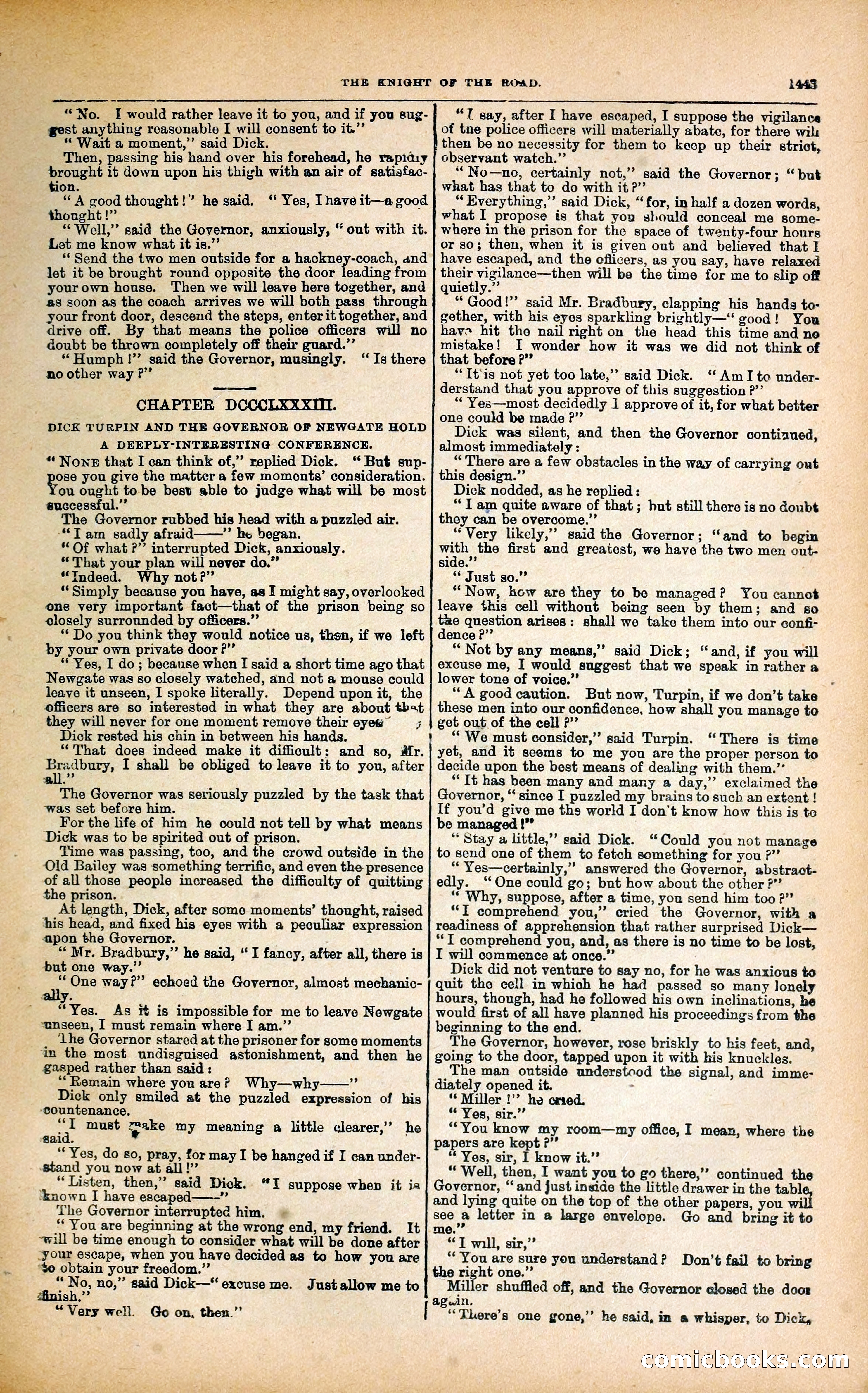
A restored page from Penny Dreadfuls, 1866. Page through the whole issue in the reader above.
📄 Transcribed text from this page (OCR, searchable)
Machine-transcribed from the original scan — historical spelling and the odd misread are preserved.
THE ENIGHT ‘““No. I would rather leave it to you, and if you eug- gest anything reasonable I will consent to it.”’ * Wait a moment,”’ said Dick. Then, passing his hand over his forehead, he rapidiy brought it down upon his thigh with an air of satisfac- tion. “A good thought!” he said. thonght !” the fat ‘Well,’ said the Governor, anxiously, “ out with it. Let me know what it is.” “Send the two men outside for a hackney-coach, and let it be brought round opposite the door leading from yourown house. Then we will leave here together, and #8 soon as the coach arrives we will both pass through your front door, descend the steps, enterit together, and drive off. By that means the police officers will no doubt be thrown completely off their guard.”’ ‘“ Humph!”’ said the Governor, musingly. ‘Is there no other way ?” CHAPTER DCCCLXXXITI. DICK TURPIN AND THE GOVERNOR OF NEWGATE HOLD A DEEPLY-INTERESTING CONFERENCE. “None that I can think of,” replied Dick. “But sup- ose you give the matter a few moments’ consideration. ou ought tobe best able to judge what will be most successful.” The Governor rubbed his head with a puzzled air. “Tam sadly afraid——”’ he began. “Of what ?” interrupted Dick, anxiously. ‘That your plan will never do.” “Indeed. Why not?” “Simply because you have, as I might say, overlooked one very important fact—that of the prison being so olosely surrounded by officers.”’ ** Do you think they would notice us, then, if we left by your own private door P”’ *“* Yes, I do ; because when I said a short time ago that Newgate was so closely watched, and not a mouse could leave it unseen, I spoke literally. Depend upon it, the officers are so interested in what they are about that they will never for one moment remove their eyew™ Dick rested his chin in between his hands. “That does indeed make it difficult: and so, wr. Bradbury, I shall be obliged to leave it to yon, after ‘all.’’ The Governor was seriously puzzled by the task that was set before him. For the life of him he could not tell by what means Dick was to be spirited out of prison. Time was passing, too, and the crowd outside in the Old Bailey was something terrific, and even the presence of all those people increased the difficulty of quitting the prison. | At length, Dick, after some moments’ thought, raised his head, and fixed his eyes with a peculiar expression apon the Governor. “Mr. Bradbury,” he said, “I fancy, after all, there is but one way.’’ eS One way?” echoed the Governor, almost mechanic- * Yes, [have it—a good 2 | ' y. “Yes. As it is impossible for me to leave Newgate ‘Tnseen, I must remain where I am.”’ ‘Lhe Governor stared at the prisoner for some moments am the most undisgnuised astonishment, and then he gasped rather than said: ‘Remain where you are? Why—why Dick only smiled at the puzzled expression of his ‘countenance. “I must make my meaning a little clearer,’ he said. ¥ | “Yes, do 80, pray, formay I be hanged if I can under- stand you now at all!” “Listen, then,” said Dick. ‘-known I have escaped——~” The Governor interrupted him. ‘You are beginning at the wrong end, my friend. It will be time enough to consider what will be done after your escape, when you have decided as to how you are ‘So obtain your freedom.” “No, no,”’ said Dick—“ excuse me. finish.”’ “Very well. Go on, then.”’ 9? “I suppose when it ia r Just allow me to OF THE ROMD. 1445 “T{ say, after I have escaped, I suppose the vigilance of tne police officers will materially abate, for there wil: then be no necessity for them to keep up their strict, observant watch.”’ ‘““No—no, certainly not,” said the Governor; “but what has that to do with it?” “Everything,” said Dick, “for, in half a dozen words, what I propose is that you should conceal me some- where in the prison for the space of twenty-four hours or so; then, when it is given out and believed that I have escaped, and the eflicers, as you say, have relaxed their vigilance—then will be the time for me to slip off quietly.”’ ““ Good!” said Mr. Bradbury, clapping his hands to- gether, with his eyes sparkling brightly—“ good! You have hit the nail right on the head this time and ne mistake! I wonder how it was we did not think of that before P” “It'is not yet too late,’ said Dick. ‘“ AmI to under- derstand that you approve of this suggestion ?”’ ““ Yes—most decidedly 1 approve of it, for what better one could be made ?”’ Dick was silent, and then the Governor continued, almost immediately : “There are a few obstacles in the way of carrying out this design.”’ Dick nodded, as he replied: “I am quite aware of that; hut still there is no doubt they can be overcome.”’ “Very likely,” said the Governor; “and to begin ae the first and greatest, we have the two men out- side.” ** Just so.” “Now, how are they to be managed? ‘You cannot leave this cell without being seen by them; and so tae question arises: shall we take them into our confi- dence ?”’ “Not by any means,” said Dick; “and, if you will excuse me, I would suggest that we speak in rather a lower tone of voice.” ““A good caution. But now, Turpin, if we don’t take these men into our confidence, how shall you manage to get out of the cell ?”’ ‘We must consider,’”’ said Turpin. “There is time yet, and it seems to me you are the proper person to decide upon the best means of dealing with them.” “It has been many and many a day,’’ exclaimed the Governor, “since I puzzled my brains to such an extent ! If you’d give me ths world I don’t know how this is te be managed !”” Stay a little,” said Dick. “Could you not manage to send one of them to fetch something for you ?” ** Yes—certainly,” answered the Governor, abstract- edly. ‘One could go; but how about the other ?” “« Why, suppose, after a time, you send him too ?” “I comprehend you,” cried the Governor, with a readiness of apprehension that rather surprised Dick— ‘I comprehend you, and, as there is no time to be lost, IT will commence at once.” Dick did not venture to say no, for he was anxious to quit the cell in which he had passed so many lonely hours, though, had he followed his own inclinations, he would first of all have planned his proceedings from the beginning to the end. The Governor, however, rose briskly to his feet, and, going to the door, tapped upon it with his knuckles. The man outside understood the signal, and imme- diately opened it. “ Miller !”’ he omed. “ Yes, sir.’ “You know my room—my office, I mean, where the papers are kept ?”’ “* Yes, sir, I know it.’’ “Well, then, I want you to go there,’”’ continued the Governor, “and just inside the little drawer in the tabl and lying quite on the top of the other papers, you wi see a letter in a large envelope. Go and bring it to me.’ “T will, sir,”’ “You are sure you understand? Don’t fail to bring the right one.”’ Miller shuffled off, and the Governor closed the door aguwin. ‘““Zkere’s one gone,” he said, in a whisper, to Dick, MiIiGDdOOKS).GO () (E(@)