
Penny Dreadfuls, 1866 · page 168 of 395
Black Bess; or, the Knight of the Road — page 168: what you’re looking at
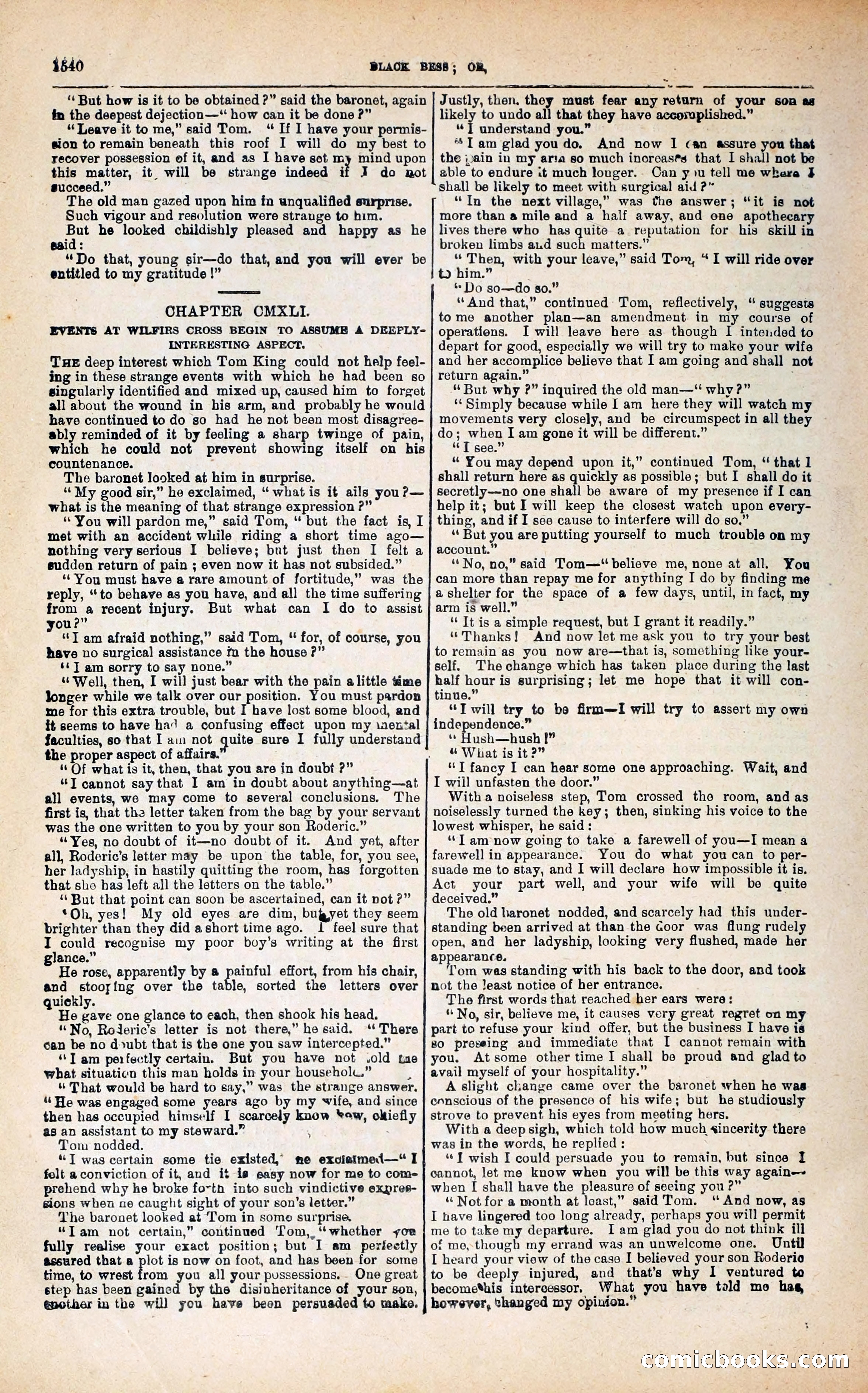
A restored page from Penny Dreadfuls, 1866. Page through the whole issue in the reader above.
📄 Transcribed text from this page (OCR, searchable)
Machine-transcribed from the original scan — historical spelling and the odd misread are preserved.
1540 “But how is it to be obtained ?” said the baronet, again in the deepest dejection—" how can it be done ?” “Leave it to me,” said Tom. “ If I have your permis- sion to remain beneath this roof I will do my best to recover possession of it, and as I have set my mind upon this matter, it will be strange indeed i? I do not succeed.” The old man gazed upon him fn unqualified surprise. Such vigour and resolution were strange to him. pe he looked childishly pleased and happy as he @aid : “Do that, young sir—do that, and you will ever be entitled to my gratitude !” CHAPTER CMXLI. EVENTS AT WILFIRS CROSS BEGIN TO ASSUME A DEEPLY- INTERESTING ASPECT. THE deep interest which Tom King could not help feel- ing in these strange events with which he had been so singularly identified and mixed up, caused him to forget all about the wound in his arm, and probably he would have continued to do so had he not been most disagree- ably reminded of it by feeling a sharp twinge of pain, which he could not prevent showing itself on his countenance. | The baronet looked at him in surprise. ‘“‘ My good sir,” he exclaimed, “ whatis it ails you?— what is the meaning of that strange expression ?” ‘You will pardon me,” said Tom, “ but the fact is, I met with an accident while riding a short time ago— nothing very serious I believe; but just then I felt a eudden return of pain ; even now it has not subsided.” ‘You must have a rare amount of fortitude,” was the reply, ‘‘to behave as you have, and all the time suffering from a recent injury. But what can I do to assist ou?” f ‘'T am afraid nothing,” said Tom, “ for, of course, you have no surgical assistance m the house ?” ‘¢] am sorry to say none.” ‘Well, then, I will just bear with the pain alittle ime longer while we talk over our position. You must pardon me for this extra trouble, but I have lost some blood, and it seems to have ha’ a confusing effect upon my wental faculties, so that I ai not quite sure I fully understand the proper aspect of affairs. ‘Of what is it, then, that you are in doubt ?” “T cannot say that I am in doubt about anything—at all events, we may come to several conclusions. The first is, that the letter taken from the bag by your servant was the one written to you by your son Roderic.” ‘Yes, no doubt of it—no doubt of it. And yet, after all, Roderic’s letter may be upon the table, for, you see, her ladyship, in hastily quitting the room, has forgotten that she has left all the letters on the table.” ‘But that point can soon be ascertained, can it not ?” *Oh, yes! My old eyes are dim, bugyet they seem brighter than they did ashort time ago. 1 feel sure that I could recognise my poor boy’s writing at the first glance.” He rose, apparently by a painful effort, from his chair, and stooying over the table, sorted the letters over quickly. He gave one glance to each, then shook his head, “No, Roderic’s letter is not there,” he said. “ There can be no doubt that is the one you saw intercepted.” ‘‘T am perfectly certain. But you have not .old tae what situaticn this man holds in your householc.” ; ‘ That would be hard to say,” was the strange answer. ‘He was engaged some years ago by my wife, and since then has occupied himself I scarcely know *ow, oltiefly as an assistant to my steward.” , Tom nodded. «7 was certain some tie existed, ne excieimeai—“ I felt a conviction of it, and it is easy now for me to com- prehend why he broke forth into such vindictive expres- sions when ne caught sight of your son’s letter.” The baronet looked at Tom in some surprise, “Tam not certain,” continued Tom, ‘whether vow fully realise your exact position; but I am _ perfectly assured that a plot is now on foot, and has been for some time, to wrest from you all your pussessions.. One great step has been gained by the disinheritance of your son, enother in the will you have been persuaded to make. -~ ¥ f bac! dans “= oe et - <i? 4; BLACK BESS; OR, — Justly, then, they must fear any return of your son as likely to undo all that they have accosuplished.” “] understand you.” “Tam glad youdo. And now I can assure yon that the ain in my arta s0 much increasé@s that I shall not be able to endure .t much longer. Can yu tell me whera J shall be likely to meet with surgical aid ?” “In the next village,” was the answer; “it is not more than a mile and a half away, and one apothecary lives there who has quite a reputation for his skill in broken limbs aud such matters.” ‘Then, with your leave,” said Tom, “I will ride over t) him.” ** Do so—do so.” “And that,” continued Tom, reflectively, “ suggests tome another plan—an amendment in my course of operations. I will leave here as though I intended to depart for good, especially we will try to make your wife and her accomplice believe that I am going and shall not return again.” “But why ?” inquired the old man—“ why?” ‘Simply because while I am here they will watch my movements very closely, and be circumspect in all they do; when I am gone it will be different.” “T see.” “ You may depend upon it,” continued Tom, “ that 1 shall return here as quickly as possible; but I shall do it secretly—no one shall be aware of my presence if I can help it; but I will keep the closest watch upon every- thing, and if I see cause to interfere will do so.” ‘But you are putting yourself to much trouble on my account.” ‘‘No, no,” said Tom—*“ believe me, none at all. You can more than repay me for anything I do by finding me a shelter for the space of a few days, until, in fact, my arm is well.” ‘“‘ It is a simple request, but I grant it readily.” “Thanks! And now let me ask you to try your best to remain as you now are—that is, something like your- self. The change which has taken place during the last half hour is surprising; let me hope that it will con- tinue.” “Twill try to be firm—I will try to assert my own independence.” | ‘* Hush—hush |” What is it 2” ‘“‘T fancy I can hear some one approaching. Wait, and I wiil unfasten the door.” With a noiseless step, Tom crossed the room, and as noiselessly turned the key; then, sinking his voice to the lowest whisper, he said: ‘“‘T am now going to take a farewell of you—I mean a farewell in appearance. You do what you can to per- suade me to stay, and I will declare how impossible it is. Act your part well, and your wife will be quite deceived.” 3 The old baronet nodded, and scarcely had this under- standing been arrived at than the coor was flung rudely open, and her ladyship, looking very flushed, made her appearance. fom was standing with his back to the door, and took not the least notice of her entrance. The first words that reached her ears were: ‘No, sir, believe me, it causes very great regret on my part to refuse your kind offer, but the business I have is so pressing and immediate that [ cannot remain with you. Atsome other time I shall be proud and glad to avail myself of your hospitality.” A slight change came over the baronet when he was conscious of the presence of his wife; but he studiously strove to prevent his eyes from meeting hers. With a deep sigh, which told how much 4incerity there was in the words, he replied : ‘I wish I could persuade you to remain, but since J cannot, let me know when you will be this way again-~ when I shall have the pleasure of seeing you ?” ‘‘ Not for a month at least,” said Tom. ‘ And now, as I have lingered too long already, perhaps you will permit me to take my departure. I am glad you do not think ill of me, though my errand was an unwelcome one. Until I heard your view of the case I believed your son Roderio to be deeply injured, and that’s why I ventured to become*his intercessor. What you have tald me hag however, thanged my opinion.” JOOKS @ (ECO) AMC (E(o)