
Penny Dreadfuls, 1866 · page 289 of 395
Black Bess; or, the Knight of the Road — page 289: what you’re looking at
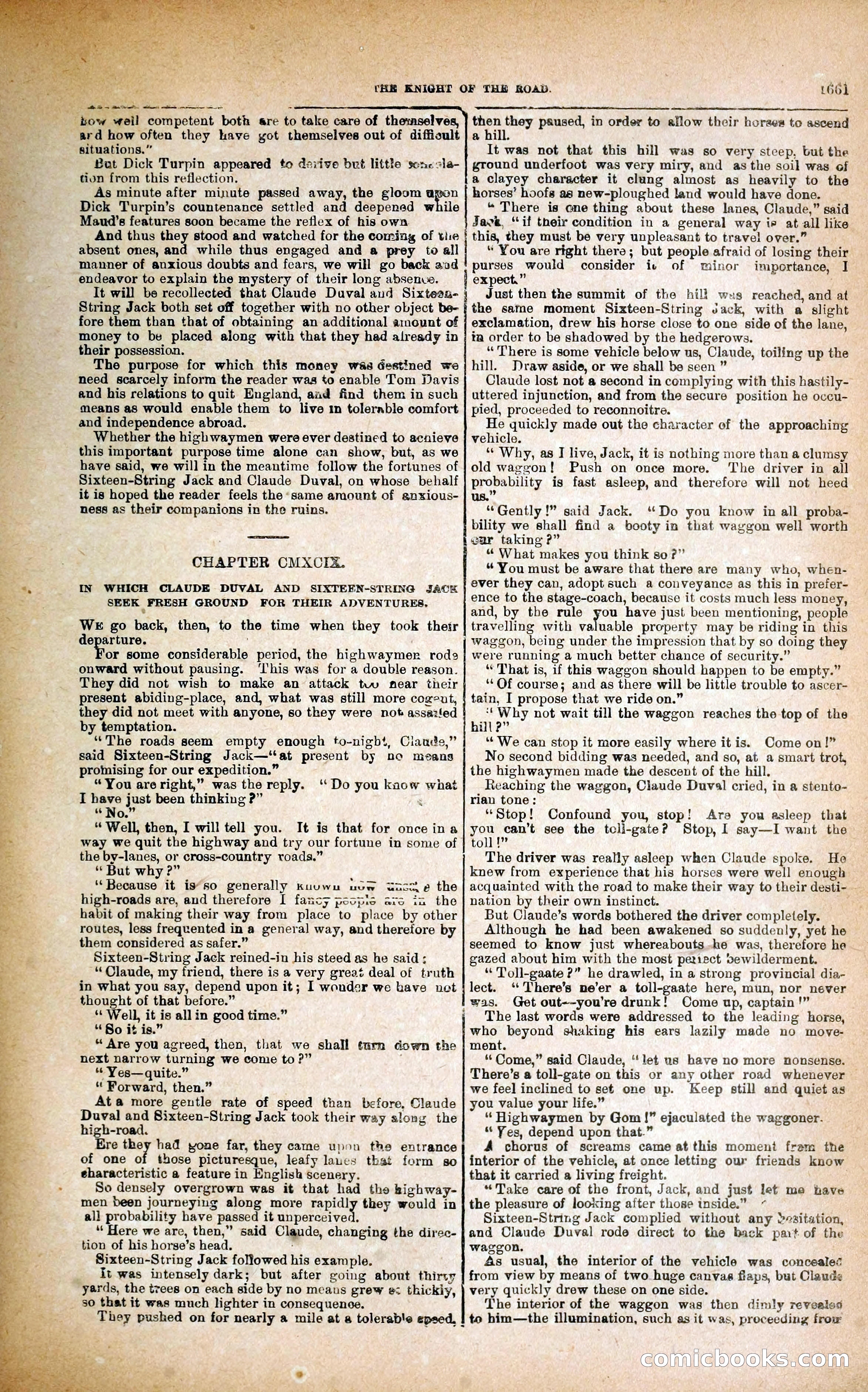
A restored page from Penny Dreadfuls, 1866. Page through the whole issue in the reader above.
📄 Transcribed text from this page (OCR, searchable)
Machine-transcribed from the original scan — historical spelling and the odd misread are preserved.
ed «. ‘Y ard how often they have got themselves out of difficult situations.” But Dick Turpin appeared to deiive but little sence sla- tion from this reflection. As minute after minute passed away, the gloom Bpon ile Dick Turpin’s countenance settled and deepened w Maud’s features soon became the reflex of his own And thus they stood and watched for the coming of the absent ones, and while thus engaged and a prey to all manner of anxious doubts and fears, we will go back aud endeavor to explain the mystery of their long absenve. It will be recollected that Claude Duval and Sixtean- String Jack both set off together with no other object be- fore them than that of obtaining an additional amount of money to be placed along with that they had already in their possession. The purpose for which this money was destined we need scarcely inform the reader was to enable Tom Davis end his relations to quit England, and find them in such means as would enable them to live in tolerable comfort and independence abroad. Whether the highwaymen were ever destined to acnieve this important purpose time alone can show, but, as we have said, we will in the meantime follow the fortunes of Sixteen-String Jack and Claude Duval, on whose behalf it is hoped the reader feels the ‘same amount of anxious- ness as their companions in the ruins. CHAPTER CMXCI&. IN WHICH CLAUDE DUVAL AND SIXTEEFN-STRING JACEK SEEK FRESH GROUND FOR THEIR ADVENTURES, WE go back, then, to the time when they took thetr departure. : : or some considerable period, the highwaymer rods onward without pausing. ‘l'his was fora double reason. They did not wish to make an attack tw near their present abiding-place, and, what was still more cog-ut, they did not meet with anyone, so they were not assailed by temptation. ‘The roads seem empty enough to-nigbt, Claude,” said Sixteen-String Jack—“‘at present by no means promising for our expedition.” “You are right,” was the reply. I have just been thinking ?” “ No.” “ Well, then, I will tell you. It is that for onceina way we quit the highway and try our fortune in some of the by-lanes, or cross-country roads.” “ But why ?” ‘Because it is’so generally Kuuwu uve ucne the high-roads are, and therefore I fancy poopis ars in the habit of making their way from place to place by other routes, less frequented in a general way, and theretore by them considered as safer.” Sixteen-String Jack reined-in his steed as he said; “Claude, my friend, there is a very great deal of truth in what you say, depend upon it; I wonder we lave not thought of that before.” “ Well, it is allin good time.” “So it is.” “ Are you agreed, then, that we shall turn down the next narrow turning we come to ?” * Yes—quite.” “ Forward, then.” Ata more gentle rate of speed than before, Claude Duval and Sixteen-String Jack took their way slong the high-road. Ere they had yone far, they came upon the entrance of one of those picturesque, leafy laues that form so eharacteristic a feature in English scenery. So densely overgrown was it that had tho kighway- men been journeying along more rapidly they would in all probability have passed it ihipevatrer: ‘“‘ Here we are, then,” tion of his horse’s head. Sixteen-String Jack followed his example. | _ it was intensely dark; but after going about thirty yards, the trees on each side by no means grew e: thickiy, “Do you know what aa ed said Claude, changing the direc- _ so that it was much lighter in consequence. They pushed on for nearly a mile at a tolerable epsed, - % - _» — * al —. ~ + >. wy * * es? a 7 as 5 4 ‘ - an ~~. & > — «i he Ne i es. ov Ne NE OR tre ate AO ee Re re be SP RE Ee airt a 166] re they paused, in order to allow their horses to ascend a hill. It was not that this hill was so very steep, but the ground underfoot was very miry, and asthe soil was of a clayey character it clung almost as heavily to the horses’ hoofs as new-ploughed land would have done. “ There is one thing about these lanes, Claude,” said Jase, “if their condition in a general way iv at all like this, they must be very unpleasant to travel over.” “ You are right there; but people afraid of losing their purses would consider iv of minor importance, IJ expect.” Just then the summit of the hill wus reached, and at the same moment Sixteen-String Jack, with a slight exclamation, drew his horse close to one side of the lane, ta order to be shadowed by the hedgerows. “There is some vehicle below us, Claude, toiling up the hill. Draw aside, or we shall be seen ” Claude lost not a second in complying with this hastily- uttered injunction, and from the secure position he occu- pied, proceeded to reconnoitre. He quickly made out the character of the approaching vehicle. ‘Why, as I live, Jack, it is nothing more than a clumsy old waggon! Push on once more. ‘The driver in all probability is fast asleep, and therefore will not heed us.’ “Gently!” said Jack. ‘Do you know in all proba- bility we shall find a booty in that waggon well worth ear taking ?” “What makes you think so?” “You must be aware that there are many who, when- ever they can, adopt such a conveyance as this in prefer- ence to the stage-coach, because it costs much less money, and, by the rule you have just been mentioning, people travelling with valuable property may be riding in this waggon, being under the impression that by so doing they were running a much better chance of security.” “That is, if this waggon should happen to be empty.” “Of course; and as there will be little trouble to ascer- tain, I propose that we ride on.” ‘ ‘‘Why not wait till the waggon reaches the top of the il?” ‘We can stop it more easily where itis. Come on!” No second bidding was needed, and so, at a smart trot, the highwaymen made the descent of the hill. Reaching the waggon, Claude Duval cried, in a stento- rian tone: “Stop! Confound you, stop! Ara you asleep that you can’t see the tcli-gate? Stop, I say—I want the toll!” . The driver was really asleep when Claude spoke. He knew from experience that his horses were well enough acquainted with the road to make their way to their desti- — nation by their own instinct. | But Claude’s words bothered the driver completely. Although he had been awakened so suddenly, yet he seemed to know just whereabouts.he was, therefore ha gazed about him with the most periect Sewilderment. “ Toll-gaate ?” he drawled, in a strong provincial dia- lect. ‘There's ne’er a toll-gaate here, mun, nor never was. Get out--you’re drunk! Come up, captain!” The last words were addressed to the leading horse, who beyond shaking his ears lazily made no move- ment. “Come,” said Claude, ‘let us have no more nonsense. There’s a toll-gate on this or any other road whenever — we feel inclined to set one up. Keep still and quiet as you value your life.” “Highwaymen by Gom!” ejaculated the waggoner-. “Yes, depend upon that.” A chorus of screams came at this moment fram the interior of the vehicle, at once letting ow friends know that it carried a living freight. | “Take care of the front, Jack, and just let me have the pleasure of looxing after those inside.” < Sixteen-String Jack complied without any >2itation, and Claude Duval rode direct to the back part of the waggon. As usual, the interior of the vehicle was conceale? from view by means of two huge canvae flaps, but Claude very quickly drew these on one side. The interior of the waggon was then dimly revealed to him—the illumination, such as it was, proceeding frow EGomichboo SS) com 7 _ ees ee. ae