
Penny Dreadfuls, 1866 · page 166 of 395
Black Bess; or, the Knight of the Road — page 166: what you’re looking at
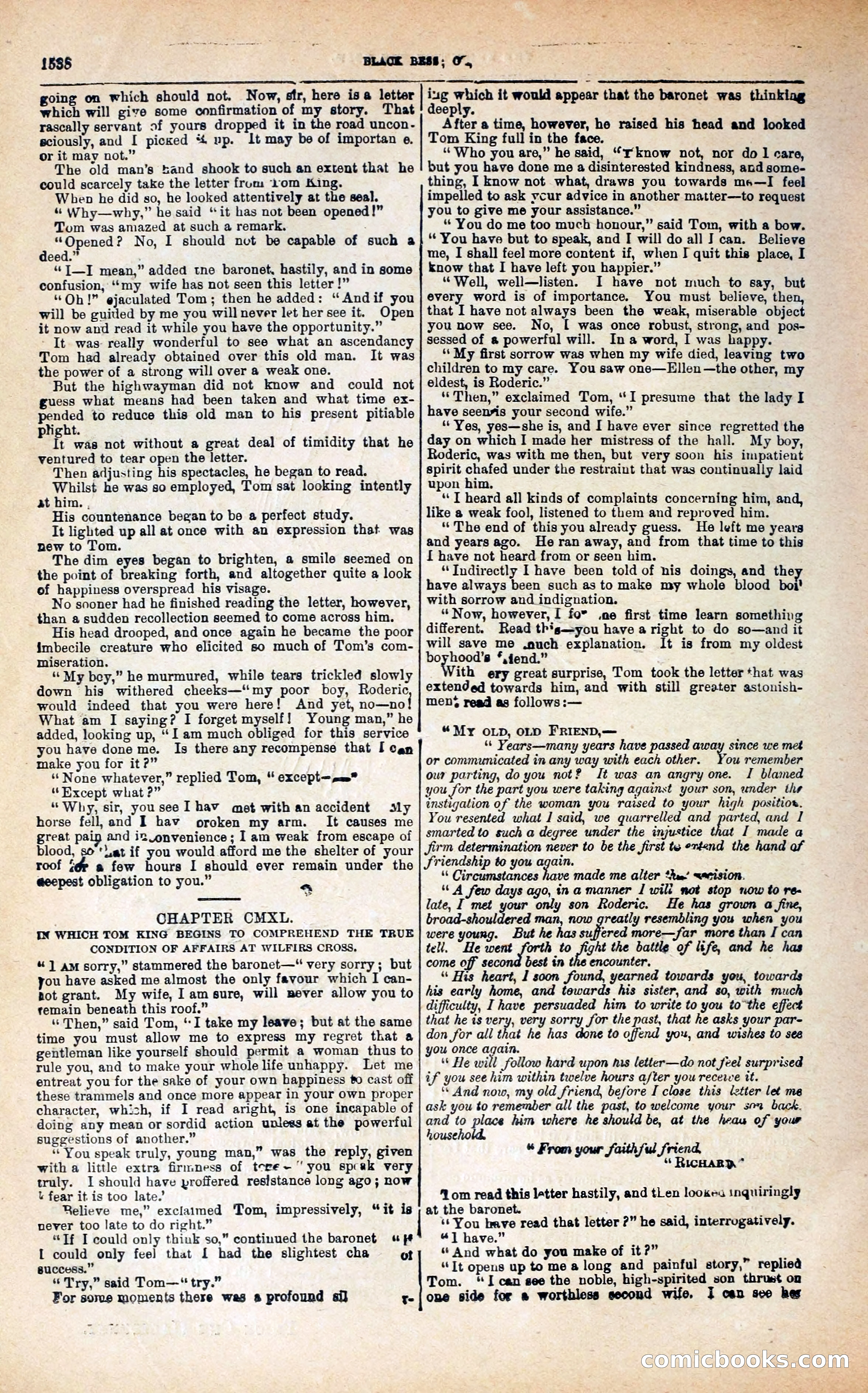
A restored page from Penny Dreadfuls, 1866. Page through the whole issue in the reader above.
📄 Transcribed text from this page (OCR, searchable)
Machine-transcribed from the original scan — historical spelling and the odd misread are preserved.
1585 BLACK BESS: 0, going on which should not. Now, str, here isa letter | iug which it would appear that the baronet was thinking which will give some confirmation of my story. That | deeply. rascally servant of yours dropped it in the road uncon- After a time, however, he raised his head and looked sciously, and [ picked *% up. It may be of importan e. | Tom King full in the face. or it may not.” “Who you are,” he said, “r'know not, nor do 1 care, The old man’s and shook to such an extent that he | but you have done me a disinterested kindness, and some- could scarcely take the letter frum om King. Wheop he did so, he looked attentively at the seal. “ Why—why,” he said “it has not bean opened!” Tom was amazed at such a remark. : “Opened? No, I should not be capable of such a deed.” | ‘‘7_T mean,” added tne baronet, hastily, and in some confusion, ‘‘my wife has not seen this letter!” “Oh!” ejaculated Tom; then he added: “Andif you will be guided by me you will never let her see it. Open it now and read it while you have the opportunity.” - It was really wonderful to see what an ascendancy Tom had already obtained over this old man. It was the power of a strong will over a weak one. But the highwayman did not know and could not guess what means had been taken and what time ex- pended to reduce this old man to his present pitiable light. - it was not without a great deal of timidity that he ventured to tear open the letter. Then adjusting his spectacles, he began to read. Whilst he was so employed, Tom sat looking intently at him. . His countenance began to be a perfect study. It lighted up all at once with an expression that was new to Tom. The dim eyes began to brighten, a smile seemed on the point of breaking forth, and altogether quite a look of happiness overspread his visage. No sooner had he finished reading the letter, however, than a sudden recollection seemed to come across him. His head drooped, and once again he became the poor imbecile creature who elicited so much of Tom’s com- miseration. “My bey,” he murmured, while tears trickled slowly down his withered cheeks—“‘my poor boy, Roderic would indeed that you were here! And yet, no—no! What am I saying? I forget myself! Young man,” he added, looking up, “I am much obliged for this service you have done me. Is there any recompense that I can - make you for it?” ‘None whatever,” replied Tom, “ except—.-_* “Except what ?” “Why, sir, youseeI hav met with an accident My horse fell,and I hav oroken my arm. It causes me great pain and iz onvenience; I am weak from escape of blood, so''.at if you would afford me the shelter of your roof fdr a few hours I should ever remain under the @eepest obligation to you.” ra 5> CHAPTER CMXL. IN WHICH TOM KING BEGINS TO COMPREHEND THE TRUE CONDITION OF AFFAIRS AT WILFIRS CROSS, «“ ] am sorry,” stammered the baronet—“ very sorry; but you have asked me almost the only favour which I can- bot grant. My wife, 1 am sure, will sever allow you to remain beneath this roof.” “ Then,” said Tom, ‘I take my leave; but at the same time you must allow me to express my regret that a gentleman like yourself should permit a woman thus to rule you, and to make your whole life unhappy. Let me entreat you for the sake of your own happiness to cast off these trammels and once more appear in your Own proper character, which, if I read aright, is one incapable of doing any mean or sordid action unless at the powerful suggestions of another.” “You speak truly, young man,” was the reply, given with a little extra firmness of tere~ “you spcak very truly. I should have proffered resistance long ago; now « fear it is too late.’ Relieve me,” exclaimed Tom, impressively, “it is never too late to do right.” “Tf I could only thiuk so,” continued the baronet « # I could only fee) that I had the slightest cha ot success.” “Try,” said Tom—‘ try.” For some moments there was s profound sil ~- ms thing, I know not what, draws you towards ms—I feel impelled to ask ycur advice in another matter—to request you to give me your assistance.” * You do me too much honour,” said Tom, with a bow. ‘You have but to speak, and I will do all J can. Believe me, I shall feel more content if, when I quit this place, I know that I have left you happier.” “Well, well—listen. I have not much to say, but every word is of importance. You must believe, then, that I have not always been the weak, miserable object you now see. No, [I was once robust, strong, and pos- sessed of a powerful will. Ina word, I was happy. ‘* My first sorrow was when my wife died, leaving two children to my care. You saw one—Ellen—the other, my eldest, is Roderic.” “Then,” exclaimed Tom, “I presume that the lady I have seenvis your second wife.” “Yes, yes—she is, and I have ever since regretted the day on which I made her mistress of the hall. My boy, Roderic, was with me then, but very soon his impatient spirit chafed under the restraint that was continually laid upon him. ‘“T heard all kinds of complaints concerning him, and, like a weak fool, listened to them and reproved him. “The end of this you already guess. He left me years and years ago. He ran away, and from that time to this { have not heard from or seen him. “Indirectly I have been told of nis doings, and the have always been such as to make my whole blood boi! with sorrow and indignation. ‘Now, however, [ for .ne first time learn something different. Read th*g—you have aright to do so—and it will save me .nuch explanation. It is from my oldest boyhood’s *,fend.” Vith ery great surprise, Tom took the letter that was extended towards him, and with still greater astonish- mens read as follows :— “My OLD, OLD FRIEND,— “© Years—many years have passed away since we met or communicated in any way with each other. You remember our parting, do you not? It was an angry one. I blamed you for the part you were taking against your son, under the instigation of the woman you raised to your high positior. You resented what I said, we quarrelled and parted, and I smarted to such a degree under the injustice I made a Jirm determination never to be the first te ertend the hand of Sriendship to you again. “« Circumstances have made me alter *hw’ ~eision. “4 few days ago, ina manner I wilt not stop now to re- late, I met your only son Roderic. He has grown a fine, broad-shouldered man, now greatly resembling you when you were young. But he has suffered more—far more than I can tel’. He went forth to pg the battle of life, and he has come off se best tn the encounter. | “ His heart, 1 soon found, yearned towards you, towards his early home, and tewards his sister, and so, with much difficulty, I have persuaded him to write to you to the effect that he is very, very sorry for the past, that he asks your par- don for all that he has done to offend you, and wishes to see you once again. “« He will follow hard upon his letter—do not feel surprised if you see him within twelve hours after you recewe tt. “ And now, my old friend, before I close this letter let me ask you to remember all the past, to welcome your sox back. and to place him where he should be, at the heau of your household. “« From your faithful friend, ‘“‘ RICHARD” fl om read this letter hastily, and tLen lookes inquiringly at the baronet. ins ‘‘ You bave read that letter ?” he said, interrogatively. “1 have.” “And what do you make of it?” “It opens up to me a long and painful story,” replied Tom. ‘I can see the noble, high-spirited son thrust on y- {one side for » worthless second wife. I can see hes Eomicdooks (E(o)