
Penny Dreadfuls, 1866 · page 123 of 395
Black Bess; or, the Knight of the Road — page 123: what you’re looking at
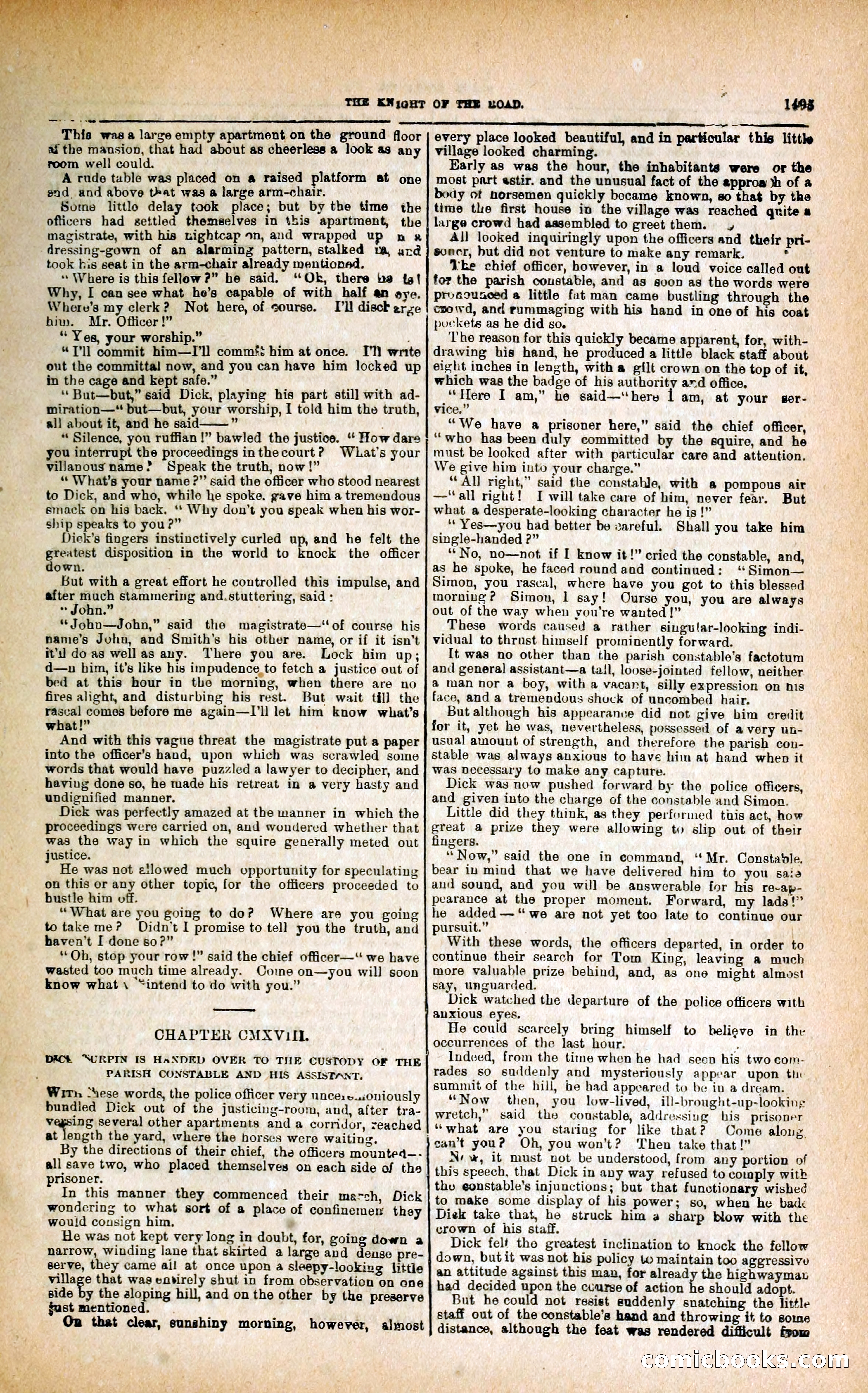
A restored page from Penny Dreadfuls, 1866. Page through the whole issue in the reader above.
📄 Transcribed text from this page (OCR, searchable)
Machine-transcribed from the original scan — historical spelling and the odd misread are preserved.
’ = Ry tod tray : é * ’ + f to Te |; +. s 2 A > te) eis Me { yf Pr So at Ny a " / ey wa we b." ‘ yay ey 7 Bed * ¥. Pet aA hl *. > ‘ A rs ae “ .. - f J ‘ ; » a A ate ,* y,! Ed > <ae - This wasa large empty apartment on the ground floor - ~~ e af the mansion, that had about as cheerless a look as any room well could. A rude table was placed on a raised platform at one sad and above that was a large arm-chalr. Some little delay took place; but by the time the ofticers had settled themselves in this apartment, the magistrate, with his nightcap on, and wrapped up n 2 -dressing-gown of an alarming pattern, stalked ww, ard took kis seat in the arm-chair already mentioned. * Where is this fellow?” he said. ‘Ok, there ba tg! Why, I can see what he’s capable of with half an oye. Where’s my clerk? Not here, of course. I'll disck ere him. Mr. Officer!” “Yes, your worship.” * I'll commit him—T'l commé: him at once. I'll write out the committal now, and you can have him locked up in the cage and kept safe.” : atin ‘“ But—but,” said Dick, playing his part still with ad- miration—“ but—but, your worship, I told him the truth, all about it, and he said——” . * Silence, you ruffian!” bawled the justice. “ How dare you interrupt the proceedings inthecourt? What's your villanous name? Speak the truth, now!” “ What’s your name ?”’ said the officer who stood nearest to Dick, and who, while he spoke. gave him a tremendous smack on his back. ‘* Why don’t you speak when his wor- ship speaks to you ?” Dick’s fingers instinctively curled up, and he felt the greatest disposition in the world to knock the officer down. But with a great effort he controlled this impulse, and after much stammering and.stuttering, said : » John.” “ John—John,” said the magistrate—of course his name’s John, and Smith's his other name, or if it isn't it’s] do as well as any. There you are. Lock him up; d—n him, it’s like his impudence_to fetch a justice out of bed at this hour in the morning, when there are no fires alight, and disturbing his rest. But wait till the rascal comes before me again—lI’ll let him know what’s what!” And with this vague threat the magistrate put a paper into the officer’s hand, upon which was scrawled some words that would have puzzled a lawyer to decipher, and having done so, he made his retreat in a very hasty and undignified manner. Dick was perfectly amazed at the manner in which the proceedings were carried on, aud wondered whether that was the way in which the squire generally meted out justice. He was not e!lowed much opportunity for speculating on this or any other topic, for the officers proceeded to bustle him off. “What are you going to do? Where are you going to take me? Didn't I promise to tell you the truth, and haven't I done 80?” “Oh, stop your row!” said the chief officer—“ we have wasted too much time already. Come on—you will soon Know what. “intend to do with you.” CHAPTER CMXVIi1IIL. DACK SURPIN IS HaNDED OVER TO TIIE CUSTODY OF THE PARISH CONSTABLE AND HIS ASSISTANT, Witn “hese words, the police officer very unces v.iOniously bundied Dick out of the justicing-room, and, after tra- vegsing several other apartments and a corridor, veached at length the yard, where the horses were waiting. By the directions of their chief, the officers mounted—- all save two, who placed themselves on each side of tha prisoner. In this manner they commenced their march, Dick wondering to what sort of a place of confinemer they would consign him. ’ He was not kept very long in doubt, for, going down a narrow, winding lane that skirted a large and deuse pre- serve, they came ail at once upon a sleepy-looking little village that was eavirely shut in from observation on one side by the sloping hill, and on the other by the preserve fast mentioned. . that clear, sunshiny morning, however, almost Py Fads THE KNIGHT OF THE LOAD, |\‘“‘what are you staring for like that? ROLAND RCT ODE LS TON AONE RA At ies aR ty ray nie 1495 every place looked beautiful, and in particular this little village looked charming. Early as was the hour, the inhabitants were or the most part estir. and the unusual fact of the approa wh of a body of horsemen quickly became known, so that by the time the first house in the village was reached quite s large crowd had assembled to greet them. | All looked inquiringly upon the officers and their pri- soncr, but did not venture to make any remark. ‘ Ike chief officer, however, in a loud voice called out for the parish constable, and as soon as the words were prosounced a little fat man came bustling through the csowd, and rummaging with his hand in one of his coat puckets as he did so. The reason for this quickly became apparent, for, with- drawing his hand, he produced a little black staff about eight inches in length, with a gilt crown on the top of it, which was the badge of his authority and office. ‘Here I am,” he said—‘there 1 am, at your sger- vice,” “We have a prisoner here,” said the chief officer, “who has been duly committed by the squire, and he must be looked after with particular care and attention. We give him into your charge.” “All right,” said the constable, with a pompous air —all right! I will take care of him, never fear. But what a desperate-looking character he is !” ‘“'Yes—you had better be zareful. Shall you take him single-handed 2?” ‘No, no—not if I know it!” cried the constable, and, as he spoke, he faced round and continued: “Simon— Simon, you rascal, where have you got to this blessed morning? Simon, 1 say! Ourse you, you are always out of the way when you're wanted !” These words caused a rather singular-looking indi- vidual to thrust himself prominently forward. It was no other than the parish constable’s factotum and general assistant—a tail, loose-jointed fellow, neither a man nor a boy, with a vacant, silly expression on nis face, and a tremendous shuck of uncombed hair. But although his appearance did not give bim credit for it, yet he was, nevertheless, possessed of avery un- usual amount of strength, and therefore the parish con- stable was always anxious to have him at hand when it Was necessary to make any capture. Dick was now pushed forward by the police officers, and given into the charge of the constable and Simon. Little did they think, as they performed tiis act, how great a prize they were allowing to slip out of their fingers. “Now,” said the one in command, ‘Mr. Constable. bear in mind that we have delivered him to you saia and sound, and you will be answerable for his re-ap- pearance at the proper moment. Forward, my lada!” he added —‘“we are not yet too late to continue our pursuit.” | With these words, the officers departed, in order to continue their search for Tom King, leaving a much more valuable prize behind, and, as one might almost say, unguarded. Dick watched the departure of the police officers with anxious eyes. He could scarcely bring himself to believe in the occurrences of the last hour. 3 Indeed, from the time when he had seen his two com- rades so suddenly and mysteriously appear upon tin summit of the hill, be had appeared to be iv a dream. “Now then, you low-lived, ill-brought-up-looking wretch,” said the coustable, addressiug his prisoner Come along. can’t you? Oh, you won't? Then take that!” N/w, it must not be understood, from any portion of this speech, that Dick in any way refused to comply with tho eonstable's injunctions; but that functionary wished to make some display of his power; so, when he bad Diek take that, he struck him a sharp blow with the crown of his staff. Dick felt the greatest inclination to knock the fellow down, but it was not his policy to maintain too aggressive an attitude against this man, for already the highwayman had decided upon the curse of action he should adopt. But he could not resist euddenly snatching the little staff out of the constable’s hand and throwing it to some distance, although the feat was rendered difficult fom CORAIELOOC () CH7(EO) am