
Penny Dreadfuls, 1866 · page 7 of 395
Black Bess; or, the Knight of the Road — page 7: what you’re looking at
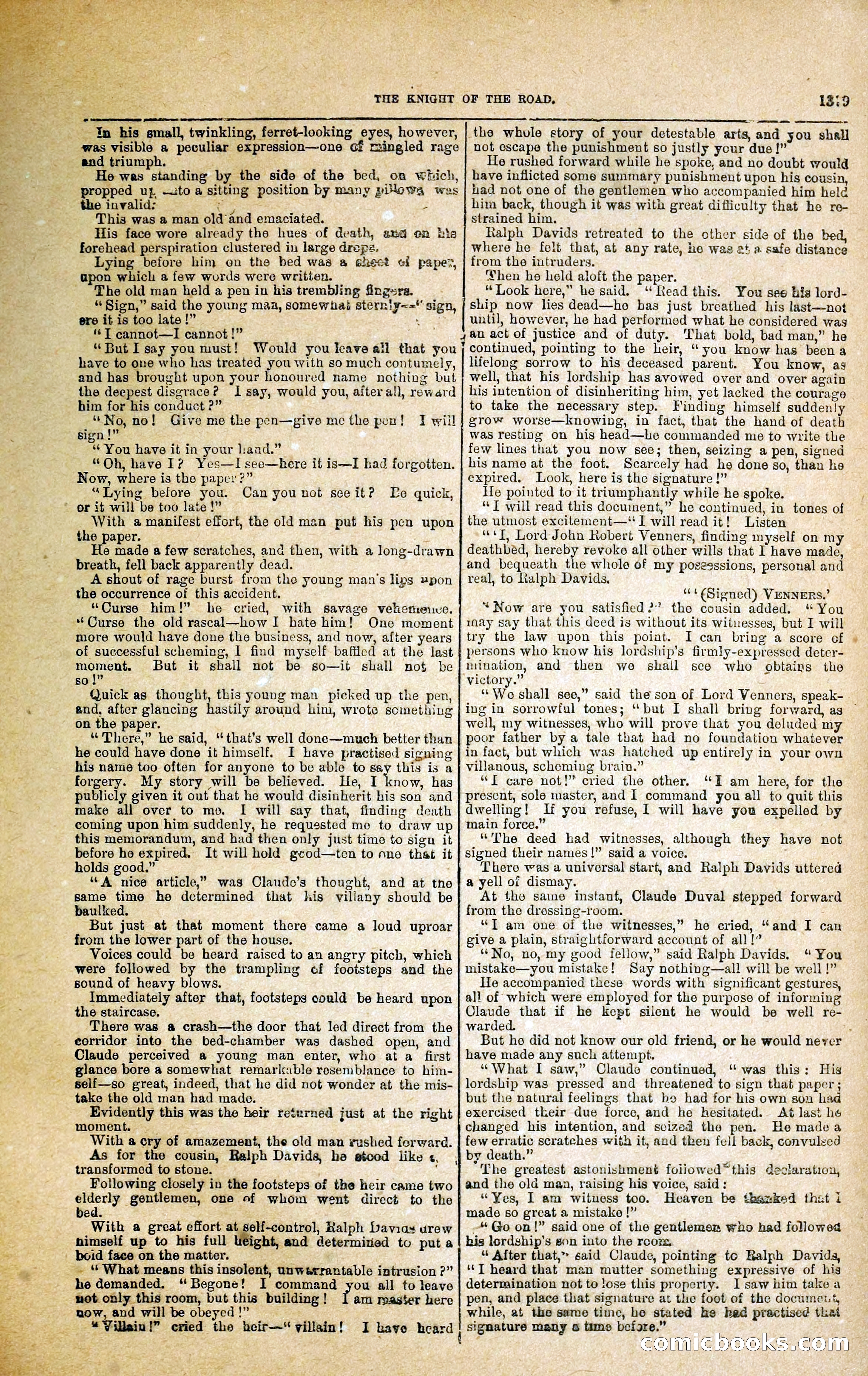
A restored page from Penny Dreadfuls, 1866. Page through the whole issue in the reader above.
📄 Transcribed text from this page (OCR, searchable)
Machine-transcribed from the original scan — historical spelling and the odd misread are preserved.
= Perdew A ae ee ; WG. 4 hs 3 ne é THE KNIGHT Tn his small, twinkling, ferret-looking eyes, however, _-—sawaas visible a peculiar expression—one Gf mingled rage a a eP? was standing by the sido of the bed, oa Which, propped uj -uto a sitting position by many pitowa wes “ » . ay Sees She invalids | : _ -~-———s s Phis was a man old and emaciated. a His face wore already the hues of death, ana on bis =e forehead perspiration clustered in large drops. ee Lying before him on the bed was a ghost oi paper, . upon which a few words were written. ses - ‘¥he old man held a pen in his trembjing Sngsrs. - “Sign,” said the young maa, somewhai sterniy~=""sign, or ere it is too late !” ee ti x —“*T cannot—I cannot!” Bact “But I say you must! Would you Icava all that you have to one who has treated you with so much contumely, and has brought upon your honoured name nothing but the deepest disgrace? IL say, would you, afterall, reward - him for his conduct 2?” “No, no! Give me the pen—give me the pen! I will sign!” iy “¢-You have it in your laad.” “Oh, have I? Yes—!see—here it is—I had forgotten. Now, where is the paper ?” “Lying before you. Can you not seeit? Loe quick, * or it will be too late !” _ With a manifest effort, the old man put his pen upon the paper. i He made a few scratches, and then, with a long-drawn breath, fell back apparently dead. A shout of rage burst from the young man’s lips upon the occurrence of this accident. “Curse him!” he cried, with savage vehemeuue. es “Curse the old rascal—how I hate him! One moment - more would have done the business, and now, after years of successful scheming, I find myself baffled at the last pa moment. But it shall not be so—it shall not be , so!” meh e Quick as thought, this young man picked up the pen, and, after glancing hastily around him, wrote scimething on the paper. “There,” he said, “that’s well done—much better than Bar EIAS he could have done it himself. I have practised signing his name too often for anyone to be able to say this is a forgery. My story will be believed. He, I know, has publicly given it out that he would disinherit his son and make all over to me. I will say that, finding death coming upon him suddenly, he requested me to draw up this memorandum, and had then only just time to sign it before he expired. It will hold geod—tcn to nno that it holds good.” “A nice article,” was Claude’s thought, and at the same time he determined that his villany should be baulled. But just at that moment there came a loud uproar from the lower part of the house. er ae Voices could be heard raised to an angry pitch, which Fe” yy were followed by the trampling cf footsteps and the | sound of heavy blows. Immediately after that, footsteps could be heard upon the staircase. There was a crash—the door that led direct from the epee corridor into the bed-chamber was dashed open, and ~~ ~Claude perceived a young man enter, who at a first =a glance bore a somewhat remark:ble resemblance to him- _ self—so great, indeed, that he did not wonder at the mis- take the old man had made. Evidently this was the heir returned just at the right moment. With a cry of amazement, the old man rushed ferward. As for the cousin, Ralph Davids, ha stood like «, transformed to stone. 3 Following closely in the footsteps of the heir came two Sra gentlemen, one of whom went direct to the be - With a great effort at self-control, Ralph bavias urew = himself up to his full ht, and determitied to puta eae _ boid face on the matter. | - _~ “What means this insolent, unwerrantable intrusion 2” ve he demanded. “Begone! I command you all to leave Tas) not only this room, but this building! I am master here now, and will be obeyed !” ie, PSST tS; ee “ - ~ ———— # Villain!” cried ‘the hoir—* villain! I Lave beard | ae OF THE ROAD, 13:9 Soe Nae toed - the whule story of your detestable arts, and you shall not escape the punishment so justly your due!” He rushed forward while he spoke, and no doubt would have inflicted some summary punishment upon his cousin, nad not one of the gentlemen who accompanied him held him back, though it was with great difliculty that he re- strained him. | Ralph Davids retreated to the other side of the bed, where he felt that, at any rate, he was at a safe distance from the intruders. hen he held aloft the paper. “Look here,” he said. ‘Read this. You sse his lord- ship now lies dead—he has just breathed his last—not until, however, he had performed what he considered wag 44n act of justice and of duty. That bold, bad man,” he ; continued, pointing to the heir, “you know has been a lifelong sorrow to his deceased parent. You know, as well, that his lordship has avowed over and over again his intention of disinheriting him, yet lacked the courage to take the necessary step. Finding himself suddenly grow worse—knowing, in fact, that the hand of death was resting on his head—he commanded me to write the few lines that you now see; then, seizing a pen, signed his name at the foot. Scarcely had he done so, than he expired. Look, here is the signature !” He pointed to it triumphantly while he spoke. “J will read this document,” he continued, in tones of the utmost excitement—“ I will read it! Listen “YT, Lord John Robert Venners, finding myself on my deathbéd, hereby revoke all other wills that 1 have made, and bequeath the whole of my posesssions, personal and real, to ialph Davids, “*¢Signed) VENNERS.’ “Now are you satisfied?” the cousin added. “You may say that this deed is without its witnesses, but I will try the law upon this point. I can bring a score cf » persons who know his lordship’s firmly-expressed deter- mination, and then we shall see who obtains the victory.” ‘‘We shall see,” said the son of Lord Venners, speak- | ing in sorrowful tones; “but I shall bring forward, as — well, my witnesses, who will prove that you deluded my poor father by a tale that had no foundation whatever in fact, but which was hatched up entirely in your own villanous, scheming brain.” “T care not!” cried the other. “I am here, for the present, sole master, and I command you all to quit this dwelling! If you refuse, 1 will have you expelled by main force.” “The deed had witnesses, although they have not signed their names!” said a voice. There was a universal start, and Ralph Davids uttered a yell of dismay. At the same instant, Claude Duval stepped forward from the dressing-room. “T am one of the witnesses,” he cried, “and I can give a plain, straightforward account of all!” ‘No, no, my good fellow,” said Ralph Davids. “ You mistake—you mistake! Say nothing—all will be well !” He accompanied these words with significant gestures, all of which were employed for the purpose of informing Claude that if he kept silent he would be well re- warded. But he did not know our old friend, or he would neyer have made any such attempt. “What I saw,” Claude continued, “ was this: His lordship was pressed and threatened to sign that paper; but the natural feelings that be had for his own son had exercised their due force, and he hesitated. At last he changed his intention, and scized the pen. He madea few erratic scratches with it, and then fell back, convulzed | by death.” The greatest astonishment foliowed™this declaration, and the old man, raising his voice, said: “Yes, 1 am witness too. Heaven be thanked that i made so great a mistake !” -* Go on!” said one of the gentlemen who had followed his lordship’s son into the rcom, “ After that,» said Claude, pointing to Ralph Davids, ©] heard that man mutter something expressive of his determination not to lose this property. I saw him takea | pen, and place that signature at the foot of the document, while, at the same time, he stated he hed practised that signature many s tame before.” Eomichbookszecom j