
Penny Dreadfuls, 1866 · page 95 of 395
Black Bess; or, the Knight of the Road — page 95: what you’re looking at
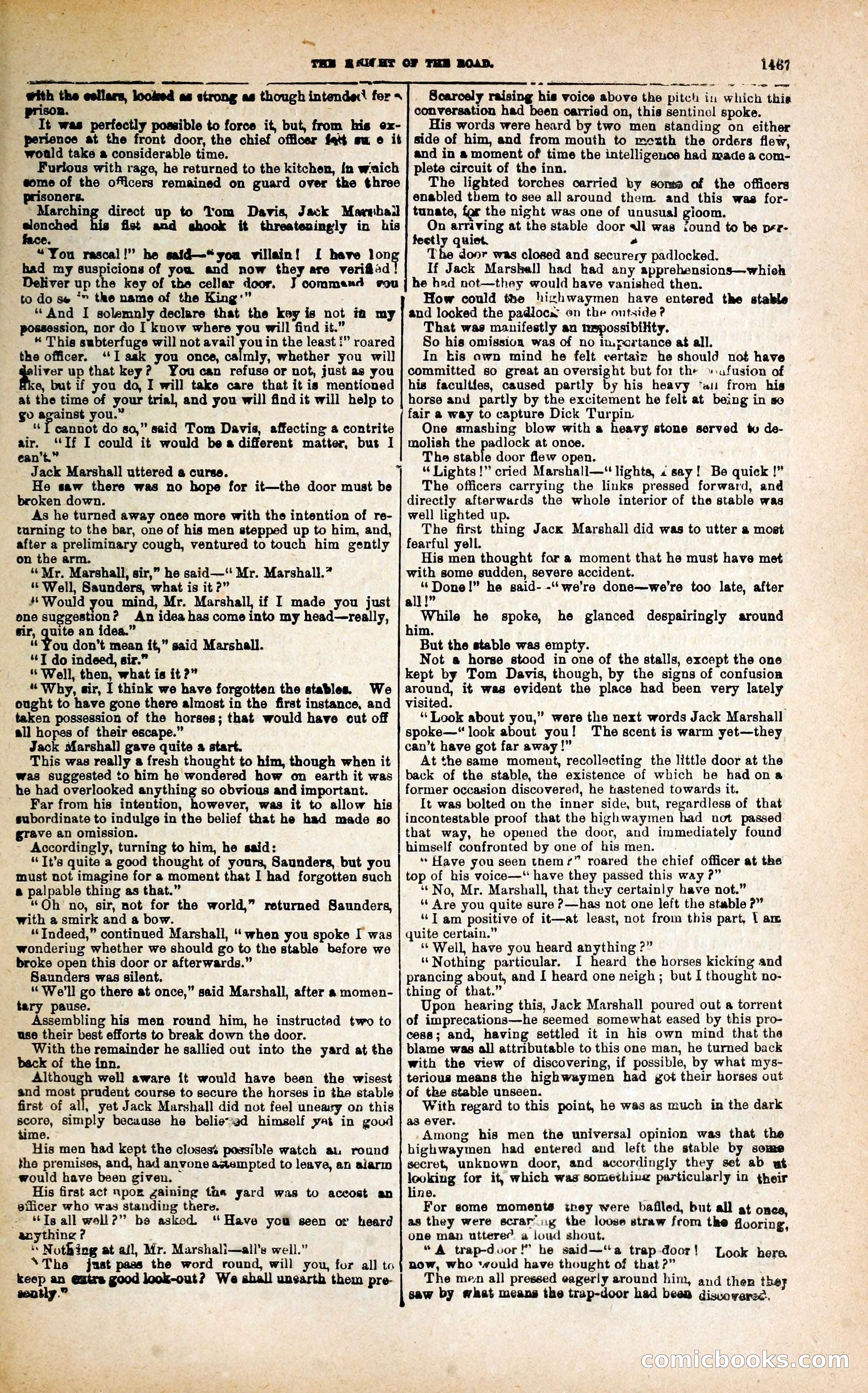
A restored page from Penny Dreadfuls, 1866. Page through the whole issue in the reader above.
📄 Transcribed text from this page (OCR, searchable)
Machine-transcribed from the original scan — historical spelling and the odd misread are preserved.
” > 4 ee prison. It was perfectly possible to force it, but, from his ex- perience at the front door, the chief officer fat su eo it wonld take a considerable time. Furious with rage, he returned to the kitchen, In waich eome of the officers remained on guard over the three prisoners. , ee ee up to Tom Davis, Jack Maruhail elonched fist and ghook it threatezingly in his face. “You rascal!” he sald—“yoa villain! { have long _ had my suspicions of you and now they are verified! Deliver up the key of the cellar door. J commend vou to do se *” the name of the King’” ‘And I solemnly declare that the key is not ta my ssion, nor do I know where you will fiud it.” “ This subterfuge will not avail pon in the least {” roared the officer. ‘‘] ask you once, calmly, whether you will liver up that key? Youcan refuse or not, just as you e, but if you do, I will take care that itis mentioned at the time of your trial, and you will find it will help to go against you.” «7 cannot do so,” said Tom Davis, affecting a contrite air. ‘If I could it would bea different matter, but 1 ean’t.” Jack Marshall uttered a curse. He saw there was no hope for it—the door must be broken down. As he turned away onee more with the intention of re- turning to the bar, one of his men stepped up to him, and, after a preliminary cough, ventured to touch him gently on the arm. ‘‘Mr. Marshall, sir,” he said—‘' Mr. Marshall.” ‘‘ Well, Saunders, what is it ?” 4*Would you mind, Mr. Marshall, if I made you just one suggestion? An idea has come into my head—really, sir, quite an idea.” : “You don’t mean it,” said Marshall. ““T do indeed, sir.” “ Well, then, what is it ?” “Why, sir, I think we have forgotten the stables. We ought to have gone there almost in the first instance, and taken possession of the horses; that would have cut off all hopes of their escape.” Jack Marshal] gave quite a start. This was really a fresh thought to him, though when it was suggested to him he wondered how on earth it was he had overlooked anything so obvious and important. _ Far from his intention, however, was it to allow his subordinate to indulge in the belief that he had made so grave an omission. - Accordingly, turning to him, he said: “ Tt’s quite a good thought of yours, Saunders, but you must not imagine for a moment that I had forgotten such a palpable thing as that.” “Oh no, sir, not for the world,” returned Saunders, with a smirk and a bow. “Indeed,” continued Marshall, “when you spoke I was wondering whether we should go to the stable before we broke open this door or afterwards.” Saunders was silent. “We'll go there at once,” said Marshall, after a momen- tary pause. Assembling his men round him, he instructed two to use their best efforts to break down the door. With the remainder he sallied out into the yard at the back of the inn. Although well aware it would have been the wisest and most prudent course to secure the horses iv the stable first of all, yet Jack Marshall did not feel uneasy on this score, simply because he beliesad himself yat in good time. His men had kept the closest possible watch au round the premises, and, had anvone aaempted to leave, an alarm would have baen given. His first act npor gaining fas yard was to aceost an gilicer who was standing there. - “Tg all wall?” be asked. “Haye you seen or heard anything ? ‘ Nothing at ail, Mr. Marshali—all’s weil.” ‘The jaat pass the word round, will you, for all to keep an @egtre good look-out? We shall unsarth them pre- seatly.” | a Pe. <> = - i h the eellars, locked as strong as though intendet for s 1467 aa oe me ” _ ———— sewn Scarcely raising his voice above the pitch in which this conversation had been carried on, this sentincl spoke. His words were heard by two men standing on either side of him, and from mouth to meth the orders flew, and in a moment of time the intelligenoe had made a com- plete circuit of the inn. The lighted torches carried by sonsa of the officers enabled them to see all around them and this was for- tunate, the night was one of unusual gioom. On arriving at the stable door all was found to be per- Sg ets a ‘The door was closed and securery padlocked. If Jack Marshal] had had any apprehensions—whieh he had not—they would have vanished then. How could the hizhwaymen have entered the stable and locked the padloca on the outside ? That wae manifestly an nepossibility. So his omission was of no in.portance at all. In kis own mind he felt certaiz he should not have committed so great an oversight but for the »-ufusion of his facultfes, caused partly by his heavy ‘aii from his horse and partly by the excitement he felt at being in so fair a way to capture Dick Turpin One smashing blow with a heavy stone served tw de- molish the padlock at once. The stable door flew open. “ Lights!” cried Marshall—“ lights, « say! Be quick !” The officers carrying the links pressed forward, and directly afterwards the whole interior of the stable was well lighted up. The first thing Jack Marshall did was to utter a most fearful yell. His men thought for a moment that he must have met with some sudden, severe accident. ‘‘ Done!” he said- -‘‘we’re done—we're too late, after all!” While he spoke, im. But the stable was empty. Not a horse stood in one of the stalls, except the one kept by Tom Davis, though, by the signs of confusion around, it was evident the place had been very lately Visited. ; ‘Look about you,” were the next words Jack Marshall spoke—“ look about you! The scent is warm yet—they can’t have got far away !” At the same moment, recollecting the little door at the back of the stable, the existence of which he had ona former occasion discovered, he hastened towards it. . It was bolted on the inner side, but, regardless of that incontestable proof that the highwaymen had not passed that way, he opened the door, and immediately found himself confronted by one of his men. * Have you seen themr” roared the chief officer at the top of his voice—“ have they passed this way ?” “No, Mr. Marshall, that they certainly have not.” ‘‘ Are you quite sure ?—has not one left the stable ?” “T am positive of it—at least, not from this part, | am quite certain.” ‘¢ Well, have you heard anything ?” “Nothing particular. I heard the horses kicking and prancing about, and I heard one neigh; but I thought no- thing of that.” Upon hearing this, Jack Marshall poured out a torrent of imprecations—he seemed somewhat eased by this pro- cess; and, having settled it in his own mind that the blame was all attributable to this one man, he turned back with the view of discovering, if possible, by what mys- terious means the highwaymen had got their horses out of the stable unseen. With regard to this point, he was as much in the dark as ever. Among his men the universal] opinion was that the highwaymen had entered and left the stable by some secret, unknown door, and accordingly they set ab wt looking for it, which was something particularly in their line. For some moments ipey were bafiled, but all at once, as they were scrarig the loose straw from the flooring, one man uttere?. a loud shout. “A trap-dvoor!” he said—“a trap-doar! now, who would have thought of that?” The men all pressed eagerly around him, and then ther saw by what means the trap-door had beam dissovarzc, — he glanced despairingly around Look here. 0)(0)0) =) a (E(@) SS (E(@)