
Penny Dreadfuls, 1866 · page 215 of 395
Black Bess; or, the Knight of the Road — page 215: what you’re looking at
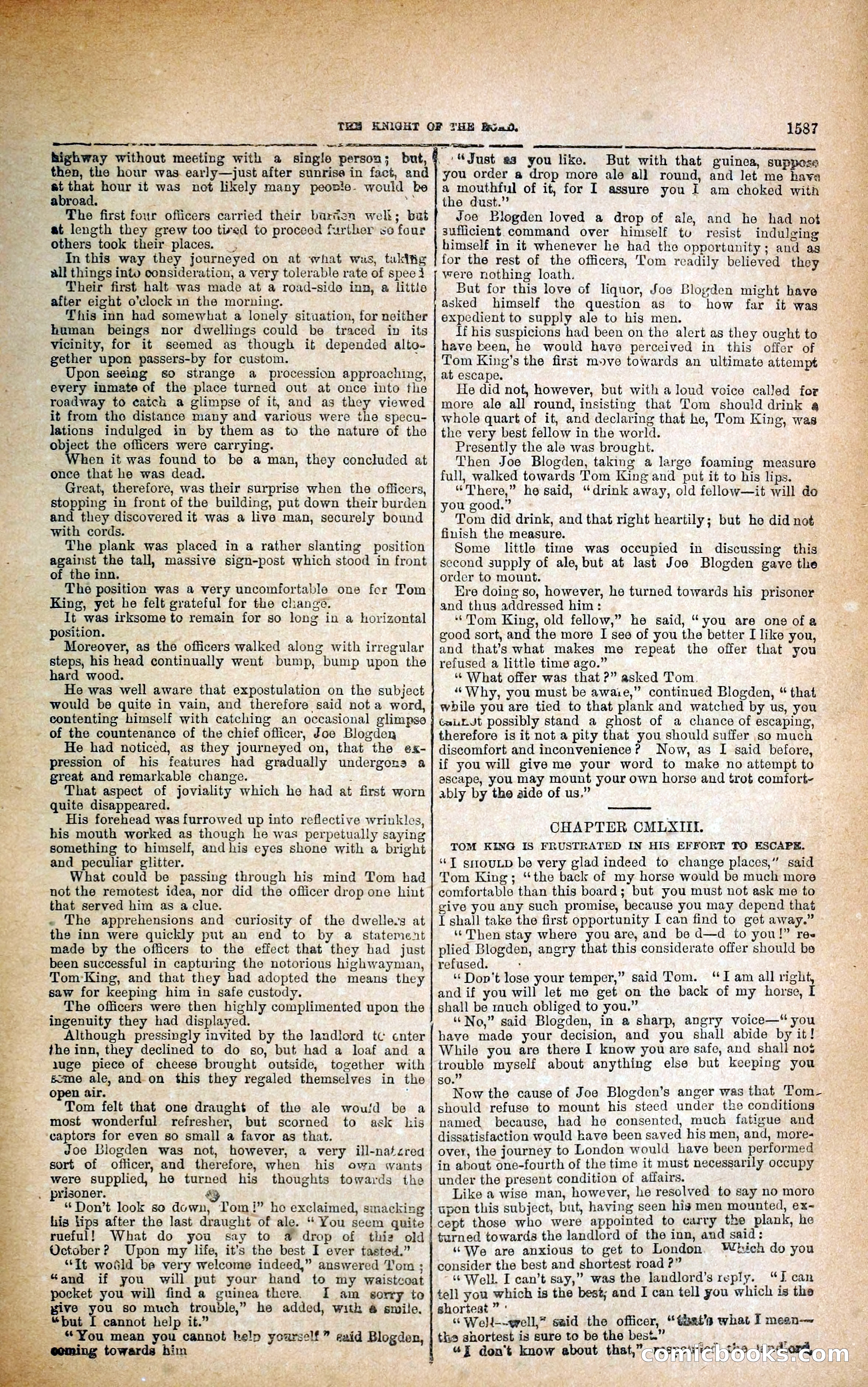
A restored page from Penny Dreadfuls, 1866. Page through the whole issue in the reader above.
📄 Transcribed text from this page (OCR, searchable)
Machine-transcribed from the original scan — historical spelling and the odd misread are preserved.
‘ eit ae fa We « Oe + = +s i* Pe ~ pocket you will find a guinea there. et tage Tote ae § i oy ~~ a _ « mt - 8. a a a ae a ~,* ee ae a Pw, ® “a Fi tiene ed —— Ss _ wighway without meeting with a single person; but, then, the hour was. early—just after sunrise in fact, and st that hour it was not likely many people. would be ~ abroad. The first four officers carried their barisn well; but at length they grew too tied to proceed further so four others took their places. , In this way they journeyed on at what wus, takiti¢ all things into consideration, a very tolerable rate of spee 4 Their first halt was made at a road-sido inn, a little after eight o’clock in the morning. This inn had somewhat a lonely situation, for neither human beings nor dwellings could be traced in its Vicinity, for it seemed as though it depended alto- gether upon passers-by for custom. Upon seeing so strange a procession approaching, every inmate of the place turned out at once into the roadway to catch a glimpse of it, and as they viewed it from the distance many and various were the specu- lations indulged in by them as to the nature of the object the officers were carrying. . en it was found to be a man, they concluded at once that he was dead. Great, therefore, was their surprise when the officers, stopping in front of the building, put down their burden and they discovered if was a live man, securely bound with cords. The plank was placed in a rather slanting position against the tall, massive sign-post which stood in front of the inn. The position was a very uncomfortable one for Tom King, yet he felt grateful for the change. It was irksome to remain for so long in a horizontal position. Moreover, as the officers walked along with irregular steps, his head continually went bump, bump upon the shard wood. He was well aware that expostulation on the subject would be quite in vain, and therefore said not a word, contenting himself with catching an occasional glimpse of the countenance of the chief oflicer, Joe Blogden He had noticed, as they journeyed on, that the e«- pression of his features had gradually undergonsa a great and remarkable change. : That aspect of joviality which he had at first worn quite disappeared. His forehead was furrowed up into reflective wrinkles, his mouth worked as though he was perpetually saying something to himself, and his eyes shone with a bright and peculiar glitter. What could be passing through his mind Tom had not the remotest idea, nor did the officer drop one hint that served him as a clue. . The apprehensions and curiosity of the dwelle.s at the inn were quickly put an end to by a statement made by the officers to the effect that they had just been successful in capturing the notorious highwayman, Tom’King, and that they had adopted the means they saw for keeping him in safe custody. The officers were then highly complimented upon the ingenuity they had displayed. Although pressingly invited by the landlord tc center the inn, they declined to do so, but had a loaf and a luge piece of cheese brought outside, together with some ale, and-on this they regaled themselves in the open air. Tom felt that one draught of the ale wou/d be a most wonderful refresher, but scorned to ask his ‘captors for even so small a favor as that. Joe Liogden was not, however, a very ill-natcred sort of officer, and therefore, when his own wants were supplied, he turned his thoughts towards the prisoner. & “Don’t look so down, Lom?” ho exclaimed, smacking his tips after the last draught of ale. “You seem quite rueful! What do you say to @ drop of thiz old Uctober? Upon my life, it’s the best I ever tasted.” “It woGld be very welcome indeed,” answered Tom ; “and if you will put your hand to my waistcoat [ am sorry to : a, give you so much trouble,” he added, with @ smile. but I cannot help it.” “You mean you cannot help yoarself” eaid Blogden, ell ig towards him . O = s .. . a ia. Re > 4 ate et ae Pan A ie at “> mosh all ; al a ~ THES KNIGHT OF THE Road, . “Just es you like. 1587 a ie But with that guinea, suppose you order a drop more ale all round, and let me hava a mouthful of it, for I assure you I am choked with the dust.” Joe Blogden loved a drop of ale, and he had not suflicient command over himself tu resist indulging himself in it whenever he had the opportunity; and ag for the rest of the officers, Tom readily believed they were nothing loath. But for this love of liquor, Joe Bloyden might have asked himself the question as to how far it was expedient to supply ale to his men. {ff his suspicions had been on the alert as they ought to have been, he would have perceived in this offer of Tom King’s the first move towards an ultimate attempt at escape. He did not, however, but with aloud voice called for more ale all round, insisting that Tom should drink @ whole quart of it, and declaring that he, Tom King, was the very best fellow in the world. Presently the ale was brought. Then Joe Blogden, taking a large foaming measure full, walked towards Tom King and put it to bis lips. “There,” he said, “drink away, old fellow—it will do you good.” Tom did drink, and that right heartily; but he did not finish the measure. | Some little time was occupied in discussing this second 3upply of ale, but at last Joe Blogden gave the order to mount. Ire doing so, however, he turned towards his prisoner and thus addressed him : ‘Tom King, old fellow,” he said, “you are one ofa good sort, and the more I see of you the better I like you, and that’s what makes me repeat the offer that you refused a little time ago.” “ What offer was that ?” asked Tom. “Why, you must be awaie,” continued Blogden, “ that while you are tied to that plank and watched by us, you ¢wLLJt possibly stand a ghost of a chance of escaping, therefore is it not a pity that you should suffer so much discomfort and inconvenience? Now, as I said before, if you will give me your word to make no attempt to ascape, you may mount your own horse and trot comfort- ably by the aide of us.” CHAPTER CMLXIII. TOM KING IS FRUSTRATED IN HIS EFFORT TO ESCAPE. ‘‘T stouLp be very glad indeed to change places,” said Tom King; “the back of my horse would be much more comfortable than this board; but you must not ask me to give you avy such promise, because you may depend that I shall take the first opportunity I can find to get away.” ‘Then stay where you are, and be d—d to you!” res plied Blogden, angry that this considerate offer should be refused. ‘Don't lose your temper,” said Tom. “TI am all right, and if you will let me get on the back of my horse, I shall be much obliged to you.” : “No,” said Blogden, in a sharp, angry voice—" you have made your decision, and you shall abide by it! While you are there I know you are safe, and shall nos trouble myself about anything else but keeping you 9 Now the cause of Joe Blogden’s anger was that Tom_- should refuse to mount his steed under the conditions named because, had he consented, much fatigue and dissatisfaction would kave been saved his men, and, mores over, the journey to London would have been performed in about one-fourth of the time it must necessarily occupy under the present condition of affairs. Like a wise man, however, he resolved to say no moro upon this subject, but, having seen his men mounted, ex~ cept those who were appointed to carry the plank, he turned towards the landlord of the inn, and said: “We are anxious to get to London Which do you consider the best and shortest road ?” Well. I can’t say,” was the landlord’sreply. “J can tell you which is the best; and I can tell you which is the shortest ” ' ‘¢ Well——eyell,* said the officer, “that’s what I mean—~ ths snortest is sure to be the best.” 10) “5 don't know about that,” -rs975 1 JOOKS:.C - 7 Yo ‘ d tix" Pte a re << SS oe ie ee eRe Gh 5 Sy Mew