
Penny Dreadfuls, 1866 · page 150 of 395
Black Bess; or, the Knight of the Road — page 150: what you’re looking at
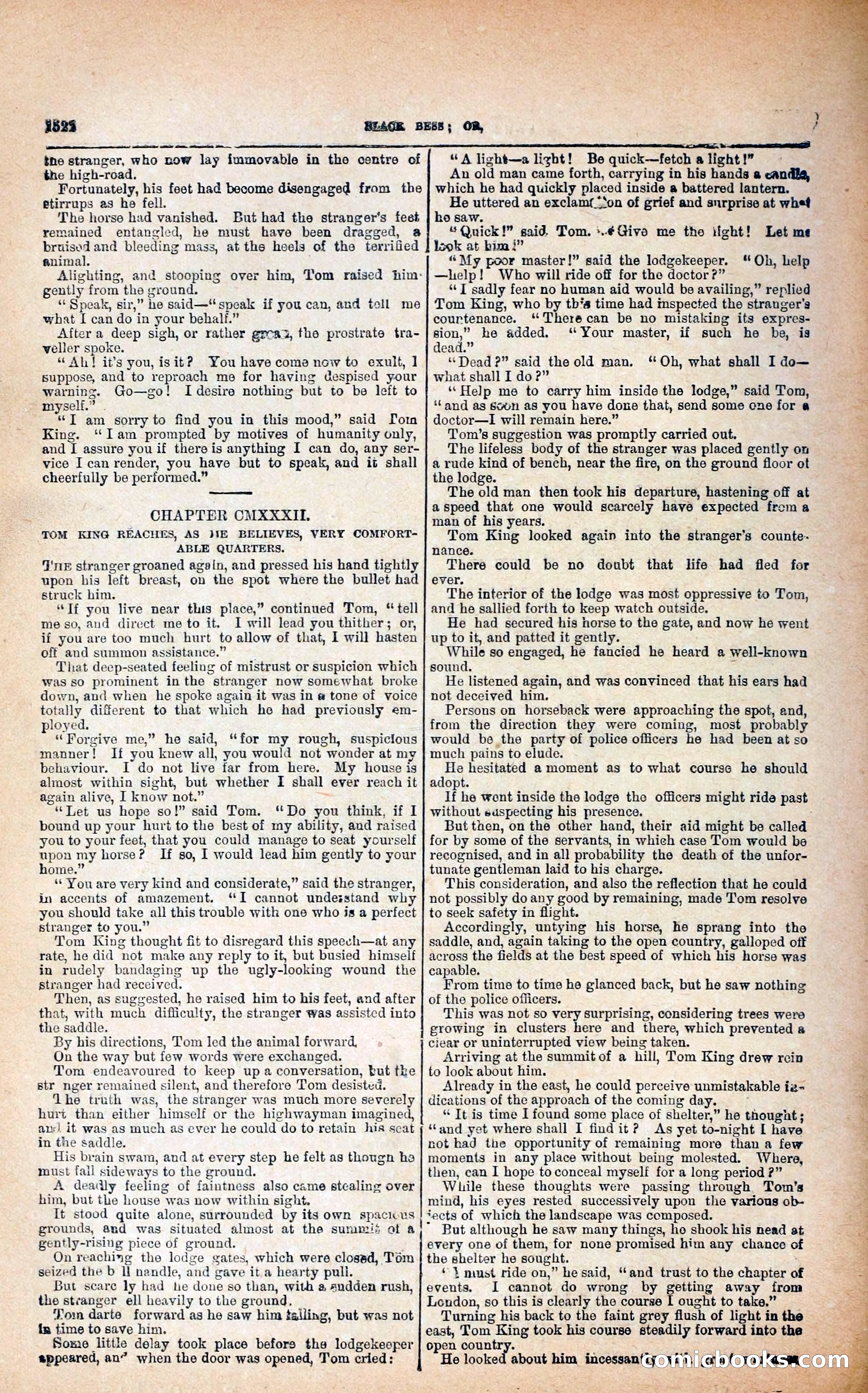
A restored page from Penny Dreadfuls, 1866. Page through the whole issue in the reader above.
📄 Transcribed text from this page (OCR, searchable)
Machine-transcribed from the original scan — historical spelling and the odd misread are preserved.
1523 the stranger, who now lay immovable in the centre of the high-road. Fortunately, his feet had become disengaged from the etirrups as he fell. The horse had vanished. But had the stranger’s feet remained entangled, he must have been dragged, a bruisud and bleeding mass, at ths heels of the terrified animal. Alighting, and stooping over him, Tom raised him: gently from the ground. “‘ Speak, sir,” he said—“ speak if you can, and tell me what I can do in your behalf.” After a deep sigh, or rather grcaz, the prostrate tra- veller spoke. “Ah! it’s you, isit? You have coma now to exult, | suppose, and to reproach me for having despised your warning. Go—go! Idesire nothing but to be left to myself.” . “JT am sorry to find you in this mood,” said Lom King. ‘lam prompted by motives of humanity only, and I assure youif there is anything I can do, any ser- vice I can render, you have but to speak, and it shall cheerfully be periormed.” CHAPTER CMXXXII. TOM KING REACHES, AS JIE BELIEVES, VERY COMFORT- ABLE QUARTERS. J'1Ee stranger groaned again, and pressed his hand tightly upon his left breast, on the spot where the bullet had struck him. “Tf you live near this place,” continued Tom, * tell me so, aud direct me to it. I will lead you thither; or, if you are too much hurt to allow of that, I will hasten off and summon assistance.” | That deep-seated feeling of mistrust or suspicion which was so prominent in the stranger now somewhat broke down, and when he spoke again it was in # tone of voice totally different to that which he had previously em- ployed. “Forcive me,” he said, “for my rough, suspicious manner! If you knew all, you would not wonder at my behaviour. I do not live tar from here. My house is almost within sight, but whether I shall ever reach it again alive, I know not.” “Tet us hope so!” said Tom. “Do you think, if I bound up your hurt to the best of my ability, and raised you to your feet, that you could manage to seat yourself upon my horse? If so, I would lead him gently to your home.” “You are very kind and considerate,” said the stranger, in accents of amazement. “I cannot undesstand why you should take all this trouble with one who js a perfect stranger to you.” Tom King thought fit to disregard this speech—at any rate, he did not make any reply to it, but busied himself in rudely bandaging up the ugly-looking wound the stranger had received. Then, as suggested, he raised him to his feet, and after that, with much difficulty, the stranger was assisted into the saddle. By his directions, Tom led the animal forward, On the way but few words were exchanged. Tom endeavoured to keep up a conversation, but the str nger remained silent, and therefore Tom desisted. Lhe truth was, the stranger was much more severely hurt than either himself or the highwayman imagined, ani it was as much as ever he could do to retain hia seat in the saddle. His brain swam, and at every step he felt as thougn hoa must fail sideways to the ground. A deadly feeling of faintness also came stealing over him, but the house was now within sight. It stood quite alone, surrounded by its own spacius grounds, and was situated almost at the summisé at a gently-rising piece of ground. On reaching the lodge gates, which were closad, Tém seized the b ll nandJe, and gave it a hearty pull. But scare ly had he done so than, with a andden rush, the stranger ell heavily to the ground. Tom darte forward as he saw him falling, but was not im time to save him. Some little delay took place before the lodgekeeper sppeared, an” when the door was opened, T'om cried: BEAGK BESS; OR, ho saw. “Quick!” said. Tom. >.¢Giva me the iight! Let me Isok at bina {” “My poor master!” said the lodgekeeper. “Oh, help —lelp! Who will ride off for the doctor?” “T sadly fear no human aid would be availing,” replied Tom King, who by tb’s time had mspected the stranger's courtenance. ‘Therecan be no mistaking its expres- sion,” he added. ‘Your master, if such he be, is dead.” “Dead 2?” said the old man. ‘Oh, what shall I do— What shall I do?” ‘Help me to carry him inside the lodge,” said Tom, ‘Cand as Scum as you have done that, send some one for @ doctor—I will remain here.” Tom’s suggestion was promptly carried out. The lifeless body of the stranger was placed gently on a rude kind of bench, near the fire, on the ground floor ot the lodge. : The old man then took his departure, hastening off at a speed that one would scarcely have expected from a man of his years. Tom King looked again into the stranger's counte- nance. There could be no doubt that life had fled for ever. The interior of the lodge was most oppressive to Tom, and he sallied forth to keep watch outside. He had secured his horse to the gate, and now he went up to it, and patted it gently. While so engaged, he fancied he heard a well-known sound, : He listened again, and was convinced that his ears had not deceived him, Persons on horseback were approaching the spot, and, from the direction they were coming, most probably would be the party of police officers he had been at so much pains to elude. He hesitated a moment as to what course he should adopt. If he went inside the lodge the officers might ride past without suspecting his presence. But then, on the other hand, their aid might be called for by some of the servants, in which case Tom would be recognised, and in all probability the death of the unfor- tunate gentleman laid to his charge. This consideration, and also the reflection that he could not possibly do any good by remaining, made Tom resolve to seek safety in flight. Accordingly, untying his horse, he sprang into the saddle, and, again taking to the open country, galloped off across the fields at the best speed of which his horse was capable. From time to time he glanced back, but he saw nothing of the police officers. This was not so very surprising, considering trees were growing in clusters here and there, which prevented a ciear or uninterrupted view being taken. Arriving at the summitof a hill, Tom King drew rein to look about him. Already in the east, he could perceive unmistakable ia- dications of the approach of the coming day. “ It is time I found some place of shelter,” he thought ; “and yet where shall I findit? As yet to-night [ have not had the opportunity of remaining more than a few moments in any place without being molested. Where, then, can I hope toconceal myseli for a long period ?” While these thoughts were passing through Tom’s mind, his eyes rested successively upon the various ob- tects of which the landscape was composed. But although he saw many things, he shook his nead at every one of them, for none promised him any chance o the shelter he sought. ‘ must ride on,” he said, “and trust to the chapter of events. I cannot do wrong by getting away from Lendon, so this is clearly the course I ought to take,” Turning his back to the faint grey flush of light in the east, Tom King took his course steadily forward into the — open countr He pate about him incessan{cjo\rn} (ale (OT @) . ese “A licht—a light! Be quick—fetch a light!” An old man came forth, carrying in his hands a eandla, which he had quickly placed inside a battered lantern. He uttered an exclam{<‘on of grief and surprise at whet Sed Dame i A NG Pid inka sg SR Pee I ee Tae Se ck SS ‘, i ‘ ° s/f ‘