
Penny Dreadfuls, 1866 · page 114 of 395
Black Bess; or, the Knight of the Road — page 114: what you’re looking at
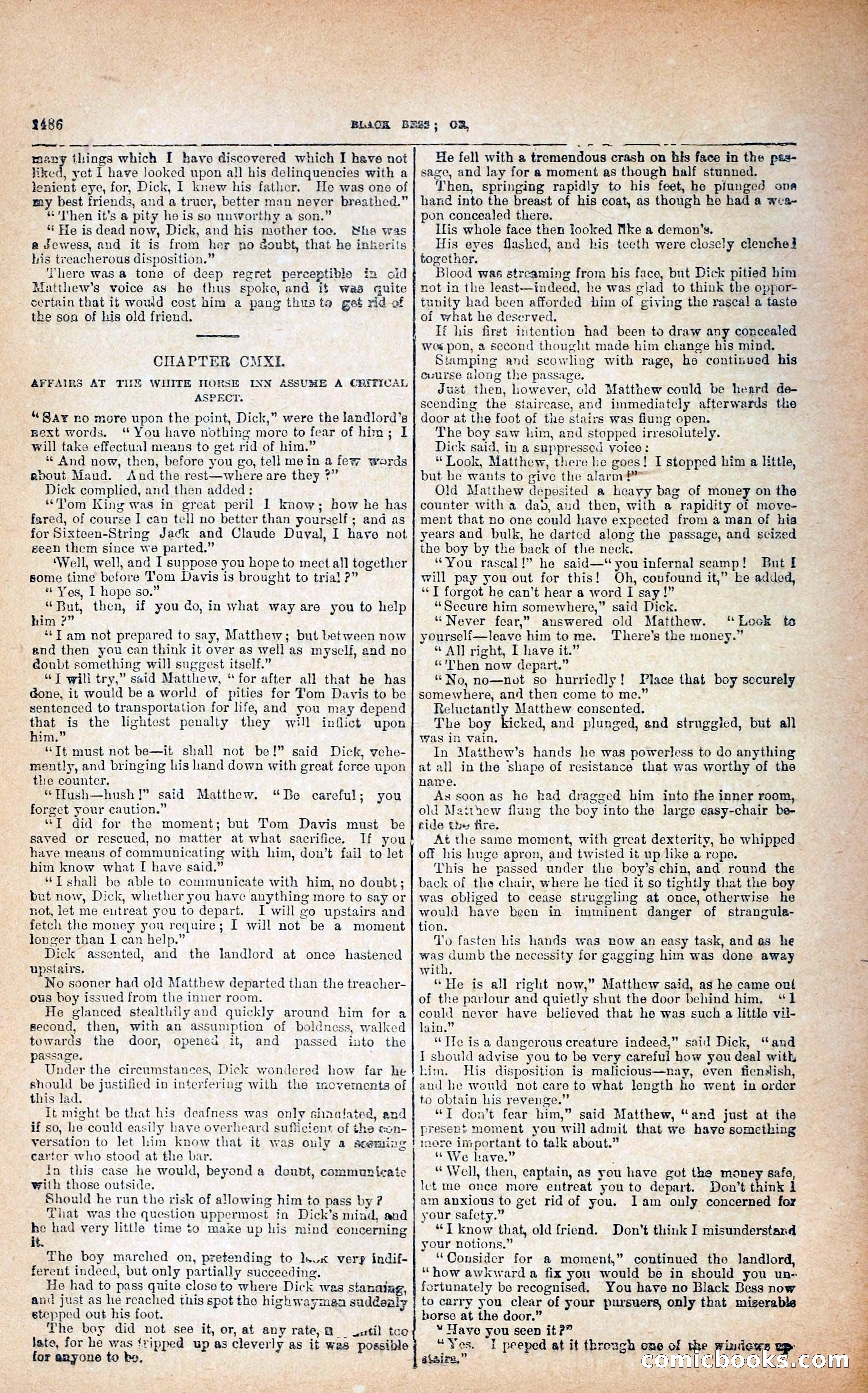
A restored page from Penny Dreadfuls, 1866. Page through the whole issue in the reader above.
📄 Transcribed text from this page (OCR, searchable)
Machine-transcribed from the original scan — historical spelling and the odd misread are preserved.
2486 taany tilings which I have discovered which I have not fiked, yet 1 have looked upon all his delinquencies with a lenient eye, for, Dick, 1 knew his father. He was one of my best friends, and a trucr, better man never breathed.” *'I'hen it’s a pity he is so unworthy a son.” ‘He is dead now, Dick, and his mother too. She was a Jscwess, and it is from her po aoubt, that he inherits his treacherous disposition.” ‘here was a tone of deep regret perceptiblo in old Matthew's voice as he thus spoke, and it was quite certain that it would cost him a pang thus ta get rid of the son of his old friend. CHAPTER CMXIL AFFAIRS AT TIS WHITE HORSE INN ASSUME A CBITICAL ASPECT. “SAY ro more upon the point, Dick,” were the landlord’s next words. ‘ You have nothing more to fear of him; I will take effectual means to get rid of him.” * And now, then, before you go, tell mein a few words ebout Maud. And the rest—where are they ?” Dick complied, and then added: “Tom King was in great peril I know; now he has fared, of course I can tell no better than yourself; and as for Sixteen-String Jack and Claude Duval, I have not geen them since we parted.” ‘Well, well, and I suppose you hope to mect all together some time before Tom Davis is brought to tria! ?” * Yes, I hope so.” “But, then, if you do, in what way are you to help him ?” ‘Tam not prepared to say, Matthew; but between now end then you can think it over as well as myself, and no doubt something will suggest itself.” “J wili try,” said Matthew, “for after all that he has Gone, it would be a world of pities for Tom Davis to be sentenced to transportation for life, and you may depend that is the lightest penalty they will inflict upon him.” “Tt must not be—it shall not be!” said Dick, vche- mently, and bringing his hand down with great force upon the counter. “Flush—hush !” said Matthew, forget your caution.” ‘“T did for the moment; but Tom Davis must be saved or rescued, no matter at what sacrifice. If you have means of communicating with him, don’t fail to let him know what I have said.” “T shall be able to communicate with him, no doubt; but now, Dick, whether you have anything more to say or not, let me eutreat you to depart. I will go upstairs and fetch the money you require; I will not be a moment longer than I can help.” Dick assented, and the landlord at once hastened upstairs. No sooner had old Matthew departed than the treacher- ous boy issued from the inner room. He glanced stealthilyand quickly around him for a second, then, with an assumption of boldness, walked towards the door, opened it, and passed into the passage. Under the circumstances, Dick wondered how far he should be justified in interfering with the movements of this lad. It might be that his deafness was only simatated, and if so, he could easily have overheard sufficient of the con- versation to let lim know that it was ouly a seeming carter who stood at the bar. In this case he would, beyond a dount, communicate with those outside, Should he run the risk of allowing him to pass by ? That was the question uppermost in Dick’s mind, and ne had very little time to make up his mind concerning t. The boy marched on, pretending to lu« very indif- ferent indeed, but only partially succeeding. He had to pass quite close to where Dick was stanaing, and just as he reached this spot tho highwayman suddenly stepped out his foot. The boy did not see it, or, at any rate, Letil tco late, for he was ‘ripped up as cleverly as it was possible for anyone to be, “Be careful; you BLiGK BESS; TS OR, He fell with a tremendous crash on bis face in the pes- sage, and lay for a moment as though half stunned. Then, springing rapidly to his feet, he plunged ona hand into the breast of his coat, as though he had a wea- pon concealed there. His whole face then looked Nke a demon’s. His eyes flashed, and his tecth were closcly clenche3 togecthor. Blood was streaming from his face, but Dick pitied him not in the least—indeed, he was glad to think the oppor- tunity had been afforded him of giving the rascal a taste of what he deserved. Ii his firgt intention had been to draw any concealed Wes pon, a second thought made him change his mind. Stamping and scowling with rage, he continued his cvuurse along the passage. Just then, however, old Matthew could be heard de- scending the staircase, and immediatcly afterwards the door at the foot of the stairs was fiung open. The boy saw him, ard stopped irresolutely. Dick said, in a suppressed yoice: “Look, Matthew, there he goes! I stopped him a little, but he wants to give the alarm?" Old Matthew deposited a heayy bag of money on the counter with a dav, aud then, with a rapidity of move- ment that no one could have expected from a man ef his years and bulk, he dartcd along the passage, and scized the boy by the back of the neck. “You rascal!” he said—“ you infernal scamp! But I will pay you out for this! Oh, confound it,” be added, ‘““T forgot he can’t hear a word I say !” “Secure him somewhere,” said Dick. ‘Never fear,” answered old Matthew. ‘Lock ts yourseli—leave hin tome. There’s the money.” “ All right, I have it.” “'lhen now depart.” “No, no—not so hurriedly! Place that boy securely somewhere, and then come to me.” Reluctantly Matthew consented. The boy kicked, and plunged, end struggled, but all was 1n vain. In Matthew’s hands he was powerless to do anything at all in the shape of resistance that was worthy of the name. As soonas he had dragg¢ed him into the inner room, old Matthew flung the boy into the large easy-chair be- ride thy fire. At the same moment, with great dexterity, he whipped off his huge apron, and twisted it up like a rope. This he passed under the boy’s chin, and round the back of the chair, where he ticd it so tightly that the boy was obliged to cease struggling at once, otherwise he would haye been in imminent danger of strangula- tion. To fasten his hands was now an easy task, and as he was duinb the necessity for gagging him was done away with. “He is all right now,” Matthew said, as he came oul of the parlour and quietly shut the door behind him. “1 could never have believed that he was such a little vil- lain.” “TTc is a dangerous creature indeed,” said Dick, “and 1 should advise you to be very careful how you deal with lim. His disposition is malicious—nay, even fiensish, and be would not care to what length he went in order to obtain his revenge.” “T don’t fear him,” said Matthew, “and just at the presepy moment you will admit that we have somcthing inere important to talk about.” “ We have.” ; “Well, then, captain, as you have got the money safo, lef me once more entreat you to depart. Don’t think 1 am anxious to get rid of you. Iam only concerned for your safety.” “T know that, old friend. Don't think I misunderstand your notions.” “Considcr for a moment,” continued the Jandlord, “how awkward a fix you would be in should you un- fortunately be recognised. You have no Black Bess now to carry you clear of your pursuers, only that miserable horse at the door.” “ Have you seen it ?” aieize, “Yes. I peeped at it through one of the windews 2 | com icbooks’ * ee aoe ~ eg fi = a, >< oe E Hf | he \ ~~ * ty » A “> by > ® < Cy ing nt ins ae wl