
Penny Dreadfuls, 1866 · page 72 of 395
Black Bess; or, the Knight of the Road — page 72: what you’re looking at
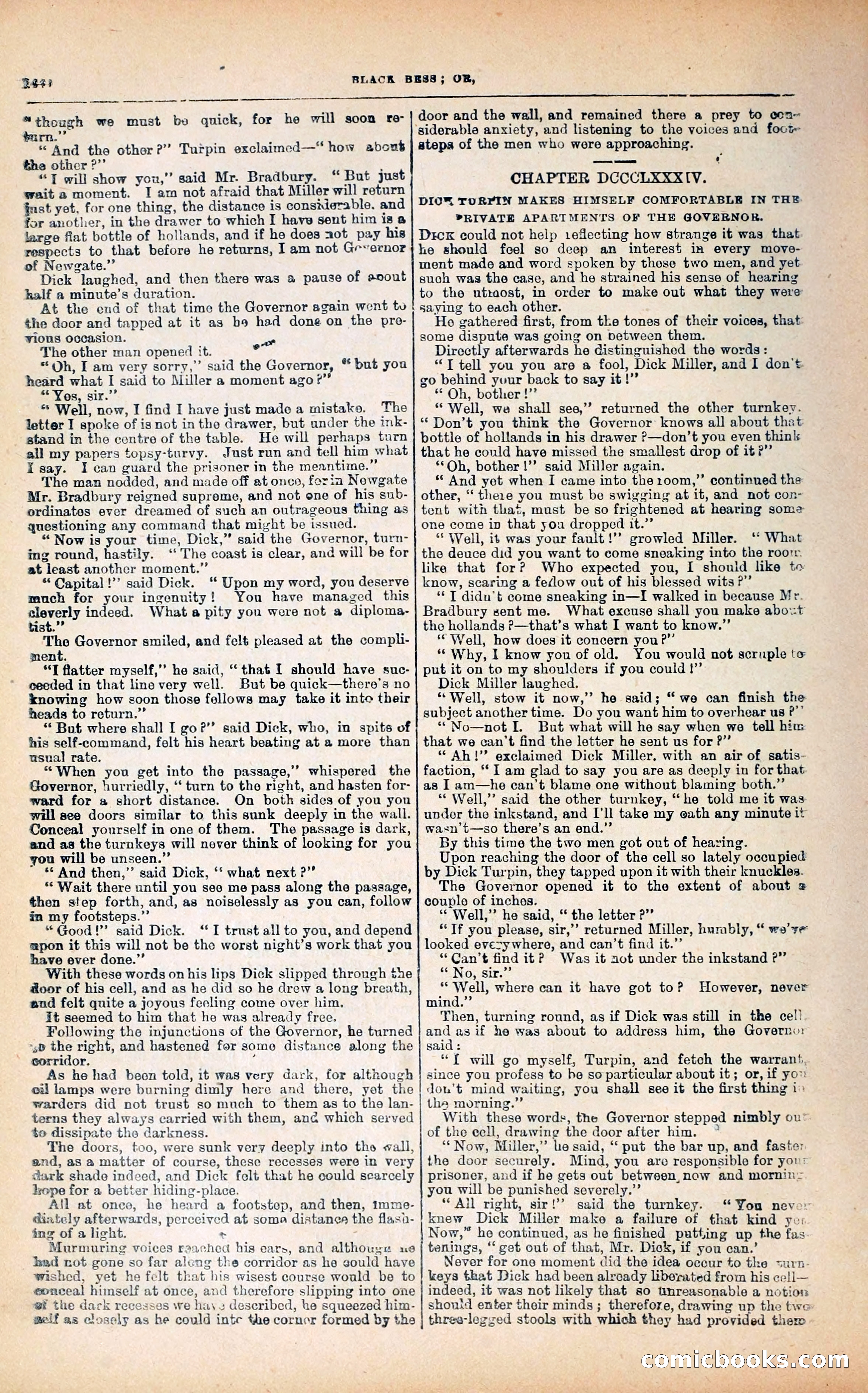
A restored page from Penny Dreadfuls, 1866. Page through the whole issue in the reader above.
📄 Transcribed text from this page (OCR, searchable)
Machine-transcribed from the original scan — historical spelling and the odd misread are preserved.
3335 a “though we must be quick, for he will soon re turn.” ‘“ And the other?” Turpin exclaimcd—“ how abou’ the other °”’ “T will show you,” said Mr. Bradbury. “ But just wait a moment. I am not afraid that Miller will return jnst yet, for one thing, the distance is considerable, and for another, in the drawer to which I have sent him 18 @ large flat bottle of hollands, and if he does rot pay his respects to that before he returns, I am not Gevernor of Newgate.” Dick laughed, and then there was a pause of aeout half a minute’s duration. At the end of that time the Governor again went tu the door and tapped at it as be had done on the pre- vions occasion. The other man opened it. * Oh, I am very sorry,” said the Governor, “ but you heard what I said to Miller a moment ago?” og, Sir. ** Well, now, I find I have just made a mistake. The letter I spoke of is not in the drawer, but under the ink- stand in the centre of the table. He will perhaps turn all my papers topsy-turvy. Just run and tell him what I say. I can guard the prisoner in the meantime.” The man nodded, and made off at once, ferin Newgate Mr. Bradbury reigned supreme, and not one of his sub- ordinates ever dreamed of such an outrageous thing as questioning any command that might be issued. “ Now is your time, Dick,” said the Governor, turn- ing round, hastily. ‘‘ The coast is clear, and will be for at least another moment.” “ Capital!’ said Dick. ‘“ Upon my word, you deserve much for your ingenuity! You have managed this cleverly indeed. What a pity you were not a diploma- tist.”” The Governor smiled, and felt pleased at the compli- ment. “TI flatter myself,’”’ he said, “that I should have suc- ceeded in that line very well. But be quick—there’s no xnowing how soon those fellows may take it into their heads to return.”’ “‘ Bot where shall I go?” said Dick, who, in spits of his self-command, felt his heart beating at a more than usual rate. “When you get into tho passage,’’ whispered the Governor, hurriedly, “ turn to the right, and hasten for- ward for a short distance. On both sides of you you will see doors similar to this sunk deeply in the wall. Conceal yourself in one of them. The passage is dark, and as the turnkeys will never think of looking for you you will be unseen.” ** And then,’’ said Dick, ‘‘ what next ?”’ *“ Wait there until you seo me pass along the passage, then step forth, and, as noiselessly as you can, follow in my footsteps.”’ “ Good!’ said Dick. ‘I trust all to you, and depend mpon it this will not be the worst night’s work that you have ever done.”’ With these words on his lips Dick slipped through the door of his cell, and as he did so he drew a long breath, and felt quite a joyous feeling come over him. It seemed to him that he was already free. Following the injunctions of the Governor, he turned ‘yb the right, and hastened for some distance along the - gorridor. ; As he had beon told, it was very dark, for although ei] lamps were burning dimly here and there, yot the warders did not trust so much to them as to the lan- terns they always carried with them, anc which served to dissipate the darkness. The doors, too, were sunk very deeply into the wall, and, as a matter of course, these recesses were in very dark shade indeed, and Dick felt that he could searcely lope for a better hiding-place. All at once, he heard a footstep, and then, imme- diately afterwards, perceived at soma distanea the flash- ine of a licht. » Murmuring voices raached his ears, and althouga ue had not gone so far aleng the corridor as he gould have wished, yet he felt that his wisest course would be to @onceal himself at once, and therefore slipping into one ef the dack recesses we hay. described, be squeezed him- gaeif as closely as he could inte {he corner formed by the en BLACK BESS; OB, door and the wall, and remained there a prey to con~ ‘siderable anxiety, and listening to the voices and foct- ateps of the men who were approaching. CHAPTER DCCCLXXXIV. DIO™% TURPIN MAKES HIMSELF COMFORTABLE IN THE PRIVATE APARTMENTS OF THE GOVERNOR. Dirck could not help 1efecting how strange it was that he should feel so deep an interest in every move- ment made and word spoken by these two men, and yet such was the case, and he strained his sense of hearing to the utraost, in order to make out what they were saying to each other. He gathered first, from tke tones of their voices, that some dispute was going on between them. Directly afterwards he distinguished the words: “T tell you you are a fool, Dick Miller, and I don’t go behind your back to say it!’ * Oh, bother !’’ ‘Well, we shall see,’ returned the other turnkev. “ Don’t you think the Governor knows all about that bottle of hollands in his drawer P—don’t you even think that he could have missed the smallest drop of it ?” *‘Oh, bother !”’ said Miller again. * And yet when I came into the1o0om,”’ continued the other, ‘‘ there you must be swigging at it, and not con- tent with that, must be so frightened at hearing some one come ip that you dropped it.”’ ‘“* Well, it was your fault!’’ growled Miller. ‘* What the deuce did you want to come sneaking into the roor. like that for? Who expected you, I shouid like te know, scaring a feflow out of his blessed wits P’’ ‘TT didn’t come sneaking in—I walked in because Mr. Bradbury sent me. What excuse shall you make about the hollands P—that’s what I want to know.” ** Well, how does it concern you?” ‘“ Why, I know you of old. You would not scruple to put it on to my shoulders if you could !”’ Dick Miller laughed. “Well, stow it now,’ he said; “we can finish the subject another time. Do you want him to overhear us ?”’ *“No—not I. But what will he say when we tell hiu that we can't find the letter he sent us for ?”’ “ Ah!’ exclaimed Dick Miller. with an air of satis- faction, “1 am glad to say you are as deeply in for that a3 I am—he can’t blame one without blaming both.” “ Well,” said the other turnkey, “he told me it was upder the inkstand, and I'll take my oath any minute it wasn’t—so there’s an end.”’ By this time the two men got out of heaving. Upon reaching the door of the cell so lately occupied by Dick Turpin, they tapped upon it with their knuckles. The Governor opened it to the extent of about @ couple of inches. ‘** Well,’ he said, “‘ the letter ?”’ ‘If you please, sir,’’ returned Miller, humbly, “ we've looked evezywhere, and can’t find it.”’ “Can’t find it? Was it not under the inkstand ?” ‘* No, sir. s woe where can it have got to? However, never mind.”’ Then, turning round, as if Dick was still in the cel! ant as if he was about to address him, the Governoe: said : “fT will go myself, Turpin, and fetch the warrant, since you profess to be so particular about it; or, if yor dou’t mind waiting, you shall see it the first thing 1» thea morning.” With these words, the Governor stepped nimbly ou’ of the eell, drawing the door after him. ~ ‘* Now, Miller,” le said, “‘ put the bar up, and faster the door securely. Mind, you are responsible for you: prisoner, and if he gets out between, now and mornin= you will be punished severely.’’ ‘All right, sir!’ said the turnkey. “You neve- knew Dick Miller make a failure of that kind ye: Now,” he continued, as he finished putting up the fas tenings, ‘get out of that, Mr. Dick, if you can.’ Never for one moment did the idea occur to the surn- keys that Dick had been already liberated from his ce!l— indeed, it was not likely that so tmnreasonable a notion shonid enter their minds ; therefore, drawing up the twe three-lezzed stools with which they had provided therm S| Eomichoo (€