
Penny Dreadfuls, 1866 · page 311 of 395
Black Bess; or, the Knight of the Road — page 311: what you’re looking at
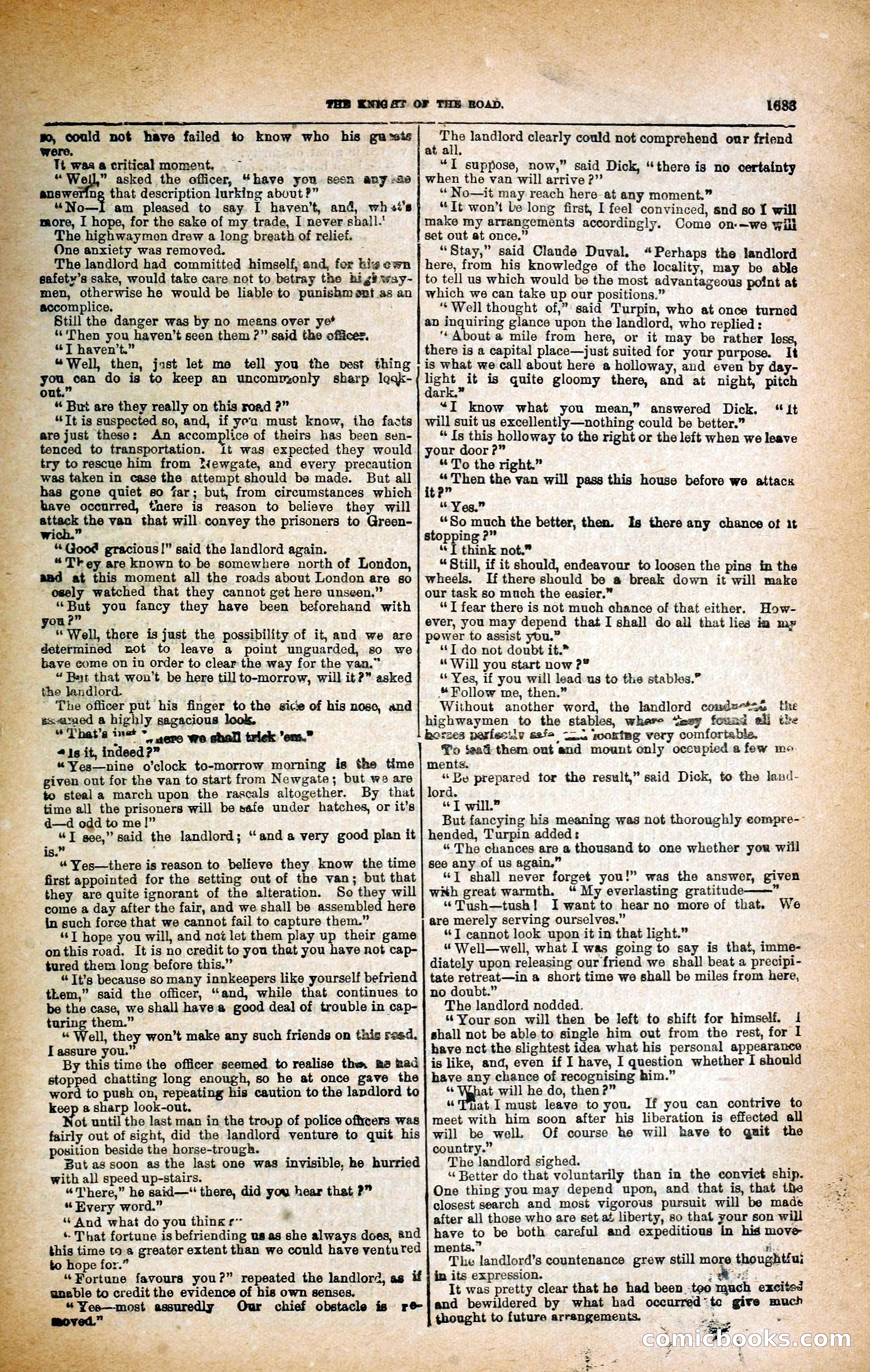
A restored page from Penny Dreadfuls, 1866. Page through the whole issue in the reader above.
📄 Transcribed text from this page (OCR, searchable)
Machine-transcribed from the original scan — historical spelling and the odd misread are preserved.
Ray . * as + . we “we - é ; * < tlle iad - Ae ey ie a y — . o'—. < - —_ - oo o v4 a ee at - . <, “ gm ‘ _ ‘ ‘ FRY rey? oe rem ae \ IN RTL Meee oe dhe. ~~ d , ee : - y.. ~ oh. 7 r : = ee = 0, ___-‘t_was a critical moment. ais 3 could not have failed to know who his gussis “Weill,” asked the officer, “have you sesn any se answering that description lurking about?” am pleased to say I haven’t, and, wh +i's more, I hope, for the sake of my trade, I never shall. The highwaymen drew a long breath of relief. One anxiety was removed. ; ‘The landlord had committed himself, and, fer hig ewn safety’s sake, would take care not to betray the hig¥.way- men, otherwise he would be liable to punishment as an accomplice. , Still the danger was by no meens over yo* ‘**'Then you haven’t seen them ?” said the offices. “T haven’t.” “Well, then, just let me tell you the pest thing you can do is to keep an uncommonly sbarp logk- - out.” “ Bui are they really on this road ?” ‘“‘Tt is suspected so, and, if yea must know, the fasts are just these: An accomplice of theirs has been sen- tenced to transportation. it was expected they would try to rescue him from Newgate, and every precaution was taken in case the attempt should be made. But all has gone quiet so far; but, from circumstances which bave occurred, tnere is reason to believe they will attack the van that will. convey the prisoners to Green- “Good gracious!” said the landlord again. “ Tr ey are known to be somewhere north of London, and at this moment all the roads about London are go -osely watched that they cannot get here unseen,” “But you fancy they have been beforehand with ou?” . _ “Well, there is just the possibility of it, and we aro determined not to leave a point unguarded, so we bave come on in order to clear the way for the van.” “ Bat that won't be here till to-morrow, will it?” asked the landlord The officer put his finger to the sice of his nose, and es-arned a highly sagacious look, “That's ie ~ | sero wo shall trick em.” “is it, indeed?” -Yes—nine o'clock to-morrow morning is the time given out for the van to start from Newgate; but we are to steal a march upon the rascals altogether. By that time all the prisoners will be safe under hatches, or it’s d—d odd to me!” “T gee,” said the landlord; “anda very good plan it is.” “ Yes—there is reason to believe they know the time first appointed for the setting out of the van; but that they are quite ignorant of the alteration. So they will come a day after tho fair, and we shall be assembled here in such force that we cannot fail to capture them.” ‘‘T hope you will, and not let them play up their game ~ onthis road. It is no credit to you thet you have not cap- tured them long before this,” é “ It’s because so many innkeepers like yourself befriend them,” said the officer, “and, while that continues to be the case, we shall havea good deal of trouble in cap- turing them.” i. Well, they won’t make any such friends on this reed. I assure you.” : By this time the officer seemed to realise the, Ba Rad stopped chatting long enough, so he at once gave the word to push on, repeating his caution to the landlord to keep a sharp look-out. Not until the last man in the troup of police offycers was fairly out of sight, did the landlord venture to quit his position beside the horse-trough. But as soon as the last one was invisible, he hurried with all speed up-stairs. “There,” he said—“ there, did you hear that ?” “ Every word.” “And what do you thing r~ ‘- That fortune is befriending us as she always does, 2nd this time to a greater extent than we could have ventured Fi ___ to hope for.” “Fortune favours you?” repeated the landlord, as if __ gnable to credit the evidence of his own senses. Yes—-most assuredly Our chief obstacle is re 1683 a LEN Met landlord clearly could not comprehend our friend at all, . “I suppose, now,” said Dick, “there is no certainty when the van will arrive 2” ‘“‘ No—it may reach here at any moment.” “It won’t be long first, I feel convinced, and so I will make my arrangements accordingly. Come on-—we will set out at once,” “Stay,” said Claude Duval. “Perhaps the landlord here, from his knowledge of the locality, may be able to tell us which would be the most advantageous potnt at which we can take up our positions.” “Well thought of,” said Turpin, who at once turned ab inquiring glance upon the landlord, who replied: ~~ ‘About a mile from here, or it may be rather less, there is a capital place—just suited for your purpose. It is what we call about here a holloway, and even by day- light it is quite gloomy there, and at night, pitch dark.” “I know what you mean,” answered Dick. “It will suit us excellently—nothing could be better.” “ Is this holloway to the right or the left when we leave your door ?” “ To the right.” - 5 the van will pass this house before we attack sc Yes.” “So much the better, then. Is there any chance of it stopping ?” “«] think not.” “Still, if it should, endeavour to loosen the pins in the wheels. If there should be a break down it will make our task so much the easier.” “‘T fear there is not much chance of that either. How- ever, you may depend that I shall do all that lies ia my power to assist you.” “I do not doubt it.” “Will you start now ?* “* Yes, if you will lead us to the stables.” “Follow me, then.” Without another word, the landlord cond=-*sa the highwaymen to the stables, where teey found eli tbe borzes pesisciiy safe Lo wortag very comfortable. To tead them out and mount only occupied a few mo. ments. ‘Be prepared tor the result,” said Dick, to the land- lord. T will.” But fancying his meaning was not thoroughly eompre-- hended, Turpin added: “ The chances are a thousand to one whether you will see any of us again.” “JT shall never forget you!” was the answer, given wh great warmth. “ My everlasting gratitude——” “Tush—tush! I want to hear no more of that. We are merely serving ourselves.” “J cannot look upon it in that light.” “ Well—well, what I was going to say is that, imme- diately upon releasing our friend we shall beat a precipi- tate retreat—in a short time we shall be miles from here, no doubt.” The landlord nodded. “Yourson will then be left to shift for himself. 1 shall not be able to single him out from the rest, for 1 have not the slightest idea what his personal appearance » is like, and, even if I have, I question whether I should have any chance of recognising him.” “ vpbat will he do, then?” ; “That I must leave to you. If you can contrive to meet with him soon after his liberation is effected all will be well. Of course he will have to guit the country.” The landlord sighed. : “Better do that voluntarily than in the convict ship. One thing you may depend upon, and that is, that the closest search and most vigorous pursuit will be made after all those who are set at liberty, so that your son will have to be both careful and expeditious in his move ments.” i. The landlord’s countenance grew still more thoughtfui in its expression. oe It was pretty clear that he had been -teo much excited and bewildered by what had occurred’te give much thought to future arrangements. 3 Se » or Gomicbooks : aay \ L (E(©)