
Penny Dreadfuls, 1866 · page 63 of 395
Black Bess; or, the Knight of the Road — page 63: what you’re looking at
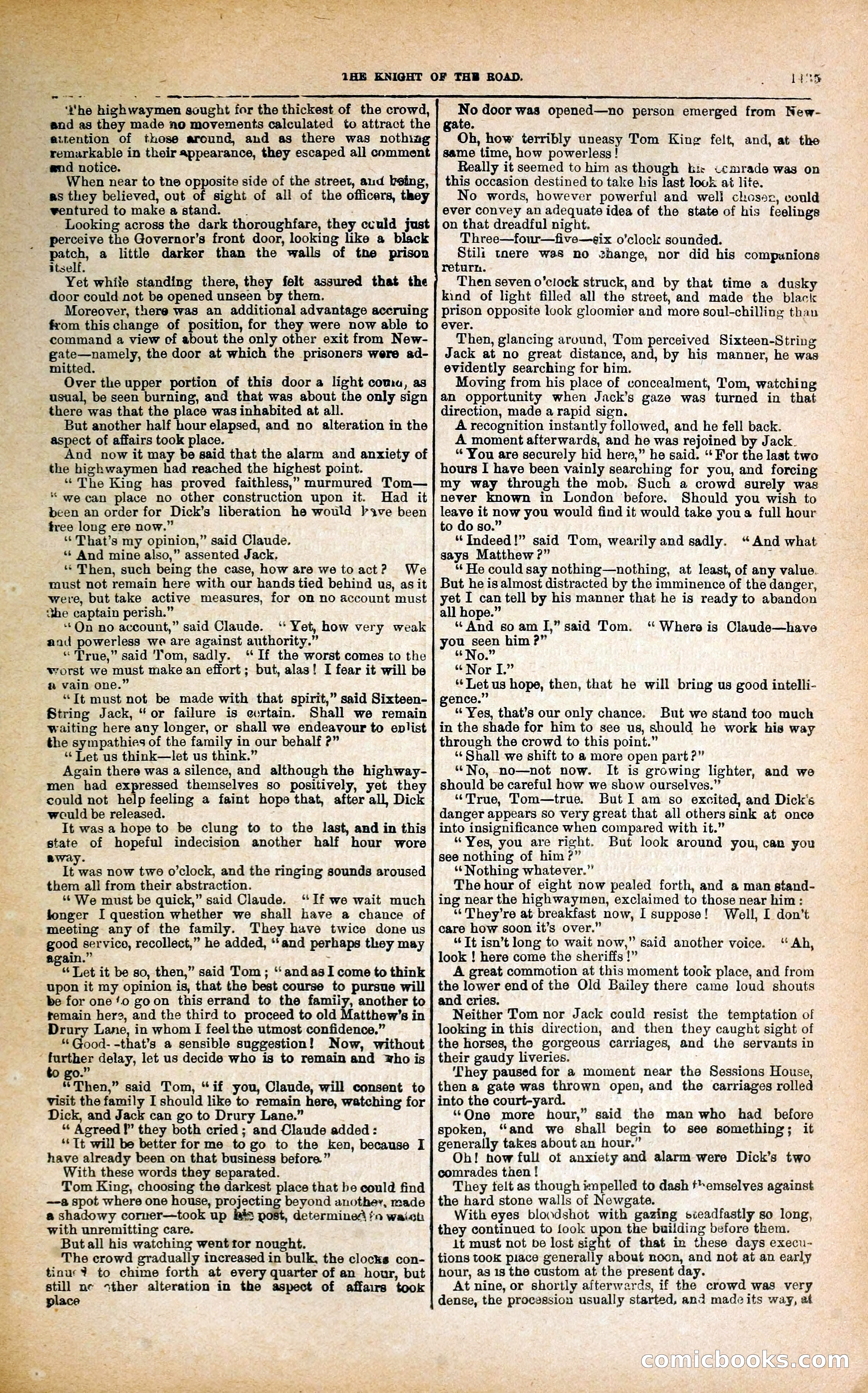
A restored page from Penny Dreadfuls, 1866. Page through the whole issue in the reader above.
📄 Transcribed text from this page (OCR, searchable)
Machine-transcribed from the original scan — historical spelling and the odd misread are preserved.
_— —™~ —. meeting any of the family. oe ‘he highwaymen sought for the thickest of the crowd, and as they made no movements calculated to attract the attention of those around, and as there was nothing remarkable in their sppearance, they escaped all comment and notice. When near to the opposite side of the street, aud being, as they believed, out of sight of all of the officers, they ventured to makea stand... , _ Looking across the dark thoroughfare, they cculd just perceive the Governor’s front door, looking like a black patch, a little darker than the walls of the prison itself. Yet while standing there, they felt assured that the door could not be opened unseen by them. Moreover, there was an additional advantage accruing from this change of position, for they were now able to command a view of about the only other exit from New- gate—namely, the door at which the prisoners were ad- mitted. ; Over the upper portion of this door a light coma, as usual, be seen burning, and that was about the only sign _ there was that the place was inhabited at all. But another half hour elapsed, and no alteration in the aspect of affairs took place. And now it may be said that the alarm and anxiety of the highwaymen had reached the highest point. “The King has proved faithless,” murmured Tom— “wecan place no other construction upon it. Had it been an order for Dick’s liberation he would }4ve been tree long ere now.” ‘“‘'That’s my opinion,” said Claude. ‘‘ And mine also,” assented Jack. ‘‘ Then, such being the case, how are we to act? We must not remain here with our hands tied behind us, as it were, but take active measures, for on no account must tthe captain perish.” ‘On no account,” said Claude. ‘ Yet, how very weak and powerless we are against authority.” “ True,” said 'lom, sadly. “If the worst comes to the worst we must make an effort; but, alas! I fear it will be ® vain one.” “Tt must not be made with that spirit,” said Sixteen- String Jack, ‘or failure is ecrtain. Shall we remain waiting here any longer, or shall we endeavour to eplist the sympathies of the family in our behalf ?” “ Let us think—let us think.” Again there was a silence, and although the highway- men had expressed themselves so positively, yet they could not help feeling a faint hope that, after all, Dick - would be released. It was a hope to be clung to to the last, and in this state of hopeful indecision another half hour wore away. if was now two o’clock, and the ringing sounds aroused them all from their abstraction. ‘‘ We must be quick,” said Claude. “If we wait much fonger I question whether we shall have a chance of They have twice done us good service, recollect,” he added, ‘‘and perhaps they may ain.” - “‘ Let it be so, then,” said Tom; “and asI come to think upon it my opinion is, that the best course to pursue will -be for one ‘o goon this errand to the famiiy, another to remain her, and the third to proceed to old Matthew’s in Drury Lane, in whom I feelthe utmost confidence.” “ Good- -that’s a sensible suggestion! Now, without ' further delay, let us decide who is to remain and Who is nv go. “Then,” said Tom, “if you, Claude, will consent to visit the family I should like to remain here, watching for Dick, and Jack can go to Drury Lane.” “* Acreed !” they both cried ; and Claude added: ‘‘ [t will be better for me to go to the ken, because I have already been on that business before.” With these words they separated. Tom King, choosing the darkest place that be could find —a spot where one house, projecting beyond another, made a shadowy corner—took up hés post, determined tn waich with unremitting care. But all his watching went for nought. The crowd gradually increased in bulk, the clocks con- tinue? to chime forth at every quarter of an hour, but still ne “ther alteration in the aspect of affairs took 1HE KNIGHT OF THB ROAD. Pei OS bt Ne door was opened—no person emerged from New- gate. Oh, how terribly uneasy Tom King felt, and, at the same time, how powerless! Really it seemed to him as though kis i.cmrade was on this occasion destined to take his last look ai lite. No words, however powerful and well choser, could ever convey an adequate idea of the state of his feelings on that dreadful night. Three—four—five—¢ix o’clock sounded. Stili tnere was no shange, nor did his compunions return. Then seven o’clock struck, and by that time a dusky kind of light filled all the street, and made the black prison opposite look gloomier and more soul-chilling than ever. Then, glancing around, Tom perceived Sixteen-String Jack at no great distance, and, by his manner, he was evidently searching for him. Moving from his place of concealment, Tom, watching an opportunity when Jack’s gaze was turned in that direction, made a rapid sign. A recognition instantly followed, and he fell back. A moment afterwards, and he was rejoined by Jack. “You are securely hid here,” he said. “‘ For the last two hours I have been vainly searching for you, and forcing my way through the mob. Such a crowd surely was never known in London before. Should you wish to leave it now you would find it would take youa full hour to do so.” “Indeed!” said Tom, wearily and sadly. says Matthew ?” “‘ He could say nothing—nothing, at least, of any value. But he is almost distracted by the imminence of the danger, yet I can tell by his manner that he is ready to abandon all hope.” “And soam I,” said Tom. “ Where is Claude—have you seen him ?” No.” * Nor I.” “Let us hope, then, that he will bring us good intelli- ence.” aa Yes, that’s our only chance. But we stand too much in the shade for him to see us, should he work his way through the crowd to this point.” ‘‘ Shall we shift to a more open part ?” ‘No, no—not now. It is growing lighter, and we should be careful how we show ourselves.” “True, Tom—true. But I am so excited, and Dick's danger appears so very great that all others sink at once into insignificance when compared with it.” “Yes, you are right. But look around you, can you see nothing of him ?” ‘‘ Nothing whatever.” The hour of eight now pealed forth, and a man stand- ing near the highwaymen, exclaimed to those near him: ‘¢They’re at breakfast now, I suppose! Well, I don’t care how soon it’s over.” “Tt isn’t long to wait now,” said another voice. ‘Ah, look ! here come the sheriffs !” A great commotion at this moment took place, and from the lower end of the Old Bailey there came loud shouts and cries. Neither Tom nor Jack could resist the temptation of looking in this direction, and then they caught sight of the horses, the gorgeous carriages, and the servants in their gaudy liveries. They paused for a moment near the Sessions House, then a gate was thrown open, and the carriages rolled into the court-yard. ‘Qne more hour,” said the man who had before spoken, “and we shall begin to see something; it generally takes about an hour.” Oh! how full of anxiety and alarm were Dick’s two comrades then ! They telt as though impelled to dash themselves against the hard stone walls of Newgate. With eyes bloodshot with gazing sceadfastly so long, they continued to fook upon the building before them. it must not be lost sight of that in these days execu- tions took piace generally about noon, and not at an early hour, a3 1s the custom at the present day. At nine, or shortly afterwards, if the crowd was very dense, the procassion usually started, and madeits way, at “ And what EON C) JOOKSAGO