
Penny Dreadfuls, 1866 · page 307 of 395
Black Bess; or, the Knight of the Road — page 307: what you’re looking at
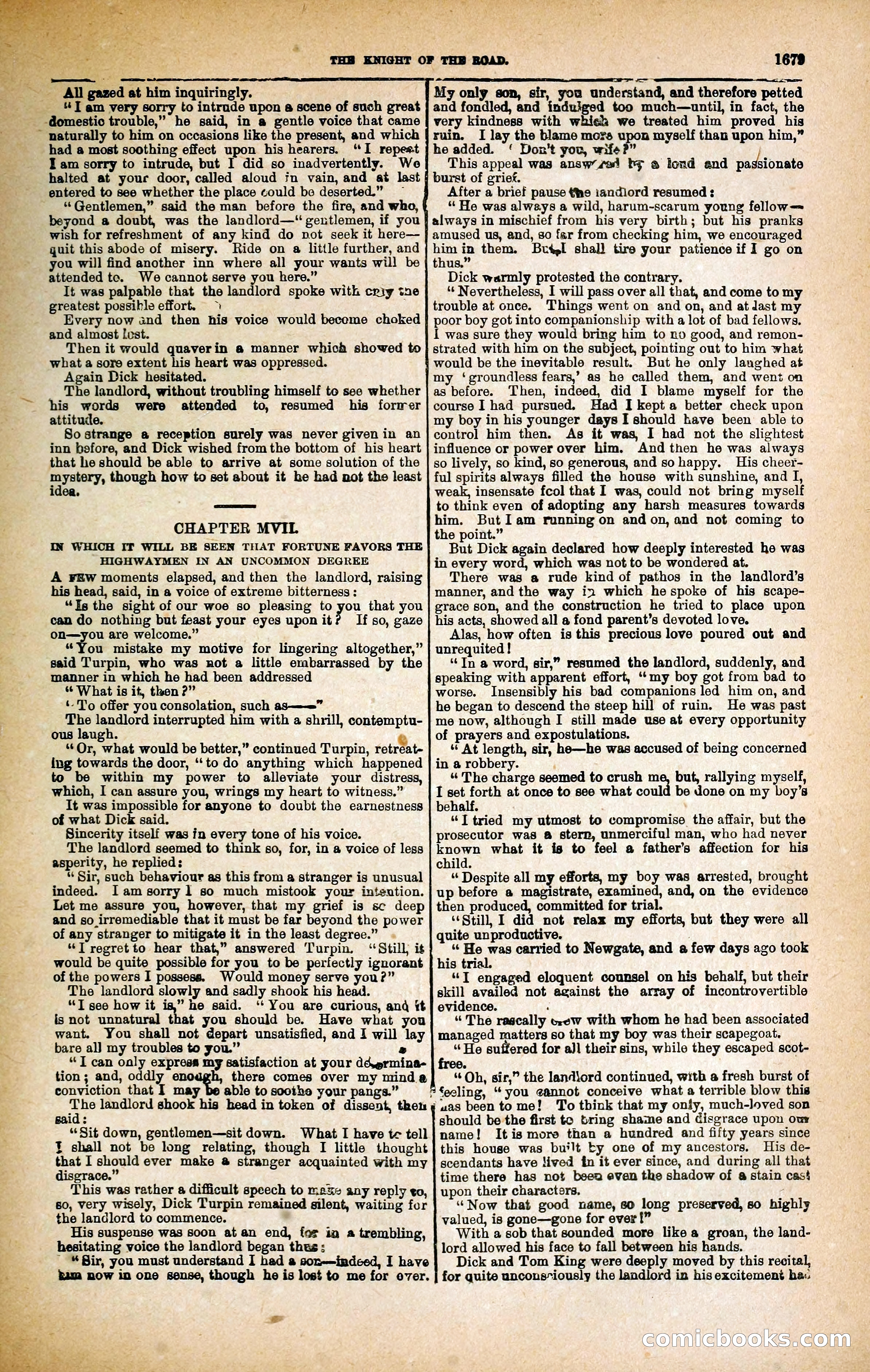
A restored page from Penny Dreadfuls, 1866. Page through the whole issue in the reader above.
📄 Transcribed text from this page (OCR, searchable)
Machine-transcribed from the original scan — historical spelling and the odd misread are preserved.
2 . * . or ire? fe ie“ bs * ~ - ills . ‘WIE Sve Eee, os . wil “es Ee meee oe it RO. Gu pety ~.> ar «% ‘ ot Dh My ‘i » + ein, RL hae > * * te, > a ° All gazed at him inquiringly. %T am ve to intrude upon a scene of such great _-domestio trouble,” he said, in a gentle voice that came naturally to him on occasions like the present, and which had a most soothing effect upon his hearers. “I repest Iam sorry to intrude, but I did so inadvertently. We halted at your door, called aloud jin vain, and at last entered to see whether the place could be deserted.” ~ ‘‘Gentlemen,” said the man before the fire, and who, beyond a doubt, was the landlord—“ gentlemen, if you wish for refreshment of any kind do not seek it here— quit this abode of misery. Ride on a little further, and you will find another inn where all your wants will be attended te. We cannot serve you here.” It was palpable that the landlord spoke with criy tne greatest possible effort. > Every now and then his voice would become choked and almost [vst. Then it would quaverin a manner which showed to what a sore extent his heart was oppressed. Again Dick hesitated. The landlord, without troubling himself to see whether his words were attended to, resumed his former attitude. So strange a reception surely was never given in an inn before, and Dick wished from the bottom of his heart that he should be able to arrive at some solution of the mystery, though how to set about it he had not the least idea. CHAPTER MVIL IN WHICH IT WILL BE SEEN THAT FORTUNE FAVORS THE HIGHWAYMEN IN AN UNCOMMON DEGREE A FEW moments elapsed, and then the landlord, raising his head, said, in a voice of extreme bitterness: “Is the sight of our woe so pleasing to you that you can do nothing but feast your eyes upon it 2 If so, gaze on—you are welcome.” e You mistake my motive for lingering altogether,” said Turpin, who was not a little embarrassed by the manner in which he had been addressed “ What is it, then ?” ‘- To offer you consolation, such as———” The landlord interrupted him with a shrill, contemptu- ous laugh. & ‘Or, what would be better,” continued Turpin, retreat- ing towards the door, ‘“‘to do anything which happened to be within my power to alleviate your distress, which, I can assure you, wrings my heart to witness.” It was impossible for anyone to doubt the earnestness of what Dick said. Sincerity itself was fn every tone of his voice. The landlord seemed to think so, for, in a voice of less asperity, he replied: “ Sir, such behaviour as this from a stranger is unusual indeed. [Iam sorry 1 so much mistook your intsution. Let me assure you, however, that my grief is sc deep and so irremediable that it must be far beyond the power of any stranger to mitigate it in the least degree.” . “T regret to hear that,” answered Turpin. “Still it would be quite possible for you to be perfectly ignorant of the powers I possess. Would money serve you?” The landlord slowly and sadly shook his head. “T see how it is,” he said. ‘‘ You are curious, and tt is not unnatural that you should be. Have what you want. You shall not depart unsatisfied, and 1 will lay bare alJ my troubles to you.” » “T can oaly express my satisfaction at your déevermina- tion; and, oddly sips there comes over my mind e conviction that I may be able to soothe your pangs.” ae landlord shook his head in token of dissent, then paid ; “Sit down, gentlomen—sit down. What I have te tell ¥ shall not be long relating, though I little thought that I should ever make & stranger acquainted with my disgrace.” This was rather a difficult speech to meze any reply to, 60, very wisely, Dick Turpin remained silent, waiting for the landlord to commence. His suspense was soon at an end, for in a trembling, hesitating voice the landlord began thus: _ “Bir, you must understand I had a son—indced, I have Bima now in ope sense, though he is lost to me for over. * 4 mt Yanhaee 4 os Pei ate Ts vs foo “wares >| ay aes te ~~ al ‘ » & ae * alld THS ENIGHT OF THE BROAD. 1678 My onl sir, you understand, and therefore petted Ria fonlled, bid ioiniced too much—until, in fact, the very kindness with whiek we treated him proved his ruin. I lay the blame mors upon myself than upon him,” he added. ‘ Don't yor, wife?” This appeal was answ /s4 burst of griek. After a brief pause {he iandiord resumed ? “ He was always a wild, harum-scarum young fellow—= always in mischief from his very birth; but his pranks amused us, and, so far from checking him, we encouraged abe ip them. But,l shal) tire your patience if I go on thus.” Dick warmly protested the contrary. ‘t Nevertheless, I will pass over all that, and come to my trouble at once. Things went on and on, and at Jast my poor boy got into companionship with a lot of bad fellows. I was sure they would bring him to no good, and remon- strated with him on the subject, pointing out to him what would be the inevitable result. But he only laughed at my ‘groundless fears,’ as he called them, and went on as before. Then, indeed, did I blame myself for the course I had pursued. Had I kept a better check upon my boy in his younger days I should have been able to control him then. As it was, I had not the slightest influence or power over him. And then he was always so lively, so kind, so generous, and so happy. His cheer- ful spirits always filled the house with sunshine, and I, weak, insensate fcol that I was, could not bring myself to think even of adopting any harsh measures towards him. But Iam running on and on, and not coming to the point.” But Dick again declared how deeply interested he was in every word, which was not to be wondered at. There was a rude kind of pathos in the landlord’s manner, and the way in which he spoke of his scape- grace son, and the construction he tried to place upon his acts, showed all a fond parent’s devoted love. Alas, how often is this precious love poured out and unrequited ! ‘In a word, sir,” resumed the landlord, suddenly, and speaking with apparent effort, ‘‘my boy got from bad to worse. Insensibly his bad companions led him on, and he began to descend the steep hill of ruin. He was past me now, although I still made use at every opportunity of prayers and expostulations. ** At length, sir, he—he was accused of being concerned in a robbery. ‘ The charge seemed to crush me, but, rallying myself, I set forth at once to see what could be done on my boy’s behalf. “T tried my utmost to compromise the affair, but the prosecutor was @ stern, unmerciful man, who had never known what it is to feel a father’s affection for his child. “ Despite all my efforts, my boy was arrested, brought up before a magistrate, examined, and, on the evidence then produced, committed for trial. ‘Still, I did not relax my efforts, but they were all quite unproductive. | ‘‘ He was carried to Newgate, and a few days ago took his trial. “T engaged eloquent counsel on his behalf, but their skill availed not against the array of incontrovertible evidence. “ The rascally cxew with whom he had been associated managed matters so that my boy was their scapegoat. “ He suffered for aJl their sins, while they escaped scot- ry @ lond and passionate “Oh, sir,” the land\ord continued, with a fresh burst of ® feeling, “you ¢annot conceive what a terrible blow this ‘was been to me! To think that my only, much-loved son should be the first to tring shame and disgrace upon our name! Itis more than a hundred and fifty years since this houge was built ty one of my ancestors. His de- scendants have lived in it ever since, and during all that time there has not bsea even the shadow of a stain cas! upon their characters, ‘Now that good name, so long preserved, so highly valued, is gone—gone for ever !” With a sob that sounded more like a groan, the land- lord allowed his face to fall between his hands. Dick and Tom King were deeply moved by this recital, for quite uncons“iously the landlord in his excitement ha: Gomichoo | eS (E(@)