
Penny Dreadfuls, 1866 · page 169 of 395
Black Bess; or, the Knight of the Road — page 169: what you’re looking at
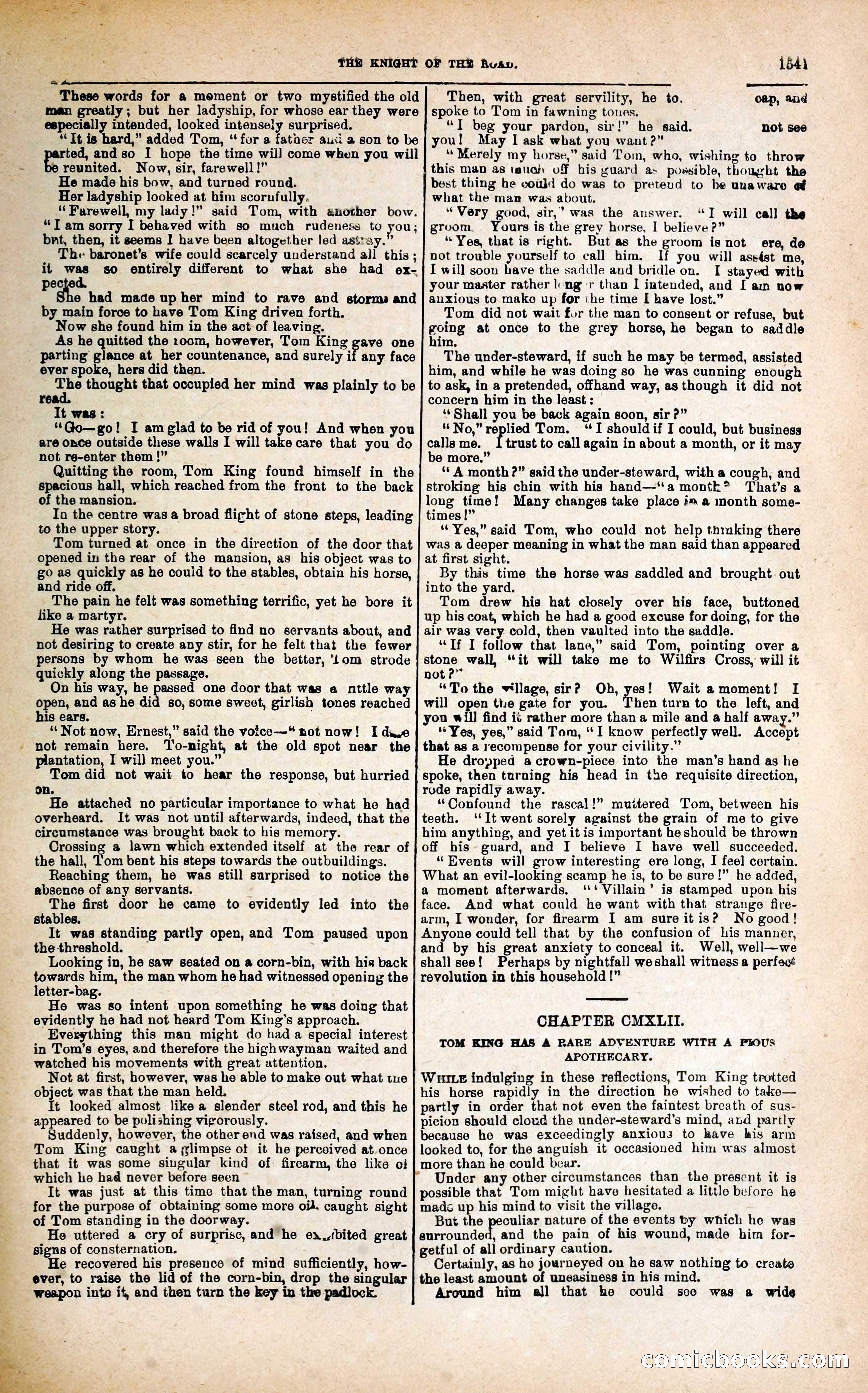
A restored page from Penny Dreadfuls, 1866. Page through the whole issue in the reader above.
📄 Transcribed text from this page (OCR, searchable)
Machine-transcribed from the original scan — historical spelling and the odd misread are preserved.
~ especially intended, looked intensely surprised. “It is hard,” added Tom, “for a fatoer audi a son to be ted, and so I hope the time wil] come when you will reunited. Now, sir, farewell!” He made his bow, and turned round. Her ladyship looked at him scorufully. “Farewell, my lady!” said Tom, with enother bow. “Tam sorry I behaved with so much rudeness to you; brit, then, it seems I have been altogether led astray.” The baronet’s wife could scarcely understand all this ; it was so entirely different to what she had ex- pected. e had made up her mind to rave and storms and by main force to have Tom King driven forth. Now she found him in the act of leaving. As he quitted the 100m, however, Tom King gave one parting glance at her countenance, and surely if any face ever spoke, hers did then. _ The thought that occupied her mind was plainly to be read. It was: ‘‘Go—go! I amglad to be rid of you! And when you are once outside these walls I will take care that you do not re-enter them !” Quitting the room, Tom King found himself in the spacious hall, which reached from the front to the back of the mansion. In the centre was a broad flight of stone steps, leading to the upper story. Tom turned at once in the direction of the door that opened in the rear of the mansion, as his object was to go as quickly as he could to the stables, obtain his horse, and ride off. The pain he felt was something terrific, yet he bore it like a martyr. He was rather surprised to find no servants about, and not desiring to create any stir, for he felt that the fewer persons by whom he was seen the better, ‘Lom strode quickly along the passage. On his way, he passed one door that was a nttle way open, and as he did so, some sweet, girlish tones reached his ears. ‘‘ Not now, Ernest,” said the voice—*“ not now! I dwe not remain here. To-night, at the old spot near the plantation, I will meet you.” Tom did not wait to hear the response, but hurried He attached no particular importance to what he had overheard. It was not until afterwards, indeed, that the circumstance was brought back to his memory. Crossing a lawn which extended itself at the rear of the hall, Tom bent his steps towards the outbuildings. Reaching them, he was still surprised to notice the absence of any servants. The first door he came to evidently led into the stables. It was standing partly open, and Tom paused upon the threshold. Looking in, he saw seated on a corn-bin, with his back towards him, the man whom he had witnessed opening the letter-bag. He was so intent upon something he was doing that evidently he had not heard Tom King’s approach. Everything this man might do had a especial interest in Tom’s eyes, and therefore the highwayman waited and watched his movements with great attention. Not at first, however, was he able to make out what tue object was that the man held. It looked almost like a slender steel rod, and this he appeared to be polishing vigorously. | Suddenly, however, the other end was raised, and when Tom King caught a glimpse ot it he perceived at.once that it was some singular kind of firearm, the like oi which he had never before seen It was just at this time that the man, turning round for the purpose of obtaining some more oid, caught sight of Tom standing in the doorway. He uttered a cry of surprise, and he ex. bited great eens of consternation. e recovered his presence of mind sufficiently, how- ever, to raise the lid of the corn-bin, drop the singular weapon inte it, and then turn the key in the padlock. THE KNIGHT OF THY fivan. These words for a mement or two mystified the old man greatly; but her ladyship, for whose ear they were 1541 Then, with great servility, he to. cap, ad spoke to Tom in fawning tones. “I beg your pardon, sir!” he said. not see you! May I ask what you want?” “Merely my horse,” said Tom, who, wishing to throw this man as tana of his guard as possible, thought the best thing he could do was to pretevd to be unaware @ what the man was about. “Very good, sir,’ was the answer. “I will call the groom. Yours is the grey horse, I believe ?” “ Yes, that is right. But as the groom is not ere, de not trouble yourself to call him. If you will assést me, I will soon have the saddle and bridle on. I stayed with your master rather long r than I intended, and I am now auxious to mako up for the time I have lost.” Tom did not wait fur the man to consent or refuse, but going at once to the grey horse, he began to saddle ™m. The under-steward, if such he may be termed, assisted him, and while he was doing so he was cunning enough to ask, in a pretended, offhand way, as though it did not concern him in the least: ‘*Shall you be back again soon, sir ?” “No,” replied Tom. “I shouldif I could, but business calls me. I trust to call again in about a month, or it may be more.” ‘A month ?” said the under-steward, with a cough, and stroking his chin with his hand—‘‘a montk® That’s a long ue Many changes take place im a month some- times !” Yes,” said Tom, who could not help thimking there was a deeper meaning in what the man said than appeared at first sight. By this time the horse was saddled and brought. out into the yard. Tom drew his hat closely over his face, buttoned up his coat, which he had a good excuse for doing, for the air was very cold, then vaulted into the saddle. “Tf I follow that lane,” said Tom, pointing over a gone wall, “it will take me to Wilfirs Cross, will it note” “To the village, sir? Oh, yes! Wait amoment! I will open tue gate for you. ‘Then turn to the left, and you will find it rather more than a mile and a half away.” “Yes, yes,” said Tom, “I know perfectly well. Accept that as a recompense for your civility.” He droyped acrown-piece into the man’s hand as he spoke, then turning his head in the requisite direction, rode rapidly away. ‘“‘Confound the rascal!” muttered Tom, between his teeth. “It went sorely against the grain of me to give him anything, and yet itis important he should be thrown off his guard, and I believe I have well succeeded. “ Events will grow interesting ere long, I feel certain. What an evil-looking scamp he is, to be sure!” he added, a moment afterwards. ‘‘ Villain’ is stamped upon his face. And what could he want with that strange fire- arm, I wonder, for firearm I am sureitis? No good! Anyone could tell that by the confusion of his manner, and by his great anxiety to conceal it. Well, well—we shall see! Perhaps by nightfall weshall witness a perfect revolution in this household !” CHAPTER CM&LII. TOM KING HAS A RARE ADVENTURE WITH A PHOUS APOTHECARY. Waite indulging in these reflections, Tom King trotted his horse rapidly in the direction he wished to take— partly in order that not even the faintest breath of sus- picion should cloud the under-steward’'s mind, and partly because he was exceedingly anxious to have his arm looked to, for the anguish it occasioned him was almost more than he could bear. Under any other circumstances than the present it is possible that Tom might have hesitated a little before he madc up his mind to visit the village. But the peculiar nature of the events by which he was surrounded, and the pain of his wound, made him for- getful of all ordinary caution. Certainly, as he journeyed on he saw nothing to create the least amount of uneasiness in his mind. Around him aj] that he could sec was a wide VNOOLKS =) a (E(@) (E(0)