
Penny Dreadfuls, 1866 · page 70 of 395
Black Bess; or, the Knight of the Road — page 70: what you’re looking at
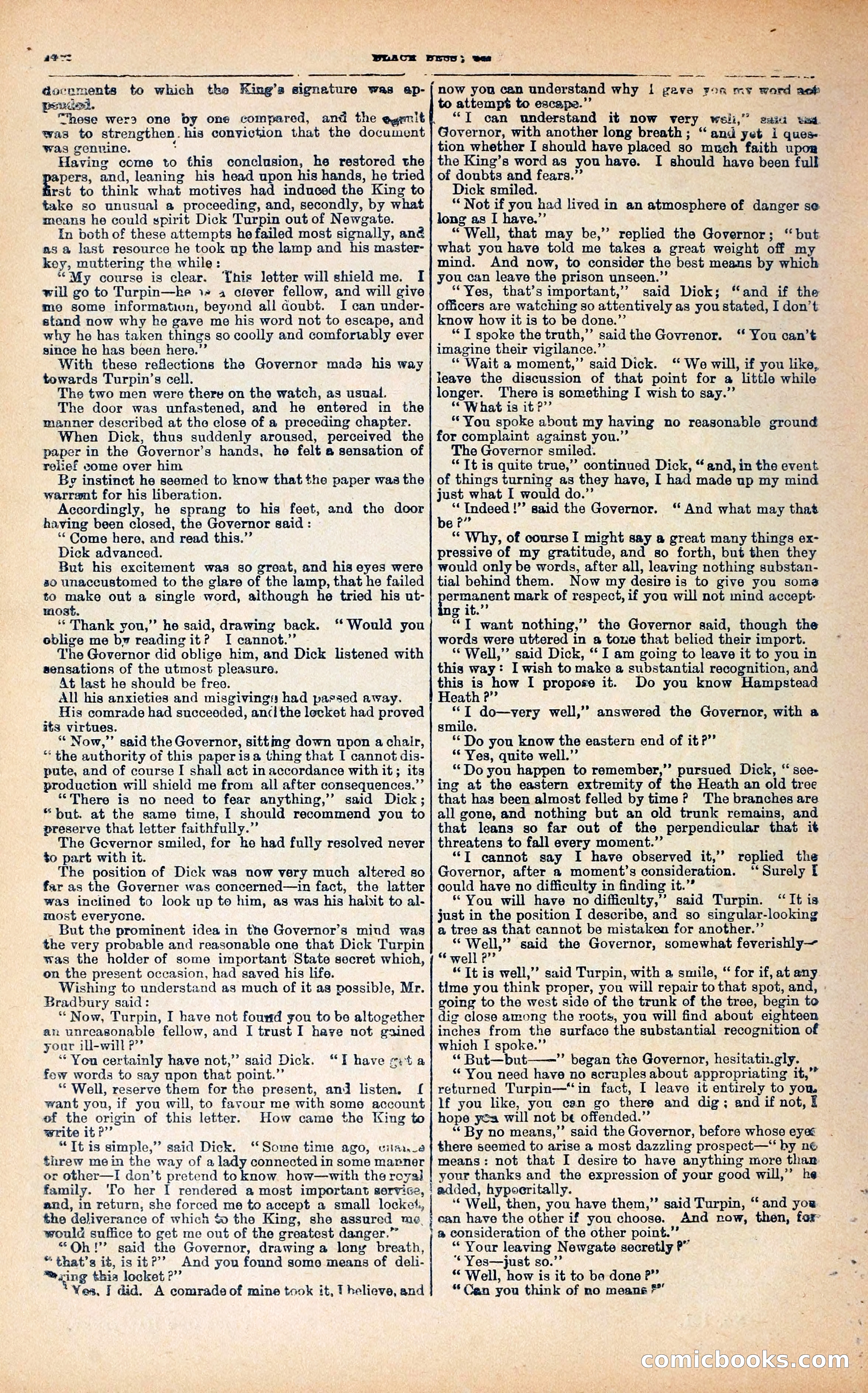
A restored page from Penny Dreadfuls, 1866. Page through the whole issue in the reader above.
📄 Transcribed text from this page (OCR, searchable)
Machine-transcribed from the original scan — historical spelling and the odd misread are preserved.
avr —— psuded. “hese werd one by one compared, and the Lt F was to strengthen. his conviction that the document was genvine. Having come to this conclusion, he restored the pers, and, leaning his head upon his hands, he tried brs t to think what motives had induced the King to take so unusual a proceeding, and, secondly, by what moans he could spirit Dick Turpin out of N ewgate. In both of these attempts he failed most signally, and as a last resource he took up the lamp and his master- koy, muttering the while: *“My course is clear. ‘his letter will shield me. I will go to Turpin—ke »~ a clever fellow, and will give mo some information, beyond all doubt. I can under- stand now why he gave me his word not to escape, and why he has taken things so coolly and comfortably ever since he has been here.” With these reflections the Governor mada his way towards Turpin’s cell. The two men were there on the watch, as usual. The door was unfastened, and he entered in the manner described at the close of a preceding chapter. When Dick, thus suddenly aroused, perceived the paper in the Governor’s hands, he felt a sensation of relief come over him Be instinct he seemed to know thatthe paper waa the warrant for his liberation. Accordingly, he sprang to his feet, and the door having been closed, the Governor said : ‘Come here, and read this.” Dick advanced. But his excitement was so great, and his eyes were 30 unaccustomed to the glare of the lamp, that he failed to make out a single word, aithough he tried his ut- most. ‘* Thank vou,’” he said, drawing back. ‘“‘ Would you oblice me by reading it? I cannot.’’ The Governor did oblige him, and Dick listened with sensations of the utmost pleasure. At last he should be freo. All his anxieties and misgivings) had passed away. His comrade had succeeded, ancl the lecket had proved ats virtues. ** Now,’’ said the Governor, sittmg down upon achalr, “‘ the authority of this paperisa thing that I cannot dis- pute, and of course I shall act in accordance with it ; its production will shield me from all after consequences.”’ “There is no need to fear anything,” said Dick; “but. at the same time, I should recommend you to preserve that letter faithfully.”’ The Gevernor smiled, for he had fully resolved never to part with it. The position of Dick was now very much altered so far as the Governer was concerned—in fact, the latter was inclined to look up to him, as was his halt to al- most everyone. _ But the prominent idea in the Governor’s mind was the very probable and reasonable one that Dick Turpin was the holder of some important State secret which, on the present occasion, had saved his life. Wishing to understand as much of it as possible, Mr. Bradbury said: * Now, Turpin, I have not fourd you to be altogether an unreasonable fellow, and I trust I have not gained your ill-will P”’ “You certainly have not,” said Dick. “I have fow words to say upon that point.”’ ““ Well, reserve them for the present, and listen. [ want you, if you will, to favour me with some account of the origin of this letter. How came the King to write it?’ “It is simple,” said Dick. “Some time ago, vitai._ea threw mein the way of a lady connected in some marner or other—I don’t pretend to know how—with the royal family. ‘To her I rendered a most important service, and, in return, she forced me to accept a small locket, the deliverance of which % the King, she assured mg. would suffice to get me out of the greatest danger,” *QOh!”’ said the Governor, drawing a lony breath, * that’s it, is it???’ And you found some means of deli- ring this locket ?’’ V Wes, I did. A comrade of mine took it, T helieve, and $2 docements to which tho King’s ipa dines was Seiinie mone i °§ b WRACH Bros; vasa a PELE Se now you can understand why | geva yor my word ach to attempt to escape.’ “T can understand it now very _weli,’ % Governor, with another long breath; “and yet i ques tion whether I should have placed 80 much faith upor the King’s word as you have. I should have been full of doubts and fears.”’ Dick smiled. * Not if you had lived in an atmosphere of danger se long as I have.’’ - Well, that may be,”’ replied the Governor; “ but what you have told me takes a great weight off my mind. And now, to consider the best means by which you can leave the prison unseen.’ | ‘Yes, that’s important,” said Dick; “and if the officers are watching so attentively as you stated, I don’t know how it is to be done.”’ “TI spoke the truth,” said the Govrenor. imagine their vigilance.” “Wait a moment,’”’ said Dick. © You can’t “We will, if you like, leave the discussion of that point for a litile while longer. There is something I wish to say.’ ** What is it P”’ You spoke about my having no reasonable ground for complaint against you.’ The Governor ‘smiled. “It is quite true,” continued Dick, “ and, in the event of things turning as they have, I had made up my mind just what I would do.” - Indeed !”’ said the Governor. ‘ And what may that @ ” “ Why, of course I might say a great many things ex- pressive of my gratitude, and so forth, but then they would only be words, after all, leaving nothing substan- tial behind them. Now my desire is to give you soma ermanent mark of respect, if you will not mind accept- g it.’”’ “T want nothing,’ the Governor said, though the words were uttered in & tone that belied their import. * Well,”’ said Dick, “‘ I am going to leave it to you in this way: I wish to make a substantial recognition, and this is how I propose it. Do you know Hampstead Heath ?” ‘al do—very well,’ answered the Governor, with a smile. “Do you know the eastern end of it ?”’ ** Yes, quite well.”’ “Do you happen to remember,” pursued Dick, “ soe- ing at the eastern extremity of the Heath an old tree that has been almost felled by time? The branches are all gone, and nothing but an old trunk remains, and that leans so far out of tho perpendicular that it threatens to fall every moment.”’ “T cannot say I have observed it,’’ replied the Surely [ could have no difficulty in finding it.’ * You will have no difficulty,” said Turpin. “It is just in the position I describe, and so singular- looking a tree as that cannot be mistaken for another.’’ “Well,” said the Governor, somewhat feverishly— “¢ well ?”’ Governor, after a moment’s consideration. “It is well,” said Turpin, with a smile, “ for if, at any. time you think proper, you wiil repair to ‘that spot, and, » going to the west side of the trunk of the tree, begin to dig close among the roots, you will find about eighteen inches from the surface the substantial recognition of which I spoke.” “ But—but——”’ began the Governor, hesitatiugly. “You need have no scruples about appropriating it,” returned Turpin—‘in fact, I leave it entirely to you lf you like, you can go there and dig; and if not, f hope yea will not be offended.”’ “By no means,’ said the Governor, before whose eyes there seemed to arise a most dazzling prospect—‘ hy ne means: not that I desire to have anything more than your thanks and the expression of your good will,” he added, hypocritally. ‘“ Well, then, you have them,”’ ean have the other if you choose. ® consideration of the other point.” “ Your leaving N ewgate secretly ?” “* Yes—just so.’ “ Well, how is it to be done ?”’ Can you think of mo means *” said Turpin, “and you Saxi Saad. And row, then, for cS (eo) ,OO (e(o) ='5