
Penny Dreadfuls, 1866 · page 372 of 395
Black Bess; or, the Knight of the Road — page 372: what you’re looking at
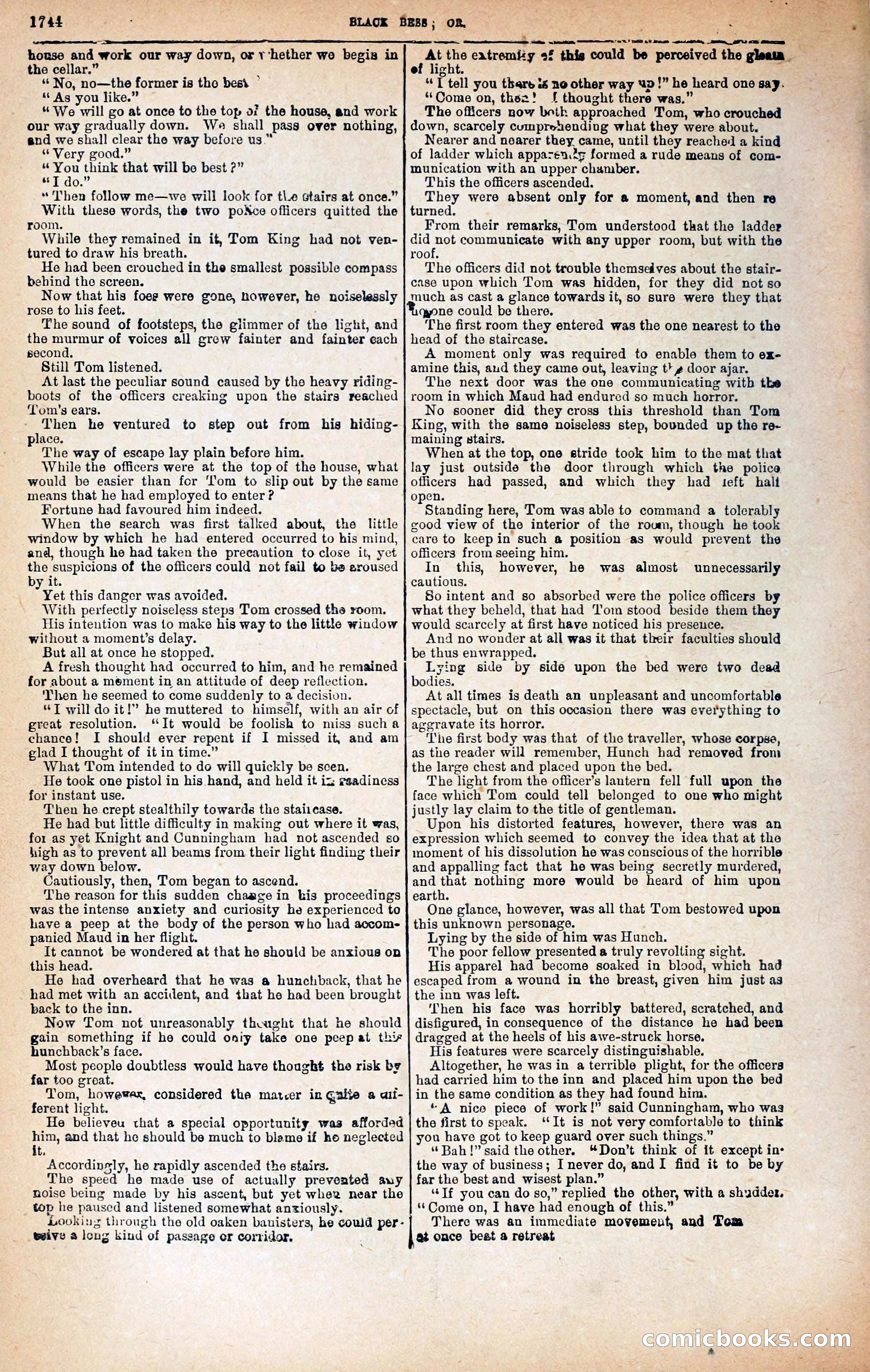
A restored page from Penny Dreadfuls, 1866. Page through the whole issue in the reader above.
📄 Transcribed text from this page (OCR, searchable)
Machine-transcribed from the original scan — historical spelling and the odd misread are preserved.
1744 house and work our way down, or r‘hether we begins in the cellar.” ‘No, no—the former is the best ~ “ Ag you like.” “We will go at once to the top of the house, and work our way gradually down. Wa shall pass over nothing, and we shall clear the way before us.“ “Very good.” “ You think that will be best ?” “5 do.” “Then follow me—we will look for tle Gtairs at once.” With these words, the two poXce officers quitted the room. While they remained in it, Tom King had not ven- tured to draw his breath. He had been crouched in the smallest possible compass behind the screen. Now that his foeg were gone, however, he noiselessly rose to his feet. The sound of footsteps, the giimmer of the light, and the murmur of voices all grew fainter and fainter each second. Still Tom listened. At last the peculiar sound caused by the heavy riding- boots of the officers creaking upon the stairs reached ‘Tom’s ears. Then he ventured to step out from his hiding- lace. , The way of escape lay plain before him. While the officers were at the top of the house, what would be easier than for ‘’om to slip out by the same means that he had employed to enter ? Fortune had favoured him indeed. When the search was first talked about, the little window by which he had entered occurred to his mind, and, though he had taken the precaution to close it, yet the suspicions of the officers could not fail to be aroused by it. "Yet this danger was avoided. With perfectly noiseless steps Tom crossed the room. His intention was to make his way to the little window without a moment’s delay. But all at once he stopped. A fresh thought had occurred to him, and he remained for about a mement in an attitude of deep reflection. ‘Then he seemed to come suddenly to a decision. “T will do it!” he muttered to himself, with an air of great resolution. ‘It would be foolish to miss sucha chance! I should ever repent if I missed it, and am glad I thought of it in time.” What Tom intended to do will quickly be scen. He took one pistol in his hand, and held it iz: readiness for instant use. Then he crept stealthily towards the staiiease. He had but little difficulty in making out where it was, for as yet Knight and Cunningham had not ascended so high as to prevent all beams from their light finding their way down below. Cautiously, then, Tom began to ascend. The reason for this sudden chaage in kis proceedings was the intense anxiety and curiosity he experienced to have a peep at the body of the person who had accome- panied Maud in her flight. It cannot be wondered at that he should be anxious on this head. He had overheard that he was a hunchback, that he had met with an accident, and that he had been brought back to the inn. Now Tom not unreasonably theught that he should gain something if he could onity take one peep at thir hunchback’s face. Most people doubtless would have thought the risk by far too groat. Tom, howewax, considered the mater in Gale a ail- ferent light. He believeu that a special opportunity was afforded 1a and that he should be much to blame if he neglected t. Accordinsly, he rapidly ascended the stairs. The speed he made use of actually prevented any noise being made by his ascent, but yet whee near the top he paused and listened somewhat anziously. Looking through the old oaken bauisters, he cowd per- ‘evive a long kiud of passage er corridor. BLAOK BESB; OR | ce at ore “ At the eatremiiy +f this could be perceived the gleata ef light. “T tell you thare is no other way up!” he heard ono say. ‘Come on, thez’ Jf thought there was.” The officers now both approached Tom, who crouched down, scarcely cumprehending what they were about. Nearer and nearer they came, until they reached a kind of ladder which appareus formed a rude means of com- munication with an upper chamber. This the officers ascended. They were absent only for a moment, and then re turned. From their remarks, Tom understood that the ladder id mgt communicate with any upper room, but with the roof. The officers did not trouble themsedves about the stair- case upon which T’om was hidden, for they did not so much as cast a glance towards it, so sure were they that Bs qyone could be there. The first room they entered was the one nearest to the head of the staircase. A moment only was required to enable them to ex- amine this, aud they came out, leaving tg door ajar. The next door was the one communicating witb tke room in which Maud had endured so much horror. No sooner did they cross this threshold than Tom King, with the same noiseless step, bounded up the re~ maining stairs. When at the top, one stride took him to the mat that lay just outside the door through which the poiice officers had passed, and which they had teft halt open. Standing here, Tom was able to command a tolerably good view of the interior of the roum, though he took care to keepin such @ position as would prevent the officers from seeing him. In this, however, he was almost unnecessarily cautious. So intent and so absorbed were the police officers by what they beheld, that had Tom stood beside them they would scarcely at first have noticed his preseuce. And no wonder at all was it that their faculties should be thus enwrapped. Lying side by side upon the bed were two dead bodies. At all times is death an unpleasant and uncomfortable spectacle, but on this occasion there was everything to ageravate its horror. The first body was that of the traveller, whose corpse, as the reader will remember, Hunch had removed from the large chest and placed upon the bed. The light from the officer’s lantern fell full upon the face which Tom could tell belonged to one who might justly lay claim to the title of gentleman. Upon his distorted features, however, there was an expression which seemed to convey the idea that at the moment of his dissolution he was conscious of the horrible and appalling fact that he was being secretly murdered, and that nothing more would be heard of him upon earth. One glance, however, was all that Tom bestowed upon this unknown personage. Lying by the side of him was Hunch. The poor fellow presented a truly revolting sight. His apparel had become soaked in blood, which had escaped from a wound in the breast, given him just as the inn was left. ‘Then his face was horribly battered, scratched, and disfigured, in consequence of the distance he had been dragged at the heels of his awe-struck horse. His features were scarcely distinguishable. Altogether, he was in a terrible plight, for the officers had carried him to the inn and placed him upon the bed in the same condition as they had found him. ‘A nice piece of work!” said Cunningham, who was the first to speak. ‘It is not very comfortable to think you have got to keep guard over such things.” “Bah!” said the other. “Don’t think of it except in: the way of business; I never do, andI find it to be by far the best and wisest plan.” ‘Tf you can do so,” replied the other, with a shudders, ‘Come on, I have had enough of this.” There was an immediate movement, and Tom at once best a retreat > “-, om a“ e ’ ef’ . ~ or. + or ‘+h ~- - (e(6) JOO CS com , on 4 »> al _—* a eal oi <l a ae oo > ge” ee