
Penny Dreadfuls, 1866 · page 382 of 395
Black Bess; or, the Knight of the Road — page 382: what you’re looking at
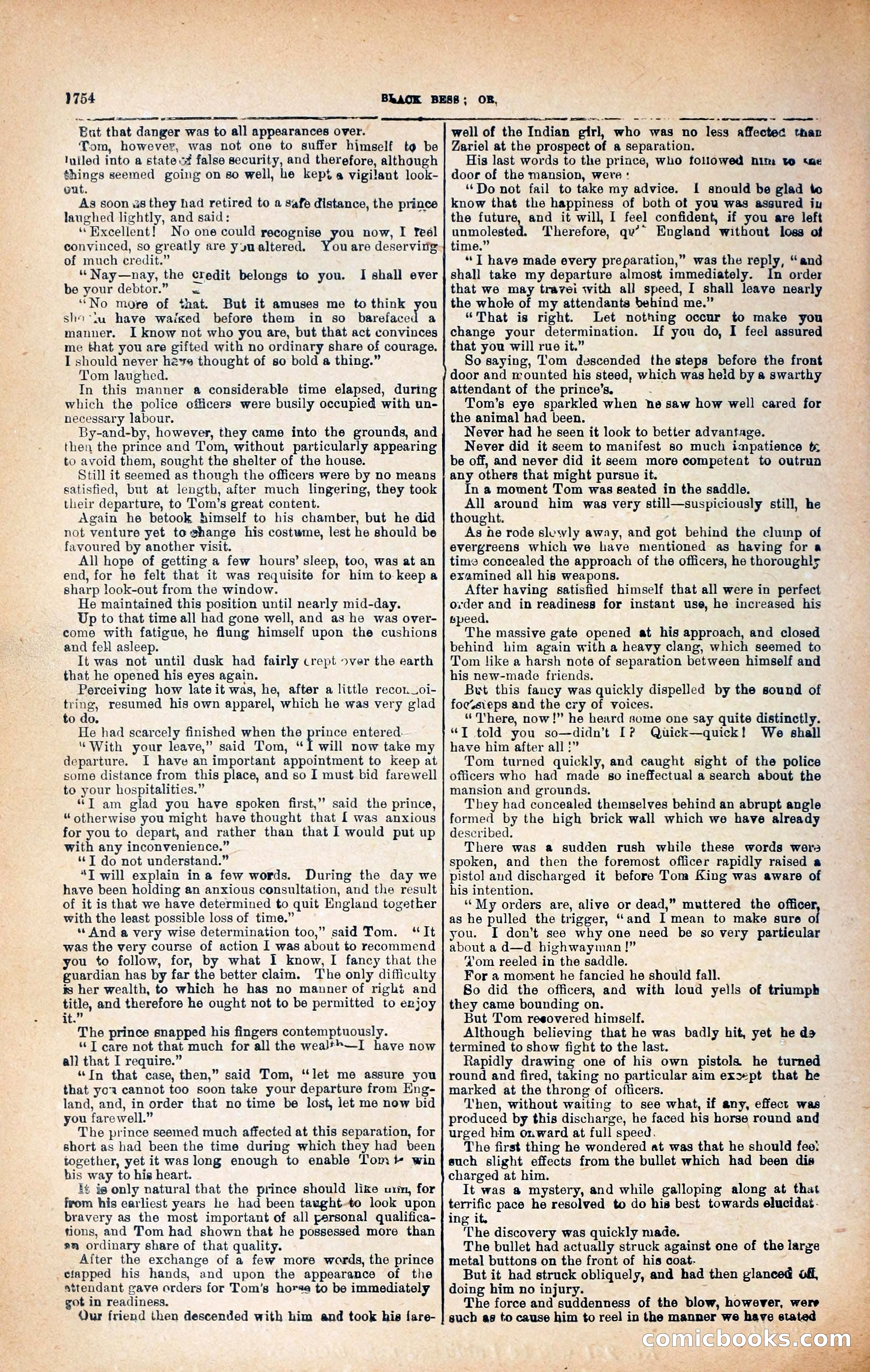
A restored page from Penny Dreadfuls, 1866. Page through the whole issue in the reader above.
📄 Transcribed text from this page (OCR, searchable)
Machine-transcribed from the original scan — historical spelling and the odd misread are preserved.
)754 But that danger was to all appearances over. Tom, however, was not one to suffer himself tg be luiled into a state of false security, and therefore, although things seemed going on so well, he kept a vigilant look- out. As soon ws they had retired to a safe distance, the prince laughed lightly, and said: ‘ Bixcellent! No one could recognise convinced, so greatly are yyu altered. of much credit.” * Nay—nay, the be your debtor.” ‘No more of that. But it amuses me to think you sho -iu have waixed before them in so barefaced a manner. I know not who you are, but that act convinces me that you are gifted with no ordinary share of courage. I should never hée thought of so bold a thing.” Tom laughed. In this manner a considerable time elapsed, during which the police officers were busily occupied with un- necessary labour. By-and-by, however, they came into the grounds, and then the prince and Tom, without particularly appearing to avoid them, sought the shelter of the house. Still it seemed as though the officers were by no means satisfied, but at length, after much lingering, they took their departure, to ‘T’om’s great content. Again he betook himself to his chamber, but he did not venture yet to shange his costwme, lest he should be favoured by another visit. All hope of getting a few hours’ sleep, too, was at an end, for he felt that it was requisite for him to keep a sharp look-out from the window. He maintained this position until nearly mid-day. Up to that time all had gone well, and as he was over- come with fatigue, he flung himself upon the cushions and fell asleep. It was not until dusk had fairly crept over the earth that he opened his eyes again. Perceiving how late it was, he, after a little recor _oi- tring, resumed his own apparel, which he was very glad to do. He had scarcely finished when the ae entered. “With your leave,” said Tom, “I will now take my departure. I have an important appointment to keep at some distance from this place, and so I must bid farewell to your hospitalities.” “JT am glad you have spoken first,” said the prince, “otherwise you might have thought that 1 was anxious for you to depart, and rather than that I would put up with any inconvenience.” ‘‘T do not understand.” “T will explain ina few words. During the day we have been holding an anxious consultation, and the result of it is that we have determined to quit England togetker with the least possible loss of time.” ‘‘ And a very wise determination too,” said Tom. ‘It was the very course of action I was about to recommend you to follow, for, by what 1 know, I fancy that the guardian has by far the better claim. The only difficulty is her wealth, to which he has no manner of right and title, and therefore he ought not to be permitted to enjoy The prince snapped his fingers contemptuously. “T care not that much for all the weal#*—I have now al) that I require.” “In that case, then,” said Tom, ‘let me assure you that you cannot too soon take your departure from Eng- land, and, in order that no time be lost, let me now bid you farewell.” The prince seemed much affected at this separation, for short as had been the time during which they had been together, yet it was long enough to enable Tom win his way to his heart. ts is only natural that the prince should like uxm, for from his earliest years he had been taught-to look upon bravery as the most important of all personal qualifica- sions, and Tom had shown that he possessed more than 9m ordinary share of that quality. Aiter the exchange of a few more words, the prince ciapped his hands, and upon the appearance of the attendant gave orders for Tom’s horse to be immediately got in readiness. Qur friend then descended with him and took his {are- EE ou now, I feel ou are deserving credit belongs to you. I shall ever BhACK BESS; OK, well of the Indian girl, who was no less affectec thar Zariel at the prospect of a separation. His last words to the prince, who followed Dim to sae door of the mansion, were ' ‘‘Do not fail to take my advice. I snould be glad to know that the happiness of both of you was assured iu the future, and it will, I feel confident, if you are left unmolested. Therefore, qv’ England without loss of time.” ‘IT have made every preparation,” was the reply, “and shall take my departure almost immediately. In order that we may travei with all speed, I shall leave nearly the whole of my attendants behind me.” “That is right. Let nothing occur to make you change your determination. If you do, I feel assured that you will rue it.” So saying, Tom descended the steps before the front door and rounted his steed, which was heid by a swarthy attendant of the prince’s. Tom’s eye sparkled when he saw how well cared for the animal had been. Never had he seen it look to better advantage. Never did it seem to manifest 50 much impatience t& be off, and never did it seem more competent to outrun any others that might pursue it. In a moment Tom was seated in the saddle. All around him was very still—suspiciously still, he thought. As he rode slewly away, and got behind the cluinp of evergreens which we have mentioned as having for a time concealed the approach of the officers, he thoroughly examined all his weapons. After having satisfied himself that all were in perfect order and in readiness for instant use, he increased his speed. The massive gate opened at his approach, and closed behind him again with a heavy clang, which seemed to Tom like a harsh note of separation between himself and his new-made friends. But this fancy was quickly dispelled by the sound of foessieps and the cry of voices. “There, now!” he heard some one say quite distinctly. “T told you so—didn’t [? Qwuick—quick! We shall have him after all !” Tom turned quickly, and caught sight of the police ofticers who had made so ineffectual a search about the mansion and grounds. They had concealed themselves behind an abrupt angle formed by the high brick wall which we have already described. There was a sudden rush while these words wers spoken, and then the foremost officer rapidly raised a pistol and discharged it before Tom King was aware of his intention. ‘‘My orders are, alive or dead,” muttered the officer as he pulled the trigger, ‘‘and I mean to make sure of you. I don’t see why one need be so very partieular about a d—d highwayman !” f'om reeled in the saddle. For a moment he fancied he should fall. So did the officers, and with loud yells of triumph they came bounding on. But Tom reeovered himself. Although believing that he was badly hit, yet he do termined to show fight to the last. Rapidly drawing one of his own pistola he turned round and fired, taking no particular aim exsept that he marked at the throng of officers. . Then, without waiting to see what, if any, effect was produced by this discharge, he faced his horse round and urged him onward at full speed. The first thing he wondered at was that he should fee: such slight effects from the bullet which had been dis charged at him. It was a mystery, and while galloping along at that terrific pace he resolved to do his best towards elucidat- ing it, ‘The discovery was quickly made. The bullet had actually struck against one of the large metal buttons on the front of his coat- But it had struck obliquely, and had then glanced off, doing him no injury. : The force and suddenness of the blow, however, were such as to cause him to reel in the manner we have stated a ed ————_ Ecomicbooks