
Penny Dreadfuls, 1866 · page 67 of 395
Black Bess; or, the Knight of the Road — page 67: what you’re looking at
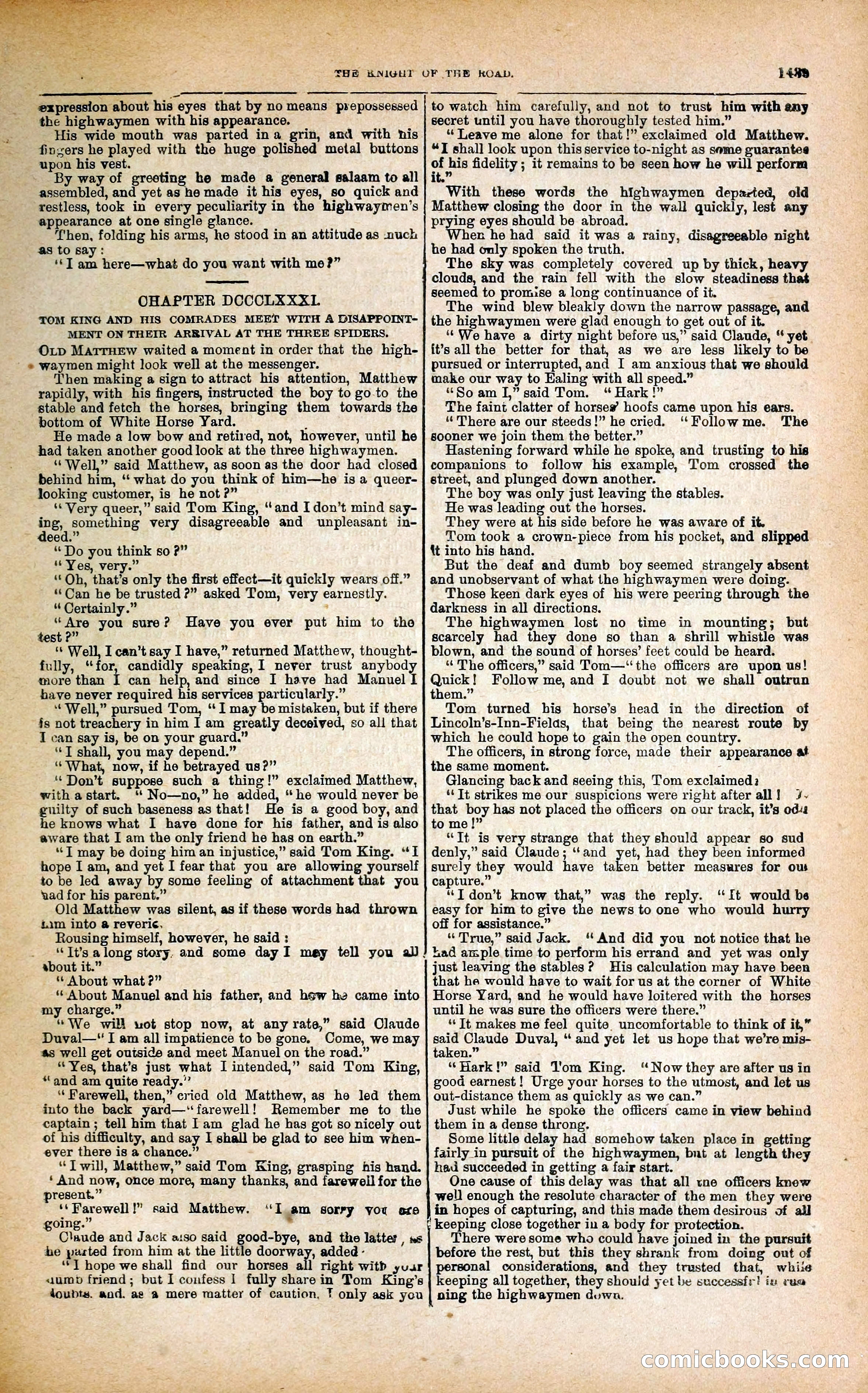
A restored page from Penny Dreadfuls, 1866. Page through the whole issue in the reader above.
📄 Transcribed text from this page (OCR, searchable)
Machine-transcribed from the original scan — historical spelling and the odd misread are preserved.
Mee elie < é ___ @xpression about his eyes that by no means prepossessed the highwaymen with his appearance. His wide mouth was parted ina grin, and with his finzers he played with the huge polished metal buttons upon his vest. | By way of greeting he made a general salaam to all assembled, and yet as he made it his eyes, so quick and restless, took in every peculiarity in the highwaymen’s appearance at one single glance. hen, folding his arms, he stood in an attitude as nuch As to say: ‘‘T am here—what do you want with me?” OHAPTER DCCCLXXXL TOM KING AND HIS COMRADES MEET WITH A DISAPPOINT- MENT ON THEIR ARRIVAL AT THE THREE SPIDERS. OLp MatrHew waited a moment in order that the high- ' * waymen might look well at the messenger. Then making a sign to attract his attention, Matthew rapidly, with his fingers, instructed the boy to go-to the stable and fetch the horses, bringing them towards the bottom of White Horse Yard. He made a low bow and retired, not, however, until he had taken another good look at the three highwaymen. ‘‘' Well,” said Matthew, as soon as the door had closed behind him, “‘ what do you think of him—he is a queer- looking customer, is he not ?” ‘* Very queer,” said Tom King, “and I don’t mind say- ing, something very disagreeable and unpleasant in- ~ deed.” “Do you think so ?” “Yes, very.” “Oh, that’s only the first effect—it quickly wears off.” “Can he be trusted ?” asked Tom, very earnestly. “ Certainly.” . “Are you sure? Have you ever put him to the test 2?” ‘ Well, I can’t say I have,” returned Matthew, thought- fully, “for, candidly speaking, 1 never trust anybody more than I can help, and since I have had Manuel I have never required his services particularly.” “Well,” pursued Tom, ‘I may be mistaken, but if there is not treachery in him I am greatly deceived, so all that I can say is, be on your guard.” “T shall, you may depend.” ‘What, now, if he betrayed us?” ‘Don’t suppose such a thing!” exclaimed Matthew, with astart. ‘‘ No—no,” he added, “ he would never be guilty of such baseness as that! He is a good boy, and he knows what I have done for his father, and is also aware that I am the only friend he has on earth.” “‘T may be doing him an injustice,” said Tom King. “I hope I am, and yet I fear that you are allowing yourself to be led away by some feeling of attachment that you nad for his parent.” Old Matthew was silent, as if these words had thrown Lim into @ reveric. | Rousing himself, however, he said ; “Tt’s along story. and some day I mey tell you al)! sbout it.” * About what ?” ‘About Manuel and his father, and hew hye came into my charge.” “We will uot stop now, at any rate,” said Olaude Duval—" I am all impatience to be gone. Come, we may 4s well get outside and meet Manuel on the road.” “Yes, that’s just what I intended,” said Tom King, “ond am quite ready.” “ Farewell, then,” cricd old Matthew, as he led them into the back yard—‘ farewell! Remember me to the captain ; tell him that lam glad he has got so nicely out of his difficulty, and say I shall be glad to see him when- ever there is a chance.” ‘Twill, Matthew,” said Tom King, grasping his hand. ‘And now, once more, many thanks, and farewell for the present.” ‘‘ Farewell!” said Matthew. going.” Claude and Jack aiso said good-bye, and the latter, ss he parted from him at the little doorway, added - ‘*T hope we shall find our horses all right with yuur aumbd friend; but I confess 1 fully sharein Tom King’s doubts. and. ae a mere matter of caution, F only ask you bes | am sorry you are wy i ey ee EN ERS ere! ate, 5 SAO FAR Ce te gee Pa A e IPRe ee 4 Sh Ra Bere at Dre <M thee 52 atl Bo eS 2S WAY bs On : wr ~s —— “ ov s < = . ae, a Soe CS “ SHE KNIGHT OF THB ROAD. L438 to waich him carefully, and not to trust him with eny secret until you have thoroughly tested him.” ‘‘ Leave me alone for that!” exclaimed old Matthew. “T shall look upon this service to-night as same guarantee f his fidelity ; it remains to be seen how he will perform t. ted With these words the highwaymen departed, old Matthew closing the door in the wall quickly, lest any prying eyes should be abroad. Wher he had said it was a rainy, disagreeable night he had only spoken the truth. The sky was completely covered up by thick, heavy clouds, and the rain fell with the slow steadiness that seemed to promise a long continuance of it. The wind blew bleakly down the narrow passage, and the highwaymen were glad enough to get out of it. ‘We have a dirty night before us,” said Claude, “ yet it’s all the better for that, as we are less likely to be pursued or interrupted, and I am anxious that we should make our way to Haling with all speed.” “Soam I,” said Tom. “ Hark!” The faint clatter of horse# hoofs came upon his ears. “There are our steeds!” he cried. ‘Followme. ‘The sooner we join them the better.” Hastening forward while he spoke, and trusting to his companions to follow his example, Tom crossed the street, and plunged down another. The boy was only just leaving the stables. He was leading out the horses. They were at his side before he was aware of it. Tom took a crown-piece from his pocket, and slipped {t into his hand. But the deaf and dumb boy seemed strangely absent and unobservant of what the highwaymen were doing. Those keen dark eyes of his were peering through the darkness in all directions. The highwaymen lost no time in mounting; but scarcely had they done so than a shrill whistle was blown, and the sound of horses’ feet could be heard. “ The officers,” said Tom—‘the officers are upon us! Quick! Follow me, and I doubt not we shall outrun them.’ Tom turned his horse’s head in the direction of Lincoln’s-Inn-Fields, that being the nearest route by which he could hope to gain the open country. The officers, in strong force, made their appearance at the same moment. Glancing back and seeing this, Tom exclaimed: “1+ strikes me our suspicions were right after all! 7- that boy has not placed the officers on our track, it’s oda to me!” “Tt is very strange that they should appear so sud denly,” said Claude; ‘‘and yet, had they been informed surely they would have taken better measures for ous capture.” “T don’t know that,” was the reply. ‘It would be easy for him to give the news to one who would hurry off for assistance.” “True,” said Jack. ‘‘And did you not notice that he had ample time to perform his errand and yet was only just leaving the stables? His calculation may have been that he wonld have to wait for us at the corner of White Horse Yard, and he would have loitered with the horses until he was sure the officers were there.” ‘‘ Tt makes me feel quite uncomfortable to think of it,” said Claude Duval, “ and yet let us hope that we’re mis- taken.” 3 “Hark!” said l'om King. “Now they are after us in good earnest! Urge your horses to the utmost, and let us out-distance them as quickly as we can.” Just while he spoke the officers came in view behind them in a dense throng. Some little delay had somehow taken place in getting fairly in pursuit of the highwaymen, bnt at length they had succeeded in getting a fair start. One cause of this delay was that all une officers knew well enough the resolute character of the men they were in hopes of capturing, and this made them desirous of all keeping close together in a body for protection. There were some who could have joined in the pursuit before the rest, but this they shrank from doing out of personal considerations, and they trusted that, whiie keeping all together, they should yet be successfr! iu rua ning the highwaymen duwn. “~ Eomichoo ®) 6S (E(@)