
Penny Dreadfuls, 1866 · page 370 of 395
Black Bess; or, the Knight of the Road — page 370: what you’re looking at
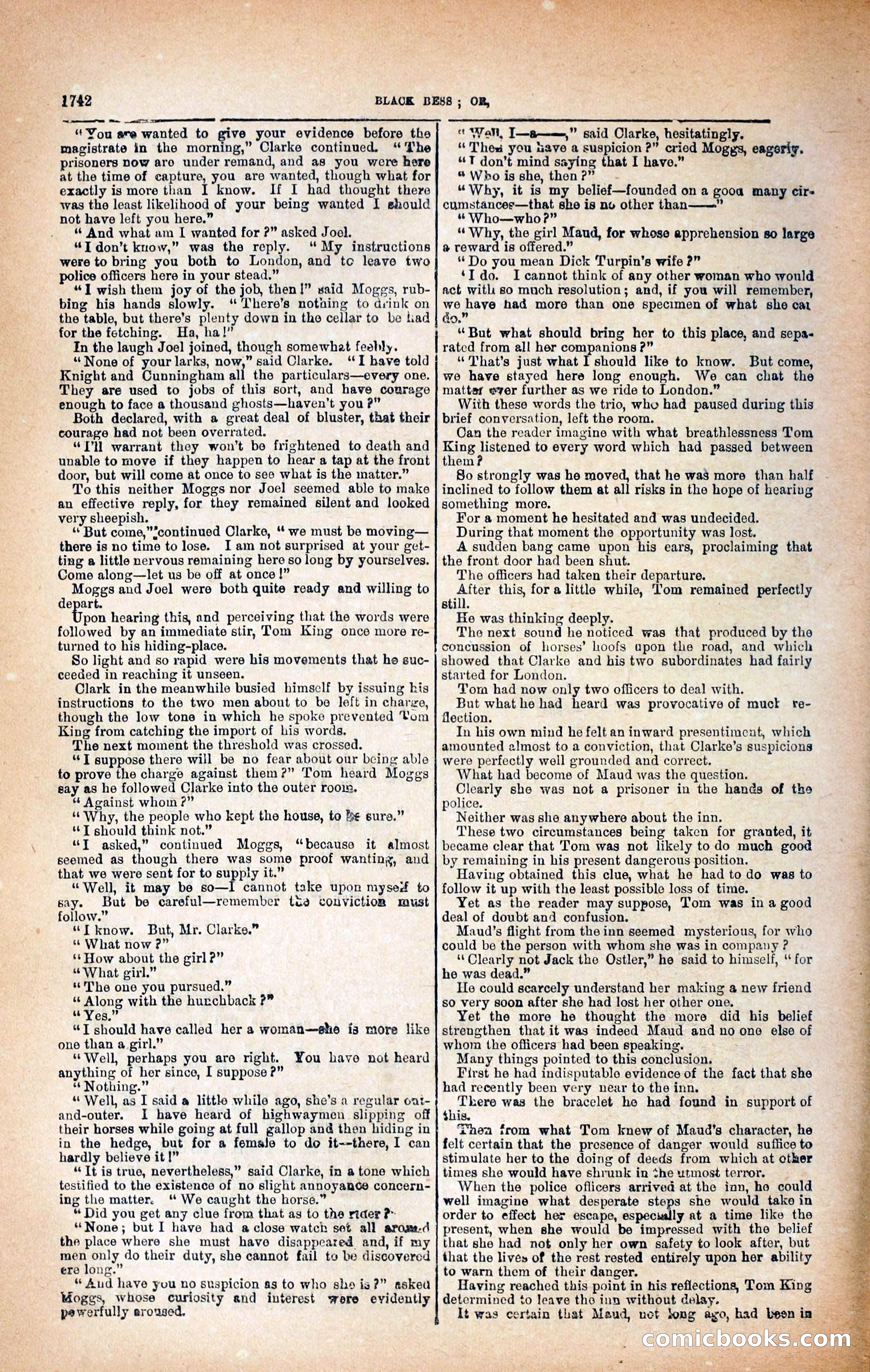
A restored page from Penny Dreadfuls, 1866. Page through the whole issue in the reader above.
📄 Transcribed text from this page (OCR, searchable)
Machine-transcribed from the original scan — historical spelling and the odd misread are preserved.
1742 ‘Vou are wanted to give your evidence before the magistrate in the morning,” Clarke continued. “The prisoners pow aro under remand, and as you were here at the time of capture, you are wanted, though what for exactly is more than I know. If I had thought there was the least likelihood of your being wanted I ehould not have left you here.” “ And what am I wanted for ?” asked Joel. “T don’t kuow,” was the reply. ‘My instructions were to bring you both to London, and te leave two police officers here in your stead.” BLACK BESS ; OR, tt Want, [—a——,”” said Clarke, hesitatingly. ‘“'Thesi you lave a suspicion ?” cried Moggs, eageriy. ‘‘T don’t mind saying that I have.” * Who is she, then?” | “Why, it is my belief—founded on a gooa many cir- cumstancer—that she is nv other than——” * Who—who ?” “Why, the girl Maud, for whose apprehension so large @ reward is offered.” ‘Do you mean Dick Turpin’s wife ?” ‘Ido. I cannot think of any other woman who would “J wish them joy of the job, then!” said Moges, rub- | act with so much resolution; and, if you will remember, bing his hands slowly. “'There’s notaing to drink on} we have had more than one specimen of what she oar the table, but there’s plenty down in the cellar to be had | do.” for the fetching. Ha, ha!” In the laugh Joel joined, though somewhat feably. ‘None of your larks, now,” said Clarke. ‘I have told Knight and Cunningham all the particulars—every one. They are used to jobs of this sort, and have courage enough to face a thousand ghosts—haven't you ?” Both declared, with a great deal of bluster, that their courage had not been overrated. “7’ll warrant they won't be frightened to death and unable to move if they happen to hear a tap at the front door, but will come at once to see what is the matter.” To this neither Moggs nor Joel seemed able to make an effective reply, for they remained silent and looked very sheepish. “But come,”’continued Clarke, ** we must be moving— there is no time to lose. Iam not surprised at your get- ting a little nervous remaining here so long by yourselves. Come along—let us be off at once !” Moggs and Joel were both quite ready and willing to depart. pon hearing this, and perceiving that the words were followed by an immediate stir, Tom King once more re- turned to his hiding-place. So light and so rapid were his movements that ho suc- ceeded in reaching it unseen. Clark in the meanwhile busied himsclf by issuing kis instructions to the two men about to be left in charge, though the low tone in which he spoke prevented tom King from catching the import of his words. The next moment the threshold was crossed. “‘T suppose there will be no fear about our being able to prove the charge against them?” Tom heard Moggs say as he followed Clarke into the outer room. “ Against whom ?” ‘Why, the people who kept the house, to he sure.” ‘T should think not.” “T asked,” continued Moggs, “because it almost seemed as though there was some proof wanting, and that we were sent for to supply it.” “Well, it may be so—I cannot take upon mysed# to say. But be careful—remember tce conviction must follow.” “TIT know. But, Mr. Clarke.” * What now ?” ‘‘ How about the girl ?” “What girl.” ‘The one you pursued.” “ Along with the hunchback ?” oY eg.Y “T should have called her a woman—she is more like one than a girl.” ‘Well, perhaps you aro right. anything of her since, I suppose ?” “ Nothing.” “ Well, as I said a little while ago, she’s a regular oat- and-outer. I have heard of highwaymen slipping off their horses while going at full gallop and then hiding in in the hedge, but for a female to do it--there, 1 can hardly believe it!” “Tt is true, nevertheless,” said Clarke, in a tone which testified to the existence of no slight annoyances concern- ing the matter. ‘ We caught the horse.” “ Did you get any clue from that as to tha rider ?> ‘None; but I have had a close watch set all arom.-d the place where she must havo disappeared and, if my en only do their duty, she cannot fail to be discovered ere long.” “ Aud have you no suspicion as to who she is?” askea Moges, whose curiosity and interest were evidently powerfully aroused. You have not heard “But what should bring her to this place, and sepa- rated from all her companions ?” “That's just what I should like to know. But come, we have stayed here long enough. We can chat the matter wyer further as we ride to London.” With these words the trio, who had paused during this brief conversation, left the room. Can the reader imagine with what breathlessness Tom Heine Hetenee to every word which had passed between them So strongly was he moved, that he was more than half inclined to follow them at all risks in the hope of hearing something more. For a moment he hesitated and was undecided. During that moment the opportunity was lost. A sudden bang came upon his ears, proclaiming that the front door had been shut. The officers had taken their departure. After this, for a little while, Tom remained perfectly still. He was thinking deeply. The next sound he noticed was that produced by the concussion of horses’ hoofs apon the road, and which showed that Clarke and his two subordinates had fairly started for London. Tom had now only two officers to deal with. But what he had heard was provocative of muck re- flection. In his own mind he felt an inward presentimcut, which amounted almost to a conviction, that Clarke’s suspicions were perfectly well grounded and correct. What had become of Maud was the question. Clearly she was not a prisoner in the hands of tho police. Neither was she anywhere about the inn. These two circumstances being taken for granted, it became clear that Tom was not likely todo much good by remaining in his present dangerous position. Having obtained this clue, what he had to do was to follow it up with the least possible loss of time. Yet as the reader may suppose, Tom was in a good deal of doubt and confusion. Maud’s flight from theinn seemed mysterious, for who could be the person with whom she was in company ? ‘Clearly not Jack the Ostler,” he said to himself, “ for he was dead.” Ile could scarcely understand her making a new friend so very soon after she had lost her other one. Yet the more he thought the more did his belief strengthen that it was indeed Maud and no one else of whom the officers had been speaking. Many things pointed to this conclusion. First he had indisputable evidence of the fact that she had recently been very near to the inn. pacer was the bracelet ho had found in support of his, nea from what Tom knew of Maud’s character, he felt certain that the presence of danger would suffice to stimulate her to the doing of deeds from which at other times she would have shrunk in the utmost terror. When the police oflicers arrived at the ian, ho could well imagine what desperate steps she would take in order to effect her escape, especially at a time like the present, when she would be impressed with the belief that she had not only her own safety to look after, but that the lives of the rest rested entirely upon her ability to warn them of their danger. Having reached this point in his reflections, Tom King determined to leave the inn without delay. It was certain that Maud, net long ago, had beenin Gomichboo 4 7 ] “ 4 ‘s