
Penny Dreadfuls, 1866 · page 158 of 395
Black Bess; or, the Knight of the Road — page 158: what you’re looking at
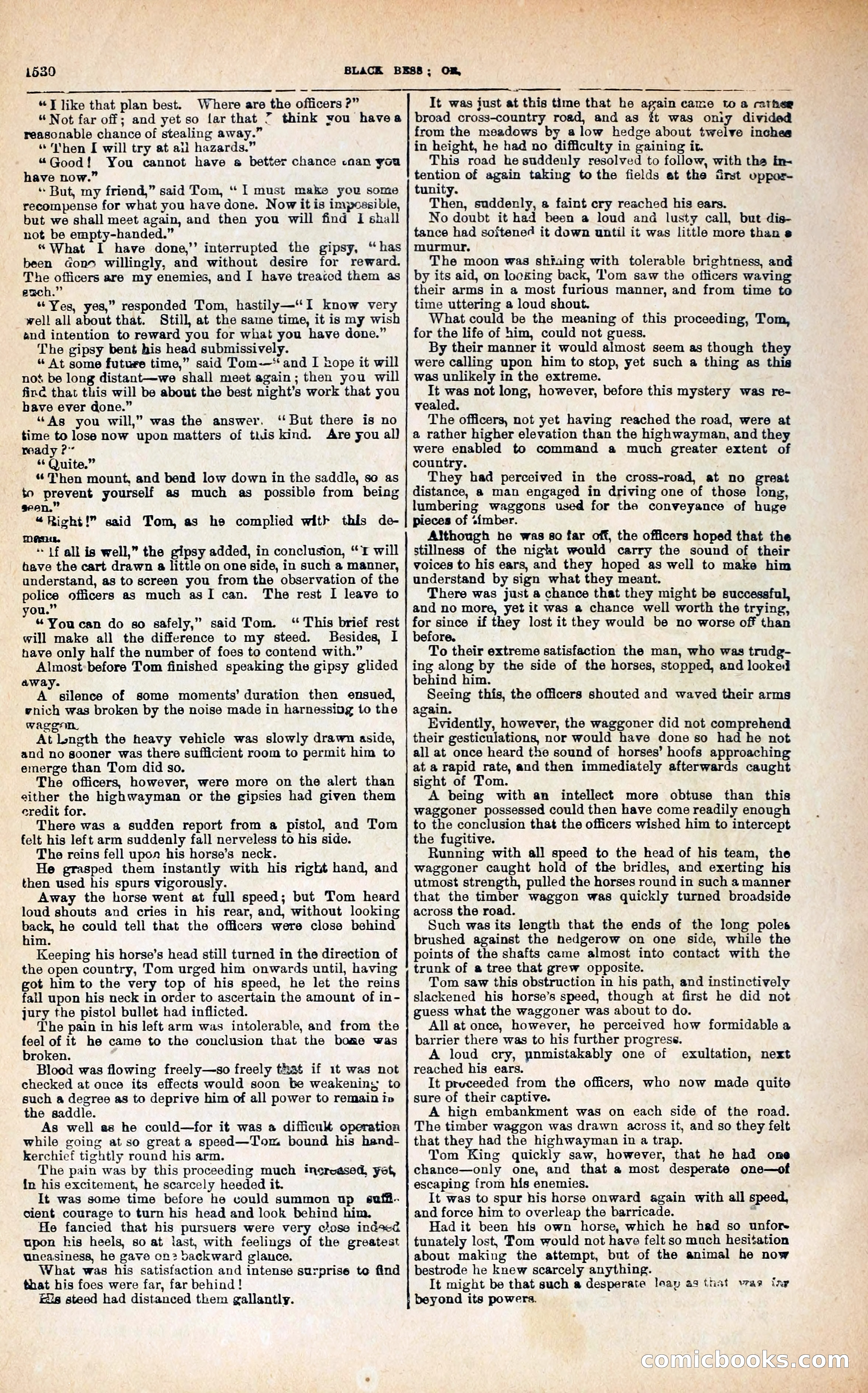
A restored page from Penny Dreadfuls, 1866. Page through the whole issue in the reader above.
📄 Transcribed text from this page (OCR, searchable)
Machine-transcribed from the original scan — historical spelling and the odd misread are preserved.
1539 “J like that plan best. Where are the officers ?” “ Not far off; and yet so lar that 7 think you havea reasonable chance of stealing away.” *“ hen I will try at aii hazards.” “Good! You cannot have s better chance cman you have now.” ‘‘ But, my friend,” said Tom, “ | must make you some recompense for what you have done. Now itis impossible, but we shall meet again, and then you will find I shall not be empty-handed.” “What I have done,’’ interrupted the gipsy, “has been Gono willingly, and without desire for reward. The officers are my enemies, and I have treated them as each.” “© Yes, yes,” responded Tom, hastily—“I know very well all about that. Still, at the same time, it is my wish snd intention to reward you for what you have done.” The gipsy bent his head submissively. “ At some future time,” said Tom-—‘‘ and I hope it will not be long distant—we shall meet again; then you will finc that this will be about the best night’s work that you have ever done.” “As you will,” was the answer. ‘But there is no time to lose now upon matters of this kind. Are you al) ready ?” “ Quite.” ‘Then mount, and bend low down in the saddle, so as to prevent yourself as much as possible from being seen. : “Richt!” said Tom, as he complied with this de- mess. “1f all is well,” the gipsy added, in conclusion, “ will have the cart drawn a little on one side, in such a manner, understand, as to screen you from the observation of the police officers as much asI can. The rest I leave to ou.” ; “Youcan do so safely,” said Tom. “ This brief rest will make all the difference to my steed. Besides, I have only half the number of foes to contend with.” Almost*before Tom finished speaking the gipsy glided away. AD silence of some moments’ duration then ensued, vnich was broken by the noise made in harnessipg to the wage At Lsneth the heavy vehicle was slowly drawn aside, and no sooner was there sufficient room to permit him to emerge than Tom did so. The officers, however, were more on the alert than either the highwayman or the gipsies had given them credit for. There was a sudden report from a pistol, and Tom felt his left arm suddenly fall nerveless to his side. The reins fell upon his horse’s neck. He grasped them instantly with his right hand, and then used his spurs vigorously. Away the horse went at full speed; but Tom heard loud shouts and cries in his rear, and, without looking back, he could tell that the officers were close behind him. Keeping his horse’s head still turned in the direction of the open country, Tom urged him onwards until, having got him to the very top of his speed, he let the reins fail upon his neck in order to ascertain the amount of in- jury the pistol bullet had inflicted. The pain in his left arm was intolerable, and from tke feel of it he came to the conclusion that the bome was broken. Blood was flowing freely—so freely tat if 1t was not checked at once its effects would soon be weakening to such a degree as to deprive him of all power to remain Ip the saddle. As well as he could—for it was a difficuk operation while going at so great a speed—Tom bound his hand- Kerchief tightly round his arm. The pain was by this proceeding much increased, yot, in his excitement, he scarcely heeded it. It was some time before he vould summon up suff. cient courage to turn his head and look behind him, He fancied that his pursuers were very close ind*«d upon his heels, so at last, with feelings of the greatest uneasiness, he gave cn? backward glance. What was his satisfaction and intense surprise toe find that his foes were far, far behind! kis steed had distanced them gallantly. It was just at this time that he a LLL BLACK BES8; OR, main caine to & rather broad cross-country road, and as it was omy divided from the meadows by a low hedge about twelve inches in height, he had no difficulty in gaining it. This road he suddenly resolved to follow, with tha In tention of again taking to the fields at the first oppor tunity. Then, suddenly, a faint cry reached his ears. No doubt it had been a loud and lusty call, but dis- tance had soitened it down until it was little more than s murmur. The moon was shtaing with tolerable brightness, and by its aid, on locking back, T'om saw the officers waving their arms in a most furious manner, and from time to time uttering a loud shout. What could be the meaning of this proceeding, Tom, for the life of him, could not guess. By their manner it would almost seem as though they were calling upon him to stop, yet such a thing as this was unlikely in the extreme. It was not long, however, before this mystery was re- vealed. The officers, not yet having reached the road, were at a rather higher elevation than the highwayman, and they were enabled to command a much greater extent of country. They had perceived in the cross-road, at no great distance, a man engaged in driving one of those long, lumbering waggons used for the conveyance of huge pieces of 4imber. Although he was so far off, the officers hoped that the stillness of the nigkt would carry the sound of their voices to his ears, and they hoped as well to make him understand by sign what they meant. There was just a chance that they might be successful, and no more, yet it was a chance well worth the trying, for since if they lost it they would be no worse off than before, To their extreme satisfaction the man, who was trudg- ing along by the side of the horses, stopped, and looked behind him. Seeing this, the officers shouted and waved their arms again. Evidently, however, the waggoner did not comprehend their gesticulations, nor would have done so had he not all at once heard the sound of horses’ hoofs approaching ata rapid rate, and then immediately afterwards caught sight of Tom. A being with an intellect more obtuse than this waggoner possessed could then have come readily enough to the conclusion that the officers wished him to intercept the fugitive. Running with all speed to the head of his team, the waggoner caught hold of the bridles, and exerting his utmost strength, pulled the horses round in such a manner that the timber waggon was quickly turned broadside across the road. Such was its length that the ends of the long poles brushed against the nedgerow on one side, while the points of the shafts came almost into contact with the trunk of a tree that grew opposite. Tom saw this obstruction in his path, and instinctively slackened his horse’s speed, though at first he did not guess what the waggoner was about to do. All at once, however, he perceived how formidable a barrier there was to his further progress. A loud cry, pnmistakably one of exultation, next reached his ears. It pruceeded from the officers, who now made quite sure of their captive. A high embankment was on each side of the road. The timber waggon was drawn across it, and so they felt that they had the highwayman in a trap. Tom King quickly saw, however, that he had one chance—only one, and that a most desperate one—of escaping from his enemies. It was to spur his horse onward again with all speed, and force him to overleap the barricade. % Had it been his own horse, which he had so unfore tunately lost, Tom would not have felt so much hesitation about making the attempt, but of the animal he now bestrode he knew scarcely anything. It might be that such a desperate leap ag that vraa inp beyond its powers. (Efe) ( c) CS Cc JOO (0)