
Penny Dreadfuls, 1866 · page 62 of 395
Black Bess; or, the Knight of the Road — page 62: what you’re looking at
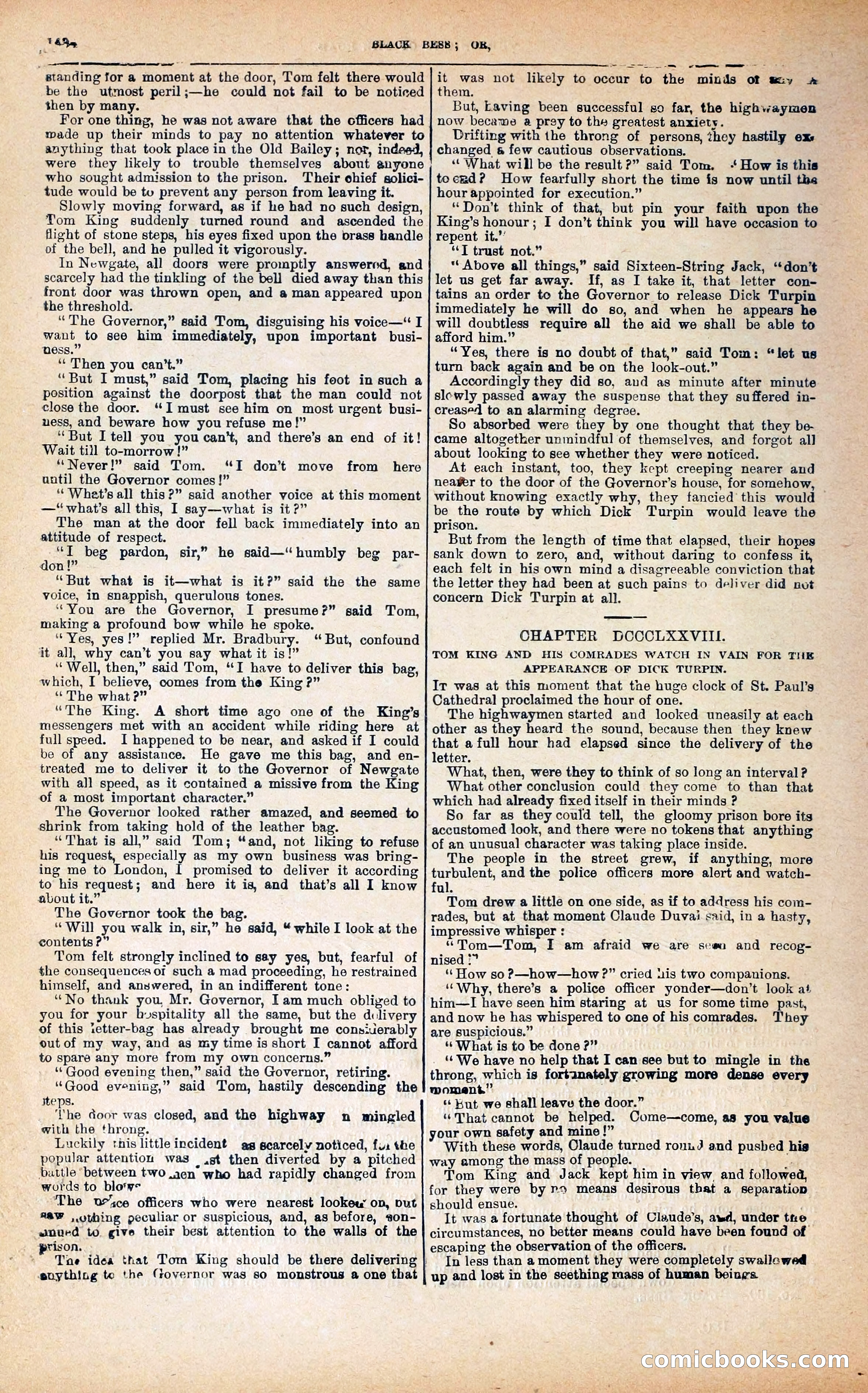
A restored page from Penny Dreadfuls, 1866. Page through the whole issue in the reader above.
📄 Transcribed text from this page (OCR, searchable)
Machine-transcribed from the original scan — historical spelling and the odd misread are preserved.
£ a TéRe — wee = —_—_—_ standing for a moment at the door, Tom felt there would be the utmost peril;—he could not fail to be noticed then by many. For one thing, he was not aware that the officers had made up their minds to pay no attention whatever to anything that took place in the Old Bailey; nor, indeed, were they likely to trouble themselves about anyone who sought admission to the prison. Their chief golici- tude would be tu prevent any person from leaving it. Slowly moving forward, as if he had no such design, Tom King suddenly turned round and ascended the flight of stone steps, his eyes fixed upon the brass handle of the bell, and he pulled it vigorously. In Newgate, all doors were promptly answered, and scarcely had the tinkling of the bell died away than this front door was thrown open, and a man appeared upon the threshold. “The Governor,” said Tom, disguising his voice—“ I want to see him immediately, upon important busi- ness.” ‘Then you can’t.” ‘But I must,” said Tom, placing his foot in such a position against the doorpost that the man could not close the door. “I must see him on most urgent busi- uess, and beware how you refuse me!” ‘But I tell you you can’t, and there’s an end of it! Wait till to-morrow !” “Never!” said Tom. “I don’t move from here until the Governor comes!” ‘‘ Whet’s all this?” said another voice at this moment —“ what’s all this, I say—what is it ?” The man at the door fell back immediately into an attitude of respect. - beg pardon, sir,” he said—“ humbly beg par- don !” ‘But what is it—what is it?” said the the same voice, in snappish, querulous tones. “You are the Governor, I presume?” gaid Tom, making a profound bow while he spoke. ‘Yes, yes!” replied Mr. Bradbury. it all, why can’t you say what it is!” ‘Well, then,” said Tom, “I have to deliver this bag, which, I believe, comes from the King ?” “The what ?” “The King. A short time ago one of the King’s messengers met with an accident while riding here at full speed. I happened to be near, and asked if I could be of any assistance. He gave me this bag, and en- treated me to deliver it to the Governor of Newgate with all speed, as it contained a missive from the King of a most important character.” The Governor looked rather amazed, and seemed to shrink from taking hold of the leather bag. “That is all,” said Tom; “and, not liking to refuse his request, especially as my own business was bring- ing me to London, I promised to deliver it according to his request; and here it is, and that’s all I know about it.” The Governor took the bag. “Will you walk in, sir,” he said, “while I look at the contents ?” Tom felt strongly inclined to say yes, but, fearful of the consequences of such a mad proceeding, he restrained himself, and answered, in an indifferent tone: “No thank you, Mr. Governor, Iam much obliged to you for your bhuspitality all the same, but the dvlivery of this ietter-bag has already brought me cons:Jerably out of my way, and as my time is short I cannot afford to spare any more from my own concerns.” “Good evening then,” said the Governor, retiring. “Good evening,” said Tom, hastily descending the iteps. The door was closed, and the highway n mingled with the throng. Luckily this little incident ag gearcely noticed, fir the popular attention was ist then diverted by a pitched battle “between two ren who had rapidly changed from words to blotw- The usce officers who were nearest lookeu’ on, put "aW ,.othing peculiar or suspicious, and, as before, son- wnued to give their best attention to the walls of the “But, confound prison. Tne idea that Tom King should be there delivering euything to the (rovernor was so monstrous a one that BLACK BESB ; y OB, to the minds ot Ky it was not likely to occur them. But, Laving been successful so far, the highwaymen now becawe a prey to the greatest anxiety. Drifting with the throng of persons, they hastily exe changed & few cautious observations. ‘What will be the result?” said Tom. - How is this toczd? How fearfully short the time is now until the hour appointed for execution.” “Don’t think of that, but pin your faith upon the King’s honour; I don’t think you will have occasion to repent it.”’ “T trust not.” “Above all things,” said Sixteen-String Jack, “don’t let us get far away. If, as I take it, that letter con- tains an order te the Governor to release Dick Turpin immediately he will do so, and when he appears he will doubtless require all the aid we shall be able to afford him.” | “Yes, there is no doubt of that,” said Tom: “let us turn back again and be on the look-out.” Accordingly they did so, and as minute after minute slewly passed away the suspense that they suffered in- creased to an alarming degree. So absorbed were they by one thought that they be- came altogether unmindful of themselves, and forgot all about looking to see whether they were noticed. At each instant, too, they kept creeping nearer and neawer to the door of the Governor’s house, for somehow, ~ without knowing exactly why, they fancied this would be the route by which Dick Turpin would leave the prison. But from the length of time that elapsed, their hopes sank down to zero, and, without daring to confess it, each felt in his own mind a disagreeable conviction that the letter they had been at such pains to deliver did not concern Dick Turpin at all. CHAPTER DCCCLXXVIII. TOM KING AND HIS COMRADES WATCH IN VAIN FOR THE APPEARANCE OF DICK TURPIN. Ir was at this moment that tne huge clock of St. Paul’s Cathedral proclaimed the hour of one. The highwaymen started and looked uneasily at each other as they heard the sound, because then they knew that a full hour had elapsed since the delivery of the letter. What, then, were they to think of so long an interval ? What other conclusion could they come to than that which had already fixed itself in their minds ? So far as they could tell, the gloomy prison bore its accustomed look, and there were no tokens that anything of an unusual character was taking place inside. The people in the street grew, if anything, more turbulent, and the police officers more alert and watch- ful. Tom drew a little on one side, as if to address his com- rades, but at that moment Claude Duvai said, in a hasty, impressive whisper : “Tom—Tom, I am afraid we are ses and recog- nised |” “‘ How so ?2—how—how ?” cried nis two companions. ‘‘Why, there’s a police officer yonder—don’t look at him—I have seen him staring at us for some time past, and now he has whispered to one of his comrades. They are suspicious.” ‘What is to be done ?” _ “ We have no help that I can see but to mingle in the throng, which is fortanately growing more dense every moment.” , : “ Kut we shall leave the door.” “That cannot be helped. Come—come, as you value your own safety and mine !” With these words, Olaude turned ronud and pusbed his way among the mass of people. 4 Tom King and Jack kept him in view. and followed, for they were by r> means desirous that a separation should ensue. 7 It was a fortunate thought of Claude’s, awd, under tne circumstances, no better means could have been found of escaping the observation of the officers. In less than a moment they were completely swallewed up and lost in the seething mass of human beings (eo) ,OO “S ~ ; ret R > ot 7 Ss ‘ - , 4 Tee, Se