
Penny Dreadfuls, 1866 · page 167 of 395
Black Bess; or, the Knight of the Road — page 167: what you’re looking at
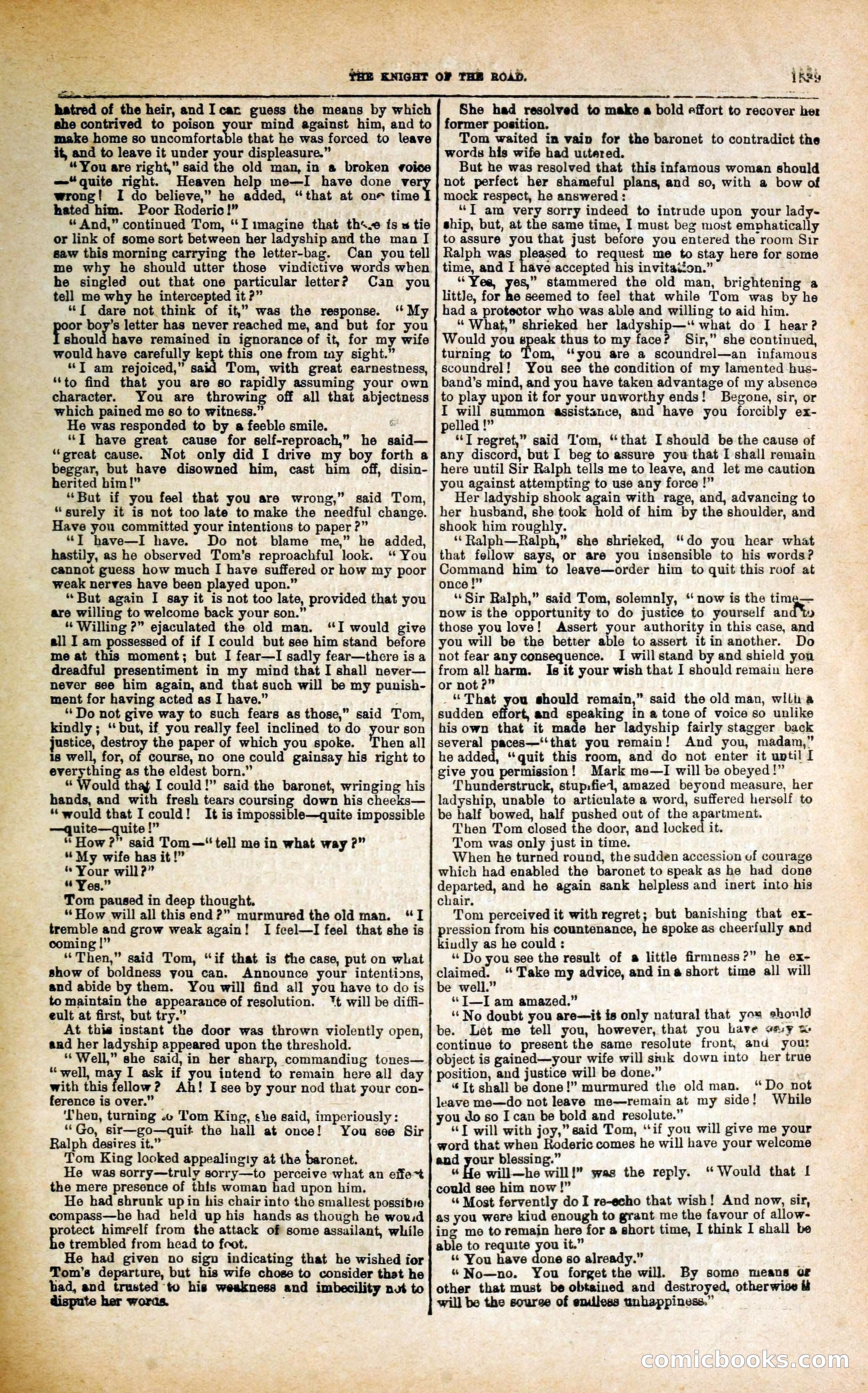
A restored page from Penny Dreadfuls, 1866. Page through the whole issue in the reader above.
📄 Transcribed text from this page (OCR, searchable)
Machine-transcribed from the original scan — historical spelling and the odd misread are preserved.
. — at) ~ » eo 5 hatred of the heir, and Icar guess the - phe contrived to poison ‘it, and to leave it under your displeasure.” “You are right,” said the old man, in a broken ¢oice —“gquite right. Heaven help me—I have done ve wrong! I do believe,” he added, “that at one time hated him. Poor Roderic!” “ And,” continued Tom, “I imagine that th*.e is u tie or link of some sort between her ladyship and the man I saw this morning carrying the letter-bag. Can you tell me why he should utter those vindictive words when he singled out that one particular letter? Can you tell me why he intercepted it ?” “{ dare not think of it,” was the response. ‘My or boy’s letter has never reached me, and but for you should have remained in ignorance of it, for my wife would have carefully kept this one from my sight.” ‘““T am rejoiced,” said Tom, with great earnestness, ‘“‘to find that you are so rapidly assuming your own character. You are throwing off all that abjectness which pained me so to witness.” He was responded to by a feeble smile. b: “J have great cause for self-reproach,” he said— “‘ereat cause. Not only did I drive my boy forth a beggar, but have disowned him, cast him off, disin- herited him!” : “But if you feel that you are wrong,” said Tom, “surely it is not too late to make the needful change. Have you committed your intentions to paper ?” “T have—I have. Do not blame me,” he added, hastily, as he observed Tom’s reproachful look. ‘ You cannot guess how much I have suffered or how my poor weak nerves have been played upon.” “But again I say it is not too late, provided that you are willing to welcome back your son.” * Willing ?” ejaculated the old man. “I would give all I am possessed of if I could but see him stand before me at this moment; but I fear—I sadly fear—there is a dreadful presentiment in my mind that I shall never— never see him again, and that such will be my punish- ment for having acted as I have.” ** Do not give way to such fears as those,” said Tom, kindly; ‘but, if you really feel inclined to do your son justice, destroy the paper of which you spoke. Then all is well, for, of course, no one could gainsay his right to everything as the eldest born.” * Would thaf I could!” said the baronet, wringing his hands, and with fresh tears coursing down his cheeks— “would that I could! It is impossible—quite impossible —quite—quite |” “ How ?” said Tom—" tell me in what way ?” “My wife has it!” * Your will?” “ Yes.” Tom paused in deep thought. “How will all this end?” murmured the old man. “I tremble and grow weak again! I feel—I feel that she is coming !”’ “Then,” said Tom, “if that is the case, put on what show of boldness you can. Announce your intentions, and abide by them. You will find all you have to do is to maintain the appearance of resolution. ‘“t will be diffi- | eult at first, but try.” , At this instant the door was thrown violently open, 7 and her ladyship appeared upon the threshold. Well,” she said, in her sharp, commandiug tones— “well, may I ask if you intend to remain here all day with this fellow? Ah! I see by your nod that your con- ference is over.” — ‘Then, turning .o Tom King, she said, impcriously : “Go, sir—go—quit the hall at once! You see Sir Ralph desires it.” Tom King looked appealingty at the baronet. He was sorry—truly sorry—to perceive what an effet ? the mere presence of this woman had upon him. He had shrunk up in his chair into the smallest possibie compass—he had held up his hands as though he woud pee himrelf from the attack of some assailant, while e trembled from head to frot. He had given no sign indicating that he wished for ‘Tom’s departure, but his wife chose to consider that he had, ae ‘to his weakness and imbecility nut to words, THE KNIGHT OF THE ROAD. means by which our mind against him, and to make home so uncomfortable that he was forced to leave She had resolved to make former position. Tom waited in vain for the baronet to contradict the words his wife had uttered. But he was resolved that this infamous woman should not perfect her shameful plans, and so, with a bow of mock respect, he answered : “I am very sorry indeed to intrude upon your lady- ship, but, at the same time, I must beg most emphatically to assure you that just before you entered the room Sir Ralph was pleased to request me to stay here for some time, and I have accepted his invitation.” aa “Yea, yes,” stammered the old man, brightening a little, for he seemed to fee] that while Tom was by he had a protector who was able and willing to aid him. “What,” shrieked her ladyship—‘‘ what do I hear? Would you speak thus to my face? Sir,” she continued, turning to Tom, “you are a scoundrel—an infamous scoundrel! You see the condition of my lamented hus- band’s mind, and you have taken advantage of my absence to play upon it for your uoworthy ends! Begone, sir, or I he summon assistance, and have you forcibly ex- pelled ! ; ‘*T regret,” said Tom, “that I should be the cause of any discord, but I beg to assure you that I shall remain here until Sir Ralph tells me to leave, and let me caution you against attempting to use any force !” Her ladyship shook again with rage, and, advancing to her husband, she took hold of him by the shoulder, and shook him roughly. ‘¢ Ralph—Ralph,” she shrieked, “do you hear what that fellow says, or are you insensible to his words? Command him to leave—order him to quit this roof at once !” ‘Sir Ralph,” said Tom, solemnly, “ now is the timae— now is the opportunity to do justice to yourself and ‘ty those you love! Assert your authority in this case, and you will be the better able to assert it in another. Do not fear any consequence. I will stand by and shield you from all harm. Is it your wish that I should remain here or not ?” _“ That you should remain,” said the old man, wilha sudden effort, and speaking in a tone of voice so unlike his own that it made her ladyship fairly stagger back several paces—‘‘that you remain! And you, madam,” he added, “quit this room, and do not enter it until I give you permission! Mark me—I will be obeyed!” Thunderstruck, stup:fiel, amazed beyond measure, her ladyship, unable to articulate a word, suffered herself to be half bowed, half pushed out of the apartment. Then Tom closed the door, and lucked it. Tom was only just in time. When he turned round, the sudden accession of courage which had enabled the baronet to speak as he had done departed, and he again sank helpless and inert into his chair. Tom perceived it with regret; but banishing that ex- pression from his countenance, he spoke as cheerfully and kindly as he could : “ Do you see the result of a little firmness?” he ex- claimed. ‘Take my advice, and inashort time all will be well.” “T_T am amazed.” ‘No doubt you are—it is only natural that you should be. Let me tell you, however, that you have wauy & continue to present the same resolute front, and you: object is gained—your wife will stuk down into her true position, and justice will be done.” : “Tt shall be done!” murmured the old man. ‘Do not leave me—do not leave me—remain at my side! While you do so Ican be bold and resolute.” “T will with joy,” said Tom, “if you will give me your word that when Roderic comes he will have your welcome and your blessing.” = lie will—he will!” was the reply. “ Would that f could see him now !” ‘‘ Most fervently do I re-echo that wish! And now, sir, as you were kiud enough to grant me the favour of allow- ing me to remajn here for a short time, I think I shall be able to requite you it.” ‘© You have done so already.” “ No—no. You forget the will. By some means oF other that must be obtained and destroyed, otherwise i will be the sourse of endless unhappiness.” | a bold effort to recover her MICELI) <S,e@ @ (E(@)