
Penny Dreadfuls, 1866 · page 367 of 395
Black Bess; or, the Knight of the Road — page 367: what you’re looking at
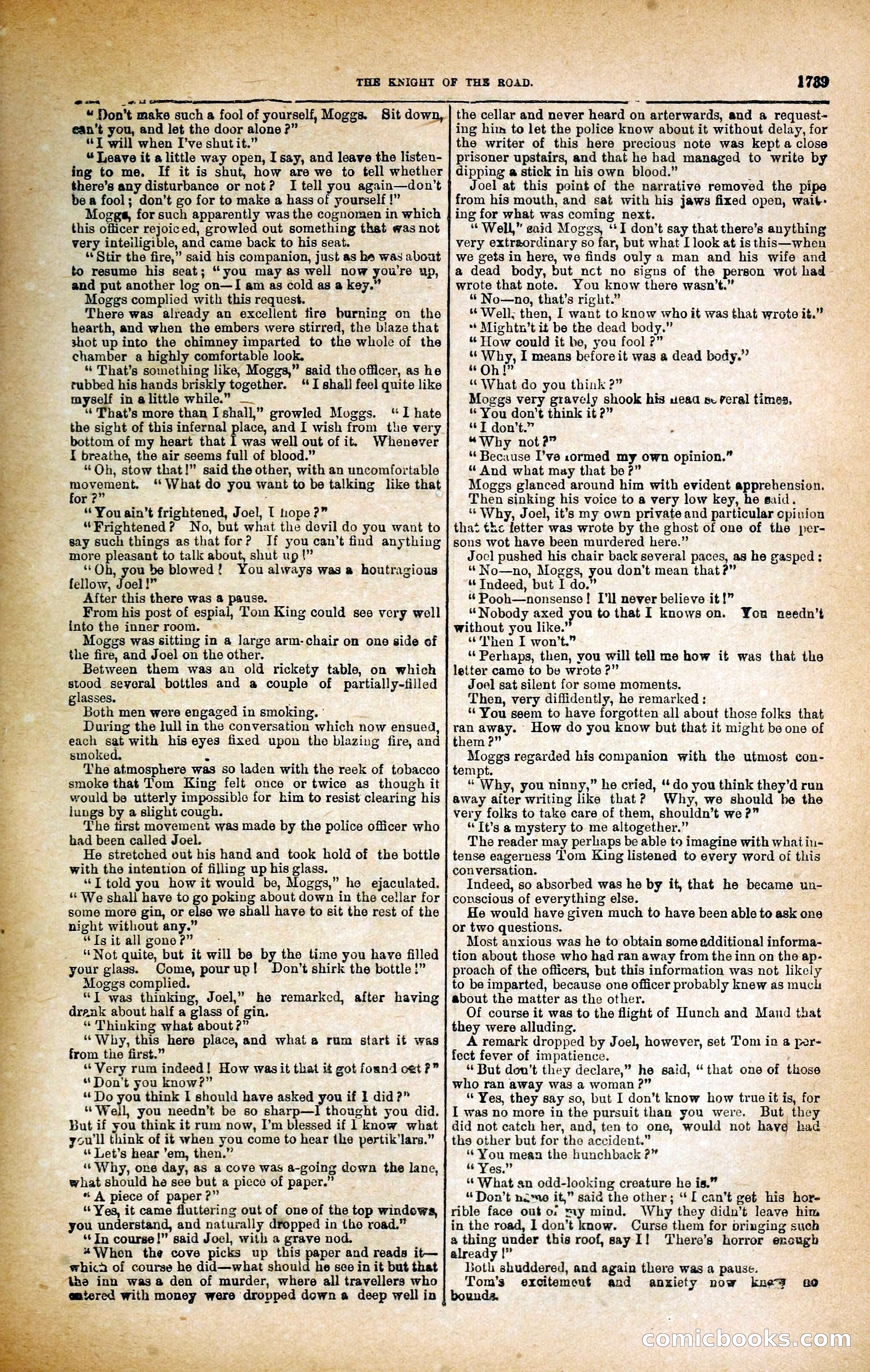
A restored page from Penny Dreadfuls, 1866. Page through the whole issue in the reader above.
📄 Transcribed text from this page (OCR, searchable)
Machine-transcribed from the original scan — historical spelling and the odd misread are preserved.
>. 2 4 - ™ « re * 7 * — 4 a < ‘a “ he 4? - = md ~ _- a > os a ee =o “3 — + ek st ean’t you, and let the door alone ?” “J will when I’ve shut it.” “ Leave it a little way open, I say, and leave the listen- ing to me. If it is shut, how are we to tell whether there’s any disturbance or not? I tell you again—don’t be a fool; don’t go for to make a hass of yourself !” Mogggs, for such apparently was the cognomen in which this officer rejoiced, growled out something that eas not very inteiligible, and came back to his seat. ‘“‘ Stir the fire,” said his companion, just as ha was about to resume his seat; “you may as well now youre 2D, and put another log on—I am as cold as a key.” Moggs complied with this request. There was already an excellent fire burnizg on the hearth, and when the embers were stirred, the blaze that shot up into the chimney imparted to the whole of the chamber a highly comfortable look. “ That’s something like, Moggs,” said the officer, as he rubbed his hands briskly together. “TI shall feel quite like mye in alittle while.” — ‘“‘ That’s more than I shall,” growled Moggs. “I hate the sight of this infernal place, and I wish from the very bottom of my heart that 1 was well out of it. Whenever I breathe, the air seems full of blood.” “Oh, stow that!” said the other, with an uncomfortable 2 ‘“ What do you want to be talking like that or _ “You ain’t frightened, Joel, [ hope ?” “Frightened? No, but what the devil do you want to say such things as that for? If you can’t find anything more pleasant to talk about, shut up |” ‘‘Oh, you be blowed! You always was a houtragious fellow, Joel!” After this there was a pause. From his post of espial, Tom King could see very well into the inner room. Moges was sitting in a large arm-chair on one side of the fire, and Joel on the other. Between them was an old rickety table, on which _ stood several bottles and a couple of partially-filled _ giasses. Both men were engaged in smoking. ’ During the lull in the conversation which now ensued, each sat with his eyes fixed upon the blazing fire, and smoked, . The atmosphere was so laden with the reek of tobacco smoke that Tom King felt once or twice as though it would be utterly impossible for him to resist clearing his lungs by a slight cough. The first movement was made by the police officer who had been called Joel. He stretched out his hand and took hold of the bottle with the intention of filling up his glass. “IT told you how it would be, Moggs,” he ejaculated. _“ We shall have to go poking about down in the cellar for some more gin, or else we shall have to sit the rest of the night without any.” “Ts it all gone 2” ‘Not quite, but it will be by the time you have filled your glass. Come, pourup! Don’t shirk the bottle!” Moggs complied. “JT was thinking, Joel,” he remarked, after having dreak about half a glass of gin. “ Thinking what about ?” “Why, this here place, and what a rum start it was from the first.” ‘“‘ Very rum indeed! How wasit that i¢ got found cet?” “Don't you know?” “Do you think I should have asked you if I did?” ‘Well, you needn’t be so sharp—I thought you did. But if you think it rum now, I’m blessed if 1 know what you'll think of it when you come to hear the pertik’lars.” ‘‘ Let’s hear ’em, then.” ‘‘ Why, one day, as a cove was a-going down the lane, what should he see but a picce of paper.” * A piece of paper ?” “ Yes, it came fluttering out of one of the top windows, you understand, and naturally dropped in the road.” ‘¢ In course!” said Joel, with a grave nod. * When the cove picks up this paper and reads it— whica of course he did—what should he see in it but that ‘Ahe inn was a den of murder, where all travellers who Bere entered with money were dropped down a deep well in THE KNIGHT OF THES ROAD. Don’t make such a fool of yourself, Moggs. Sit down, 1789 the cellar and never heard on arterwards, and a request~ ing him to let the police know about it without delay, for the writer of this here precious note was kept a close prisoner upstairs, and that he had managed to write by dipping a stick in his own blood.” : Joel at this point of the narrative removed the pipe from his mouth, and sat with his jaws fixed open, wait: ing for what was coming next. “Well,” gaid Moges, “I don’t say that there’s anything very extraordinary so far, but what I look at is this—when we gets in here, we finds ouly a man and his wife and a dead body, but nct no signs of the person wot had - wrote that note. You know there wasn’t.” “ No—no, that’s right.” “ Well, then, I want to know who it was that wrote it.” ** Michtn’t it be the dead body.” * How could it be, you fool ?” “‘ Why, I means beforeit was a dead body.” “Oh!” What do you think ?” Moggs very gravely shook his stead sv reral times, “You don’t think it 2?” “T don’t.” “Why not?” * Because I’ve cormed my own opinion.” “ And what may that be ?” Moggs glanced around him with evident apprehension. Then sinking his voice to a very low key, he said. ‘‘ Why, Joel, it’s my own private and particular opinion that the letter was wrote by the ghost of one of the per- sons wot have been murdered here.” Joc] pushed his chair back several paces, as he gasped : ** No—no, Moggs, you don’t mean that ?” ‘6 Indeed, but I do.” “ Pooh—nonsense ! I'll never believe it!” | “ Nobody axed you to that I knows on. Yon needn't without you like.’ “hen I won't.” ‘‘ Perhaps, then, vou will tell me how it was that the letter came to be wrote ?” Joel sat silent for some moments. Then, very diffidently, he remarked: ‘You seem to have forgotten all about those folks that ran away. How do you know but that it might be one of them ?” Moggs regarded his companion with the utmost econ- tempt. “ Why, you ninny,” he cried, ‘do you think they’d run away after writing like that? Why, we should be the very folks to take care of them, shouldn’t we ?” “ It’s a mystery to me altogether.” The reader may perhaps be able to imagine with what iu- tense eagerness Tom King listened to every word of this conversation. Indeed, so absorbed was he by it, that he became un- conscious of everything else. He would have given much to have been able to ask one or two questions. Most anxious was he to obtain some additional informa- tion about those who had ran away from the inn on the ap- proach of the officers, but this information was not likely to be imparted, because one officer probably knew as much about the matter as the other. Of course it was to the flight of Hunch and Mand that they were alluding. A remark dropped by Joel, however, set Tom in a pers fect fever of impatience. ? ‘‘ But don’t they declare,” he said, “that one of those who ran away was a woman ?” “Yes, they say so, but I don’t know how true it is, for I was no more in the pursuit than you were. But they did not catch her, and, ten to one, would not have had the other but for the accident.” ‘You mean the hunchback ?” *t: Yes.” “‘ What an odd-looking creature he is,” “Don’t name it,” said the other; “[ can't get his hore rible face out o: my mind. Why they didn’t leave him in the road, I don’t know. Curse them for oringing such a thing under this roof, say I! There’s horror ercugh already |” Both shuddered, and again there was a pause. Tom’s excitemout and anxiety now kne v #0 bounda. ee Oe 5 CONNIE OOO KSHEC)