
Penny Dreadfuls, 1866 · page 58 of 395
Black Bess; or, the Knight of the Road — page 58: what you’re looking at
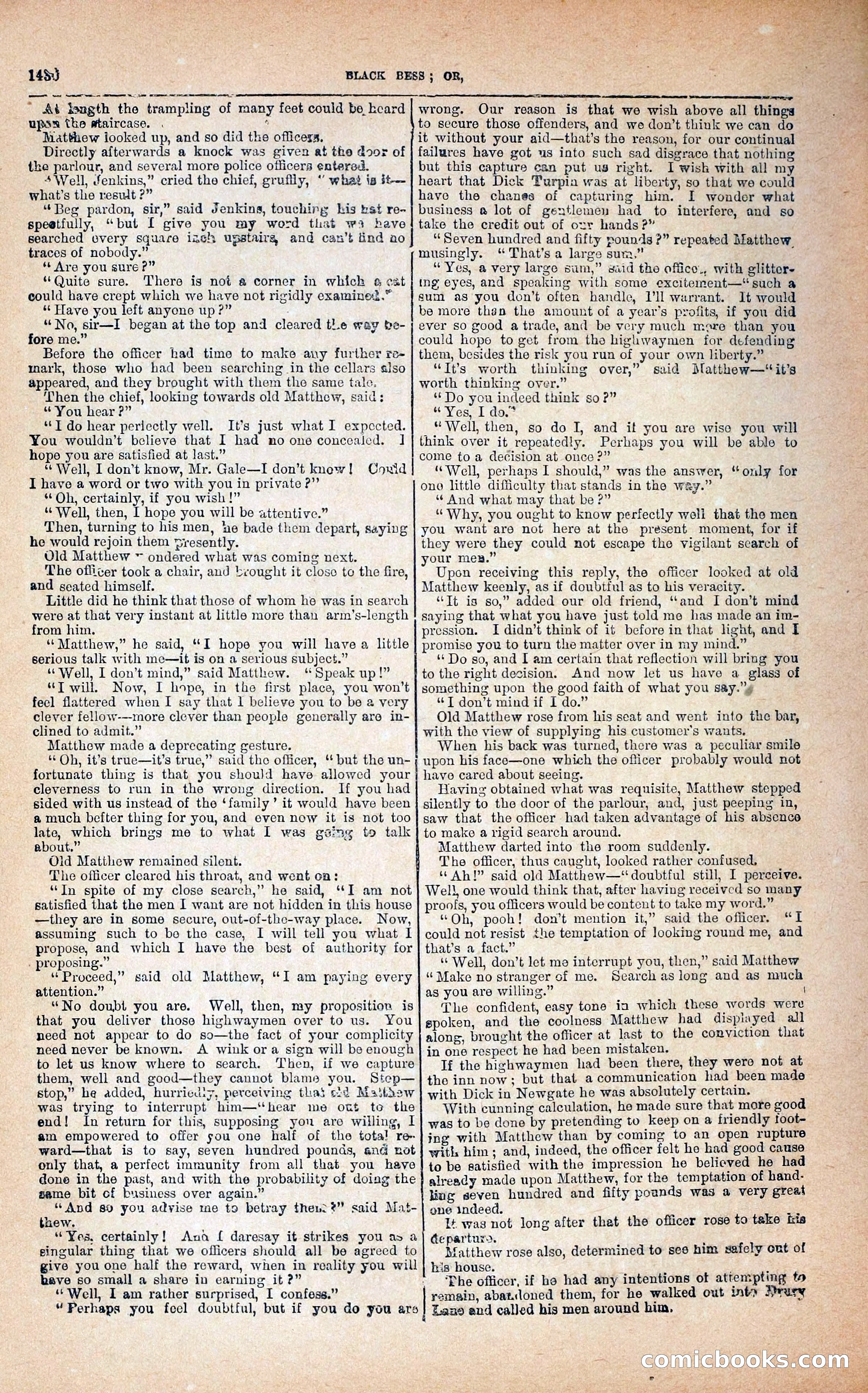
A restored page from Penny Dreadfuls, 1866. Page through the whole issue in the reader above.
📄 Transcribed text from this page (OCR, searchable)
Machine-transcribed from the original scan — historical spelling and the odd misread are preserved.
1433 — a * At isugth the trampling of many feet could be kcard upsn the ataircase. . ‘ Matthew looked up, and so did the officers. Directly afterwards a knock was given at the door of the parlour, and several more police officers entered. 4Well, fenkins,” cried the chief, gruffly, “ what is it-— what’s the result ?” ‘Bee pardon, sir,” said Jenkina, touching his kst re- spestfully, “but [ give you my word that wa have searched every square inch ugatairg, and can’t tind ao traces of nobody.” ** Are you sure P” ‘Quite sure. There is not a corner in which «@ cat could have crept which we have not rigidly examine:3.* * Have you left anyone up ?” “No, sir—I began at the top and cleared tlhe way be- fore me.” Before the officer had time to make any further re- mark, those who had been searching in the cellars slso appeared, and they brought with them the same tale. Then the chief, looking towards old Matthew, said: “You hear ?” ‘*‘T do hear pericctly well. It’s just what I expccted. You wouldn’t believe that I had no one concealed. 1] hope you are satisfied at last.” ** Well, I don’t know, Mr. Gale—I don’t Inew | I have a word or two with you in private ?” ‘Oh, certainly, if you wish!” Well, then, I hope you will be attentive.” Then, turning to his men, ‘ne bade them depart, saying he would rejoin them resently. Uld Matthew ~ ondered what was coming next. The officer took a chair, and brought it closo to the fire, and seated himself. Little did he think that those of whom he was in search were at that very instant at little more than arm’s-length from him. *¢ Matthew,” he said, “I hope you will have a little serious talk with me—it is on a serious subject.” ‘© Well, I don’t mind,” said Matthew. “Speak up!” “T will. Now, I hope, in the first place, you won’t fecl flattered when I say that 1 believe you to be a very clever fellow-—more clever than people generally are in- clined to admit.” Matthew made a deprecating gesture. * Oh, it’s true—it’s true,” said the officer, * but the un- fortunate thing is that you should have allowed your cleverness to run in the wrong direction. If you had sided with us instead of the ‘family’ it would have been a much befter thing for you, and even now it is not too late, which brings me to what I was game to talk about.” Old Matthew remained silent. The officer cleared his throat, and went on: “‘In spite of my close search,” he said, ‘*I am not satisfied that the men I want are not hidden in this house —they are in some secure, out-of-the-way place. Now, assuming such to be the case, I will tell you what I propose, and which I have the best of authority for . proposing.” “Proceed,” said old Matthew, “1 am paying every attention.” “No doubt you are. Well, then, my proposition is that you deliver those highwaymen over to us. You need not appear to do so—the fact of your complicity need never be known. <A wink ora sign will be enough to let us know where to search. Then, if we capture them, well and good—they cannot blame you. Step— stop,” he added, hurricdiz, perceiving thas oid Mattsow was trying to interrupt him—‘thear me ott to the end! In return for this, supposing you are willing, I am empowered to offer sou one half of the total! re- ward—that is to say, seven hundred pounds, and not only that, a perfect immunity from all that you have done in the past, and with the probability of doing the same bit cf business over again.” “And sv you advise me to betray then: ?” said Mat- thew. “Yos. certainly! Ana f daresay it strikes you as a singular thing that we officers should all be agreed to give you one half the reward, when in reality you will have so small a share in earning it ?” ‘‘ Well, I am rather surprised, I confess.” “Perhaps you feel doubtful, but if you do you ars Conid BLACK BESS; OR, *) - aa “P4 Oe ee we ee ee, fe PSG, ne. hy * ‘<~ a Ae acy ci Shee Md? AlN ell “Vid Wh OPA ole Uae. oF lth SBA viet ts Steel 9 vé “yi ab Tod We ae 4 Vd. ee Ne Sh oe Pais Oe 23 TAL t yA > _ . a. ee rie ¥ " . . a . g Sr as e) a ganas . ee ee a a ~~ 7 \¢¥ - . ss fog ge ~ % wal i > . 7 : ~ . . . ‘ ’ He “vs - ew ee eee ee ee wrong. Our reason is that we wish above all things to secure those offenders, and we don’t think we can do it without your aid—that’s the reason, for our continual failures have got us into such sad disgrace that nothing but this capture ean put us right. I wish with all my heart that Dick Turpin was at liberty, so that we could have the chanes of capturing him. I wonder what business a lot of gentlemen had to interfere, and so take the credit out of ozr hands ?” “Seven hundred and fifty pounds ?” repeated Matthew musingly. “ That’s a large sum,” “Yes, a very large sum,” said the offico., with glitter. ing eyes, and speaking with some excitement— such a sum as you don’t often handle, Vl warrant. It would be more than the amount of a year’s profits, if you did ever so good a trade, and be very much mare than you could hope to get from the highwaymen for defending them, besides the risk you run of your own liberty.” “It’s worth thinking over,” said Matthew—‘it’s worth thinking over.” “Do you indeed think so ?” “Yes, I do.* “Well, then, so do I, and it you are wise you will think over it repeatedly. Perhaps you will be able to come to a decision at once ?” “Well, perhaps I should,” was the answer, “only for ono little difficulty that stands in the way.” “And what may that be ?” “Why, you ought to know perfectly weli that the men you want are not here at the present moment, for if they were they could not escape the vigilant search of your mex.” Upon receiving this reply, the officer looked at old Matthew keenly, as if doubtful as to his veracity. “Tt is so,” added our old friend, ‘‘and I don’t mind saying that what you have just told me has made an im- pression. I didn’t think of it before in that light, and I promise you to turn the matter over in my mind.” ‘Do so, and I am certain that reflection will bring you to the right decision. And now let us have a glass of something upon the good faith of what you say.” “T don’t mind if I do.” Old Matthew rose from his seat and went into the bar, with the view of supplying his customer's wauts. When his back was turned, there was a peculiar smile upon his face—one which the officer probably would not have cared about seeing. Having obtained what was requisite, Matthew stepped silently to the door of the parlour, and, just peeping in, saw that the officer had taken advantage of his absence to make a rigid search around. Matthew darted into the room suddenly. The officer, thus caught, looked rather confused, Ah!” said old Matthew—‘ doubtful still, I perceive. Well, one would think that, after having received so many proofs, you officers would be content to take my word.” “Oh, pooh! don’t mention it,” said the officer, “TI could not resist the temptation of looking round me, and that’s a fact.” ‘Well, don’t let ma interrupt you, then,” said Matthew “ Make no stranger of me. Scarch as long and as nuich as you are willing.” | The confident, easy tone in which these words were spoken, and the coolness Matthew had displayed all along, brought the officer at last to the conviction that in one respect he had been mistaken. If the highwaymen had been there, they were not at the inn now; but that a communication had been made with Dick in Newgate he was absolutely certain. With cunning calculation, he made sure that more good was to be done by pretending to keep on a friendly toot- ing with Matthew than by coming to an open rupture with him ; and, indeed, the officer felt he had good cause to be satisfied with the impression he believed he had already made upon Matthew, for the temptation of hand- ling seven hundred and fifty pounds was a very great one indeed. mS lt was not long after that the officer rose to take kis departuro. Matthew rose also, his house. . 2 ‘Phe officer, if ho had any intentions of attempting to remain, abatloned them, for he walked out inty Fury Zane end called bis men around him, determined to ses him safely ont of Eomichboo (E <. =