
Penny Dreadfuls, 1866 · page 314 of 395
Black Bess; or, the Knight of the Road — page 314: what you’re looking at
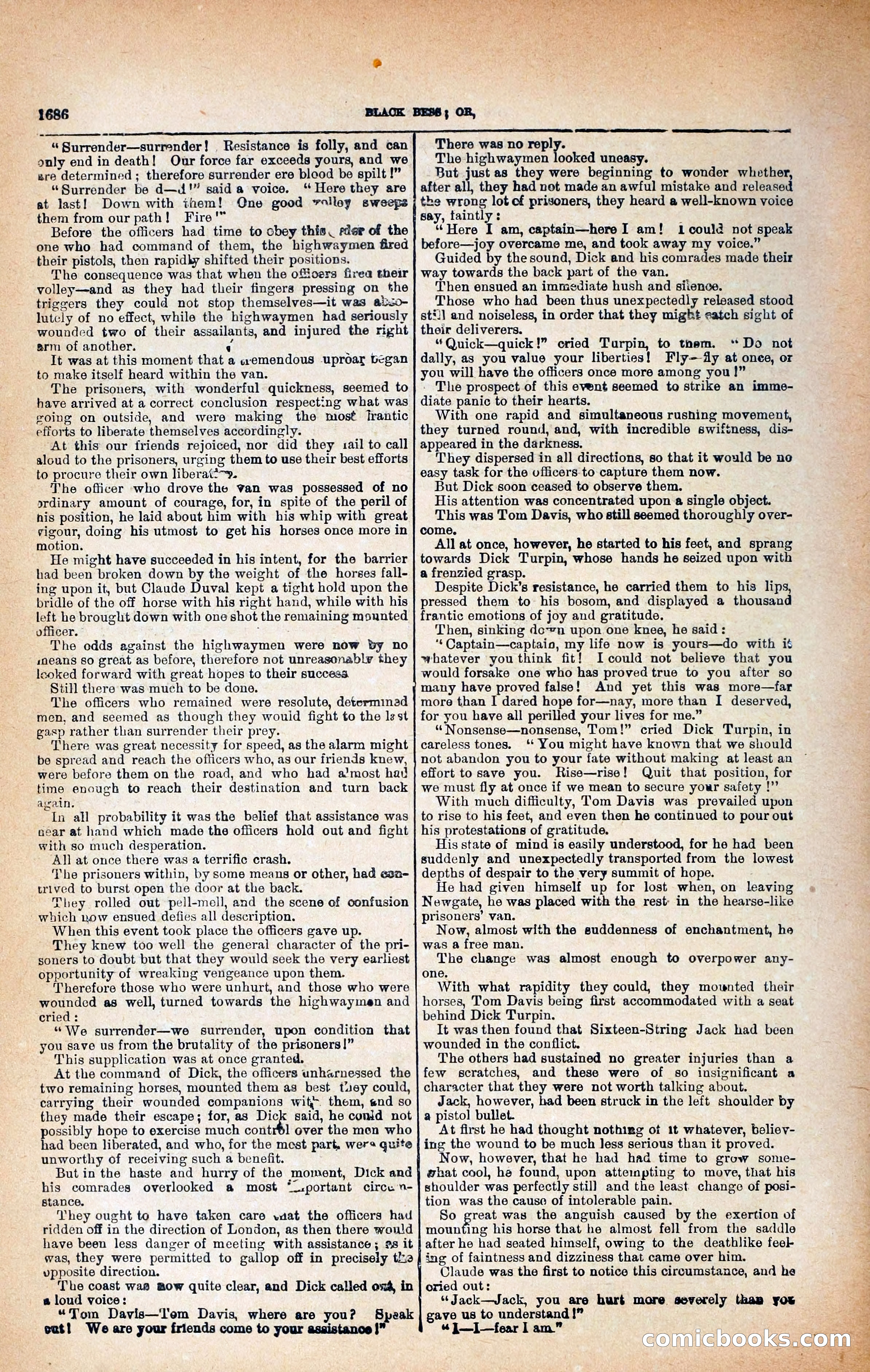
A restored page from Penny Dreadfuls, 1866. Page through the whole issue in the reader above.
📄 Transcribed text from this page (OCR, searchable)
Machine-transcribed from the original scan — historical spelling and the odd misread are preserved.
1686 “ Surrender—surrender! . Resistance is folly, and can only end in death! Our force far exceeds yours, and we wre determined ; therefore surrender ere bleod be spilt !” “Surrender be d—d'” said a voice. ‘“ Here they are at last! Down with them! Qne good volley sweeps them from our path! Fire" Before the officers had time to cbey this. rier of the one who had command of them, the highwaymen fired their pistols, then rapidby shifted their positions. The consequence was that when the ofoers firea their volley—and as they had their fingers pressing on the trigzers they could not stop themselves—it was abco- lutcly of no effect, while the highwaymen had seriously wounded two of their assailants, and injured the right arm of another. q It was at this moment that a «.emendous uproar began to make itself heard within the van. The prisoners, with wonderful quickness, seemed to have arrived at a correct conclusion respecting what was roing on outside, and were making the most frantic efforts to liberate themselves accordingly. At this our friends rejoiced, nor did they ail to call aloud to the prisoners, urging them to use their best efforts to procure their own liberat?~. The officer who drove the van was possessed of no ordinary amount of courage, for, in spite of the peril of his position, he laid about him with his whip with great vigour, doing his utmost to get his horses once more in motion. He might have succeeded in his intent, for the barrier had been broken down by the weight of the horses fall- ing upon it, but Claude Duval kept a tight hold upon the bridle of the off horse with his right hand, while with his left he brought down with one shot the remaining mounted officer. The odds against the highwaymen were now by no seans so great as before, therefore not unreasonably they leoked forward with great hopes to their success. Still there was much to be done. The officers who remained were resolute, determinad men, and seemed as though they wouid fight to the lsst gasp rather than surrender their prey. There was great necessity for speed, as the alarm might be spread and reach the officers who, as our friends knew, were before them on the road, and who had a’most hat time enough to reach their destination and turn back again. “In all probability it was the belief that assistance was near at hand which made the officers hold out and fight with so much desperation. All at once there was a terrific crash. The prisoners within, by some means or other, had eaa- trived to burst open the door at the back. <hey rolled out pell-mell, and the scene of confusion which now ensued defies all description. When this event took place the officers gave up. They knew too well the general character of the pri- soners to doubt but that they would seek the very earliest opportunity of wreaking vengeance upon them. Therefore those who were unhurt, and those who were wounded as well, turned towards the highwaymen and cried : ‘We surrender—we surrender, upon condition that you save us from the brutality of the prisoners!” This supplication was at once granted. At the command of Dick, the officers unharnessed the two remaining horses, mounted them as best tuey could, carrying their wounded companions wit them, end so they made their escape; for, as Dick said, he conld not possibly hope to exercise much contr®l over the men who had been liberated, and who, for the mest part. wer quite unworthy of receiving such a benefit. But in the haste and hurry of the moment, Dick and | his comrades overlooked a most “portant circu n- stance. Vhey ought to have taken care vat the officers had ridden off in the direction of London, as then there would have been less danger of meeting with assistance; 98 it was, they were permitted to gallop off in precisely tle vpposite direction. The coast waa gow quite clear, and Dick called oxé, in a loud voice: “‘'om Davis—‘l’em Davis, where are you? Speak eat! We are your friends come to your assistance | BLAGK BES#; OR, There was no nen The highwaymen looked uneasy. But just as they were beginning to wonder whether, after all, they had not made an awful mistake and released ithe wrong lot cf prisoners, they heard a well-known voice | say, taintly : “Here I am, captain—hereI am! Lcould not speak before—joy overcame me, and took away my voice.” Guided by the sound, Dick and his comrades made their way towards the back part of the van. Then ensued an immediate hush and siience. Those who had been thus unexpectedly released stood st®)] and noiseless, in order that they might satch sight of their deliverers. “ Quick—quick!” cried Turpin, to them. “Do not dally, as you value your liberties! Fly--dy at once, or you will have the officers once more among you !” - The prospect of this event seemed to strike an imme- diate panic to their hearts. With one rapid and simultaneous rushing movement, they turned round, and, with incredible swiftness, dis- appeared in the darkness. They dispersed in all directions, so that it would be no easy task for the officers to capture them now. But Dick soon ceased to observe them. His attention was concentrated upon a single object. This was Tom Davis, who still seemed thoroughly over- come. All at once, however, he started to his feet, and sprang towards Dick Turpin, whose hands he seized upon with a frenzied grasp. Despite Dick’s resistance, he carried them to his lips, pressed them to his bosom, and displayed a thousand frantic emotions of joy and gratitude. Then, sinking dc--n upon one knee, he said : ‘‘ Captain—captaio, my life now is yours—do with it whatever you think fit! Icould not believe that you would forsake one who has proved true to you after so many have proved false! And yet this was more—far more than I dared hope for—nay, more than I deserved, for you have all perilled your lives for me.” ‘‘ Nonsense—nonsense, Tom!” cried Dick Turpin, in careless tones. ‘ You might have known that we should not abandon you to your fate without making at least an effort to save you. Rise—rise! Quit that position, for we must fly at once if we mean to secure your safety !”’ With much difficulty, Tom Davis was prevailed upon to rise to his feet, and even then he continued to pour out his protestations of gratitude. His state of mind is easily understood, for he had been suddenly and unexpectedly transported from the lowest depths of despair to the very summit of hope. He had given himself up for lost when, on leaving Newgate, he was placed with the rest in the hearse-like prisoners’ van. Now, almost with the suddenness of enchantment, he was a free man. The change was almost enough to overpower any- one. With what rapidity they could, they mownted their horses, Tom Davis being first accommodated with a seat behind Dick Turpin. It was then found that Sixteen-String Jack had been wounded in the conflict. The others had sustained no greater injuries than a few scratches, and these were of so insignificant a character that they were not worth talking about. Jack, however, had been struck in the left shoulder by a pistol bullet. At first he had thought nothing of 1t whatever, believ- ing the wound to be much less serious than it proved. Now, however, that he had had time to grow some- ghat cool, he found, upon attempting to move, that his shoulder was perfectly still and the least change of posi- tion was the cause of intolerable pain. So great was the anguish caused by the exertion of se as his horse that he almost fell from the saddle | after he had seated himself, owing to the deathlike feel | ing of faintness and dizziness that came over him. Claude was the first to notice this circumstance, and he oried out: “Jack—Jack, you are hurt more severely thaw you gave us to understand |” “ J—]—fear I am” ANKE GO JOOK: »