
Penny Dreadfuls, 1866 · page 298 of 395
Black Bess; or, the Knight of the Road — page 298: what you’re looking at
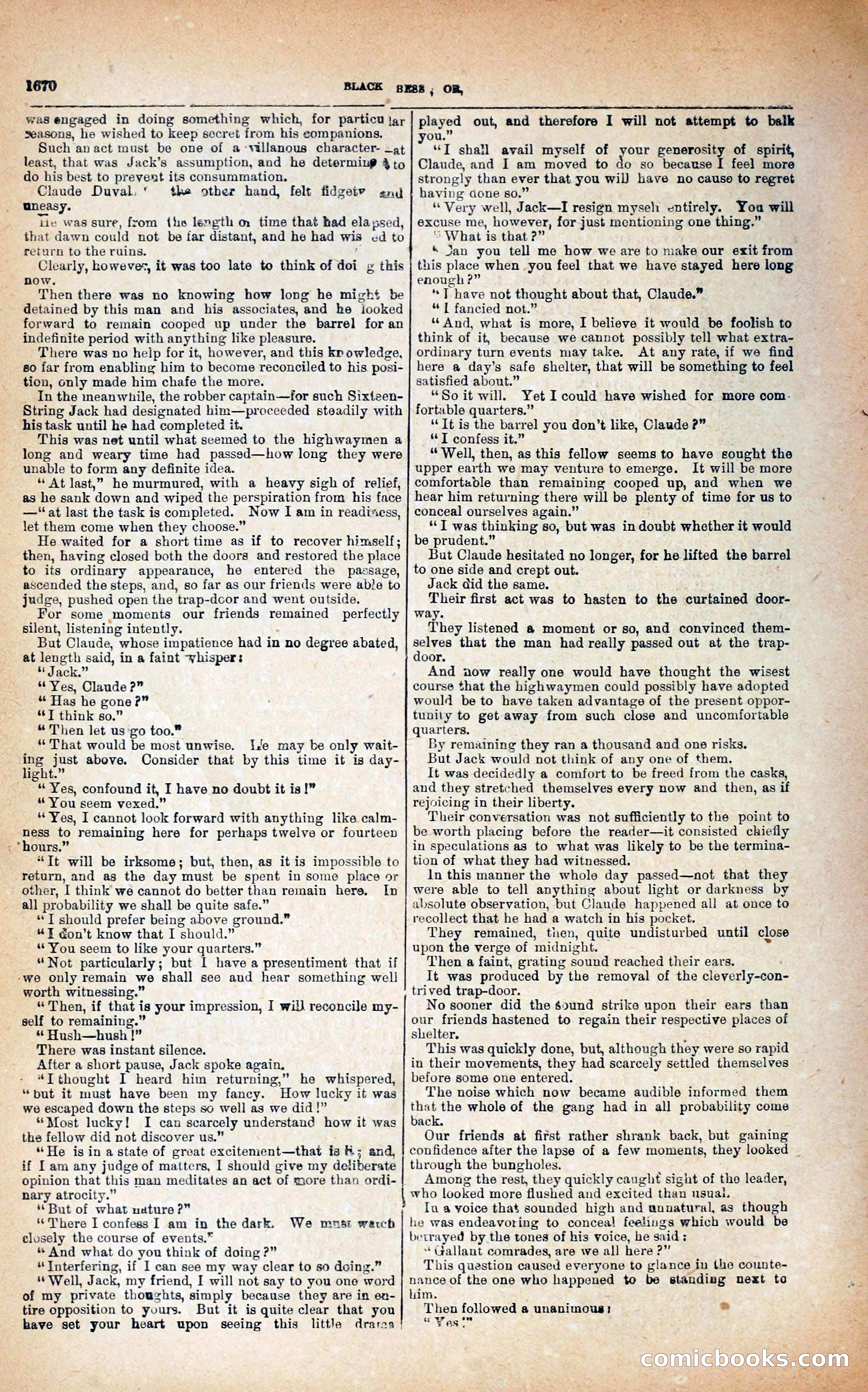
A restored page from Penny Dreadfuls, 1866. Page through the whole issue in the reader above.
📄 Transcribed text from this page (OCR, searchable)
Machine-transcribed from the original scan — historical spelling and the odd misread are preserved.
_ 1670 was engaged in doing something which, for particu lar seasons, he wished to keep secret from his companions, Such an act must be one of a-villanous character- —at least, that was Jack’s assumption, and he determing 3 to do his best to prevent its consummation. Claude Duval: ‘ the other hand, felt fidzetvy ang uneasy. lic was sure, from the length m time that had ela psed, that dawn could not be far distant, and he had wis ed to return to the ruins. Clearly, however, it was too late to think of doi ¢ this now. Then there was no knowing how long he might be detained by this man and his associates, and he looked forward to remain cooped up under the barrel for an indefinite period with anything like pleasure. There was no heip for it, however, and this kn owledge, so far from enabling him to become reconciled to his posi- tion, only made him chafe the more. _ In the meanwhile, the robber captain—for such Sixteen- String Jack had designated him—proceeded steadily with his task until he had completed it. This was net until what seemed to the highwaymen a long and weary time had passsd—how long they were unable to form any definite idea. “ At last,” he murmured, with a heavy sigh of relief, as he sank down and wiped the perspiration from his face —“at last the task is completed. Now I am in readiness, let them come when they choose.” He waited for a short time as if to recover himself; then, having closed both the doors and restored the place to its ordinary appearance, he entered the passage, ascended the steps, and, so far as our friends were able to judge, pushed open the trap-door and went outside. For some moments our friends remained perfectly silent, listening intently. But Claude, whose impatience had in no degree abated, at length said, in a faint whisper: ow BCK,” “Yes, Claude 2?” “Has he gone ?” “T think so.” “Then let us ‘go too.” “That would be most unwise. Ie may be only wait- ing just above. Consider that by this time it is day- light.” “Yes, confound it, I have no doubt it is!” “You seem vexed,” “Yes, I cannot look forward with anything like calm- ness to remaining here for perhaps twelve or fourteen hours.” “Tt will be irksome; but, then, as it is impossible to return, and as the day must be spent in some place or other, I think we cannot do better than remain here. In all probability we shall be quite safe.” “*T should prefer being above ground.” “J gon’t know that I should.” “You seem to like your quarters.” “Not particularly; but 1 have a presentiment that if -we only remain we shall see and hear something well worth witnessing.” “Then, if that is your impression, I will reconcile my- self to remaining.” “ Hush—hush !” There was instant silence. After a short pause, Jack spoke again, *T thought I heard him returning,” he whispered, “but it must have been my fancy. How lucky it was we escaped down the steps so well as we did!” “Most lucky! I can scarcely understand how it was the fellow did not discover us.” ‘‘He isin a state of great excitenient—that ia BR; and, if I am any judge of matters, 1 should give my deliberate opinion that this man meditates an act of more than ordi- nary atrocity.” ‘But of what uature ?” ‘There I confess I am in the dark. We mnsi watch clusely the course of events.” * And what do you think of doing ?” “Interfering, if 1 can see my way clear to so doing.” “ Well, Jack, my friend, I will not say to you one word of my private thoughts, simply because they are in en- tire opposition to yours. But it is quite clear that you have set your heart upon seeing this little draraa' BLACK BESS, OR, played out, and therefore I will not attempt to balk ou.” “T shall avail myself of your generosity of spirit, d Claude, and I am moved to of so because I feel more ree strongly than ever that you wil) have no cause to regret having done s0.” “Very well, Jack—I resign myseli entirely. You will excuse me, however, for just mentioning one thing.” What is that ?” | « Jan you tell me how we are to make our exit from this place when you feel that we have stayed here long enough ?” “T have not thought about that, Claude.” “TI fancied not.” “ And, what is more, I believe it would be foolish to think of it, because we cannot possibly tell what extra- ordinary turn events may take. At any rate, if we find here a day’s safe shelter, that will be something to feel satisfied about.” “So it will. Yet I could have wished for more com: fortable quarters.” “Tt is the barrel you don’t like, Claude ?” “*T confess it.” “Well, then, as this fellow seems to have sought the upper earth we may venture to emerge. It will be more comfortable than remaining cooped up, and when we hear him returning there will be plenty of time for us to conceal ourselves again.” ““] was thinking so, but was in doubt whether it would be prudent.” But Claude hesitated no longer, for he lifted the barrel to one side and crept out. ‘ Jack did the same. Their first act was to hasten to the curtained door- way. They listened & moment or so, and convinced them- ares that the man had really passed out at the trap- oor. And aow really one would have thought the wisest course that the highwaymen could possibly have adopted would be to have taken advantage of the present oppor- tunity to get away from such close and uncomfortable quarters. By remaining they ran a thousand and one risks. But Jack would not think of any one of them. It was decidedly a comfort to be freed from the casks, and they stretched themselves every now and then, as if rejoicing in their liberty. Their conversation was not sufficiently to the point to be worth placing before the reader—it consisted chiefly in speculations as to what was likely to be the termina- tion of what they had witnessed. ln this manner the whole day passed—not that they were able to tell anything about light or darkness by absolute observation, but Claude happened all at once to recollect that he had a watch in his pocket. They remained, then, quite undisturbed until close upon the verge of midnight. Then a faint, grating sound reached their ears. It was produced by the removal of the cleverly-con- trived trap-door. No sooner did the s0und strike upon their ears than our friends hastened to regain their respective places of shelter. } This was quickly done, but, although they were so rapid in their movements, they had scarcely settled themselves before some one entered. d The noise which now became audible informed them that the whole of the gang had in all probability come back, | Our friends at first rather shrank back, but gaining confidence after the lapse of a few moments, they looked | through the bungholes. Among the rest, they quickly caught sight of the leader, | who looked more flushed and excited than usual, Iu a voice that sounded high and annatural, as though he was endeavoring to conceal feelings which would be betrayed by the tones of his voice, he said; “ Gallant comrades, are we all here ?” This question caused everyone to glance in the counte- nance of the one who happened to be standing next to A liim. Then followed a unanimous} Vax Eomicboo