
Penny Dreadfuls, 1866 · page 278 of 395
Black Bess; or, the Knight of the Road — page 278: what you’re looking at
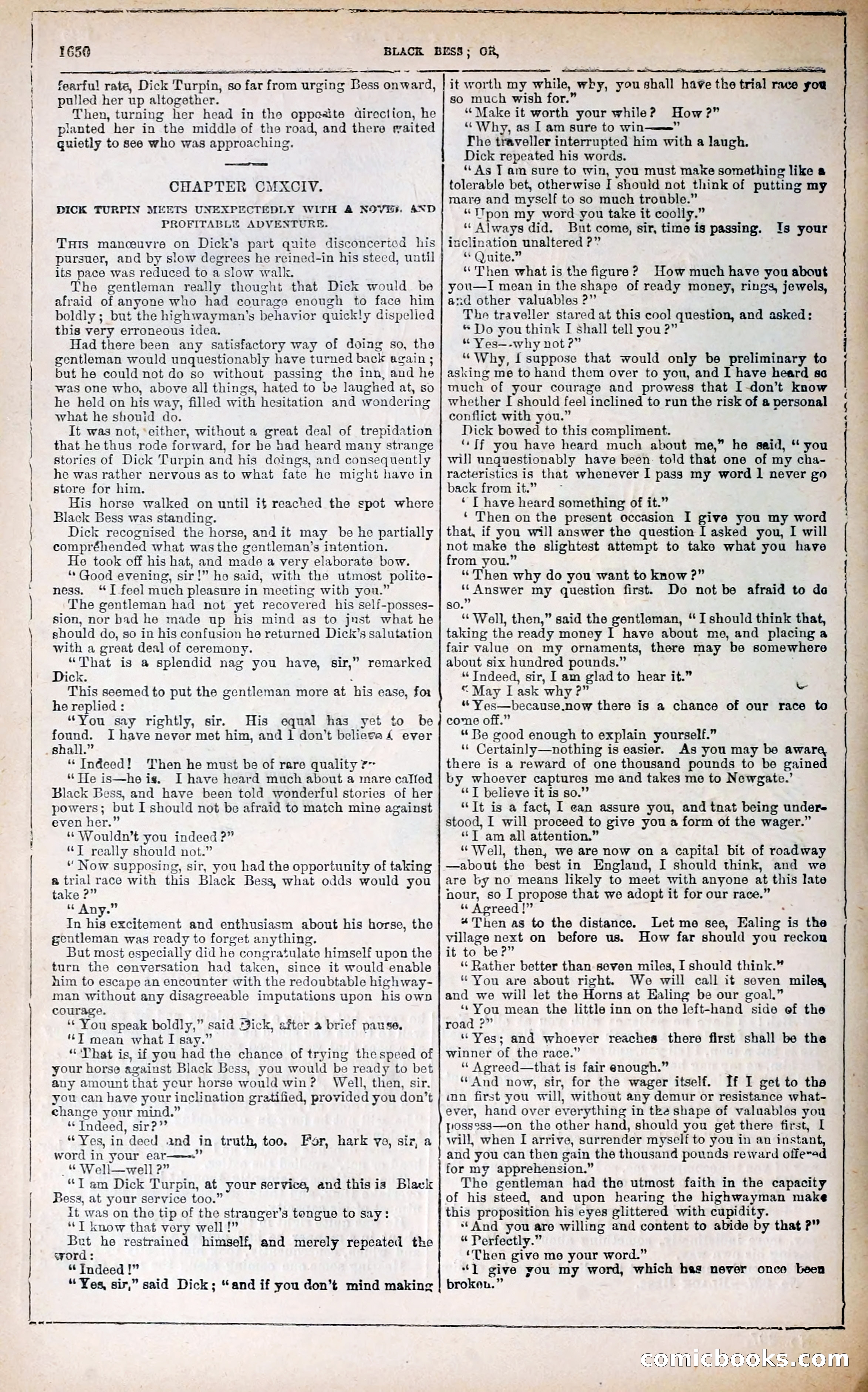
A restored page from Penny Dreadfuls, 1866. Page through the whole issue in the reader above.
📄 Transcribed text from this page (OCR, searchable)
Machine-transcribed from the original scan — historical spelling and the odd misread are preserved.
| | | | . — 1650 fearful rate, Dick Turpin, so far from urging pulled her up altogether. Then, turning her head in the oppcaite direction, he planted her in the middle of the road, and there rraited guietly to see who was approaching. _ ow CHAPTER CMXCIV. DICK TURPIN MEETS UNEXPECTEDLY WITH A NOVs. 4ND PROFITABLE ADVENTURE. THIs manceuvre on Dick's part quite disconcerted his pursuer, and by slow degrees he reined-in his steed, until its pace was reduced to a slow walk. The gentleman really thought that Dick would be afraid of anyone who had courage enough to face him boldly; but the highwayman’s behavior quickly dispelled this very erroneous idea. Had there been any satisfactory way of doing so, the gentleman would unquestionably have turned back again ; but he could not do so without passing the inn, and he was one who, above all things, hated to be laughed at, so he held on his way, filled with hesitation and wondering what he shouid do. It was not, ‘either, without a great deal of trepidation that he thus rode forward, for he had heard many strange stories of Dick Turpin and his doings, and consequently he was rather nervous as to what fate he might have in store for him. His horse walked on until it reached the spot where Black Bess was standing. Dick recognised the horse, and it may be he partially compréhended what wasthe gentleman’s intention. He took off his hat, and made a very elaborate bow. “Good evening, sir!” he said, with the utmost polite- ness. “I feel much pleasure in meeting with you.” The gentleman had not yet recovered his self-posses- sion, nor bad he made up his mind as to jnst what he should do, so in his confusion he returned Dick’s salutation with a great deal of ceremony. “That is a splendid nag you have, sir,” remarked Dick. This seemed to put the gentleman more at his ease, for he replied : “You say rightly, sir. His equal has yet to be found. Ihave never met him, and 1 don’t belierae < ever shall.” ‘‘ Indeed! Then he must be of rare quality ?~ “He is—he is. I have heard much about a mare called Black Bess, and have been told wonderful stories of her powers; but I should not be afraid to match mine against even her.” * Wouldn’t you indeed ?” “T really should not.” “ Now supposing, sir, you had the opportunity of taking a ore with this Black Bess, what odds would you Se A ny In his excitement and enthusiasm about his horse, the gentleman was ready to forget anything. But most especially did he congratulate himself upon the turn the conversation had taken, since it would enable him to escape an encounter with the redoubtable highway- man without any disagreeable imputations upon his own courage. ‘‘' You speak boldly,” said {3ick, after a brief pause. *T mean what I say.” “That is, if you had the chance of trying thespeed of your horse against Black Bess, you would be ready to bet any amount that your horse would win? Well, then, sir. you can have your inclination gratified, provided you don’t change your mind.” ‘“‘ Indeed, sir?”’ “Yes, in decd ind in truth, too. For, hark yo, sir, a word in your ear——”’ _“ Well—well ?” “TY am Dick Turpin, at your service, and thisis Black Bess, at your service too.” it was on the tip of the stranger’s tongue to say: ‘“*T know that very well !” But he restrained himself, and merely repeated the word: “ Indeed !” “Yes, sir,” said Dick; “and if you don’t mind making BLACK BESS; OR, . so much wish for.” “Make it worth your while? How?” “Why, as I am sure to win—” rhe traveller interrupted him with a laugh. Dick repeated his words. ‘As Tam sure to win, you must make something like a tolerable bet, otherwise I should not think of putting my mare and myself to so much trouble.” “ITpon my word you take it coolly.” ‘Always did. But come, sir, time is passing. Is your inclination unaltered ?” “ Quite.” “Then what is the figure ? How much have you about you—I mean in the shape of ready money, rings, jewels, and other valuables ?”’ The traveller stared at this cool question, and asked: * Do you think I shall tell you 2?” “ Yes—-why not ?” “ Why, [ suppose that would only be preliminary to asking me to hand them over to you, and I have heard se much of your courage and prowess that I-don’t know whether I should feel inclined to run the risk of a personal conflict with you.” Dick bowed to this compliment. “Tf you have heard much about me,” he seid, * you wil] unquestionably have been: told that one of my cha- racteristics is that whenever I pass my word 1 never go back from it.” ‘ [ have heard something of it.” ‘ Then on the present occasion I give you my word that, if you will answer the question I asked you, I will not make the slightest attempt to take what you have from you.” “Then why do you want to know ?” ‘‘ Answer my question first. Do not be afraid to de ‘‘ Well, then,” said the gentleman, “ I should think that, taking the ready money I have about me, and placinga fair value on my ornaments, there may be somewhere about six hundred pounds.” ; “ Indeed, sir, I am glad to hear it.” = May I ask why ?” “'Yes—because.now there is a chance of our race to come off.” “ Be good enough to explain yourself.” ‘* Certainly—nothing is easier. As you may be aware, there is a reward of one thousand pounds to be gained by whoever captures me and takes me to Newgate.’ ‘“‘T believe it is so.” “Tt is a fact, I ean assure you, and tnat being undere stood, I will proceed to give you a form of the wager.” “T am all attention.” “Well, then, we are now on a capital bit of roadway —about the best in England, I should think, and we are by no means likely to meet with anyone at this late nour, so I propose that we adopt it for our race.” “ Acreed !” “Then as to the distance. village next on before us. it to be?” ‘Rather better than seven miles, I should think.” “You are about right. We will call it seven mileg and we will let the Horns at Ealing be our goal.” ‘* You mean the little inn on the left-hand side ef the road 2” ‘‘ Yes; and whoever reaches there first shall be the winner of the race.” “ A oreed—that is fair enough.” “And now, sir, for the wager itself. If I get to the inn first you will, without any demur or resistance what- ever, hand over everything in tke shape of valuables you possess—on the other hand, should you get there first, I will, when I arrive, surrender myself to you in an instant, and you can then gain the thousand pounds reward offered for my apprehension.” The gentleman had the utmost faith in the capacity of his steed, and upon hearing the highwayman make this proposition his eyes glittered with cupidity. ‘And you are willing and content to abide by that ?” “ Perfectly.” ‘Then give me your word.” “7 give you my word, which has never onco been broken.” | sO we Let me see, Ealing is the How far should you reckon Bess onward, | it worth my while, why, youshall have the trial race you | (E@) lEboo \ see. pda een mn sate ee el ee ee ee ae . * o te aa ai : ‘ — “\ — t i at ? i in a ie tte | i ae