
Penny Dreadfuls, 1866 · page 264 of 395
Black Bess; or, the Knight of the Road — page 264: what you’re looking at
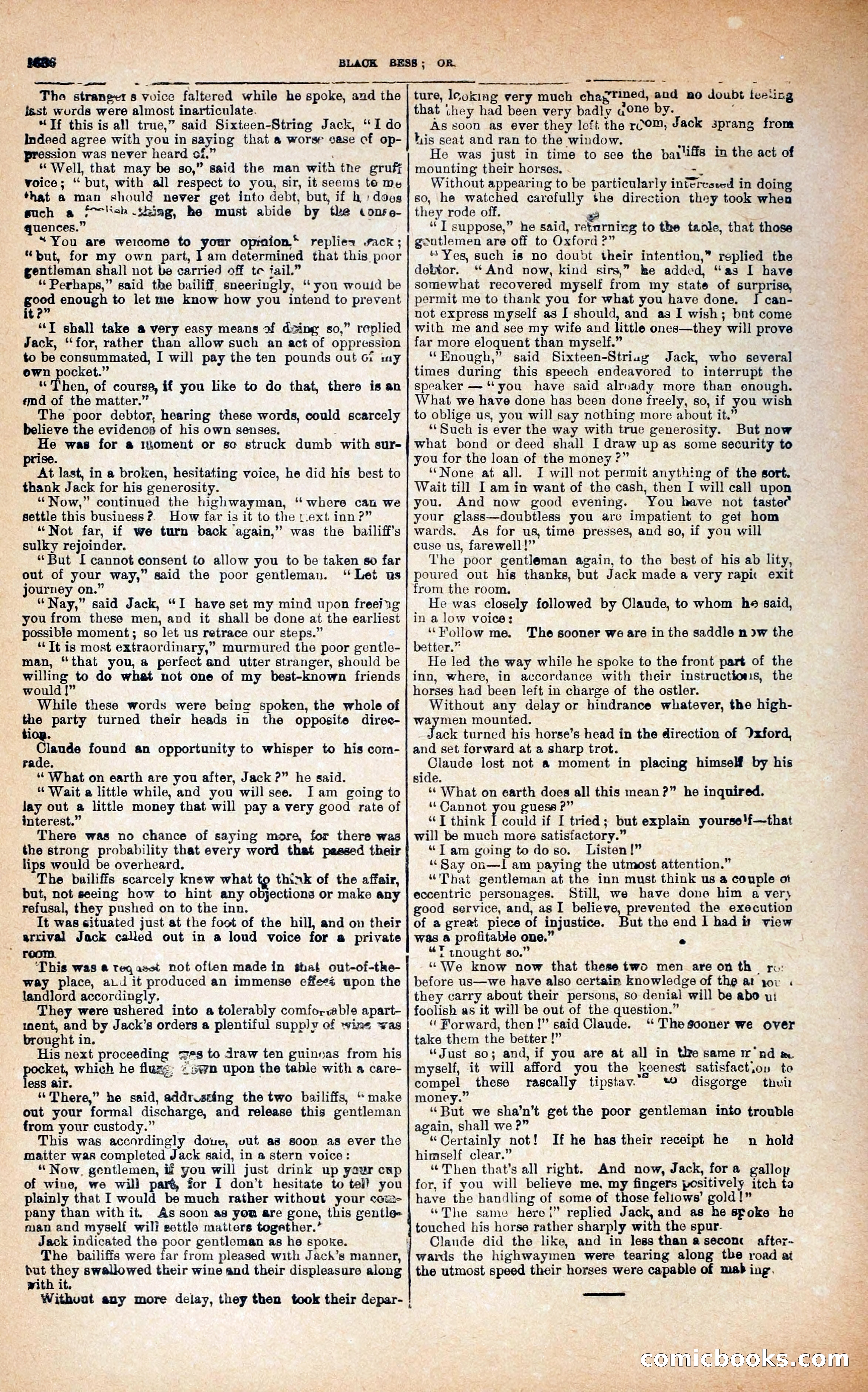
A restored page from Penny Dreadfuls, 1866. Page through the whole issue in the reader above.
📄 Transcribed text from this page (OCR, searchable)
Machine-transcribed from the original scan — historical spelling and the odd misread are preserved.
The straneer 8 s vuice faltered while he spoke, and the fest words were almost inarticulate. “Tf this is all true,” said Sixteen-String Jack, “Ido Indeed agree with you in saying that a worse gase of op- ssion was never heard ci. “Well, that may be so,” said the man with the grubs voice; ‘“ ‘but, with all respect to you, sir, if seems te mg that a man should never get into debt, but, if h ) does such a SNS aaa thing, he must abide by the conse- quences.” “You are weicome to your oprnion* repliex sack; “but, for my own part, I am determined that this poor gentleman shall not be carried off te tail.” “Perhaps,” said the bailiff. sneeringly, “you would be good enough to let me know how you intend to prevent it ‘T shall take a very easy means of dzing so,” replied Jack, ‘‘for, rather than allow such an act of oppression to be consummated, I will pay the ten pounds out o: wy own ocket.” hen, of course, if you like to do that, there is an ma of the matter.” The poor debtor, hearing these words, could scarcely believe the evidencs of his own senses. He was for a 1oment or sc struck dumb with sur- prise At last, in a broken, hesitating voice, he did his best to thank Jack for his generosity. “Now,” continued the highwayman, ‘where can we settle this business? How far is it to the text inn 2” “Not far, if we turn back again,” was the bailiff’s sulky rejoinder. “But I cannot consent to allow you to be taken so far out of your way,” said the poor gentleman. ‘ Let us journey on.’ “Nay,” said Jack, “I have set my mind upon freeixg you from these men, and it shall be done at the earliest possible moment; so let us retrace our steps.” ‘“‘ Tt is most extraor dinary,” murmured the poor gentle- man, “that you, a perfect and utter stranger, should be willing to do what not one of my best-known friends would |” While these words were being spoken, the whole of the party turned their heads in the opposite direc- tiog Ciande found an opportunity to whisper to his com- rade “What on earth are you after, Jack ?” he said. “Wait a little while, and you will see. Iam going to lay out a little money that will pay a very good rate of interest.” There was no chance of saying mora, for there was the strong probability that every word that passed their lips would be overheard. The bailiffs scarcely knew what to think of the affair, but, not seeing how to hint any objections or make any refusal, they pushed on to the inn. It was situated just at the foot of the hill, and on their arrival Jack called out in a loud voice for a private ’ room. This was @ teqasct not ofien madein shat out-of-the- way place, aid it produced an immense effets upon the landlord accordingly. They were ushered into a tolerably comforvable apart- inent, and by Jack’s orders a plentiful supply of wine was brought in. His next proceeding wes to draw ten guineas from his ket, which he fluz¢: «een upon the table with a care- ess air. “There,” he said, addristing the two bailiffs, “ make out your formal discharge, and release this gentleman from your custody.” This was accordingly douse, vut as soon as ever the matter was completed Jack said, in a stern voice: “ Now. gentlemen, ii you will just drink up your cup of wine, we will pare, for I don’t hesitate to tell you plainly that I ould be much rather without your com- pany than with it. As soon as you are gone, this gentlee man and myself will settle matters together.’ Jack indicated the poor gentleman as he spoke. The bailiffs were far from pleased with Jack’s manner, but they swallowed their wine and their displeasure along with it. Withuot any more delay, they then took their depar- BLACK BESS; shee OR. ture, Ieoking very much chagTined, and-1 BO doubt testing that they had been very badly aone by. As soon as ever they left the rcom, Jack sprang from his seat and ran to the window. He was just in time to see the bai'iffs in the act of mounting their horses. Without appearing to be particular] ly infoieowas in doing s0, he watched carefully the direction they took when they rode off. 2 “T suppose,” he said, returnizg to the taole, that those goutlemen are off to Oxford 2” “Yes, such is no doubt their intention,” replied the debtor. ‘And now, kind sirs,” he added, “as I have somewhat recovered myself from my state of surprise, permit me to thank you for what you have done. I can- not express myself as I should, and as I wish; bnt come with me and see my wife and little ones—they will prove far more eloquent than myself.” “Enough,” said Sixteen-Striug Jack, who several times during this speech endeavored to interrupt the speaker — ‘you have said alruady more than enough. What we have done has been done freely, so, if you wish to oblige us, you will say nothing more about it.” “Such is ever the way with true generosity. But now what bond or deed shall I draw up as some security to you for the loan of the money ?” ‘None at all. I will not permit anything of the sort. Wait till I am in want of the cash, then I will call upon you. And now good evening. ‘You have not taste your glass—doubtless you are impatient to get hom wards. As for us, time presses, and so, if you will cuse us, farewell!” The poor gentleman again, to the best of his ab lity, poured out his thanks, but Jack made a very rap exit from the room. He was closely followed by Olaude, to whom he said, in a low voice: “Follow me. The sooner we are in the saddle n »w the better.” He led the way while he spoke to the front part of the inn, where, in accordance with their instructious, the horses had been left in charge of the ostler. Without any delay or hindrance whatever, the high- waymen mounted. ack turned his horse’s head in the direction of Dxford, and set forward at a sharp trot. Claude lost not a moment in placing himself by his side. ‘‘ What on earth does all this mean?” he inquired. ‘Cannot you guess P” “T think f aati if I tried; but explain yourse'f—that will be much more satisfactory.” “Tam going todoso. Listen!” “Say on—I am paying the utmost attention.” “That gentleman at the inn must think us a couple ot eccentric personages. Still, we have done him a ver} good service, and, as I believe, prevented the execution of a great piece of injustice. But the end I had it view was @ profitable one.” “T thought so.” “We know now that these two men are on th ru: before us—we have also certain knowledge of the at yor « they carry about their persons, so denial “will be abo ut foolish as it will be out of the question.” “ Forward, then!” said Claude. ‘“ Thesgooner we over take them the better !” “Just so; and,if you are at all in tle same rnd m myself, it will afford you the keenest satisfact.on te compel | these rascally tipstav. to disgorge thuil money.” “But we sha’n’t get the poor gentleman into trouble again, shall we ?” “ Certainly not! himself clear.” “Then that’s all right. And now, Jack, fora gallop for, if you will believe me, my fingers positively itch ta have the handling of some of those feliows’ gold!” “The same here” replied Jack, and as he spoke he gienened his horse rather sharply with the spur- Claude did the like, and in less than aseconc aftex- Dee the highwaymen were tearing along tbe road at the utmost speed their horses were capable of mab ing. If he has their receipt he n hold (ECO) (E