
Penny Dreadfuls, 1866 · page 227 of 395
Black Bess; or, the Knight of the Road — page 227: what you’re looking at
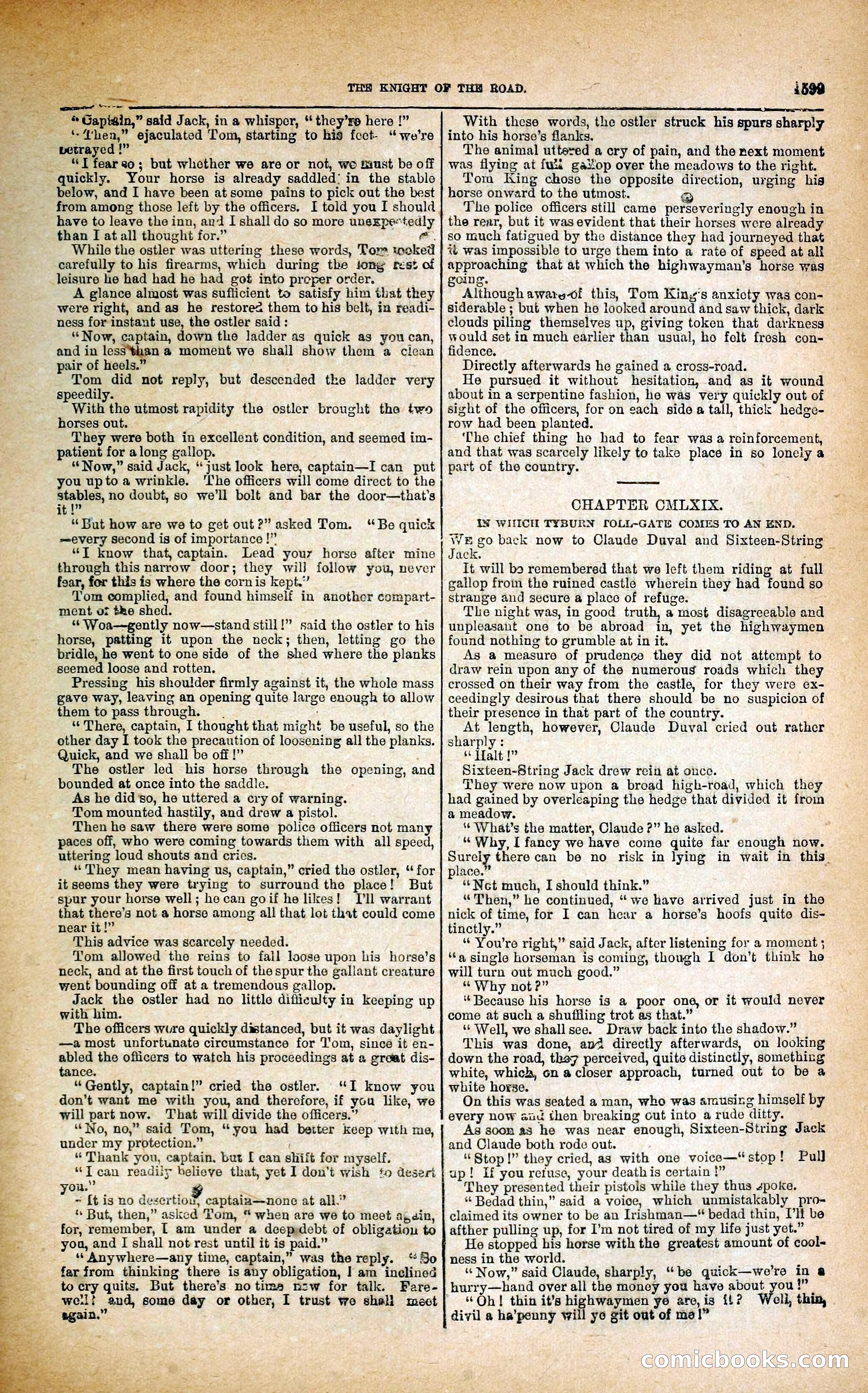
A restored page from Penny Dreadfuls, 1866. Page through the whole issue in the reader above.
📄 Transcribed text from this page (OCR, searchable)
Machine-transcribed from the original scan — historical spelling and the odd misread are preserved.
J = _ : —_ -— oes — p< paltye bi oe ent ie? ete - Z . Gapisin,” said Jack, in a whisper, “ they’re here !” a “TI fearso; but whether we are or not, we Hiust be off quickly. Your horse is already saddled‘ in the stable below, and I have been at some pains to pick out the best from among those left by the officers. I told you I should have to leave the inn, and I shall do so more unexpetedly than I at all thought for.” a While the ostler was uttering these words, Tom tnpoked carefully to his firearms, which during the tong res? of leisure he had had he had got into proper order. A glance almost was sufficient to satisfy him that they were right, and as he restorea them to his belt, in readi- ness for instant use, the ostler said: “Now, captain, down the ladder as quick as you can, and in less*than @ moment we shall show them a cican pair of heels.’ - Tom did not reply, but descended the ladder very speedily. With the utmost rapidity the ostler brought the two horses out. They were both in excellent condition, and seemed im- patient for along gallop. “* Now,” said Jack, “just look here, captain—I can put you uptoa wrinkle. ‘The officers will come direct to the ae no doubt, so we'll bolt and bar the door—that’s it !” “ But how are we to get out ?” asked Tom. every second is of importance !” “JT know that, captain. Lead your horse after mine through this narrow door; they wil) follow you, never foar, for this is where the cornis kept.” Tom complied, and found himself in another compart- ment oz the shed. ** Woa—gently now—stand still!” said the ostler to his horse, patting it upon the neck; then, letting go the bridle, he went to one side of the shed where the planks seemed loose and rotten. Pressing his shoulder firmly against it, the whole mass gave way, leaving an opening quite large enough to allow them to passthrough. ‘* There, captain, I thought that might be useful, so the other day I took the precaution of loosening all the planks. Quick, and we shall be off!” : The ostler led his horse through the opening, and bounded at once into the saddle. As he did‘so, he uttered a cry of warning. Tom mounted hastily, and drew a pistol. Then he saw there were some police officers not many paces off, who were coming towards them with all speed, uttering loud shouts and cries. “They mean having us, captain,” cried the ostler, “for it seems they were trying to surround the place! But spur your horse well; he can goif he likes! Ill warrant that there’s not a horse among all that lot that could come near it!” This advice was scarcely needed. Yom allowed the reins to fall loose upon his horse’s neck, and at the first touch of thespur the gallant creature went bounding off at a tremendous gallop. Jack the ostler had no little difficulty in keeping up with him. The officers wure quickly distanced, but it was daylight —a most unfortunate circumstance for Tom, since it er- abled the officers to watch his proceedings at a great dis- tance. “Gently, captain!” cried the ostler. “I know you don’t want me with you, and therefore, if you like, we will part now. That will divide the officers.” | ‘No, no,” said Tom, “you had better keep with me, under my protection.” “ Thank you, captain, but [ can shift for myself. “T can readily believe that, yet I don’t wish 0 deseri you.” 9 | ~ {¢ is no desertion, captaia—none at all.” * But, then,” asked Vom, “ when are we to meet apain, for, remember, | am under a deep debt of obligation to _ * Anywhere—any time, captain,” was the reply. “3o far from thinking there is any obligation, I am inclined to ery quits. But there’s notima new for taik. Pare- * Be quick -yoa, and I shall not rest until it is paid.” egain.” THR KNIGHT OF THE ROAD. welt and, some day or other, I trust wo shall meet | “_ 1598 With these words, the ostler struck his spurs sharply _ *© fhen,” ejaculated Tom, starting to his fect- “we're | into his horse’s flanks. The animal uttered a cry of pain, and the next moment was flying at fuis gaYop over the meadows to the right. Tom King chose the opposite direction, urging hig horse onward to the utmost. The police officers still came perseveringly enough in the rear, but it was evident that their horses were already so much fatigued by the distance they had journeyed that % was impossible to urge them fnto a rate of speed at all approaching that at which the highwayman’s horse was going. ! Although awareOi this, Tom King’s anxicty was con- siderable ; but when he looked around and saw thick, dark clouds piling themselves up, giving token that darkness would set in much earlier than usual, ho felt fresh con- fidence. Directly afterwards he gained a cross-road. He pursued it without hesitation, and as it wound about in a serpentine fashion, he was very quickly out of sight of the officers, for on each side a tall, thick hedge- row had been planted. ‘'he chief thing he had to fear was a reinforcement, and that was scarcely likely to take place in so lonely a part of the country. CHAPTER CMLXIX. IN WITICH TYBURN [OLL-GATE COMES TO AN END. WE go back now to Claude Duval and Sixteen-String — Jack. It will bo remembered that we left them riding at full gallop from the ruined castle wherein they had found so strange and secure a place of refuge. The night was, in good truth, a most disagreeable and unpleasant one to be abroad in, yet the highwaymen found nothing to grumble at in it. As a measure of prudence they did not attempt to draw rein upon any of the numerous roads which they crossed on their way from the castle, for they were ex- ceedingly desirous that there should be no suspicion of their presence in that part of the country. At length, however, Claude Duval cried out rather sharply : * Halt)” Sixteen-String Jack drew rein at once. They were now upon a broad high-road, which they had gained by overleaping the hedge that divided it from a meadow. * What's the matter, Claude ?” he asked. “ Why, I fancy we have come quite far enough now. Surely there can be no risk in lying in wait in this place.” ‘‘ Nct much, I should think.” “Then,” he continued, “we have arrived just in the nick of time, for I can hear a horse’s hoofs quite dis- tinctly.” “ You're right,” said Jack, after listening for a moment ; ‘‘a, single horseman is coming, though I don’t think ho will turn out much good.” “Why not?” ‘Because his horse is a poor one, or if would never come at such a shuffling trot as that.” “© Well, we shallsee. Draw back into the shadow.” This was done, avi directly afterwards, on looking down the road, thay perceived, quite distinctly, something white, which, on a closer approach, turned out to be a white horse. On this was seated a man, who was amusing himself by every now auc then breaking out into a rude ditty. As soon a8 he was near enough, Sixteen-String Jack and Claude both rode out. “ Stop!” they cried, as with one voice—“stop! Pull up! If you refuse, your death is certain !” They presented their pistols while they thus spoke. “ Bedad thin,” said a voice, which unmistakably pro- claimed its owner to be an Irishman—* bedad thin, Ili be afther pulling up, for I’m not tired of my life just yet.” He stopped his horse with the greatest amount of cool- ness in the world. “ Now,” said Claude, sharply, ‘‘be quick—we’re in @ hurry—hand over all the money you have about you!” “Oh! thin it’s lige yo are,is it? Well, thin, - divil a ha’penny will yo git out of ma!” e(0) CORMIC SOO ( (©) 6S