
Penny Dreadfuls, 1866 · page 184 of 395
Black Bess; or, the Knight of the Road — page 184: what you’re looking at
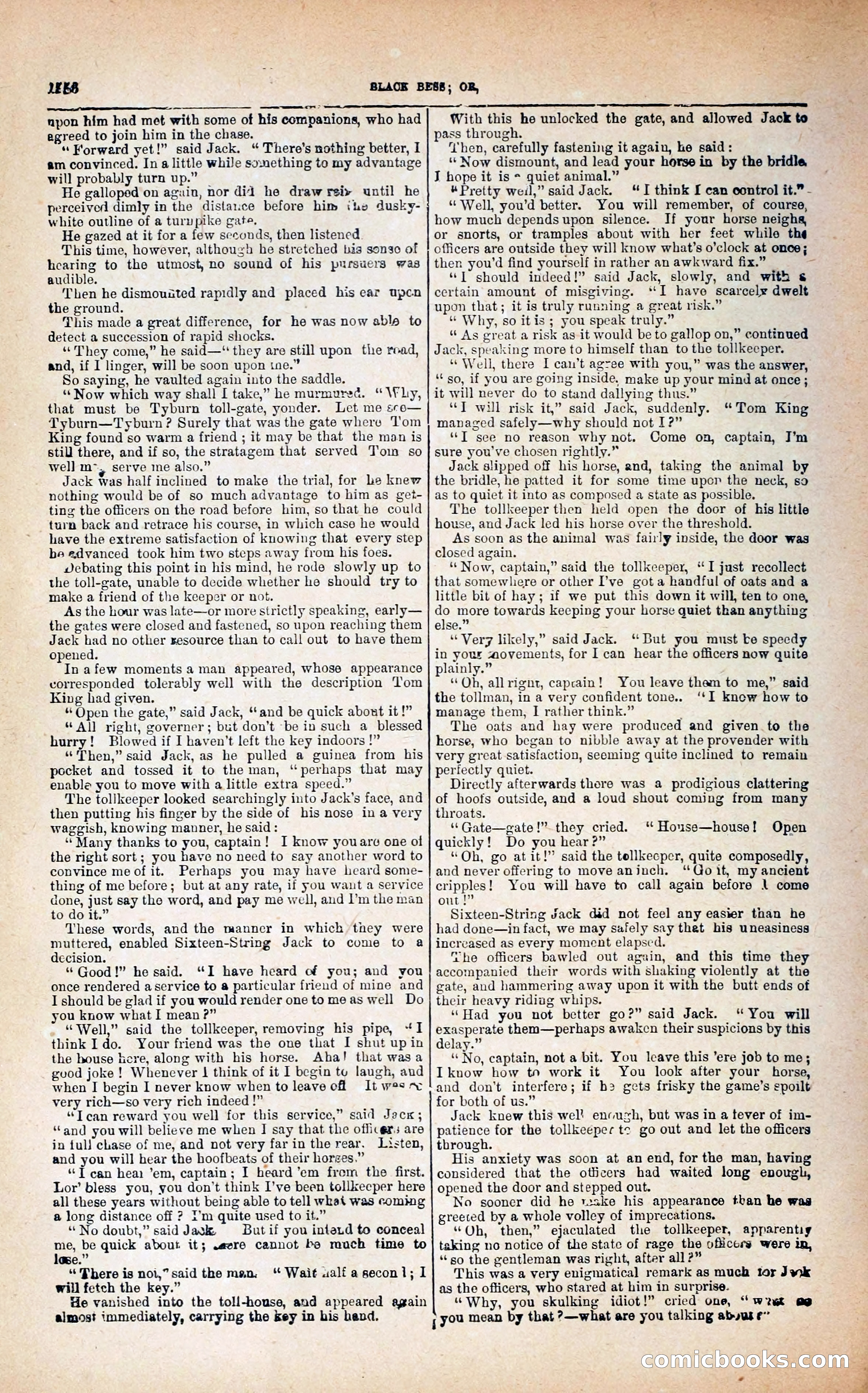
A restored page from Penny Dreadfuls, 1866. Page through the whole issue in the reader above.
📄 Transcribed text from this page (OCR, searchable)
Machine-transcribed from the original scan — historical spelling and the odd misread are preserved.
LEES npon him had met with some of his companions, who had agreed to join him in the chase. “Forward yet!” said Jack. “ There's nothing better, I am convinced. In a little while something to my advantage will probably turn up.” _ He galloped on again, nor did he draw reiy until he perceived dimly in the distaice before him ‘he dusky- white outline of a turupike gate. He gazed at it for a few seconds, then listened This time, however, although he stretched bis sonso of hearing to the utmost, no sound of his pursuers was audible. Then he dismousted rapidly and placed his ear upen the ground. This made a great difference, for he was now able to detect a succession of rapid shocks. “They come,” he said—“ they are still upon the road, and, if I linger, will be soon upon tne.” So saying, he vaulted again into the saddle. “Now which way shall I[ take,” he murmured. “ Why, that must be Tyburn toll-gate, yonder. Let me sco— Tyburn—Tyburn ? Surely that was the gate where ‘T’om King found so warm a friend ; it may be that the man is still there, and if so, the stratagem that served Ton so wel] m~, serve me also.” Jack was half inclined to make the trial, for he knew nothing would be of so much advantage to him as gei- ting the officers on the road before him, so that he could turn back and retrace his course, in which case he would have the extreme satisfaction of knowing that every step be edvanced took him two steps away from his foes. Jebating this point in his mind, he rode slowly up to the toll-gate, unable to decide whether he should try to make a friend of the keeper or not. As the kour was late—or more strictly speaking, early— the gates were closed and fastened, so upon reaching them Jack had no other sesource than to call out to have them opened. In afew moments a man appeared, whose appearance corresponded tolerably well with the description ‘om King had given. ‘Open the gate,” said Jack, “‘and be quick abont it!” “All right, governer; but don’t be in such a_ blessed hurry! Blowed if I haven't left the key indoors !” “Then,” said Jack, as he pulled a guinea from his pocket and tossed it to the man, “perhaps that may enable you to move with a little extra speed.” The tollkeeper looked searchingly into Jack’s face, and then putting his finger by the side of his nose in a very waggish, knowing manner, he said: ‘Many thanks to you, captain! I know youarse one ol the right sort; you have no need to say another word to convince me ofit. Perhaps you may have heard some- thing of me before; but at any rate, if you want a service done, just say the word, and pay me well, and |’m the man to do it.” These words, and the manner in which they were muttered, enabled Sixteen-String Jack to come to a decision. “ Good!” he said. “I have heard cf you; and you once rendered aservice to a particular friend of mine and I should be glad if you would render one to me as well Do you know what I mean ?” _ “Well,” said the tollkeeper, removing his pipe, “I think Ido. Your friend was the one that I shut up in the bouse bere, along with his horse. Aha! that wasa gvod joke ! Whenever | think of it I begin tu laugh, and when I begin I never know when to leave ofl Itwes~ very rich—so very rich indeed !” “Tecan reward you well for this service,” said Jack; ‘and you will believe me when I say that the officers are in ful) chase of me, and not very far in the rear. Listen, and you will hear the hoofbeats of their horges.” “‘T can hea) ’em, captain; I heard ’em frem the first. Lor’ bless you, you don’t think I’ve been tollkeeper here all these years without being able to tell what was commg a long distance off ? I’m quite used to it.” ‘‘No doubt,” said Jask Butif you intexrd to conceal ay be quick about it; wzeere cannot be much time to ase.” “‘ Phere is noi,” said the man. will fetch the key.” He vanished into the toll-house, and appeared again almost immediately, carrying the key in his hand. “ Wait ualf a seconl; I CL LL CCl LLL LLL LLL LLL LLL LLLLL LE A LL BLACK BESS; OR, With this he unlocked the gate, and allowed Jack to pass through. ‘Then, carefully fastening it again, he said: ‘‘ Now dismount, and lead your horse in by the bridle J hope it is * quiet animal.” “Pretty weil,” said Jack. “Well, you’d better. You will remember, of course, how much depends upon silence. If your horse neighs, or snorts, or tramples about with her feet while the officers are outside they will know what’s o'clock at once; then you'd find yourself in rather an awkward fix.” ‘T should indeed!” said Jack, slowly, and with s certain amount of misgiving. “I have scarcely dwelt upon that; it is truly running a great risk.” “ Why, so itis ; you speak truly.” “ As great a risk as it would be to gallop on,” continued Jack, speaking more to himself than to the tollkeeper. “Well, there I can’t agree with you,” was the answer, “so, if you are going inside, make up your mind at once; it will never do to stand dallying thus.” “TY will risk it,” said Jack, suddenly. managed safely—why should not I?” ‘““T see no reason why not. Come on, captain, J’m sure you've chosen rightly.” Jack slipped off his horse, and, taking the animal by the bridle, he patted it for some time upcr the neck, so as to quiet it into as composed a state as possible. The tollkeeper then held open the door of his little house, and Jack led his horse over the threshold. As soon as the animal was fairly inside, the door was closed again. ‘‘ Now, captain,” said the tollkeeper, “I just recollect that somewhere or other I’ve gota handful of oats and a little bit of hay; 1f we put this down it will, ten to one, ge more towards keeping your horse guiet than anything else. ‘“Verz likely,” said Jack. “But you must be speedy in your «aovements, for I can hear the officers now quite plainly.” “Oh, allrignt, caprain! You leave tham to me,” said the tollman, in a very confident tone.. ‘‘I knew how to manage them, I rather think.” ; The oats and hay were produced and given to the horse, who began to nibble away at the provender with very great satisfaction, seeming quite inclined to remain perfectly quiet. Directly afterwards there was a prodigious clattering of hoofs outside, and a loud shout coming from many throats. ‘“‘Gate—gate!” they cried. quickly! Do you hear?” “Oh, go at it!” said the tellkecper, quite composedly, and never offering to move aninch. ‘Go it, my ancient cripples! You will have to call again before | come out !” Sixteen-String Jack did not feel any easier than he had done—in fact, we may safely say thet his uneasiness increased as every moment elapsed. The officers bawled out again, and this time they accompanied their words with shaking violently at the gate, and hammering away upon it with the butt ends of their heavy ridiag whips. “Had you not better go?” said Jack. “You will exasperate them—perhaps awakcn their suspicions by this delay.” “No, captain, not a bit. You leave this ’ere job to me; I know how tn work it You look after your horse, and don't interfere; if b> gets frisky the game’s spoilt for both of us.” | Jack knew this wel’ encush, but was in a fever of im- patience for the tollkeepec te go out and let the officers through. His anxiety was soon at an end, for the man, having considered that the otticers had waited long enough, opened the door and stepped out. No sooner did he t2ske his appearance tban he was greeted by a whole volley of imprecations. “Qh, then,” ejaculated the tollkeeper, apparentiy taking no notice of the state of rage the officers were in, “so the gentleman was right, after all?” This was a very enigmatical remark as much tor Jwk as the officers, who stared at him in surprise. “Why, you skulking idiot!” cried one, “wi ag “Tom King “‘ House—house! Open j you mean by that ?—what are you talking abuse” “ T think I can control it.” - —_ com (C 000) « S