
Penny Dreadfuls, 1866 · page 171 of 395
Black Bess; or, the Knight of the Road — page 171: what you’re looking at
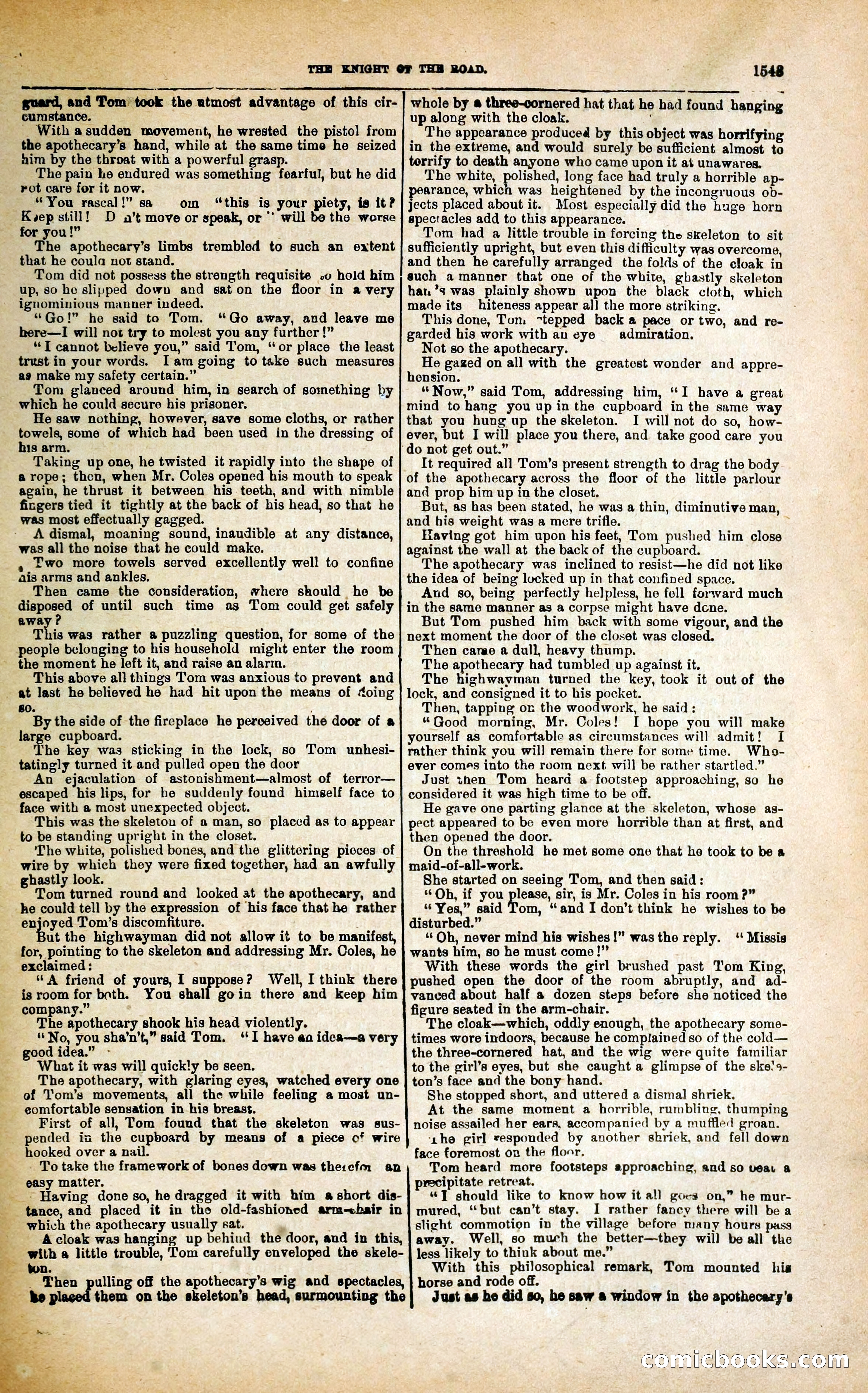
A restored page from Penny Dreadfuls, 1866. Page through the whole issue in the reader above.
📄 Transcribed text from this page (OCR, searchable)
Machine-transcribed from the original scan — historical spelling and the odd misread are preserved.
nes SA Avg cet ee ee ye ava? * le « aig > oo - x ’ oe = => 5 ? an a " ~*~ me A se _ cumstance. With asudden movement, he wrested the pistol from the apothecary’s hand, while at the same time he seized him by the throat with a powerful grasp. The pain he endured was something fearful, but he did rot care for it now. “You rascal!” sa om “this is your piety, is it? _ Keep still! D a’t move or speak, or “' will be the worse for you!” The apothecary’s limbs trembled to such an extent that he coula not stand. Tom did not possess the strength requisite .o hold him up, so he slipped down and saton the floor in a very ignominious manner indeed. “Go!” he said to Tom. “Go away, and leave me here—I will not try to molest you any further!” “T cannot believe you,” said Tom, “or place the least trust in your words. Iam going to take such measures ag make my safety certain.” Tom glanced around him, in search of something by which he could secure his prisoner. He saw nothing, however, save some cloths, or rather towels, some of which had been used in the dressing of his arm. Taking up one, he twisted it rapidly into the shape of a rope; then, when Mr. Coles opened his mouth to speak again, he thrust it between his teeth, and with nimble fingers tied it tightly at the back of his head, so that he was most effectually gagged. A dismal, moaning sound, inaudible at any distance, was all the noise that he could make. .» £wo more towels served excellently well to confine ais arms and ankles. Then came the consideration, where should he be disposed of until such time as Tom could get safely away ? This was rather a puzzling question, for some of the people belonging to his household might enter the room ~ the moment he left it, and raise an alarm. This above all things Tom was anxious to prevent and _ at last he believed he had hit upon the means of doing gO. , By the side of the fireplace he perceived the door of a large cupboard. . The key was sticking in the lock, so Tom unhesi- tatingly turned it and pulled open the door An ejaculation of astonishment—almost of terror— escaped his lips, for be suddeuly found himself face to face with a most unexpected object. This was the skeleton of a man, so placed as to appear to be standing upright in the closet. The white, polished bones, and the glittering pieces of wire by which they were fixed together, had an awfully ghastly look. Tom turned round and looked at the apothecary, and he could tell by the expression of his face that he rather enjoyed Tom’s discomfiture. But the highwayman did not allow it to be manifest, for, pointing to the skeleton and addressing Mr. Coles, he exclaimed: “A friend of yours, 1 suppose? Well, I think there is room for both. You shall goin there and keep him company.” | : The apothecary shook his head violently. “No, you sha’n't,” said Tom. ‘I have ao idca—a very good idea.” - What it was will quick!y be seen. : The apothecary, with glaring eyes, watched every one of Tom’s movements, all the while feeling a most un- _ eomfortable sensation in his breast. First of all, Tom found that the skeleton was sus- _ pended in the cupboard by means of a piece of wire hooked over a nail. . Yo take the framework of bones down was the:efm an «easy matter. + Having done so, he dragged it with him ashort dis- tance, and placed it in the old-fashioned arm-cbair in which the apothecary usually sat. " | Acloak was hanging up behind the door, and in this, with a little trouble, Tom carefully enveloped the skele- won. _ . hen pulling off the apothecary’s wig and spectacles, be them on the skeleton’s head, surmounting the nd, and Tom’ took the utmost advantage of this cir- THE KNIGHT OF THH ROAD. oe 1548 arene nnnreeerreeereeeeeere ee se eee aan Si - ~= whole by « three-cornered hat that he had found hanging up along with the cloak. The appearance produced by this object was horrifying in the extreme, and would surely be sufficient almost to terrify to death anyone who came upon it at unawares. The white, polished, long face had truly a horrible ap- earance, which was heightened by the incongruous ob- jects placed about it. Most especially did the huge horn spectacles add to this appearance. Tom had a little trouble in forcing the skeleton to sit sufficiently upright, but even this difficulty was overcome, and then he carefully arranged the folds of the cloak in such a manner that one of the white, ghastly skeleton han ’s was plainly shown upon the black cloth, which made its hiteness appear all the more striking. This done, Tom “tepped back a pace or two, and re- garded his work with aneye admiration. Not so the apothecary. He gaged on all with the greatest wonder and appre- hension. “Now,” said Tom, addressing him, “I have a great mind to hang you upin the cupboard in the same way that you hung up the skeleton. I will not do so, how- ever, but I will place you there, and take good care you ‘do not get out.” It required all Tom’s present strength to drag the body of the apothecary across the floor of the little parlour and prop him up in the closet. But, as has been stated, he was a thin, diminutive man, and his weight was a mere trifle. : Having got him upon his feet, Tom pushed him close against the wall at the back of the cupboard. The apothecary was inclined to resist—he did not like the idea of being lucked up in that confined space. And so, being perfectly helpless, be fell forward much in the same manner as a corpse might have dcne. But Tom pushed him back with some vigour, and the next moment the door of the closet was closed. Then care a dull, heavy thump. The apothecary had tumbled up against it. The highwayman turned the key, took it out of the lock, and consigned it to his pocket. Then, tapping or the woodwork, he said : “Good morning, Mr. Coles! I hope you will make yourself as comfortable as circumstances will admit! I rather think you will remain there for some time. Who- ever comes into the room next will be rather startled.” Just then Tom heard a footstep approaching, so he considered it was high time to be off. He gave one parting glance at the skeleton, whose as- pect appeared to be even more horrible than at first, and then opened the door. On the threshold he met some one that he took to be a maid-of-all-work. She started on seeing Tom, and then said: “Oh, if you please, sir, is Mr. Coles in his room ?” “Yes,” said Tom, “and I don’t think he wishes to be disturbed.” ‘Oh, never mind his wishes!” wasthe reply. ‘‘ Missis wants him, so he must come!” With these words the girl brushed past Tom King, pushed open the door of the room abruptly, and ad- vanced about half a dozen steps before she noticed the figure seated in the arm-chair. The cloak—which, oddly enough, the apothecary some- times wore indoors, because he complained so of the cold— the three-cornered hat, and tke wig were quite familiar to the girl’s eyes, but she caught a glimpse of the ske!9- ton’s face and the bony hand. She stopped short, and uttered a dismal shriek. At the same moment a horrible, rumbling, thumping noise assailed her ears, accompanied by a muffled groan. he girl responded by another shriek, and fell down face foremost oz the floor. Tom heard more footsteps approaching, and so veau a recipitate retreat. “J should like to know how it all gocsa on,” he mur- mured, “but can’t stay. I rather fancy there will bea slight commotion in the village before many hours pass away. Well, so much the better—they will be all the less likely to think about me.” With this philosophical remark, Tom mounted hia horse and rode off. Just as ho did so, he saw a window in the apothecary’s @| EORMIC IDOOKS (E(0)