
Penny Dreadfuls, 1866 · page 353 of 395
Black Bess; or, the Knight of the Road — page 353: what you’re looking at
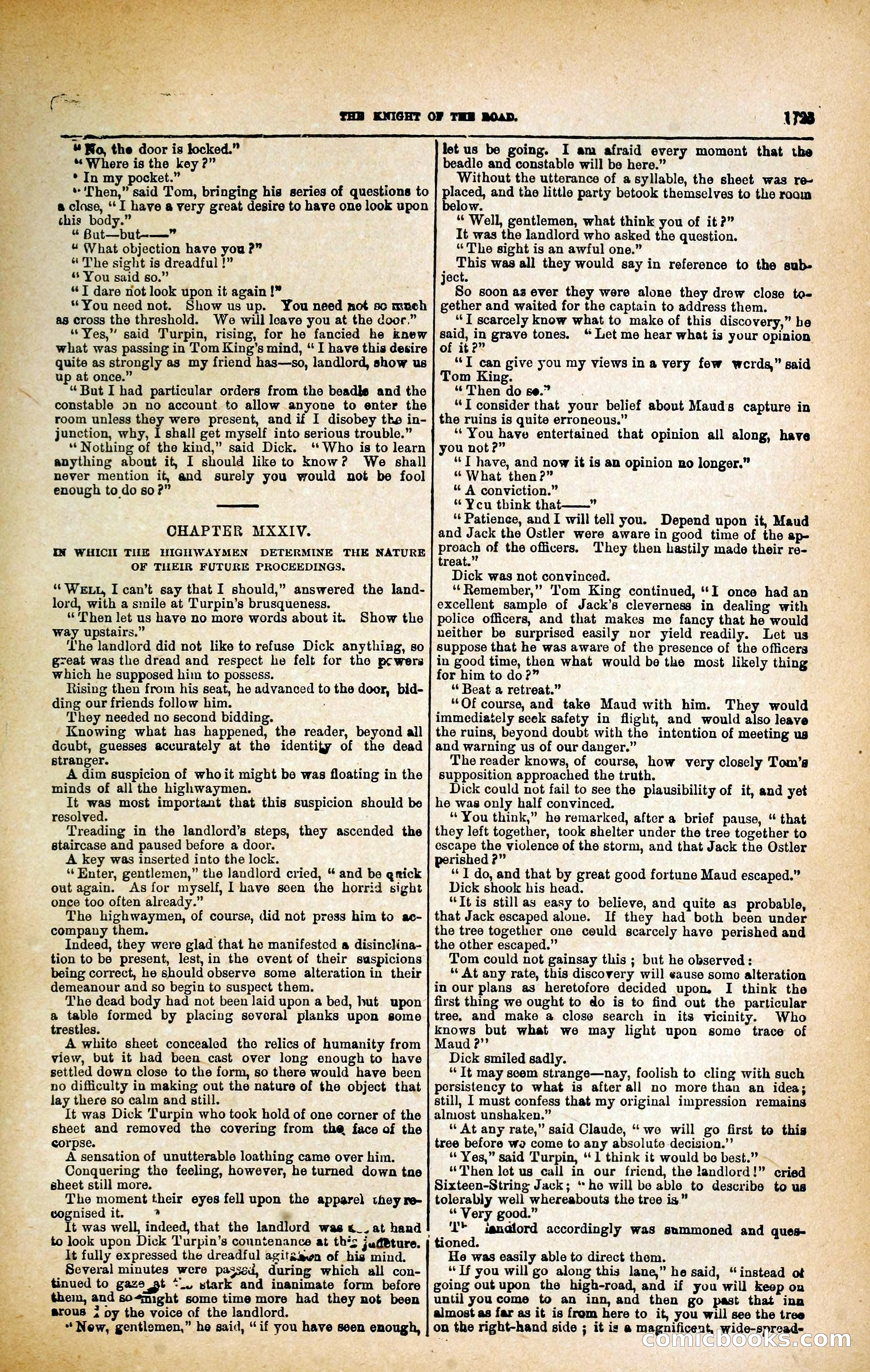
A restored page from Penny Dreadfuls, 1866. Page through the whole issue in the reader above.
📄 Transcribed text from this page (OCR, searchable)
Machine-transcribed from the original scan — historical spelling and the odd misread are preserved.
a “ Ko, the door is locked.” e “Where is the key ?” * In my pocket.” | * Then,” said Tom, bringing his series of questions to - a close, ‘I have a very great desire to have one look upon . this body.” “ But—but~-—” “ What objection have you ?” “The sight is dreadful !” “s You said so.” “T dare not look upon it again !” “You need not. Show us up. You need not sc much as cross the threshold. We will leave you at the door.” ‘‘'Yes,” said Turpin, rising, for he fancied he knew what was passing in Tom King’s mind, “I have this desire quite as strongly as my friend has—so, landlord, show us up at once.” “ But I had particular orders from the beadle and the constable dn no account to allow anyone to enter the room unless they were present, and if I disobey the in- junction, why, I shall get myself into serious trouble.” ** Nothing of the kind,” said Dick. ‘* Who is to learn anything about it, I should like to know? We shall never mention it, and surely you would not be fool enough to do so?” CHAPTER MXXIV. IN WHICH THK HIGHWAYMEN DETERMINE THE NATURE OF THEIR FUTURE PROCEEDINGS. “WELL, I can’t say that I should,” answered the land- lord, with a smile at Turpin’s brusqueness. ‘Then let us have no more words about it. Show the way upstairs.” The landlord did not like to refuse Dick anythiag, so gzeat was the dread and respect he felt for the pcwers which he supposed him to possess. Rising then from his seat, he advanced to the door, bid- ding our friends follow him. They needed no second bidding. Knowing what has happened, the reader, beyond all doubt, guesses accurately at the identity of the dead stranger. A dim suspicion of whoit might be was floating in the minds of all the highwaymen. It was most important that this suspicion should be resolved. Treading in the landlord’s steps, they ascended the staircase and paused before a door. A key was inserted into the lock. ‘Enter, gentlemen,” the landlord cried, “ and be qnick out again. Asfor myself, l have seen the horrid sight once too often already.” The highwaymen, of course, did not press him to ac- company them. : Indeed, they were glad that he manifestcd a disinclina- tion to be present, lest, in the event of their saspicions being correct, he should observe some alteration in their demeanour and so begin to suspect them. The dead body had not been laid upon a bed, hut upon a table formed by placing several planks upon some trestles. A white sheet concealed the relics of humanity from view, but it had been cast over long enough to have settled down close to the form, so there would have been no difficulty in making out the nature of the object that lay there so calm and still. It was Dick Turpin who took hold of one corner of the sheet and removed the covering from the face of the corpse. A sensation of unutterable loathing came over him. Conquering the feeling, however, he turned down tne sheet still more. The moment their eyes fell upon the apparel they re- vognised it. > . It was well, indeed, that the landlord was «__ at hand to look upon Dick Turpin’s countenance at ths judéture. It fully expressed the dreadful agitgmwn of his mind. Several minutes were passed, during which all con- _ tinued to gaze at “_. stark and inanimate form before rs: them, and so“might some time more had they not been ‘ grous 7 py the voice of the landlord. ~~~ * New, gentlemen,” he said, “if you have seen enough, UP Se ae ee ee ST eee VET ee ee “ Vis — —~— ery 2° 4 "vo aed 4 "utes F Ai — , (i “it ry eS Se , ' ‘hte Fe fe . “- ‘| t ; ? ea THE KNIGHT OF THE ROAD. 1733 RLS ERS AS ake te UNSERE Ci TES IAS a CCMA Si a) let us be going. I am afraid every moment that the beadle and constable will be here.” | Without the utterance of a syllable, the sheet was re- placed, and the little party betook themselves to the roam ow. “Well, gentlemen, what think you of it?” It was the landlord who asked the question. “The sight is an awful one.” aes was all they would say in reference to the sub- ject. So soon ag ever they were alone they drew close tee gether and waited for the captain to address them. “IT scarcely know what to make of this discovery,” he Batts ip grave tones, “ Let me hear what is your opinion of it ‘“‘T can give you my views in a very few werds,” said Tom King. ‘Then do se.” ! “TI consider that your belief about Mauds capture in the ruins is quite erroneous.” ‘‘ You have entertained that opinion all along, have you not ?” ‘‘T have, and now it is an opinion no longer.” * What then?” “ A conviction.” Yeu think that——” ‘Patience, and I will tell you. Depend upon it, Maud and Jack the Ostler were aware in good time of the ap- proach of the officers. They then hastily made their re- treat.’ Dick was not convinced. ‘*Remember,” ‘Tom King continued, I once had an excellent sample of Jack’s cleverness in dealing with police officers, and that makes me fancy that he would neither be surprised easily nor yield readily. Let us suppose that he was aware of the presence of the officers in good time, then what would be the most likely thing for him to do?” “‘ Beat a retreat.” “Of course, and take Maud with him. They would immediately seek safety in flight, and would also leave the ruins, beyond doubt with the intention of meeting us and warning us of our danger.” The reader knows, of course, how very closely Tom’s supposition approached the truth. Dick could not fail to see the plausibility of it, and yet he was only half convinced. “You think,” he remarked, after a brief pause, “ that they left together, took shelter under the tree together to escape the violence of the storm, and that Jack the Ostler perished ?” “I do, and that by great good fortune Maud escaped.” Dick shook his head. “Itis stillas easy to believe, and quite as probable, | that Jack escaped alone. If they had both been under the tree together one could scarcely have perished and the other escaped.” Tom could not gainsay this ; but he observed: ‘At any rate, this discovery will eause some alteration in our plans as heretofore decided upon. I think the first thing we ought to do is to find out the particular tree. and make a close search in its vicinity. Who knows but what we may light upon some trace of Maud ?”’ Dick smiled sadly. “It may scem strange—nay, foolish to cling with such persistency to what is after all no more than an idea; still, I must confess that my original impression remains almost unshaken.” “ At any rate,” said Claude, “we will go first to this tree before wa come to any absolute decision.”’ “ Yes,” said Turpin, ‘1 think it would be best.” ‘Then let us call in our friend, the landlord!” cried Sixteen-String Jack; “he will be able to describe to us tolerably well whereabouts the tree is.” “Very good.” i’ ianalord accordingly was summoned and ques- | tioned. He was easily able to direct them. “Tf you will go along this lane,” he said, “instead ot going out upon the high-road, and if you will keep on until youcome to an inn, and then go past that ina almost as far as it is from here to it, you will see the tree on the right-hand side ; it is a magnificent, wide-snread- ; Gomicbiooksrco ()