
Penny Dreadfuls, 1866 · page 214 of 395
Black Bess; or, the Knight of the Road — page 214: what you’re looking at
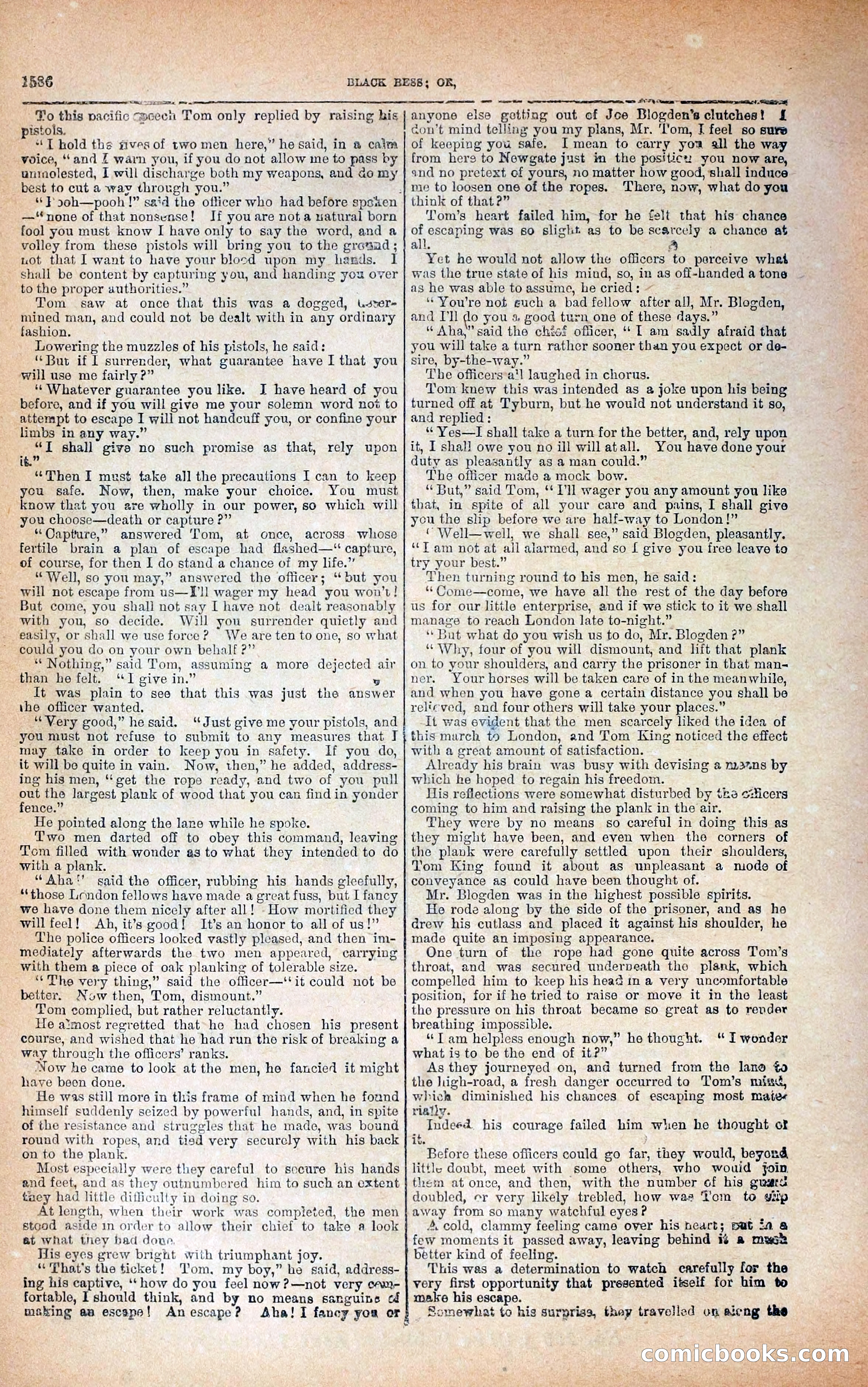
A restored page from Penny Dreadfuls, 1866. Page through the whole issue in the reader above.
📄 Transcribed text from this page (OCR, searchable)
Machine-transcribed from the original scan — historical spelling and the odd misread are preserved.
St ta ce at Lh tae pes mrat in. Bia Lie Say See >i: €; Vite > dete PP GB aL ee fae gtr Pe rapa | “ Werth if uv i hr ithy aN; (ue - v the 2586 i BLACK BESS; OK, Ue Patt tebe To this pacific cech Tom only replied by raising his} anyone else getting out of Joe Blogden’s clutches! £ pistols. *T hold the mves of two men here,” he said, in ® calm voice, ‘and £ warn you, if you do not allow me to pass by uninolested, I will discharge both my weapons, and do my best to cut a way through you.” ** F 90h—pooh !” said the officer who had before spsien. —*none of that nonsense! If you are nota natural born fool you must know I have only to say the word, and a volley from these pistols will bring you to the grenad ; uot that I want to have your blocd upon my hands. I shall be content by capturing you, and handing you over to the proper authorities.” | Tom saw at once that this was a dogged, Uszer- mined man, and could not be dealt with in any ordinary y fashion. Lowering the muzzles of his pistols, he said: ‘But if 1 surrender, what guarantee have I that you will use me fairly ?” ‘‘ Whatever guarantee you like. J have heard of you before, and if you will give me your solemn word noi to attempt to escape I will not handcuff you, or confine your limbs in any way.” ‘than: he felt. al shall give no such promise as that, rely upon it. “Then I must take all the precautions I can to keep you safe. Now, then, make your choice. You must know that you are wholly in our power, so which will you choose—death or capture ?” * Oapture,” answered ‘om, at once, across whose fertile brain a plan of escape had flashed—‘ capture, of course, for then I do stand a chance of my life.’’ “ Well, so you may,” answered the officer; ‘but you will not escape from us—Ill wager my head you won't! But come, you shall not say I have not dealt reasonably with you, so decide. Will you surrender quietly and easily, or shall we use force? We are ten to one, so what could you do on your own behalf 2” Nothing,” said Tom, assuming a more dejected air ‘) eive in.” 5 It was plain to see that this was just the answer the officer wanted. ‘WVery good,” he said. “Just give me your pistols, and you must not refuse to submit to any measures that J may take in order to keep you in safety. If you do, it will be quite in vain. Now, then,” he added, address- ing his men, ‘‘get the rope ready, and two of you pull out the largest plank of wood that you can find in yonder fence.” He pointed along the lane while he spoke. Lwo men darted off to obey this command, leaving Tom filled with wonder as to what they intended to do with a plank. “Aha‘’ said the officer, rubbing his hands gleefully, “those London fellows have made a great fuss, but I fancy we have done them nicely after all! -How mortified they will feel! Ah, it’s good! It’s an honor to all of us!” The police officers looked vastly pleased, and then im- mediately afterwards the two men appeared, carrying with them a piece of oak planking of tolerable size. “The very thing,” said the officer—‘it could not be better. Now then, Tom, dismount.” T'om complied, but rather reluctantly. He atmost regretted that he had chosen his present course, and wished that he had run tho risk of breaking a way through the officers’ ranks. Now he came to look at the men, he fancied it might have been done. He was still more in this frame of mind when he found himself suddenly seized by powerful hands, and, in spite of the resistance and struggles that he made, was bound round with ropes, and tisd very securcly with his back on to the plank. Most especially were they careful to secure his hands and feet, and as they outnumbered him to such an extent taey had little difficulty in doing so. At length, when their work was completed, the men stood aside in order to allow their chief to take a look at what tniey bad done. HWis eyes grew bright with triumphant joy. “That's the ticket!) Tom, my boy,” he said, address- ing his captive, ‘how do you feel now?—not very can- fortable, I should think, and by no means sanguine cd making aw escape! Anescape? Aha! I fancy yoa or - con't mind telling: you my plans, Mr. 'l’om, I feel so sure of keeping you safe. I mean to carry you all the way from hers to Newgate just in the positicz you now are, and no pretext of yours, no matter how good, shall induce me to loosen one of the ropes. There, now, what do you think of that 2?” ‘’om’s heart failed him, for he felt that his chance of escaping was so slight as to be scarcely a chance at all. a Yet he would not allow the officers to perceive wheat was the true state of his mind, so, in as off-banded a tone as he was able to assume, he cried: ~ “You're not euch a bad fellow after all, Mr. Blogden, and Dll do you s, good turn one of these days.” “ Aha,” said the chief officer, ‘I am sadly afraid that you will take a turn rather sooner than you expect or de- sire, by-the-way.” The officers’a'l laughed in chorus. T'om knew this was intended as 2 joke upon his being turned off at Tyburn, but he would not understand it so, and replied : ““Yes—I shall tale a turn for the better, and, rely upon it, I shal! owe you no ill will atall. You have done your duty as pleasantly as a man could.” The officer made a mock bow. “But,” said Tom, *‘ Pll wager you any amount you like that, in spite of all your care and pains, I shall give you the slip before we are half-way to London!” ‘ Well—well, we shall see,” said Blogden, pleasantly. “Tam not at all alarmed, and so [ give you free leave to try your best.” Then turning round to his men, he said: ‘* Come—come, we have all the rest of the day before us for our little enterprise, and if we stick to it we shall manage to reach London late to-night.” ‘‘ But what do you wish us to do, Mr. Blogden ?” “Why, four of you will dismount, and lift that plank on to your shoulders, and carry the prisoner in that man-< ner. Your horses will be taken care of in the meanwhile, and when you have gone a certain distance you shall be relieved, and four others will take your places.” It was evident that the men scarcely liked the idea of this march to London, and Tom King noticed the effect with a great amount of satisfaction. Already his brain was busy with devising a m3%ns by which he hoped to regain his freedom. His reflections were somewhat disturbed by tho c#icers coming to him and raising the plank in the air. They were by no means so careful in doing this as they might have been, and even when the corners of the plank were carefully settled upon their shoulders, Tom King found it about as unpleasant a mode of conveyance as could have been thought of. Mr. Blogden was in the highest possible spirits. He rode along by the side of the prisoner, and as hoe drew his cutlass and placed it against his shoulder, he made quite an imposing appearance. One turn of the rope had gone quite across Tom’s throat, and was secured underveath the plank, which compelled him to keep his head in a very uncomfortable position, for if he tried to raise or move it im the least the pressure on his throat became so great as to render breathing impossible. ‘‘T am helpless enough now,” he thought. what is to be the end of it?” As they journeyed on, and turned from the lane %o the ligh-road, a fresh danger occurred to Tom’s mind, which diminished his chances of escaping most mate« rially. Indeed his courage failed him when he thought of “ T wonder it. Before these officers could go far, they would, beyond little doubt, meet with some others, who wouid join them at once, and then, with the number of his guara doubled, er very likely trebled, how was Yom to gyNp away from so many watchful eyes ? A, cold, clammy feeling came over his heart; pat a @ few moments it passed away, leaving behind 1% a muse better kind of feeling. This was a determination to watch earefully for the very first opportunity that presented itself for him to make his escape. _ Somewhat to his surprisa, they travelled on aicng the Eomichboo