
Penny Dreadfuls, 1866 · page 230 of 395
Black Bess; or, the Knight of the Road — page 230: what you’re looking at
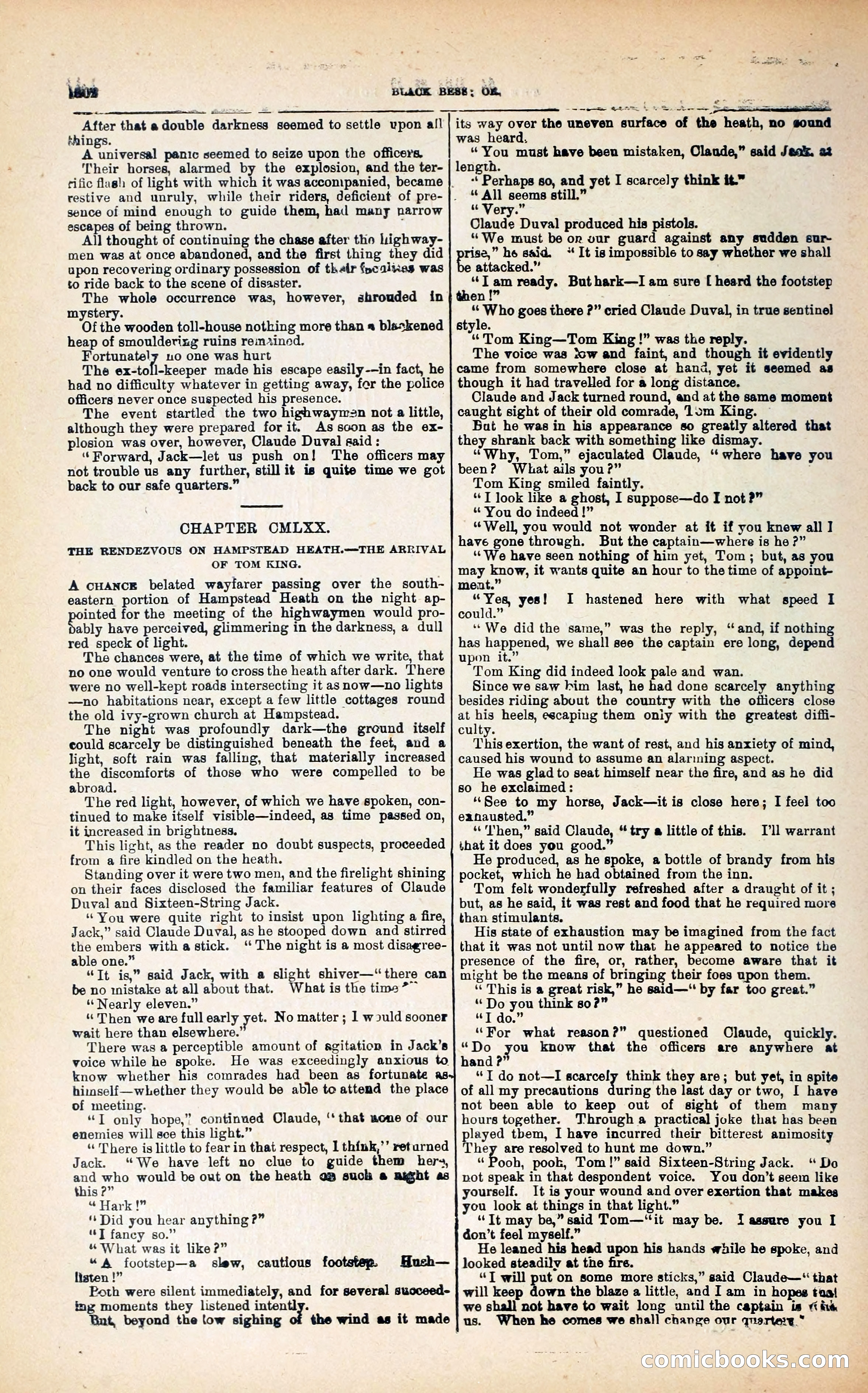
A restored page from Penny Dreadfuls, 1866. Page through the whole issue in the reader above.
📄 Transcribed text from this page (OCR, searchable)
Machine-transcribed from the original scan — historical spelling and the odd misread are preserved.
After that a doubl things. A universal panic seemed to seize upon the officers. ‘heir horses, alarmed by the explosion, and the ter- tific flash of light with which it was accompanied, became |. restive and unruly, while their riders, deficient of pre- |. sence of mind enough to guide them, had many narrow escapes of being thrown. ’ All thought of continuing the chase after tho Lighway- men was at once abandoned, and the first thing they did upon recovering ordinary possession of their {pcaiies was to ride back to the scene of disaster. The whole occurrence was, however, shrouded in mystery. Of the wooden toll-house nothing more than s blankened heap of smoulderizg ruins reinxined. Fortunately uo one was hurt The ex-toll-keeper made his escape easily--in fact, he had no difficulty whatever in getting away, fer the police officers never once suspected his presence. The event startled the two highwaym=n not a little, although they were prepared forit. Asscon as the ex- plosion was over, however, Claude Duval said: ‘Forward, Jack—let us push on! The officers may not trouble us any further, still it is quite time we got back to our safe quarters.” CHAPTER CMLXX. THE RENDEZVOUS ON HAMPSTEAD HEATH.==THE ARRIVAL OF TOM KING. A CHANCE belated wayfarer passing over the south- eastern portion of Hampstead Heath on the night ap- inted for the meeting of the highwaymen would pro- S ably have perceived, glimmering in the darkness, a dull red speck of light. The chances were, at the time of which we write, that no one would venture to cross the heath after dark. There were no well-kept roads intersecting it as now—no lights —no habitations near, except a few little cottages round the old ivy-grown church at Hampstead. The night was profoundly dark—the ground itself could scarcely be distinguished beneath the feet, and a light, soft rain was falling, that materially increased the discomforts of those who were compelled to be abroad. The red light, however, of which we have spoken, con- tinued to make itself visible—indeed, as time passed on, it increased in brightness. This light, as the reader no doubt suspects, proceeded from a fire kindled on the heath. Standing over it were two men, and the firelight shining on their faces disclosed the familiar features of Claude Duval and Sixteen-String Jack. ‘You were quite right to insist upon lighting a fire, Jack,” said Claude Duval, as he stooped down and stirred the embers with astick. ‘The night is a most disagree- able one.” “Tt is,” said Jack, with a slight shiver—‘there can be no inistake at all about that. What is the time? ‘Nearly eleven.” “Then we are full early yet. No matter ; 1 wuld sooner wait here than elsewhere.’ There was a perceptible amount of agitation in Jack’s voice while he spoke. He was exceedingly anxious to know whether his comrades had been as fortunate himself—whether they would be able to attemd the place of meeting. “T only hope,” continued Claude, ‘‘ that wone of our enemies will sce this light.” “ There is little to fear in that respect, I think,’’ retarned Jack. ‘We have left no clue to guide them hers, and who would be out on the heath a3 such a aight as this ?” “ Hark !” ''Did you hear anything ?” “T fancy so.” “ What was it like?” “A footstep—a slew, cautious footetep. Huch— laten |!” Poth were silent immediately, and for several suoceed- ing moments they listened intently. Bat, beyond the low sighing of the wind as it made darkness seemed to settle upon all | its way over the uneven surface of the eath, no e- ‘ . e ~ -~—. . > ~ ~ — — ~~ —-— wee ETS OA eS sound was heard. | “ ne must have been mistaken, Claude,” said Jank. at ength. ‘‘ Perhaps so, and yet I scarcely think it.” “ All seems still.” “ Very.” Olaude Duval produced his pistols. “We must be orn vur guard against any sudden sur- ‘heat he said. “It is impossible to say whether we shall attacked.” ‘‘T am ready. But hark—I am sure [ heard the footstep then !” 3 Who goes there ?” cried Claude Duval, in true sentinel style. “Tom King—Tom King !” was the reply. The voice was tow and faint, and though it evidently came from somewhere close at hana, yet it seemed as though it had travelled for a long distance. Claude and Jack turned round, and at the same moment caught sight of their old comrade, ‘1om King. — But he was in his appearance so greatly altered that they shrank back with something like dismay. “Why, Tom,” ejaculated Claude, “where have been? What ails you ?” Tom King smiled faintly. ‘“‘T look like a ghost, I suppose—do I not ?” “You do indeed!” ‘Well, you would not wonder at it if you knew all J have gone through. But the captain—where is he ?” “We have seen nothing of him yet, Tom; but, as you may know, it wants quite an hour to the time of appoint- you ment.” “Yes, yes! could.” ‘‘We did the same,” was the reply, “and, if nothing I hastened here with what speed I has happened, we shall see the captain ere long, depend upon it.” Tom King did indeed look pale and wan. Since we saw kim last, he had done scarcely anything besides riding abuut the country with the officers close at his heels, escaping them oniy with the greatest diffi- culty. This exertion, the want of rest, and his anxiety of mind, caused his wound to assume an alarining aspect. He was glad to seat himself near the fire, and as he did so he exclaimed: ‘‘See to my horse, Jack—it is close here; I feel too eanausted.” ‘“‘'l'’hen,” said Claude, “try a little of this. Ill warrant that it does you good.” He produced, as he spoke, a bottle of brandy from his pocket, which he had obtained from the inn. Tom felt wonderfully refreshed after a draught of it ; but, as he said, it was rest and food that he required more than stimulants. His state of exhaustion may be imagined from the fact that it was not until now that he appeared to notice the presence of the fire, or, rather, become aware that it might be the means of bringing their foes upon them. “ This is a great risk,” he said—‘ by far too great.” “Do you think so?” “Tl dow: “For what reason?” questioned Claude, quickly. “Do you know that the officers are anywhere at hand ?” “T do not—I scarcely think they are; but yet, in spite of all my precautions during the last day or two, I have not been able to keep out of sight of them many hours together. Through a practical] joke that has been played them, I have incurred their bitterest animosity They are resolved to hunt me down.” “ Pooh, pook, Tom!” said Sixteen-String Jack. pot speak in that despondent voice. You don’t seem like yourself. It is your wound and over exertion that makes you look at things in that light.” “Tt may be,” said Tom—‘“it may be. I assure you I don’t feel myself.” He leaned his head upon his hands while he spoke, and looked steadily at the fire. “T will put on some more sticks,” said Claude—“ that will keep down the blaze a little, and I am in hopes tas we shall not have to wait long until the captain is «is bs Do us. When he comes we shall change our quarter¢.“ (e(0) JOO AMC m a <SriGO