
Penny Dreadfuls, 1866 · page 129 of 395
Black Bess; or, the Knight of the Road — page 129: what you’re looking at
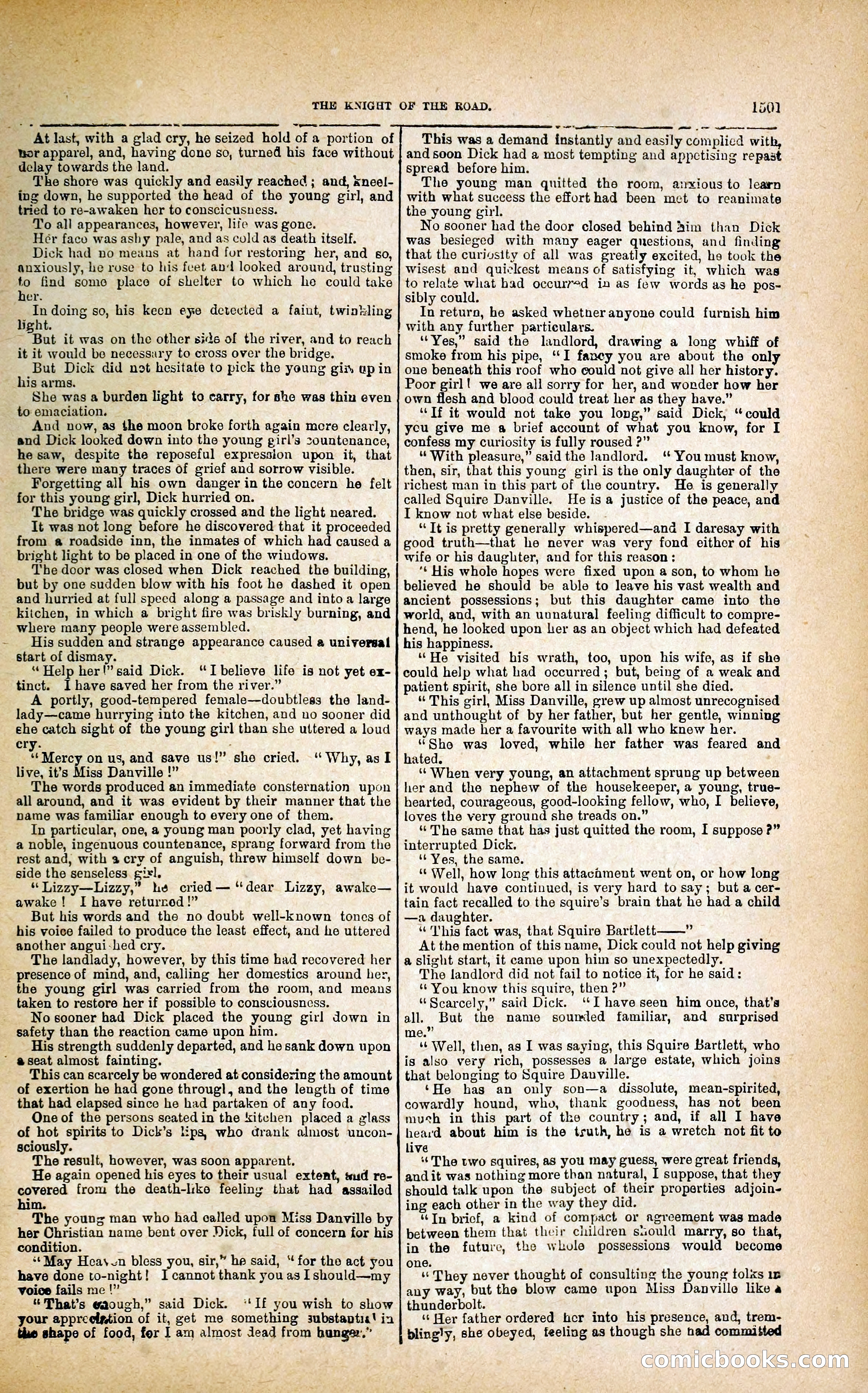
A restored page from Penny Dreadfuls, 1866. Page through the whole issue in the reader above.
📄 Transcribed text from this page (OCR, searchable)
Machine-transcribed from the original scan — historical spelling and the odd misread are preserved.
‘ See ~ At last, with a glad cry, he seized hold of a portion of hor apparel, and, having done so, turned his face without _ delay towards the land. The shore was quickly and easily reached; and, xneel- ing down, he supported the head of the young girl, and tried to re-awaken her to conscicusness. To all appearances, however, life was gone. _ Hér face was ashy pale, and as cold as death itself. Dick had no means at hand for restoring her, and 0, _ anxiously, he ruse to his feet and looked around, trusting to find some place of shelter to which he could take her. In doing so, his keen eye detected a faint, twinkling light. 7 But it was on the other side of the river, and to reach it it would be necessary to cross over the bridge. But Dick did not hesitate to pick the young gis up in his arms. She was a burden light to carry, for she was thin even to emaciation. And now, as the moon broke forth again mere clearly, and Dick looked down into the young girl’s sountenance, he saw, despite the reposeful expression upon it, that there were many traces Of grief and sorrow visible. Forgetting all his own danger in the concern he felt for this young girl, Dick hurried on. The bridge was quickly crossed and the light neared. It was not long before he discovered that it proceeded from a roadside inn, the inmates of which had caused a bright light to be placed in one of the windows. The door was closed when Dick reached the building, but by one sudden blow with his foot he dashed it open and hurried at full speed along a passage and into a large kitchen, in which a bright fire was briskly burning, and where many people were assembled. His sudden and strange appearance caused a universal start of dismay. “ Help her! said Dick. “I believe life is not yet ex- tinct. I have saved her from the river.” A portly, good-tempered female—doubtless the land- lady—came hurrying into the kitchen, and no sooner did ehe catch sight of the young girl than she uttered a loud cry. Mercy on us, and save us!” she cried. ‘ Why, as I live, it’s Miss Danville !” The words produced an immediate consternation upon all around, and it was evident by their manner that the pame was familiar enough to every one of them. In particular, one, a young man poorly clad, yet having a noble, ingenuous countenance, sprang forward from the rest and, with a cry of anguish, threw himself down be- side the senseless givl, “ Lizzy—Lizzy,” he cried— “dear Lizzy, awake— awake! I have returned!” But his words and the no doubt well-known tones of his voice failed to produce the least effect, and he uttered another angui-hed cry. The landlady, however, by this time had recovered her presence of mind, and, calling her domestics around her, the young girl was carried from the room, and means taken to restore her if possible to consciousness. No sooner had Dick placed the young girl down in safety than the reaction came upon him. His strength suddenly departed, and hesank down upon ’ @seat almost fainting. This can scarcely be wondered at considering the amount of exertion he had gone throug], and the length of time that had elapsed since he had partaken of any food. One of the persons seated in the kitchen placed a glass of hot spirits to Dick’s ips, who drank almost uncon- sciously. The result, however, was soon apparent. He again opened his eyes to their usual extent, tud re- covered from the death-like feeling that had assailed him. The young man who had called upou Miss Danville by her Christian name bent over Dick, full of concern for his condition. ‘*May Heavyvn bless you, sir,” he said, “ for the act you have done to-night! I cannot thank you as I should—my voice fails me !” “Phat’s eaough,” said Dick. ‘If you wish to show your apprcelgtion of it, get me something substantia! in the shape of food, for 1 am almost Jead from bangs.” on ; = Sy ant: } <- 1 — . a Tae a a " in eS Obie ee LeeTe ye Te eee eee: ee eA hE te THE KNIGHT OF THE ROAD, 150] This was a demand instantly and easily complicd witb, and soon Dick had a most tempting and appctising repast Spread before him. The young man quitted the room, a:rxious to learn with what success the effort had been met to reanimate the young girl. No sooner had the door closed behind Aim than Dick was besieged with many eager questions, and finding that the curiosity of all was greatly excited, he took the wisest and quickest means of satisfying it, which was to relate what had occurred in as few words as he pos- sibly could. In returo, he asked whetner anyone could furnish him with any further particulars. “Yes,” said the landlord, drawing a long whiff of smoke from his pipe, “I faney you are about the only one beneath this roof who could not give all her history. Poor girl! we are all sorry for her, and wonder how her own flesh and blood could treat her as they have.” “TE it would not take you long,” said Dick, “could ycu give me a brief account of what you know, for I confess my curiosity is fully roused ?” “With pleasure,” said the landlord. ‘ You must know, then, sir, that this young girl is the only daughter of the richest man in this part of the country. He is generally called Squire Danville. He isa justice of the peace, and I know not what else beside. - “Tt is pretty generally whispered—and I daresay with good truth—that he never was very fond eithor of his wife or his daughter, and for this reason: ‘6 His whole hopes were fixed upon a son, to whom he believed he should be able to leave his vast wealth and ancient possessions; but this daughter came into the world, and, with an unnatural feeling difficult to compre- hend, he looked upon her as an object which had defeated his happiness. ‘He visited his wrath, too, upon his wife, as if she could help what had occurred ; but, being of a weak and patient spirit, she bore all in silence until she died. “ This girl, Miss Danville, grew up almost unrecognised and unthought of by her father, but her gentle, winning ways made her a favourite with all who knew her. “Sho was loved, while her father was feared and hated. ‘When very young, an attachment sprung up between her and the nephew of the housekeeper, a young, true- hearted, courageous, good-looking fellow, who, I believe, loves the very ground she treads on.” “The same that has just quitted the room, I suppose ?” interrupted Dick. ‘6 Yes, the same. ‘ Well, how long this attachment went on, or how long it would have continued, is very hard to say; but a cer- tain fact recalled to the squire’s brain that he had a child —a daughter. “ This fact was, that Squire Bartlett-——” At the mention of this name, Dick could not help giving a slight start, it came upon him so unexpectedly. The landlord did not fail to notice it, for he said: ‘ You know this squire, then ?” “Scarcely,” said Dick. ‘I have seen him once, that’s all. But the name soumded familiar, and surprised ?) 6 Well, then, as I was saying, this Squire Bartlett, who is also very rich, possesses a large estate, which joins that belonging to Squire Dauville. ‘He has an only son—a dissolute, mean-spirited, cowardly hound, who, thank goodness, has not been much in this part of the country; and, if all I have heard about him is the truth, he is a wretch not fit to live “The two squires, as you may guess, were great friends, audit was nothing more than natural, I suppose, that they should talk upon the subject of their properties adjoin- ing each other in the way they did. “Tn bricf, a kind of compact or agreement was made between them that their children suould marry, so that, in the future, the whole possessions would become one. ‘They never thought of consulting the young folxs ip any way, but the blow came upon Miss Danville like a thunderbolt. ‘‘ Fer father ordered ber into his presence, and, trem- blingly, she obeyed, teeling as though she nad committed am oe eB Eomicboo ?) cS (E(0)