
Penny Dreadfuls, 1866 · page 316 of 395
Black Bess; or, the Knight of the Road — page 316: what you’re looking at
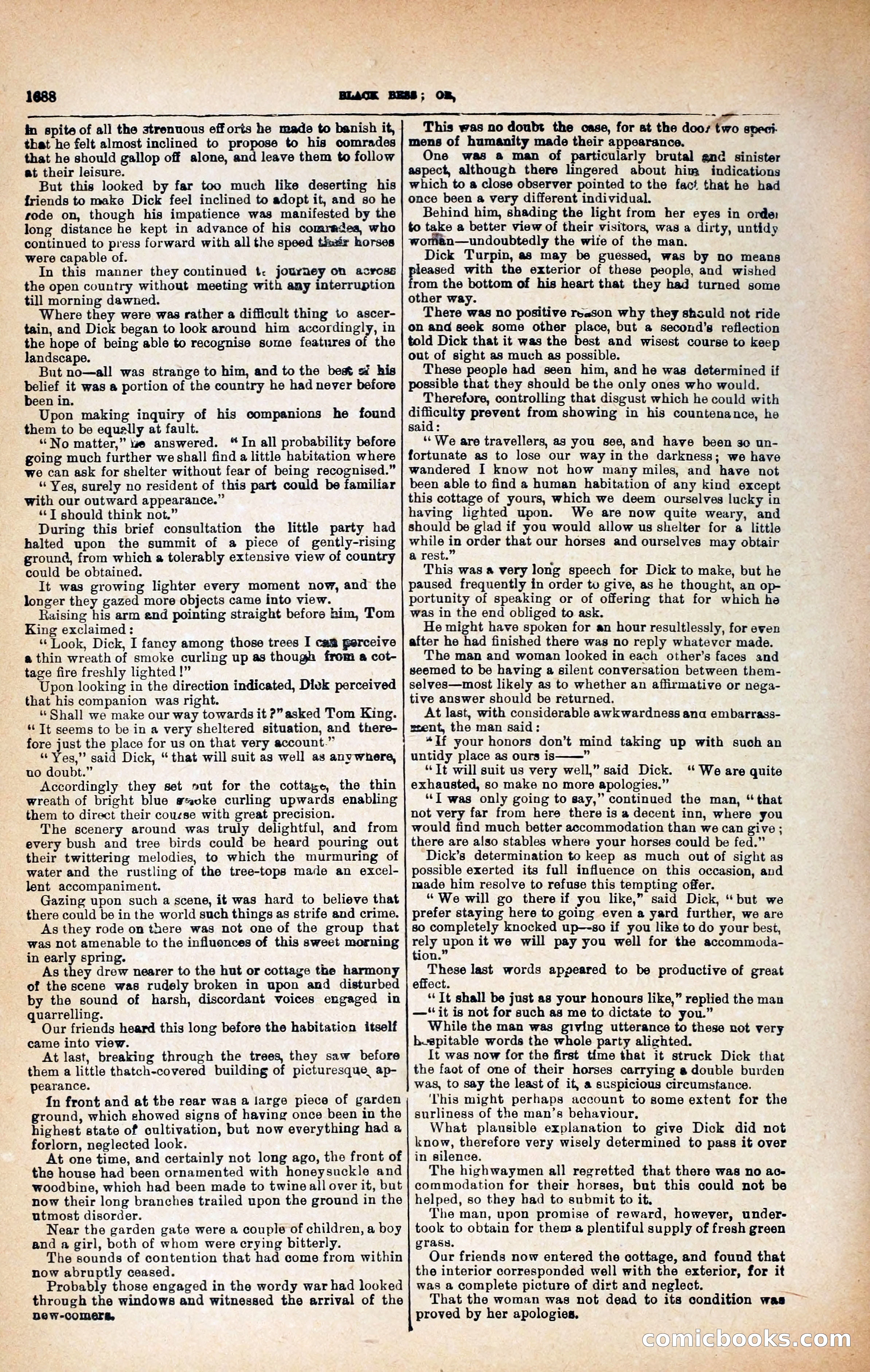
A restored page from Penny Dreadfuls, 1866. Page through the whole issue in the reader above.
📄 Transcribed text from this page (OCR, searchable)
Machine-transcribed from the original scan — historical spelling and the odd misread are preserved.
1688 in spite of all the strenuous efforts he made to banish it, that he felt almost inclined to propose to his comrades that he should gallop off alone, and leave them to follow at their leisure. But this looked by far too much like deserting his friends to make Dick feel inclined to adopt it, and so he rode on, though his impatience was manifested by the long distance he kept in advance of his comrades, who continued to press forward with all the speed tiszér horses were capable of. In this manner they continued t: journey on across the open country without meeting with amy interruption till morning dawned. Where they were was rather a difficult thing to ascer- tain, and Dick began to look around him accordingly, in the hope of being able to recognise sume features of the landscape. But no—all was strange to him, and to the best of his belief it was a portion of the country he had never before been in. Upon making inquiry of his companions he found them to be equelly at fault. ‘No matter,” se answered. “In all probability before going much further we shall find a little habitation where we can ask for shelter without fear of being recognised.” “Yes, surely no resident of this part could be familiar with our outward appearance.” ‘‘T should think not.” During this brief consultation the little party had halted upon the summit of a piece of gently-rising ground, from which a tolerably extensive view of country could be obtained. It was growing lighter every moment now, and the longer they gazed more objects came into view. Raising his arm end pointing straight before him, Tom King exclaimed: ‘‘ Look, Dick, I fancy among those trees I cas perceive a thin wreath of smoke curling up as though from a cot- tage fire freshly lighted !” Upon looking in the direction indicated, Disk perceived that his companion was right. “Shall we make our way towards it ?” asked Tom King. *‘ Tt seems to be in a very sheltered situation, and there- fore just the place for us on that very account.” “Yes,” said Dick, “ that will suit as well as anywhere, no doubt.” Accordingly they set »ut for the cottage, the thin wreath of bright blue woke curling upwards enabling them to direct their cousse with great precision. The scenery around was truly delightful, and from every bush and tree birds could be heard pouring out their twittering melodies, to which the murmuring of water and the rustling of the tree-tops made an excel- lent accompaniment. Gazing upon such a scene, it was hard to believe that there could be in the world such things as strife and crime. As they rode on there was not one of the group that was not amenable to the influences of this sweet morning in early spring. As they drew nearer to the hut or cottage the harmony of the scene was rudely broken in upon and disturbed by the sound of harsh, discordant voices engaged in quarrelling. Our friends heard this long before the habitation itself came into view. At last, breaking through the trees, they saw before them a little thatch-covered building of picturesque, ap- pearance. In front and at the rear was a large piece of garden ground, which showed signs of having once been in the highest state of cultivation, but now everything had a forlorn, neglected look. At one time, and certainly not long ago, the front of the house had been ornamented with honeysuckle and woodbine, which had been made to twine all over it, but now their long branches trailed upon the ground in the utmost disorder. Near the garden gate were a couple of children, a boy and a girl, both of whom were crying bitterly. The sounds of contention that had come from within now abruptly ceased. Probably those engaged in the wordy war had looked through the windows and witnessed the arrival of the bew-comers, BLAGK BESS; OB, This was no doubt the oase, for at the doo/two avec. mens of humanity made their appearance. ; One was a man of particularly brutal gnd sinister aspect, although there lingered about him indications which to a close observer pointed to the fact that he had once been a very different individual. Behind him, shading the light from her eyes in orde to take a better view of their visitors, was a dirty, untidy worlan—undoubtedly the wife of the man. : Dick Turpin, as may be guessed, was by no means sag with the exterior of these people, and wished rom the bottom of his heart that they had turned some other way. There was no positive reason why they shsuld not ride on and seek some other place, but a second’s reflection told Dick that it was the best and wisest course to keep out of sight as much as possible. These people had seen him, and he was determined if possible that they should be the only ones who would. Therefore, controlling that disgust which he could with aay prevent from showing in his countenance, he said: ‘‘ We are travellers, as you see, and have been go un- fortunate as to lose our way in the darkness; we have wandered I know not how many miles, and have not been able to find a human habitation of any kind except this cottage of yours, which we deem ourselves lucky in having lighted upon. We are now quite weary, and should be glad if you would allow us shelter for a little while in order that our horses and ourselves may obtair a rest.” This was a very long speech for Dick to make, but he paused frequently in order to give, as he thought, an op- portunity of speaking or of offering that for which he was in the end obliged to ask. He might have spoken for an hour resultlessly, for even after he had finished there was no reply whatever made. The man and woman looked in each other’s faces and seemed to be having a silent conversation between them- selves—most likely as to whether an affirmative or nega- tive answer should be returned. At last, with considerable awkwardness ana embarrass- srent, the man said: *If your honors don’t mind taking up with such an untidy place as ours is——” “Tt will suit us very well,” said Dick. exhausted, so make no more apologies.” “T was only going to say,” continued the man, “that not very far from here there is a decent inn, where you would find much better accommodation than we can give ; there are also stables where your horses could be fed.” Dick’s determination to keep as much out of sight as possible exerted its full influence on this occasion, and rmaade him resolve to refuse this tempting offer. “We will go there if you like,” said Dick, ‘but we prefer staying here to going even a yard further, we are so completely knocked up—~so if you like to do your best, rely upon it we will pay you well for the accommoda- on.” a7 ee last words appeared to be productive of great effect. “Tt shall be just as your honours like,” replied the man —‘it is not for such as me to dictate to you.” While the man was giving utterance to these not very bespitable words the whole party alighted. It was now for the first time that it struck Dick that the faot of one of their horses carrying a double burden was, to say the least of it, a suspicious circumstance. ‘This might perhaps account to some extent for the surliness of the man’s behaviour. What plausible explanation to give Dick did not know, therefore very wisely determined to pass it over in silence. The highwaymen all regretted that there was no ace commodation for their horses, but this could not be helped, so they had to submit to it. The man, upon promise of reward, however, under- took to obtain for them a plentiful supply of fresh green grass. Our friends now entered the cottage, and found that the interior corresponded well with the exterior, for it was a complete picture of dirt and neglect. “We are quite That the woman was not dead to its condition was — proved by her apologies, (E(6) ,00 MiG S.