
Penny Dreadfuls, 1866 · page 84 of 395
Black Bess; or, the Knight of the Road — page 84: what you’re looking at
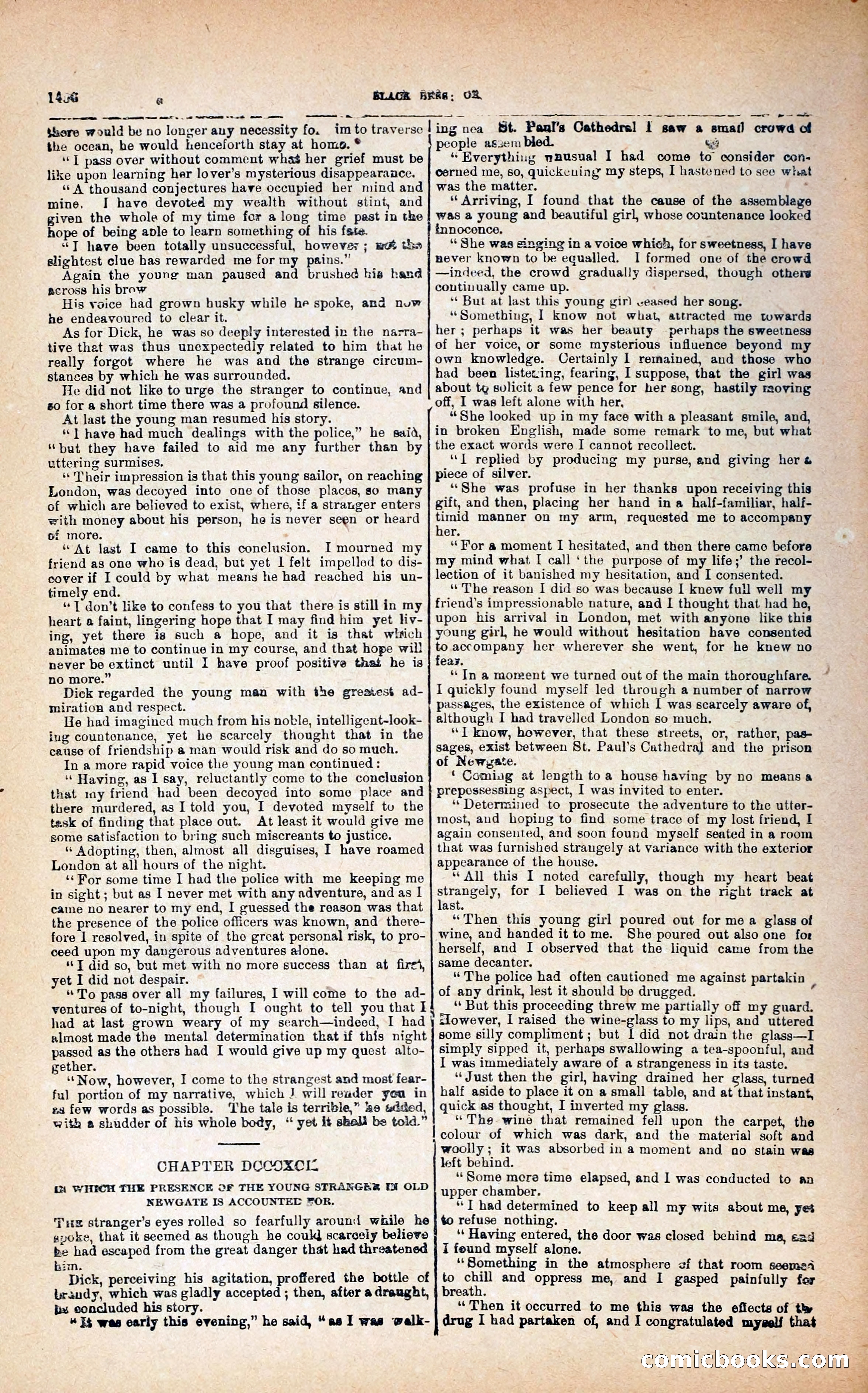
A restored page from Penny Dreadfuls, 1866. Page through the whole issue in the reader above.
📄 Transcribed text from this page (OCR, searchable)
Machine-transcribed from the original scan — historical spelling and the odd misread are preserved.
145% a shore would be no longer any necessity fo. the ocean, he would henceforth stay at home. * ‘I pass over without comment what her grief must be like upon learning her lover’s mysterious disappearance. “A thousand conjectures have occupied her mind and mine, I have devoted my wealth without stint, and given the whole of my time fer a long time past in the hope of being anle to learn something of his fate. “JT have been totally unsuccessful, however; wa tha slightest clue has rewarded me for my pains.” Again the young man paused and brushed hia hand across his brow His vaice had grown busky while he spoke, and nuw he endeavoured to clear it. As for Dick, he was so deeply interested in the narra- tive thet was thus unexpectedly related to him that he really forgot where he was and the strange circum- stances by which he was surrounded. He did not like to urge the stranger to continue, and eo for a short time there was a profound silence. At last the young man resumed his story. ‘‘T have had much dealings with the police,” he said, “but they have failed to aid me any further than by uttering surmises. ‘¢ Their impression is that this young sailor, on reaching London, was decoyed into one of those places, so many of which are believed to exist, where, !f a stranger enters with money about his person, he is never seen or heard of more. ‘At last I came to this conclusion. I mourned my friend as one who is dead, but yet I felt impelled to dis- cover if I could by what means he had reached his un- timely end. “T don’t like to confess to you that there is still in my heart a faint, lingering hope that I may find him yet liv- ing, yet there is such a hope, and it is that whtich animates me to continue in my course, and that hope will never be extinct until I have proof positive that he is no more.” Dick regarded the young man with the greatest ad- miration and respect. Ge had imagined much from his noble, intelligent-look- ing countenance, yet he scarcely thought that in the cause of friendship a man would risk and do so much. In a more rapid voice the young man continued : ‘“ Having, as I say, reluctantly come to the conclusion that iny friend had been decoyed into some place and there murdered, as I told you, I devoted myself tu the tesk of finding that place out. At least it would give me some satisfaction to bring such miscreants to justice. “ Adopting, then, almost all disguises, I have roamed London at all hours of the night. ‘‘ For some time I had tlie police with me keeping me in sight ; but as I never met with any adventure, and as [| came no nearer to my end, I guessed the reason was that the presence of the police officers was known, and there- fore I resolved, in spite of the great personal risk, to pro- ceed upon my dangerous adventures alone. ‘‘T did so, but met with no more success than at firs, yet I did not despair. . “To pass over all my failures, I will come to the ad- ventures of to-night, though I ought to tell you that I had at last grown weary of my search—indeed, I had almost made the mental determination that if this night passed as the others had I would give up my quest alto- gether. ‘Now, however, I come to the strangest and most fear- ful portion of my narrative, which J will reader yeu in 2a few words as possible. The tale is terrible,” be added, with a shudder of his whole body, ‘ yet it shel’ be toid.” CHAPTER DCCOXCL. Ci WHICH THE PRESENCE OF THE YOUNG STRANGER EI OLD NEWGATE IS ACCOUNTELC *OR. Tue stranger’s eyes rolled so fearfully around while he spoke, that it seemed as though he could scarcely believe be had escapod from the great danger that had threatened Dick, perceiving his agitation, proffered the bottle of brandy, which was gladly accepted ; then, after a draught, by concluded his story. * Ig was early this evening,” he said, ‘as Il was walk- im to traverse | ing nea St. Panl’s Cathedral { saw a BLACK KFRe; OZ —E email crowd of people assem bled. G4 ‘ Everything mwausual I had come to consider con- cerned me, so, quickcuing my steps, I hastened to see wha was the matter. ‘ “ Arriving, I found that the cause of the assemblage was a young and beautiful girl, whose countenance looked innocence, ‘‘ She was einging in a voice which, for sweetness, I have never known to be equalled. I formed one of the crowd —indeed, the crowd gradually dispersed, though others continually came up. ‘‘ But at last this young gir) -eased her song. “Something, 1 know not what, attracted me towards her; perhaps it was her beauty perhaps the sweetness of her voice, or some mysterious influence beyond my own knowledge. Certainly I remained, and those who had been listewing, fearing, I suppose, that the girl was about tg solicit a few pence for her song, hastily moving off, I was left alone with her, “She looked up in my face with a pleasant smile, and, in broken English, made some remark to me, but what the exact words were I cannot recollect. “T replied by producing my purse, and giving heré piece of silver. ‘“She was profuse in her thanks upon receiving this gift, and then, placing her hand ina half-familiar, half- nes manner on my arm, requested me to accompany er. “For a moment I hesitated, and then there came before my mind what I call ‘the purpose of my life;’ the recol- lection of it banished my hesitation, and I consented. ‘The reason I did so was because I knew full well my friend’s impressionable nature, and I thought that had he, upon his arrival in London, met with anyone like this young gil, he would without hesitation have consented pe eo her wherever she went, for he knew no eay. ‘In a moment we turned out of the main thoroughfare. I quickly found myself led through a number of narrow passages, the existence of which I was scarcely aware of, although I had travelled London so much. ‘“T know, however, that these streets, or, rather, pas- sages, exist between St. Paul’s Cathedra] and the prison of New ate. ‘ Coming at length toa house having by no means a prepossessing aspect, I was invited to enter. ‘* Determined to prosecute the adventure to the utter- most, and hoping to find some trace of my lost friend, I again consented, and soon found myself seated in a room that was furnished strangely at variance with the exterior appearance of the house. “All this I noted carefully, though my heart beat eset for I believed I was on the right track at ast. “Then this young girl poured out for me a glass of wine, and handed it to me. She poured out also one for herself, and I observed that the liquid came from the same decanter. “The police had often cautioned me against partakin of any drink, lest it should be drugged. ‘But this proceeding threw me partially off my guard. slowever, I raised the wine-glass to my lips, and uttered some silly compliment; but I did not drain the glass—I simply sipped it, perhaps swallowing a tea-spoonful, and I was immediately aware of a strangeness in its taste. “Just then the girl, having drained her glass, turned half aside to place it on a small table, and at that instant, quick as thought, I inverted my glass. ‘The wine that remained fell upon the carpet, the colour of which was dark, and the material soft and woolly; it was absorbed in a moment and oo stain was left behind. “Some mere time elapsed, and I was conducted to an upper chamber, ‘I had determined to keep all my wits about me, yet to refuse nothing. ‘‘ Having entered, the door was closed behind ma, exd I found myself alone. ‘Something in the atmosphere ef that room seemeA to chill and oppress me, and I gasped painfully for breath. “Then it occurred to me this was the eflects of ty drug I had partaken of, and I congratulated myself that (E(@) MIG cS 00 (e(e)