
Penny Dreadfuls, 1866 · page 336 of 395
Black Bess; or, the Knight of the Road — page 336: what you’re looking at
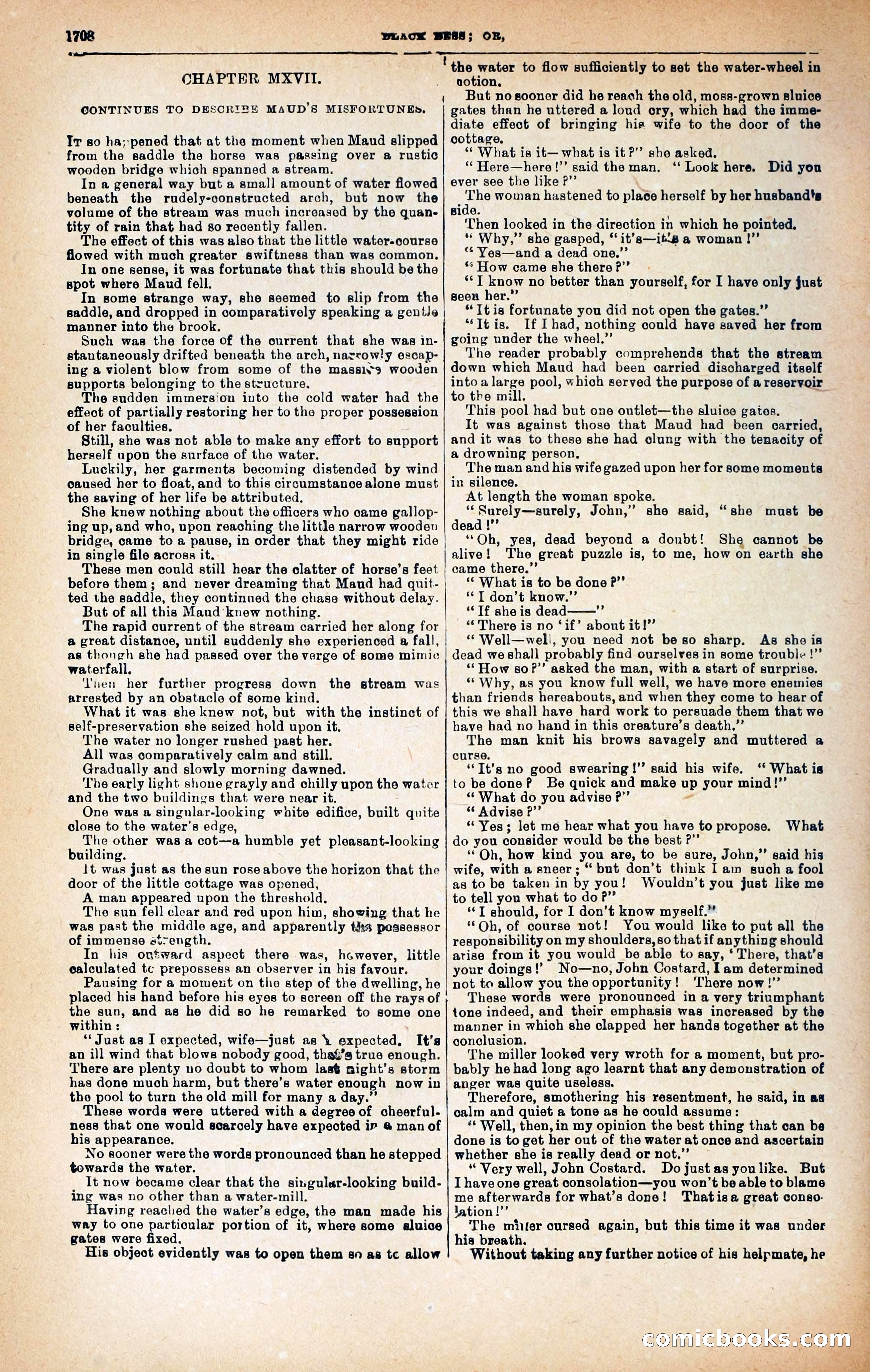
A restored page from Penny Dreadfuls, 1866. Page through the whole issue in the reader above.
📄 Transcribed text from this page (OCR, searchable)
Machine-transcribed from the original scan — historical spelling and the odd misread are preserved.
1708 —— CHAPTER MXVII. CONTINUES TO DESCRIBE MAUD’S MISFORTUNES. Ir so ha;pened that at tha moment when Maud slipped from the saddle the horse was passing over a rustic wooden bridge which spanned a stream. In a general way but a small amount of water flowed beneath the rudely-constructed arch, but now the volume of the stream was much increased by the quan- tity of rain that bad 80 recently fallen. The effect of this was also that the little water-course flowed with much greater swiftness than was common. In one sense, it was fortunate that this should be the spot where Maud fell. In some strange way, she seemed to alip from the saddle, and dropped in comparatively speaking a gentle manner into the brook. Such was the force of the current that she was in- etantaneously drifted beneath the arch, narrow'y escap- ing a violent blow from some of the massin3 wooden supports belonging to the structure, The sudden immersion into the cold water had the effect of partially restoring her to the proper possession of her faculties. Still, she was not able to make any effort to support herself upon the surface of the water. Luckily, her garments becoming distended by wind caused her to float, and to this circumstance alone must the saving of her life be attributed. She knew nothing about the officers who came gallop- ing up, and who, upon reaching the little narrow wooden bridge, came to a pause, in order that they might ride in single file across it. These men could still hear the clatter of horse’s feet before them; and never dreaming that Mand had quit- ted the saddle, they continued the chase without delay. But of all this Maud ‘knew nothing. The rapid current of the stream carried her along for a great distance, until suddenly she experienced a fall, as thongh she had passed over the verge of some mimic waterfall. ‘Tuen her further progress down the stream was arrested by an obstacle of some kind. What it was she knew not, but with the instinct of self-preservation she seized hold upon it. The water no longer rushed past her. All was comparatively calm and still. Gradually and slowly morning dawned. The early light shone grayly and chilly upon the water and the two buildings that were near it. One was a singular-looking white edifice, built quite close to the water’s edge, The other was a cot—a humble yet pleasant-looking building. lt was just as the sun rose above the horizon that the door of the little cottage was opened, A man appeared upon the threshold, The sun fell clear and red upon him, showing that he was past the middle age, and apparently tJss pessessor of immense strength. In his outward aspect there was, however, little calculated tc prepossess an observer in his favour. Pausing for a moment on the step of the dwelling, he placed his hand before his eyes to screen off the rays of the sun, and as he did so he remarked to some one within : ‘‘ Just as I expected, wife—just as 4 expected. It’s an ill wind that blows nobody good, tha¢’g true enough. There are plenty no doubt to whom las¢ night’s storm has done much harm, but there’s water enough now in the pool to turn the old mill for many a day.”’ These words were uttered with a degree of cheerful- ness that one would scarcely have expected ir @ man of his appearance. No sooner were the words pronounced than he stepped towards the water. It now became clear that the singuler-looking build- ing was no other than a water-mill. Having reached the water’s edge, the man made his way to one particular portion of it, where some aluice gates were fixed. His object evidently was to open them sn aa tc allow WLACK BESS; OR, NN - — 'the water to flow sufficiently to set the water-wheel in > notion, gates than he uttered a loud ory, which had the imme- diate effect of bringing his wife to the door of the cottage, ** What is it— what is it P’”’ she asked. ‘*‘ Here—here!”’’ said the man. ‘‘ Look here. Did you ever see the like P”’ : he woman hastened to plaée herself by her husband's side. Then looked in the direction in which he pointed, ‘* Why,’ she gasped, “it’s—ite a woman !”’ ‘* Yes—and a dead one,”’ ** How came shethereP” . ‘*] know no better than yourself, for I have only just seen her.”’ “Tt is fortunate you did not open the gates.”’ “‘It is. If Ihad, nothing could have saved her from going under the wheel.”’ The reader probably comprehends that the stream down which Mand had been carried disoharged itself into a large pool, which served the purpose of a reservoir to the mill. This pool had but one outlet—the sluice gates. It was against those that Maud had been carried, and it was to these she had clung with the tenacity of a drowning person, The man and his wife gazed upon her for some moments in silence. At length the woman spoke. ‘‘Surely—surely, John,’ she said, “she must be dead !”’ “Oh, yes, dead beyond a donbt! She cannot be alive! The great puzzle is, to me, how on earth she came there.” ‘What is to be done P’’ *T don’t know.”’ “Tf sheis dead ‘‘ There is no ‘if’ about it!” “ Well—well, you need not beso sharp. As she is dead weshall probably find ourselves in some trouble !”’ ‘“ How soP”’ asked the man, with a start of surprise. * Why, as you know full well, we have more enemies than friends hereabouts, and when they come to hear of this we shall have hard work to persuade them that we have had no hand in this creature’s death,”’ The man knit his brows savagely and muttered a curse. ‘‘Tt’s no good swearing !’’ said his wife. ‘‘ What is to be done? Be quick and make up your mind!”’ ‘What do you advise P”’ ‘6 Advise P”’ “Yes; let me hear what you have to propose. do you consider would be the best ?” ‘‘Oh, how kind you are, to be sure, John,”’ said his wife, with a sneer; “ but don’t think I am such a fool as to be taken in by you! Wouldn’t you just like me to tell you what to do P” ‘‘T should, for I don’t know myself.” “Oh, of course not! You would like to put all the responsibility on my shoulders, so that if anything should arise from it you would be able to say, ‘ There, that’s your doings!’ No—no, John Costard, Iam determined not ta allow you the opportunity! There now!”’ These words were pronounced in a very triumphant tone indeed, and their emphasis was increased by the manner in which she clapped her hands together at the conclusion. The miller looked very wroth for a moment, but pro- bably he had long ago learnt that any demonstration of anger was quite useless. Therefore, smothering his resentment, he said, in as calm and quiet a tone as he could assume: ‘* Well, then, in my opinion the best thing that can be done is to get her out of the water at once and ascertain whether she is really dead or not,”’ “Very well, John Costard. Dojustasyoulike. But I have one great consolation—you won’t be able to blame me afterwards for what’s done! Thatisa great conso-: lation!’’ The miler cursed again, but this time it was under his breath. Without taking any further notice of his helpmate, he 99 — What But no sooner did he reach the old, moss-grown sluice — (E(o) ooo) Cc ES €O ~ be | dp heh ee