
Penny Dreadfuls, 1866 · page 83 of 395
Black Bess; or, the Knight of the Road — page 83: what you’re looking at
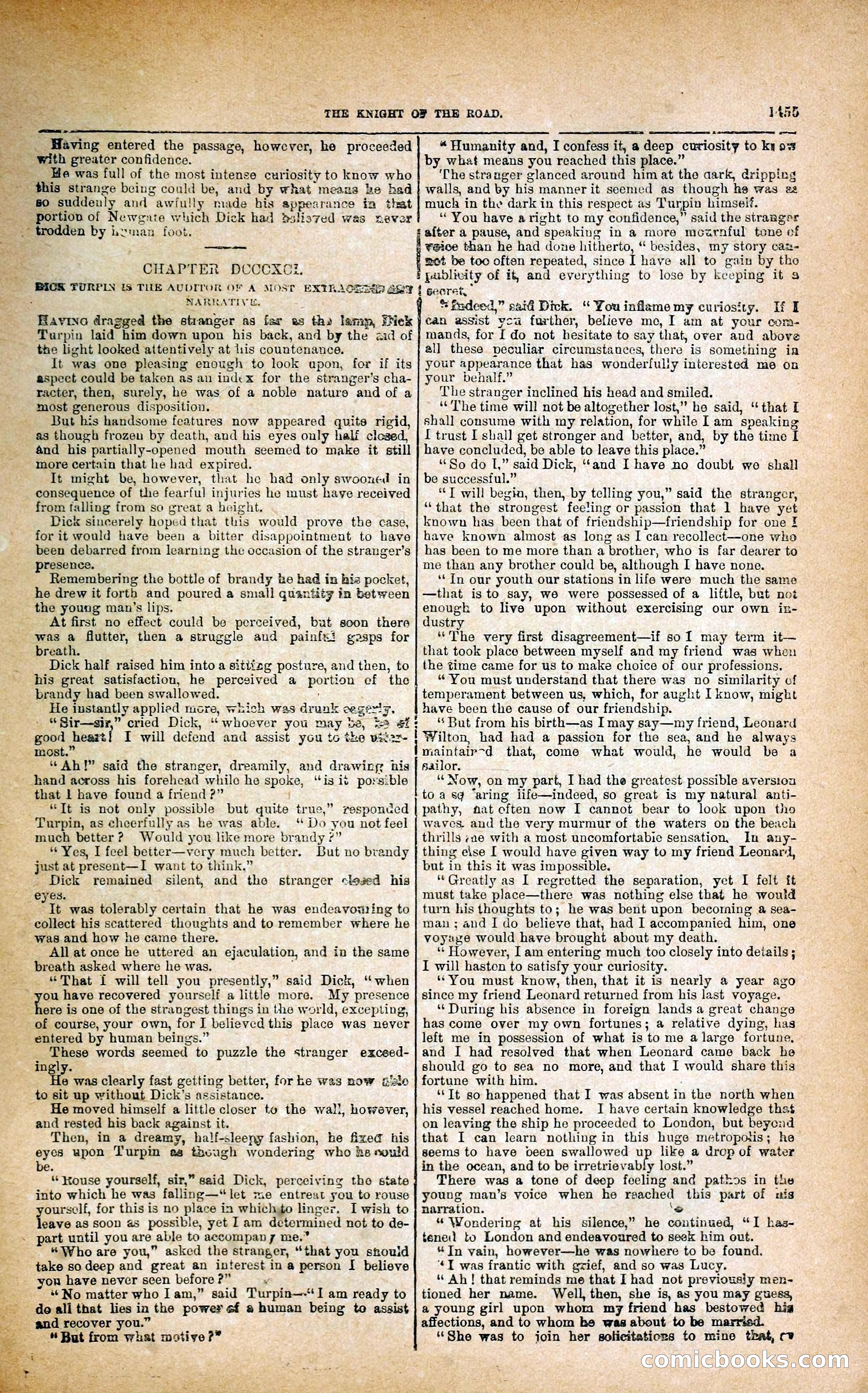
A restored page from Penny Dreadfuls, 1866. Page through the whole issue in the reader above.
📄 Transcribed text from this page (OCR, searchable)
Machine-transcribed from the original scan — historical spelling and the odd misread are preserved.
- - ” AAS > a ee Having entered the passage, however, he proceeded With greater confidence. ___ He was full of the most intense curiosity to know who ~* S = hie hae hiaee LY ee 3 =. é portion of Newgate which Dick had bslisved was never trodden by Leman foot. me sg ‘THE KNIGHT OF THE ROAD. Eee at eT ote 1455 wo “Humanity and, I confess it, a deep curiosity to ky ow by what means you reached this place.” ‘The stranger glanced around him at the aark, dripping on this Strange being could be, and by what means ke bad } walls, and by his manner it seemed as though he was 22 BO suddeuly and awfully made his appearance im that | much in the dark in this respect as Turpin himself. ‘You have aright to my confidence,” said the stranger after a pause, and speaking in a more mozarnful tone of ¥eice than he had done hitherto, “ besides, my story can- net be too often repeated, since I have all to gain by the f pabdlivity of it, and everything to lose by keeping it 3 Ayres sae = CHAPTER DCCCXC?, — > Mas BICK TURPLN 1S THE AUDITOR OF A MOST EXTRACHIM GQ7 } secret. ie: NARRATIVE. _ avino dragged the stranger as far as tha lamp, Fick Turpin laid him down upon his back, and by the aid of the light looked attentively at lis countenance. It was one pleasing enough to look apon, for if its aspect could be taken as an index for the stranger’s cha- racter, then, surely, he was of a noble nature and of a most generous disposition. But his handsome features now appeared quite rigid, as though frozen by death, and his eyes only half clesed, nd his partially-opened mouth seemed to make it still ‘more certain that he had expired. It might be, however, that he had only swooned in consequence of the fearful injuries he must have received from falling from so great a height. Dick sincerely hoped that this would prove the case, for it would have been a bitter disappointment to have been debarred from learning the occasion of the stranger’s | presence. - Remembering the bottle of brandy be had in his pocket, he drew it forth and poured a small quantity in between the young man’s lips. At first no effect could be perceived, but soon there was a flutter, then a struggle and painfxi gasps for breath. Dick half raised him into a sititzg posture, and then, to _ his great satisfaction, he perceived a portion ef the brandy had been swallowed. _ He instantly applied more, which was drunk ceger'y, _ “Sir—sir,” cried Dick, “whoever you may 52, == af good heazt! I will defend and assist you to the vitor ye THOst.” “Ah!” said the stranger, dreamily, and drawing his hand across his forehead while he spoke, “is it porsible that 1 have found a friend ?” : "Tt is not only possible but quite true,” responded Turpin, as cheerfully as he was able. “ Do you not feel | much better? Would you like more brandy ?” gs ** Yes, I feel better—very much better. But no brandy just at present—I want to think.” _ Dick remained silent, and tho stranger closed his eyes. Sted) "Tt was tolerably certain that he was endeavowting to collect his scattered thoughts and to remember where he -_-was and how he came there. oi _ Allat once he uttered an ejaculation, and in the same ’ re __ breath asked where he was. “Phat I will tell you presently,” said Dick, “when you have recovered yourself a little more. My presence hore is one of the strangest things in the world, excepting, of course, your own, for I believed this place was never __ entered by human beings.” _ Phese words seemed to puzzle the stranger exceed- ; tte was clearly fast getting better, for ke was now to sit up without Dick’s assistance. He moved himself a little closer to the wall, however, and rested his back against it. Then, in a dreamy, half-sleeny fashion, ke fixed his eyes upon Turpin ea though wondering who he sould »> t ad “}ouse yourself, sir,” said Dick, perceiving tho state into which he was falling—“ let me entreut you to rouse ourself, for this is no place in whicho linger, I wish to eave as soon as possible, yet 1 am determined not to de- -* part until you are able to accompan7 me.” a “Who are you,” asked the stranger, “that you should ys take so deep and great an interest in a person J believe __- you have never seen before ?” r ae “No matter who lam,” said Turpin—-“I am ready to _ doalithat lies in the power sf a human being to asaist ___gnd recover you.” : But from what motive ?” : : * fadeed,” saif Dick. “ Youinflame my curiosity. If I can assist vou further, believe mo, I am at your com- mands, for I do not hesitate to say that, over and above al] these peculiar circumstances, there is something in your appearance that has wonderfully interested me on your behalf.” The stranger inclined his head and smiled. ‘The time will not be altogether lost,” he said, “that I shall consume with my relation, for while [am syeaking [ trust I shall get stronger and better, and, by the time I have concluded, be able to leave this place.” “So do I,” said Dick, ‘‘and I have no doubt we shall be successful.” “T will begin, then, by telling you,” said the stranger, ‘that the strongest feeling or passion that 1 have yet known has been that of frieundship—friendship for one I have known almost as long as I can recollect—one who has been to me more than a brother, who is far dearer to me than any brother could be, although I have none. ‘In our youth our stations in life were much the same —that isto say, we were possessed of a little, but not enough to live upon without exercising our own iz- dustry “The very first disagreement—if soI may term it— that took place between myself and my friend was when the time came for us to make choice of our professions. “You must understand that there was no similarity of temperament between us, which, for aught I know, might have been the cause of our friendship. ‘But from his birth—as I may say—my friend, Leonard | Wilton, had had a passion for the sea, and he always maintair-d that, come what would, he would be a sailor. ‘¢Now, on my part, I had the greatest possible aversion to a sg ‘aring life—indeed, so great is my natural anti- pathy, nat cften now I cannot bear to look upon tho waves, and the very murmur of the waters on the beach thrills ¢ne with a most uncomfortabiec sensation, In any- thing else I would have given way to my friend Leonar‘, but in this it was impossible. ‘Greatly as I regretted the separation, yet I felt ft must take place—there was nothing else that he would turn his thoughts to; he was bent upon becorning a sea- man ; and I do believe that, had I accompanied him, one voyage would have brought about my death. ‘‘ However, lam entering much too closely into deiails ; I will haston to satisfy your curiosity. ‘You must know, then, that it is nearly a year ago since my friend Leonard returned from his last voyage. ‘ During his absence in foreign lands a great change has come over my own fortunes; a relative dying, has left me in possession of what is to me a large fortune, and I had resolved that when Leonard came back he should go to sea no more, and that I would share this fortune with him. ‘Tt so happened that I was absent in the north when his vessel reached home. I have certain knowledge that on leaving the ship he proceeded to London, but beyend | that I can learn nothing in this huge metropotis; he seems to have oeen swallowed up like a drop of water in the ocean, and to be irretrievably lost.” There was a tone of deep feeling and pathos in the young man’s yoice when he rgached this part of nis narration. ‘\e “ Wondering at his silence,” he continued, “I has- tened’ to London and endeavoured to seek him out. “Tn vain, however—he was nowhere to be found. “1 was frantic with grief, and so was Lucy. “ Ah! that reminds me that [had not previously men- tioned her name. Well, then, she is, as you may guess, a young girl upon whom m7 friend has bestowed hia affections, and to whom he was about to be marrisd. ‘‘She was to join her solicitations to mine that, cv Eomicdbooks (é (0)