
Penny Dreadfuls, 1866 · page 286 of 395
Black Bess; or, the Knight of the Road — page 286: what you’re looking at
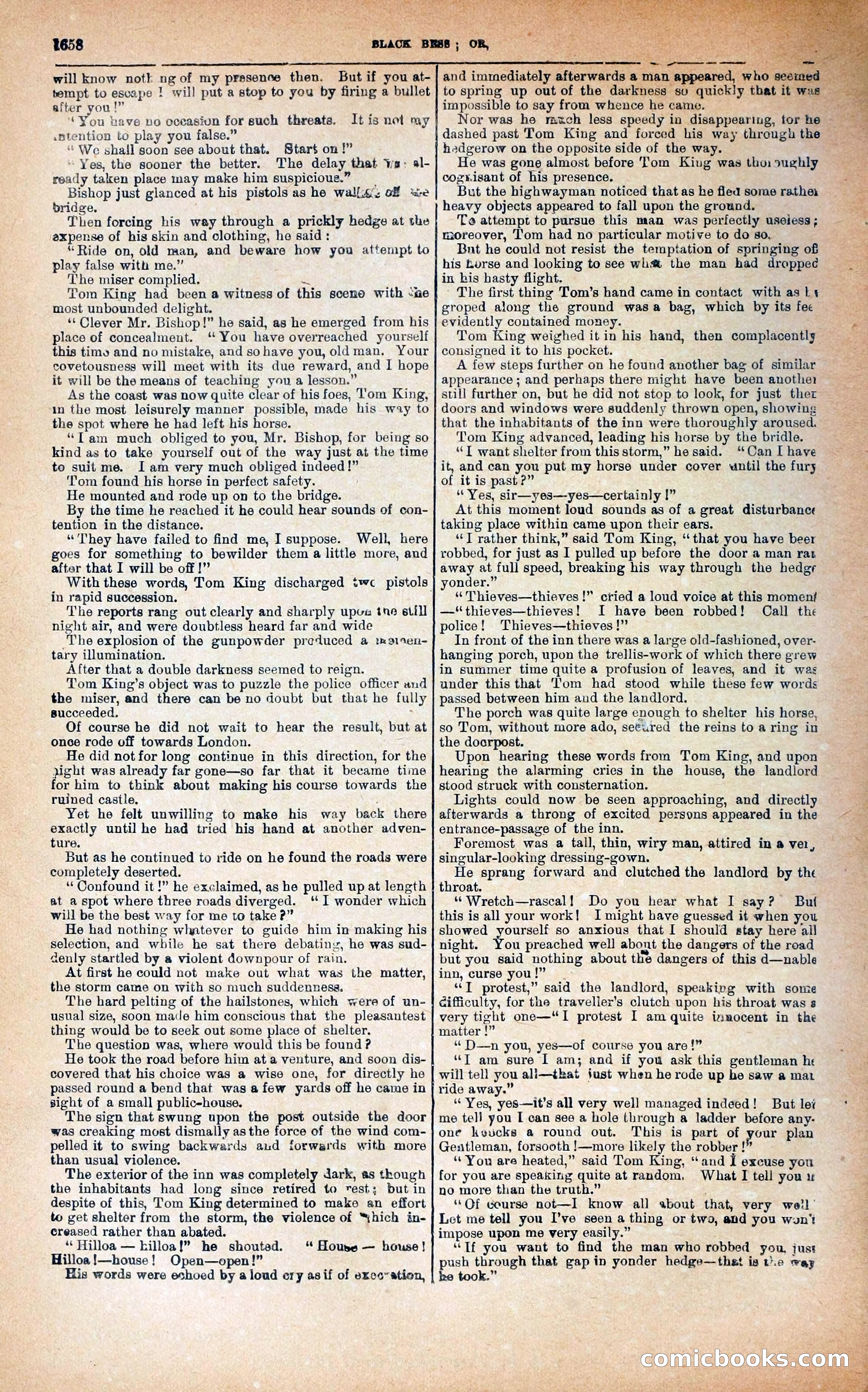
A restored page from Penny Dreadfuls, 1866. Page through the whole issue in the reader above.
📄 Transcribed text from this page (OCR, searchable)
Machine-transcribed from the original scan — historical spelling and the odd misread are preserved.
1658 will know notk ng of my prasence then. after you!” ‘You have bo oceasivn for such threats. .ntention to play you false.” ‘We shall soon see about that. Start on!” - Yes, the sooner the better. The delay that Wa: sl- ready taken place may make him suspicious.” Bishop just glanced at his pistols as he wall of xe bridge, | Then forcing his way through a prickly hedge at the expense of his skin and olothing, he said: “Ride on, old man, and beware how you atfempt to play false with me.” The miser complied. ~ Tom King had been a witness of this sceno with ‘he most unbounded delight. ‘‘ Clever Mr. Bishop!” he said, as he emerged from his place of concealment. ‘You have overreached yourself this timy and no mistake, and sohave you, oldman. Your covetousness will meet with its due reward, and I hope it will be the means of teaching you a lesson.” As the coast was now quite clear of his foes, T'om King, in the most leisurely manner possible, made his way to the spot where he had left his horse. “Tam much obliged to you, Mr. Bishop, for being so kind as to take yourself out of the way just at the time to suitme. Iam very much obliged indeed!” ‘om found his horse in perfect safety. He mounted and rode up on to the bridge. By the time he reached it he could hear sounds of con- tention in the distance. “They have failed to find me, I suppose. Well, here goes for something to bewilder them a little more, and after that I will be off !” It is net my With these words, Tom King discharged twc pistols in rapid succession. The reports rang out clearly and sharply upve the etill night air, and were doubtless heard far and wide ‘The explosion of the gunpowder preduced a mairen- tary illumination. After that a double darkness seemed to reign. Tom King’s object was to puzzle the police officer and the miser, and there can be no doubt but that he fully succeeded. Of course he did not wait to hear the result, but at once rode off towards London. He did not for long continue in this direction, for the jight was already far gone—so far that it became time for him to think about making his course towards the ruined castle, Yet he felt unwilling to make his way back there exactly until he had tried his hand at another adven- ture. But as he continued to ride on he found the roads were completely deserted. “Confound it !” he exclaimed, as he pulled up at length at a spot where three roads diverged. ‘ I wonder which will be the best way for me to take ?” He had nothing whatever to guide him in making his selection, and while he sat there debatiny, he was sud- aenly startled by a violent downpour of rain. At first he could not make out what was the matter, the storm came on with so much suddenness, The hard pelting of the hailstones, which were of un- usual size, soon made him conscious that the pleasantest thing would be to seek out some place of shelter. The question was, where would this be found ? He took the road before him at a venture, and soon dis- covered that his choice was a wise one, for directly he passed round a bend that was afew yards off he came in sight of a small public-house. The sign that swung upon the post outside the door was creaking most dismally as the force of the wind com- pelled it to swing backwards aud forwards witb more than usual violence. The exterior of the inn was completely dark, as though the inhabitants had long since retired to vest; but in despite of this, Tom King determined to make an effort to get shelter from the storm, the violence of “ihich in- creased rather than abated. ‘“‘ Hilloa — Lilloa!” he shouted. Hilloa!—house! Open—open!” Elis words were echoed by aloud ery asif of exec~ation, “ House — house ! But if you at- tempt to escape ! will put a stop to you by firing a bullet . es ip ae a Ae ‘ . 7 -_ »» ~ ¢ wd ee bare Sara, vs - and immediately afte impossible to say from whence he came. | . dashed past Tom King and forced his way through the hedgerow on the opposite side of the way. He was gone almost before Tom Kiug was thoi .ughly cozxisant of his presence. But the highwayman noticed that as he fled some rathes heavy objects appeared to fall upon the ground. Toa attempt to pursue this man was perfectly useless; moreover, ‘'om had no particular motive to do so, Bunt he could not resist the temptation of springing of his horse and looking to see wha the man had droppec in his hasty flight. ~The first thing Tom’s hand came in contact with as L4 groped along the ground wasa bag, which by its fee evidently contained money. Tom King weighed it in his hand, then complacently consigned it to his pocket. A few steps further on he found another bag of similar appearance ; and perhaps there might have been anothie still further on, but he did not stop to look, for just thez doors and windows were suddenly thrown open, showing that the inhabitants of the inn were thoroughly aroused. Tom King advanced, leading his horse by the bridle. “]T want shelter from this storm,” he said. ‘Can I[ have it, and can you put my horse under cover until the fury of it is past ?” “Yes, sir—yes—yes—certainly |” At this moment loud sounds as of a great disturbance taking place within came upon their ears. ‘‘T rather think,” said Tom King, “that you have beer robbed, for just as I pulled up before the door a man ras away at full speed, breaking his way through the hedge yonder.” “Thieves—thieves !” cried a loud voice at this moment — thieves—thieves! I have been robbed! Call the police! Thieves—thieves !” In front of the inn there was a large old-fashioned, over- hanging porch, upon the trellis-work of which there grew in summer time quite a profusion of leaves, and it was under this that 'om had stood while these few words passed between him and the landlord. The porch was quite large enough to shelter his horse, so Tom, without more ado, setured the reins to a ring in the docrpost. Upon hearing these words from Tom King, and upon hearing the alarming cries in the house, the landlord stood struck with consternation. Lights could now be seen approaching, and directly afterwards a throng of excited persons appeared in the entrance-passage of the inn. Foremost was a tall, thin, wiry man, attired in a ver, singular-looking dressing-gown. He sprang forward and clutched the landlord by the throat. ‘ Wretch—rascal! Do you hear what I say? But this is all your work! I might have guessed it when you showed yourself so anxious that I should stay here all night. You preached well about the dangers of the road but you said nothing about the dangers of this d—nable inn, curse you!” _ “T protest,” said the landlord, speaking with some Gifficulty, for the travelier’s clutch upon his throat was s very tight one—“I protest I am quite inmocent in the matter !” “D—n you, yes—of course you are!” “T am sure I am; and if you ask this gentleman he will tell you ali—tkat just when he rode up he saw a mat ride away.” ‘Yes, yes—it’s all very well managed indeed! But lei me tel) you I can see a hole through a ladder before any- one kyucks a round out. This is part of your plan Gentleman, forsooth !—more likely the robber !” “You are heated,” said Tom King, “and I excuse you for you are speaking quite at random. What I tell you x no more than the truth.” “Of course not—I know all about that, very we?l’ Let me tell you I’ve seen a thing or two, and you won't impose upon me very easily.” “Tf you want to find the man who robbed you, just push through that gap in yonder hedge—thet is t).e way he took.” to spring up out of the darkness su quickly that it was Nor was he match less speedy in disappearing, torhe —_ ae on a rr he - ee (E(e) choo , Trice Fe at Z ~~. 4 ¥~ ae | 4 ¥ _ a ha