
Penny Dreadfuls, 1866 · page 188 of 395
Black Bess; or, the Knight of the Road — page 188: what you’re looking at
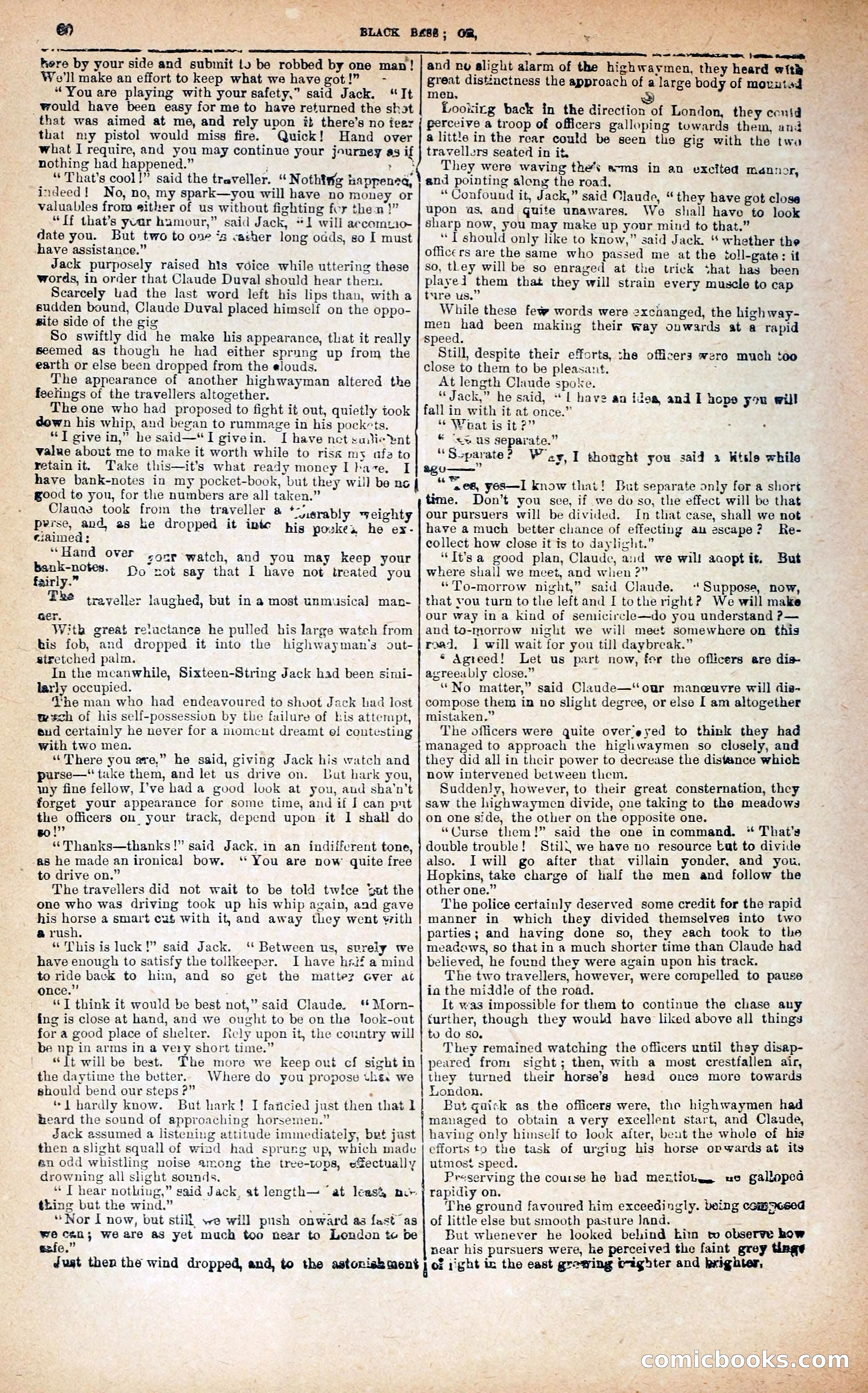
A restored page from Penny Dreadfuls, 1866. Page through the whole issue in the reader above.
📄 Transcribed text from this page (OCR, searchable)
Machine-transcribed from the original scan — historical spelling and the odd misread are preserved.
mae here by your side and submit to be robbed by one man! Wo'll make an effort to keep what we have got!” - “You are playing with your safety,” said Jack. “It would have been easy for me to have returned the shat that my pistol would miss fire. Quick! Hand over what I require, and you may continue your journey as if nothing had happened.” a. “That's cool!” said the traveller. “ Nothtrg happenea, valuables from either of us without fighting fcr then !” “{f that’s your humour,” said Jack, “1 will aecommo- date you. But two to one ‘s casher long odds, so I must have assistance.” Jack purposely raised his voice while uttering these words, in order that Claude Duval should hear them. Scarcely tad the last word left his lips than, with a sudden bound, Claude Duval placed himself on the oppo- gite side of the gig So swiftly did he make his appearance, that it really seemed as though he had either sprung up from the earth or else been dropped from the elouds. The appearance of another highwayman altered the feelings of the travellers altogether. The one who had proposed to fight it out, quietly took down his whip, and began to rummage in his pock*ts. “I give in,” be said—“I givein. I have nct sudie ent value about me to make it worth while to risz mv afa to retain it. Take this—it’s what ready money I bate, I have bank-notes in my pocket-book, but they will be ns good to you, for the numbers are all taken.” Clauae took from the traveller a “s wisrably weighty perse, aud, as ke dropped it inte pi, poukes he ex- eiaimed: ‘“Hand over bank-notes. fairly.” vo Eke traveller laughed, but in a most unmusica] man- Ger. With great reluctance he pulled his large watch from his fob, and dropped it into the highwayman's out- siretched palm. In the meanwhile, Sixteen-String Jack had been simi- larly occupied. Yhe man who had endeavoured to shvot Jack had lost msch of his self-possession by the failure of his attempt, sud certainly he never for a momceut dreamt ef contesting with two mean. ‘‘There you are,” he said, giving Jack his watch and purse—‘ take them, and let us drive on. But hark you, wy fine fellow, I’ve had a good look at you, and sha'n't forget your appearance for some time, and if I can pnt the officers on your track, depend upon it I shall do 1) sonr watch, and you may keep your not say that I have not treated you “ Thanks—thanks!” said Jack. in an indifferent tone, as he made an ironical bow. ‘ You are now quite free to drive on.” The travellers did not wait to be told twice %ut the one who was driving took up his whip again, and gave his horse a smart cut with it, and away they went with a@ rush. “This is luck!” said Jack. ‘ Between us, surely we have enough to satisfy the tollkeeper. I have h-if a mind to ride back to him, and so get the matter over at once.” 7 “JT think it would be best not,” said Claude. ‘** Morn- fng is close at hand, and we ought to be on the look-out for a good place of shelter. Rely upon it, the country will be np in arms in a very short time.” “It will be best. The more we keep out cf sight in the daytime the better. Where do you propose ths, we should bend our steps ?” ‘ ‘J hardly know. But hark! I fancied just then that 1 heard the sound of approaching horsemen.” dack assumed a listening attitude immediately, bet just then aslight squall of wind had sprung up, which made en odd whistling noise among the tree-tops, eSectually drowning all slight sounds. “ T hear nothing,” said Jack, at length— ‘at leas mv thine but the wind.” “ Nor I now, but still we will push onward as fast’ as me cal; Weare as yet much too near to London te be e. indeed! No, no, my spark—you will have no money | l . ee : 1 _ ? ~~ Pp ra . ~ BLACK Bgse ; that was aimed at me, and rely upon it there’s no jeer | i a TY Deen en ene es . - * , & ake ’ 7 gees A tif-_F 2 > } = * ne se eee jee and no slight alarm of the highwaymen, they heard oith ; great distinctness the approach of a large body of movutad men. Lookirg back in the direction of London. they centd perceive a troop of officers galloping towards them, and a little in the rear could be seen the gig with the twa travellers seated in it. They were waving thes a-ms in an excited mannor, and pointing along the road, “Confound it, Jack,” said Claude, “they have got close upon as, and quite unawares. We shall have to look sharp now, you may make up your mind to that.” ‘‘ I should only like to know,” said Jack. “ whether the officers are the same who passed me at the toll-gate: if so, tLey will be so enraged at the trick ‘hat has been playei them that they will strain every muscle to cap ture us.” While these few words were 2xchanged, the high way- peas been making their way onwards at a rapid speed. Still, despite their efforts, the officers wero much too close to them to be pleasant. At length Claude spoke. “Jack,” he said, “1 have aa idea and I hope you will fall in with it at once.” is “What is it ?” « “xs us separate.” 2 Svparate ? Way, I thought you said a litsle while agu “red, yes—I know thai! But separate only for a shoré time. Don’t you sce, if we do so, the effect will be that our pursuers will be divided. have a much better chance of effecting au escape ? collect how close it is to daylight.” “It’s a good plan, Claude, aud we will aaoptit. But where shall we meet, and when ?” “To-morrow night,” said Claude. ‘Suppose, now, that vou turn to the left and I tothe right? We will make our way ina kind of semicircle—do you understand ?— and to-morrow night we will meet somewhere on this road. | will wait for you till daybreak.” * Agreed! Let us part now, fer the oflicers are dis- acreeably close.” “No matter,” said Claude—“our maneuvre will dia- compose them in no slight degree, or else I am altogether mistaken.” The officers were quite over’eyed to think they had managed to approach the higlwaymen so clusely, and they did all in their power to decrease the distance whick now intervened between them. Suddenly, however, to their great consternation, they saw the highwaymen divide, one taking to the meadows on one side, the other on the opposite one. “Curse them!” said the one in command. “ That's double trouble! Stil. we have no resource Lut to divide also. I will go after that villain yonder, and you. Hopkins, take charge of half the men and follow the other one.” The police certainly deserved some credit for the rapid manner in which they divided themselves into two parties; and having done so, they each took to the meadows, so that in a much shoricer time than Claude had believed, he found they were again upon his track. The two travellers, however, were compelled to pause ia the middie of the road. It was impossible for them to continue the cliase any further, though they would have liked above all thingy to do so. They remained watching the officers until they disap- peared from sight; then, with a most crestfallen air, they turned their horse’s head oncs more towards London. But quirk as the officers were, the highwaymen had managed to obtain avery excellent start, and Claude, haying only himself to look after, bent the whole of his efforts to the task of urging his horse onwards at its utmost speed. ‘ Preserving the course he bad mextioLw, ue galloped rapidity on. The ground favoured him exceedingly. being compesed of little else but smooth pasture Jand. But whenever he looked behind kimn to observe how near his pursuers were, he perceived the faint grey tings Re- dust then the wind dropped, and, to the astoriskment | of 1 ght iz the east grewring t~ighter and brighter, ~~ 4 we ne ts id tt ie a \, ¥ oe - In that case, shall we not - (E(0) (E 9 rh. f . fe + all (E(@) ks : i i 4 I | —. < 45+ «