
Penny Dreadfuls, 1866 · page 218 of 395
Black Bess; or, the Knight of the Road — page 218: what you’re looking at
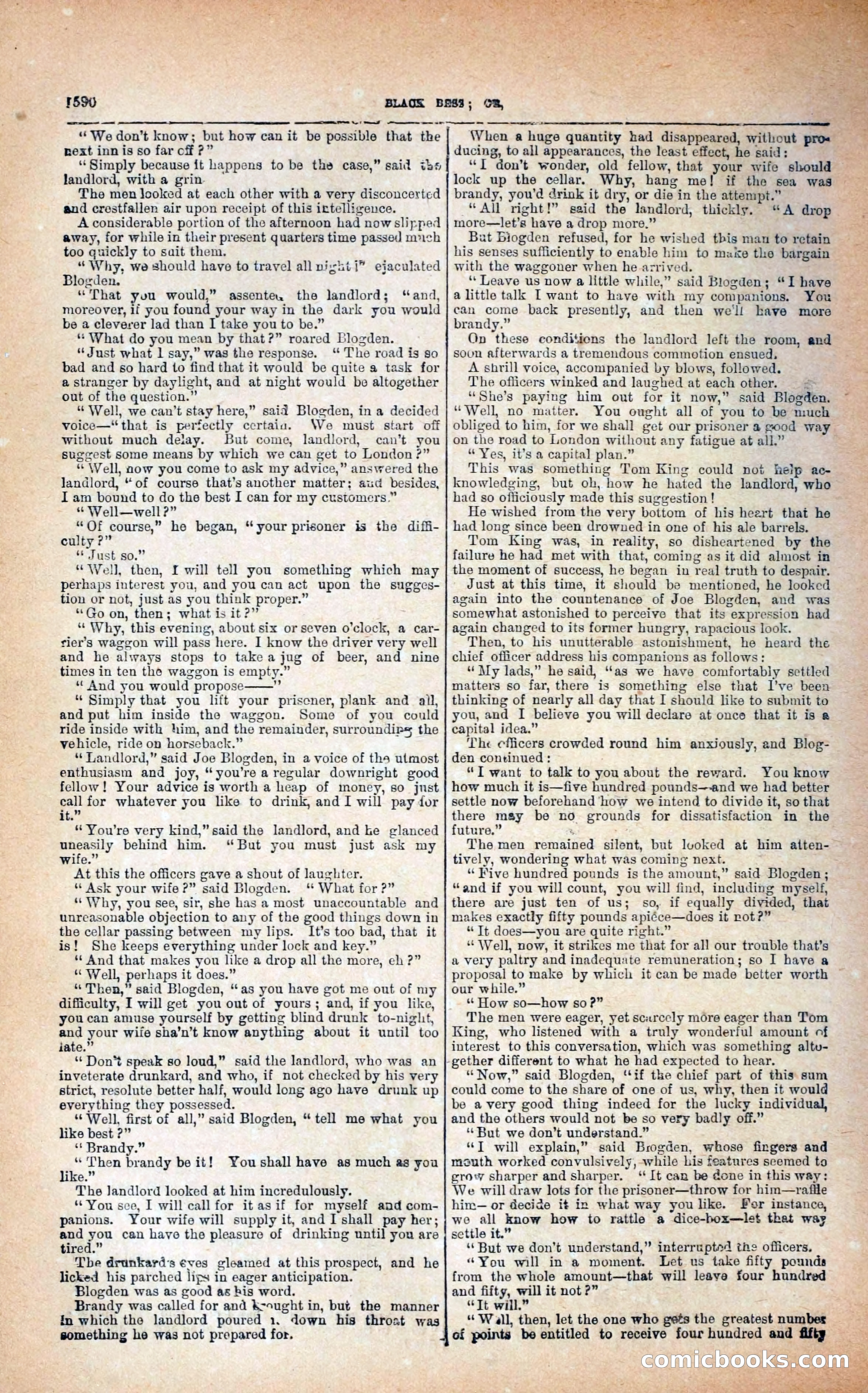
A restored page from Penny Dreadfuls, 1866. Page through the whole issue in the reader above.
📄 Transcribed text from this page (OCR, searchable)
Machine-transcribed from the original scan — historical spelling and the odd misread are preserved.
Sr Pees Siar! rok oN we ‘pat ts B Bee Oe ee NS Se “ ” ' : \ >| - ‘ , 7 . F530 “We don’t know; but how can it be possible that the next inn is so far off ?” “Simply because it happens to be the case,” said ths landlord, with a grin. The men looked at each other with a very disconcerted and crestfallen air upon receipt of this intelligence. A considerable portion of the afternoon had nowslipped away, for while in their present quarters time passed mach too quickly to sait them. “Why, we should have to travel all vighti” eiaculated Blogden. “That you would,” assente. the landlord; “and, moreover, if you found your way in the dark you would be a cleverer lad than I take you to be.” ‘* What do you mean by that?” roared Blogden. “Just what 1 say,” was the response. “ The road is so bad and so hard to find that it would be quite a task for a stranger by daylight, and at night would be altogether out of the question.” “ Well, we can’t stay here,” said Blogden, in a decided voice—“ that is perfectly ccertaiua. We must start off without much delay. But come, landlord, can’t you suggest some means by which we can get to London ?” “ Well, now you come to ask my advice,” answered the landlord, “of course that’s another matter; aud besides, I am bound to do the best I can for my customers.” * Well—well ?” “Of course,” he began, “your prisoner is the diffi- culty?” * Tust so.” “Well, then, I will tell you something which may perhaps Interest you, and you can act upon the sugges- tion or not, just as you think proper.” “Go on, then; what is it ?” “ Why, this evening, about six or seven o’clock, a car- fier’s waggon will pass here. I know the driver very well and he always stops to take a jug of beer, and nine times in ten the waggon is empty.” ‘‘ And you would propose ” * Simply that you lift your prisener, plank and all, and put him inside the waggon. Some of you could ride inside with him, and the remainder, surroundips the vehicle, ride on horseback.” ‘‘ Landlord,” said Joe Blogden, in a voice of tha utmost enthusiasm and joy, “you’re a regular downright good fellow! Your advice is worth a heap of money, so just call for whatever you like to drink, and I will pay dor at.” * You're very kind,” said the landlord, and ke glanced uneasily behind him. “But you must just ask my wife.” At this the officers gave a shout of laughter. “ Ask your wife?” said Blogden. ‘ What for ?” ‘Why, you see, sir, she has a most unaccountable and unreasonable objection to any of the good things down in the cellar passing between my lips. It’s too bad, that it is! She keeps everything under lock and key.” *‘ And that makes you like a drop all the more, eh ?” “ Well, perhaps it does.” “Then,” said Blogden, ‘as you have got me out of my difficulty, I will get you out of yours; and, if you like, you can amuse yourself by getting blind drunk to-night, and your wiie sha’n’t know anything about it until too iate.” ** Dont speak so loud,” said the landlord, who was an inveterate drunkard, and who, if not checked by his very strict, resolute better half, would long ago have drunk up everything they possessed. ‘Well, first of all,” said Blogden, “tell me what you like best ?” ‘“‘ Brandy.” “ Then brandy be it! like.” The Jandlord looked at him incredulously. * You sce, I will call for it asif for myself and com- panions. Your wife will supply it, and I shall pay her; are. can have the pleasure of drinking until you are tired.” The drunkards ¢ves gleamed at this prospect, and he licked his parched lips in eager anticipation. Blogden was as good as his word. Brandy was called for and krought in, but the manner in which the landlord poured 1. down his throat was something he was not prepared for, You shall have as much as you BLAGS BESS; CR, ee ee When a huge quantity had disappeared, without prow : ra, ducing, to all appearances, the least effect, he said; “JT don’t wonder, old fellow, that your wife should lock up the cellar. Why, hang me! if the sea was brandy, you'd 4rink it dry, or die in the attempt.” “All right!” said the landlord, thickly. more—let’s have a drop more.” | But Biogden refused, for he wished this man to retain his senses sufficiently to enable him to make the bargain with the waggoner when he arrived. ‘Leave us now a little while,” said Blorden; “I have a little talk [want to have with my companions. You can come back presently, and then we'll kave more brandy.” A drop _ On these conditions the landlord left the room, and 7 soon afterwards a tremendous commotion ensued, A shrill voice, accompanied by blows, followed. The officers winked and laughed at each other. = ‘“She’s paying him out for it now,” said Blogden. “Well, no matter. You ought all of you to be much obliged to him, for we shall get our prisoner a good way on the road to London without any fatigue at all.” “Yes, it’s a capital plan.” This was something Tom King could not help ac- knowledging, but oh, how he hated the landlord, who had so officiously made this suggestion ! He wished from the very bottom of his heert that he had long since been drowned in one of his ale barrels. Tom King was, in reality, so disheartened by the failure he had met with that, coming as it did almost in the moment of success, he began in real truth to despair. Just at this time, it should be mentioned, he looked again into the countenance of Joe Blogden, and was somewhat astonished to perceive that its expression had again changed to its former hungry, rapacious look. Then, to his unutterable astonishment, he heard the chief officer address his companions as follows: “ My lads,” he said, “as we have comfortably settled matters so far, there is something else that I’ve been thinking of nearly all day that I should like to submit to you, and I believe you will declare at once that it is ae capital idea.” The cfficers crowded round him anxiously, and Blog- den continued : : “T want to talk to you about the reward. You know how much it is—five hundred pounds—and we had better settle now beforehand how we intend to divide it, so that there msy be no grounds for dissatisfaction in the future.” : i The men remained silent, but looked at him atten- ~ tively, wondering what was coming next. “ Five hundred pounds is the amount,” said Blogden ; “and if you will count, you will find, including myself, there are just ten of us; so, if equally divided, that makes exactly fifty pounds apiéce—does it rot?” “Tt does—you are quite right.” ‘Well, now, it strikes me that for all our trouble that’s a very paltry and inadequate remuneration; so I have a proposal to make by which it can be made better worth © our while.” “*‘ How so—how so ?” The men were eager, yet scurccly more eager than Tom King, who listened with a truly wonderful amount of interest to this conversation, which was something altv- -gether different to what he had expected to hear. “ Now,” said Blogden, ‘if the chief part of this sum could come to the share of one of us, why, then it would be avery good thing indeed for the lucky individual, and the others would not be so very badly off.” ‘But we don’t understand.” “T will explain,” said Brogden, whose fingers and mouth worked convulsively,-while his features seemed ta grow sharper and Sharper. ‘It can be done in this way: We will draw lots for the prisoner—throw for him—rafile him— or decide it in what way youlike. For instance, we all know how to rattle a dice-box—let that wap setile it.” ‘But we don’t understand,” interrupted the officers, “You will in a moment. Let us take fifty pounds from the whole amount—that will leave four hundred and fifty, will it not?” “Tt will.” “‘ Wall, then, let the one who gets the greatest numbes of points be entitled to receive four hundred and fifty ~ a ahna 2) GOomicboo