
Penny Dreadfuls, 1866 · page 180 of 395
Black Bess; or, the Knight of the Road — page 180: what you’re looking at
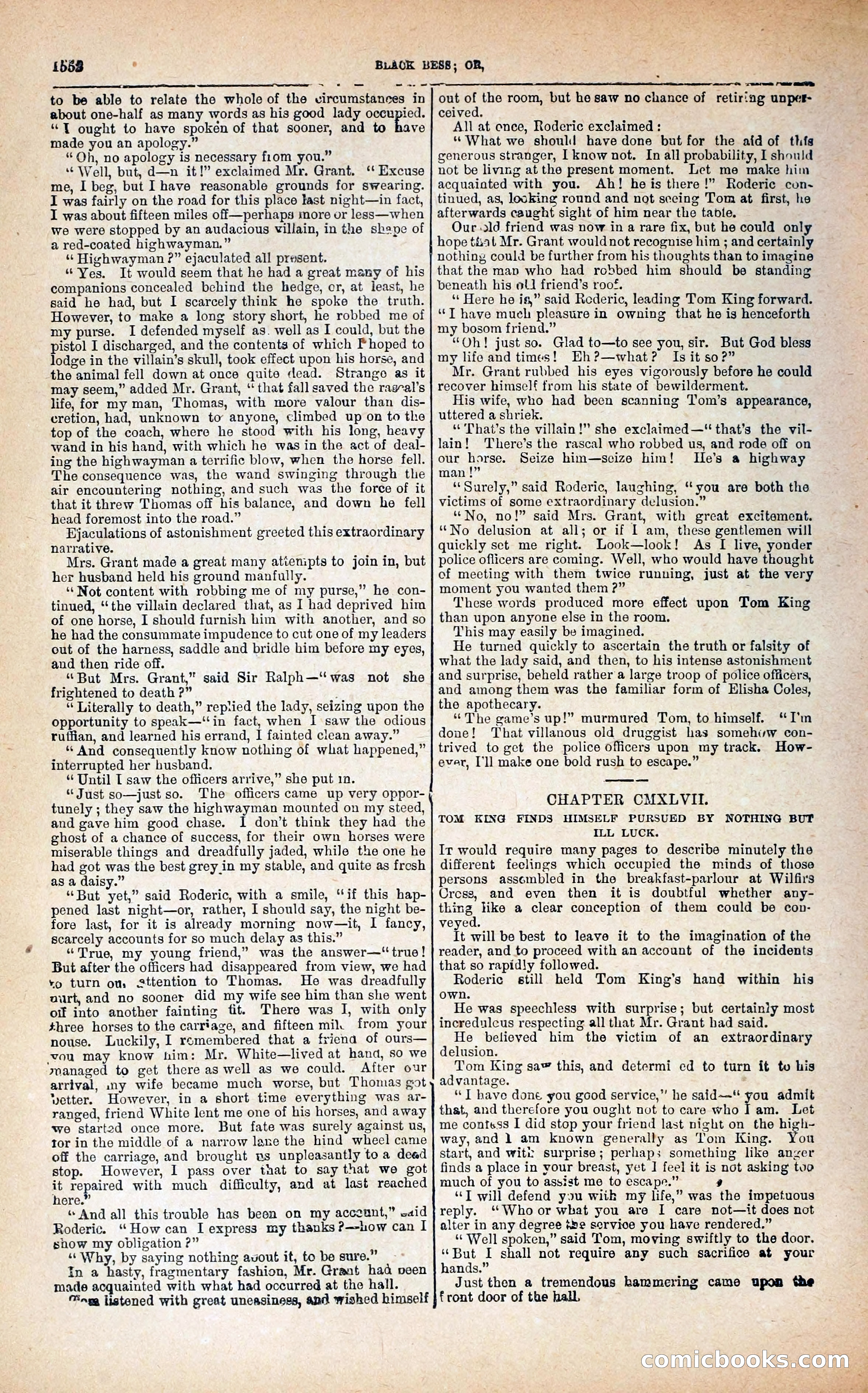
A restored page from Penny Dreadfuls, 1866. Page through the whole issue in the reader above.
📄 Transcribed text from this page (OCR, searchable)
Machine-transcribed from the original scan — historical spelling and the odd misread are preserved.
£653 > to be able to relate the whole of the vircumstances in about one-half as many words as his good lady opepiet “T ought to have spoken of that sooner, and to have made you an apology.” “Oh, no apology is necessary from you.” ‘Well, but, d—n it!” exclaimed Mr. Grant. ‘' Excuse me, I beg, but I have reasonable grounds for swearing. I was fairly on the road for this place last night—in fact, I was about fifteen miles off—perhaps more or less—when we were stopped by an audacious villain, in the shape of a red-coated highwayman.” “ Hishwayman ?” ejaculated all present. ‘Yes. It would seem that he had a great many of his companions concealed behind the hedge, cr, at least, he said he had, but I scarcely think he spoke the truth. However, to make a long story short, he robbed me of my purse. I defended myself as. well as I could, but the pistol I discharged, and the contents of which Phoped to lodge in the villain’s skull, took effect upon his horse, and the animal fell down at once quite dead. Strange as it may seem,” added Mr. Grant, ‘“ that fall saved the ragval’s life, for my man, Thomas, with more valour than dis- cretion, had, unknown to anyone, climbed up on to the top of the coach, where he stood with his long, heavy wand in his hand, with which he was in the act of deal- ing the highwayman a terrific blow, when the horse fell. The consequence was, the wand swinging through the air encountering nothing, and such was the force of it that it threw Thomas off his balance, and down he fell head foremost into the road.” Ejaculations of astonishment greeted this extraordinary narrative. Mrs. Grant made a great many attempts to join in, but her husband held his ground manfully. ‘Not content with robbing me of my purse,” he con- tinued, “the villain declared that, as I had deprived him of one horse, I should furnish him with another, and so he had the consummate impudence to cut one of my leaders out of the harness, saddle and bridle him before my eyes, and then ride off. “But Mrs. Grant,” said Sir Ralph—‘‘was not she frightened to death ?” “ Literally to death,” reptied the lady, seizing upon the opportunity to speak—‘‘in fact, when I saw the odious ruffian, and learned his errand, | fainted clean away.” ‘ And consequently know nothing of what happened,” interrupted her husband. ‘¢ Until IT saw the officers arrive,” she put 1n. “Just so—just so. The officers came up very oppor- tunely ; they saw the highwayman mounted on my steed, and gave him good chase. I don’t think they had the ghost of a chance of success, for their own horses were miserable things and dreadfully jaded, while the one he had got was the best grey in my stable, and quite as fresh as a daisy.” ‘But yet,” said Roderic, with a smile, “if this hap- pened last night—or, rather, I should say, the night be- fore last, for it is already morning now—it, I fancy, scarcely accounts for so much delay as this.” “True, my young friend,” was the answer—“ true! But after the officers had disappeared from view, we had vo turn ow. Sttention to Thomas. He was dreadfully aurt, and no sooner did my wife see him than she went oif into another fainting tit. There was J, with only three horses to the carriage, and fifteen mik from your nouse. Luckily, I remembered that a friend of ours— vou may know him: Mr. White—lived at hand, so we managed to get there as well as we could. After our arrival, ny wife became much worse, but Thomas got wetter. However, in a short time everything was ar- ranged, friend White lent me one of his horses, and away we started once more. But fate was surely against us, tor in the middle of a narrow lane the hind wheel came off the carriage, and brought us unpleasantly to a dead stop. However, I pass over tnat to say that we got it repaired with much difficulty, and at last reached here.” “And all this trouble has beon on my acc2ant,” waid Roderic. “How can I express my thanks ?—-how can | show my obligation ?” ‘Why, by saying nothing avout it, to be sure.” In a hasty, fragmentary fashion, Mr. Grant had veen made acquainted with what had occurred at the hall. nea listened with great uneasiness, and wished himself BLACK BESS; OR, ) | fat. - eae Nene Gee out ur the room, but he saw no chance of retir:ng unper- ceived. All at once, Roderic exclaimed : ‘What we shoul! have done but for the aid of thfs generous stranger, [ know not. In all probability, I should not be living at the present moment. Let me make him acquainted with you. Ah! hets there!” Roderic con-~ tinued, as, looking round and not seeing Tom at first, he afterwards caught sight of him near the table. Our ..ld friend was now in a rare fix, but he could only hope that Mr. Grant would not recognise him ; and certainly nothing could be further from his thoughts than to imagine that the man who had robbed him should be standing beneath his ol] friend’s roof. ‘“‘ Here he is,” said Rederic, leading Tom King forward. ‘‘T have much pleasure in owning that he is henceforth my bosom friend.” “Oh! just so. Glad to—to see you, sir. But God bless my life and times! Eh?—what? Is itso?” Mr. Grant rubbed his eyes vigorously before he could recover himself from his state of bewilderment. His wife, who had been scanning Tom’s appearance, uttered a shriek. “That’s the villain!” she exclaimed—“ that’s the vil- lain! There’s the rascal who robbed us, and rode off on our BSE Seize him—scize him! We’s a highway man !” “Surely,” said Roderic, laughing, “you are both the victims of some extraordinary delusion.” “No, no!” said Mrs. Grant, with great excitement. “No delusion at all; or if I am, these gentlemen will quickly set me right. Look—look! As I live, yonder police oflicers are coming. Well, who would have thought of meeting with them twice running, just at the very moment you wanted them ?” These words produced more effect upon Tom King than upon anyone else in the room. This may easily be imagined. He turned quickly to ascertain the truth or falsity of what the lady said, and then, to his intense astonishment and surprise, beheld rather’a large troop of police officers, and among them was the familiar form of Elisha Coles, the apothecary. ‘The game’s up!” murmured Tom, to himself. ‘I’m done! That villanous old druggist has somehvw con- trived to get the police officers upon my track. How- ever, I'll make one bold rush to escape.” CHAPTER CMXLVII. TOM KING FINDS HIMSELF PURSUED BY ILL LUCK. Ir would require many pages to describe minutely the different feelings which occupied the minds of those persons ass6mbled in the breakfast-parlour at Wilfirs Cress, and even then it is doubtful whether any- thing like a clear conception of them could be con- veyed. It will be best to leave it to the imagination of the reader, and to proceed with an account of the incidents that so rapidly followed. Roderic still held Tom King’s hand within his own. He was speechless with surprise; but certainiy most incredulcus respecting all that Mr. Grant had said. He believed him the victim of an extraordinary delusion. Tom King sa this, and determi ed to turn it to his advantage. ) “JT have done you good service,” he said~~"' you admit that, and therefore you ought not to care who Iam. Let me contfsss I did stop your friend last night on the high- way, and 1 am known generally as Tom King. You start, and witz surprise; perhaps; something like anger finds a place in vour breast, yet I feel it is not asking tuo much of you to assist me to escape.” ’ “T will defend you wiih my life,” was the impetuous reply. ‘‘Who or what you are I care not—it does not alter in any degree tre service you have rendered.” ‘‘ Well spoken,” said Tom, moving swiftly to the door. “But I shall not require any such sacrifice at your hands,” Just then a tremendous hammering came upon the front door of the hall, NOTHING BUT (e(o) ,OO cS (E(@)