
Penny Dreadfuls, 1866 · page 194 of 395
Black Bess; or, the Knight of the Road — page 194: what you’re looking at
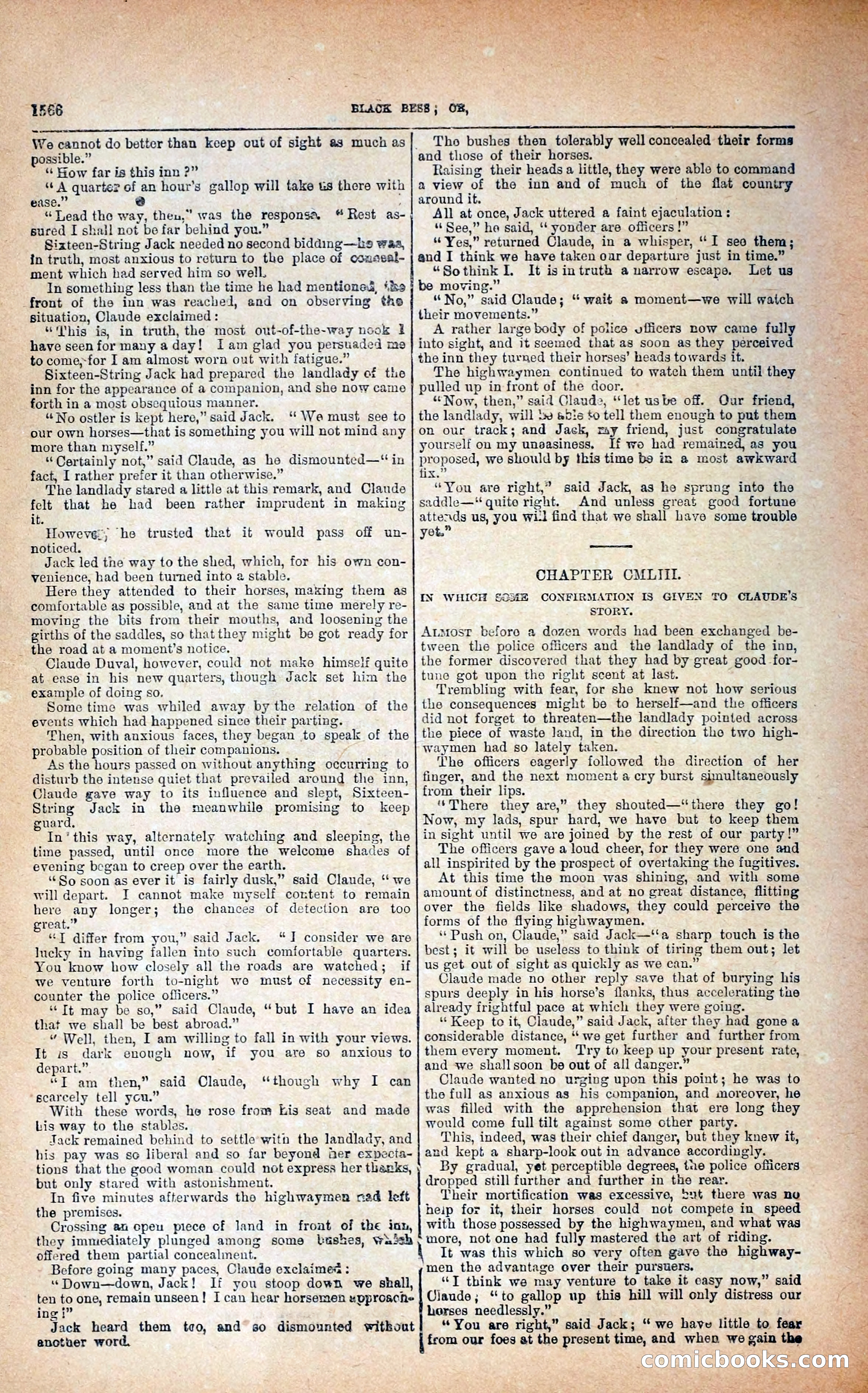
A restored page from Penny Dreadfuls, 1866. Page through the whole issue in the reader above.
📄 Transcribed text from this page (OCR, searchable)
Machine-transcribed from the original scan — historical spelling and the odd misread are preserved.
Ey i | TBE Los SRE Ga SR eI A REUSE abe 2 sl RP We cannot do better than keep out of sight as much as]. possible.” “ ow far is this inn ?” “A quarter of an hour’s gallop will take us there with ease.” & | * Tead the way, then,” was the responsa, sured I shail not be far behind you.” Sixteen-String Jack needed no second bidding—k» waa, in truth, most anxious to return to the place of cousssal- ment which had served him so well. In something less than the time he had mentioned, ‘tks front of the inn was reached, and on observing ths situation, Claude exclaimed : “This is, in truth, the most out-of-the-way nook 1 have seen for many a day! Iam glad you persuaded me to come>for I am almost wora out with fatigue.” Sixteen-String Jack had prepared the landlady of the inn for the appearance of a companion, and she now came forth in a most obsequious manner. “No ostler is kept here,” said Jack. ‘“ We must see to our own horses—that is something you will not mind any more than myself.” “Certainly not,” said Claude, as he dismounted—“ in fact, I rather prefer it than otherwise.” The landlady stared a little at this remark, and Claude felt that he had been rather imprudent in making it. Howevez; he trusted that it would pass off un- noticed. Jack led the way to the shed, which, for his own con- venience, had been turned into a stable. Here they attended to their horses, making them as comfortable as possible, and at the same time merely re- moving the bits from their mouths, and loosening the girths of the saddles, so thatthey might be got ready for the road at a moment’s notice. Claude Duval, however, could not make himself quite at ease in his new quarters, though Jack set him the example of doing so, Some time was whiled away by the relation of the events which had happened since their parting. Then, with anxious faces, they began to speak of the probable position of their companions. As the hours passed on without anything occurring to disturb the intense quiet that prevailed around the inn, Claude gave way to its influence and slept, Sixteen- String Jack in the meanwhile promising to keep uard, In’this way, alternately watching and sleeping, the time passed, until once more the welcome shades of evening began to creep over the earth. ‘So soon as ever it is fairly dusk,” said Claude, ‘ we will depart. I cannot make myself content to remain here any longer; the chances of detection are too great.” “1 differ from you,” said Jack. “J consider we are lucky in having fallen into such comiortable quarters. You know how closely all the roads are watched; if we venture forth to-night we must cf necessity en- counter the police officers.” “It may be so,” said Claude, “but I have an idea that we shall be best abroad.” “ Well, then, I am willing to fall in with your views. It is dark enough now, if you are so anxious to depart.” “T am then,” said Claude, ‘scarcely tell you.” With these words, he rose from his seat and made Lis way to the stables. . Tack remained behind to settle with the landlady, and his pay was sco liberal and so far beyond ber expecta- * Rest as- “thouch why I can tions that the good woman could not express her thanks, » but only stared with astonishment. In five minutes afterwards the highwaymen rad left the premises. Crossing an cpeu piece of land in front of the inn, they immediately plunged among some btshes, Walch offered them partial concealment. Before going many paces, Claude exclaimes : “ Dowu—down, Jack! If you stoop down we shall, ten to one, remain unseen! I can hear horsemen upprosche ing }” Jack heard them tco, and so dismounted witkout anotuer word. BLACK BESS; 6%, ‘Canis, Tho bushes then tolerably well concealed their forms and those of their horses. 5S er Raising their heads a little, they were able to command their movements.” A rather large body of police officers now came fully | into sight, and it seemed that as soon as they perceived aoe the inn they turned their horses’ heads towards it. The highwaymen continued to watch them until they a view of the inn and of much of the flat country Sar around it. , . isan) All at once, Jack uttered a faint ejaculation ; ose “‘ See,” he said, “‘ yonder are officers !” SoS “Yes,” returned Claude, in a whisper, “I see them; gaat and I think we have taken our departure just in time.” b Eat ae “Sothink I. It is intruth a uarrow escape. Let us eS he be moving.” * ak “No,” said Claude; “ wait a moment—we will watch pulled up in front of the door. +f its “Now, then,” said Claude, “let usbe off. Qur friend, Sars the landlady, will be &bis to tell them enough to put them Xe on our track; and Jack, ray friend, just congratulate vr yourself on my uneasiness. If wo had remained, as you > proposed, we should by this time bo in a most awkward 3 x. “You are right,” said Jack, as he sprung into the ‘ saddle—* quite right. And unless great good fortune +e attends us, you wil find that we shall have some trouble EPA. ne yot. ae CHAPTER CMLIIL. - IN WHICH £0312 CONFIRMATION IS GIVEN TO CLAUDE’S STORY. Atmost before a dozen words had been exchanged be- tween the police officers and the landlady of the inn, the former discovered that they had by great good for- tune got upon the right scent at last. Trembling with fear, for she knew not how serious ee the consequences might be to herself—and the officers . = did not forget to threaten—the landlady pointed across | the piece of waste Jand, in the direction the two high- waymen had so lately taken. The officers eagerly followed the direction of her finger, and the next moment a cry burst simultaneously from their lips. ‘‘There they are,” they shouted—“tnere they go! Now, my lads, spur hard, we have but to keep them in sight until we are joined by the rest of our party!” The officers gave a loud cheer, for they were one and all inspirited by the prospect of overtaking the fugitives. At this time the moon was shining, and with some amount of distinctness, and at no great distance, flitting over the fields like shadows, they could perceive the forms of the flying highwaymen. ‘“ Push on, Claude,” said Jack—‘‘a sharp touch is the best; it will be useless to think of tiring them out; let us get out of sight as quickly as we can.” Claude made no other reply save that of burying his spurs deeply in his horse’s flanks, thus accelerating the already frightful pace at which they were going. “Keep to it, Claude,” said Jack, after they had gone a considerable distance, “we get further and further from them every moment. Try to keep up your present rate, and we shallsoon be out of all danger.” Claude wanted no urging upon this point; he was to 4 the full as anxious as his companion, and moreover, he om was filled with the apprehension that ere long they would come full tilt against some other party. ¥ This, indeed, was their chief danger, but they knew it, a and kept a sharp-look out in advance accordingly. i rr, By gradual, yet perceptible degrees, tne police officers ; dropped still further and further in the rear. > Their mortification was excessive, but there was ne * heip for it, their horses could not compete in speed og with those possessed by the highwaymen, and what was tm more, not one had fully mastered the art of riding. = It was this which so very often gave the highway- rT men the advantage over their pursuers. ae ‘“T think we may venture to take it easy now,” said gs Claude; “to gallop up this hill will only distress our eee horses needlessly.” paisa “You are right,” said Jack; “ we have little to fear from our foes at the present time, and when we gain the oO me” | é ~* ~ : i> *S a, ow een oS Pe a