
Penny Dreadfuls, 1866 · page 235 of 395
Black Bess; or, the Knight of the Road — page 235: what you’re looking at
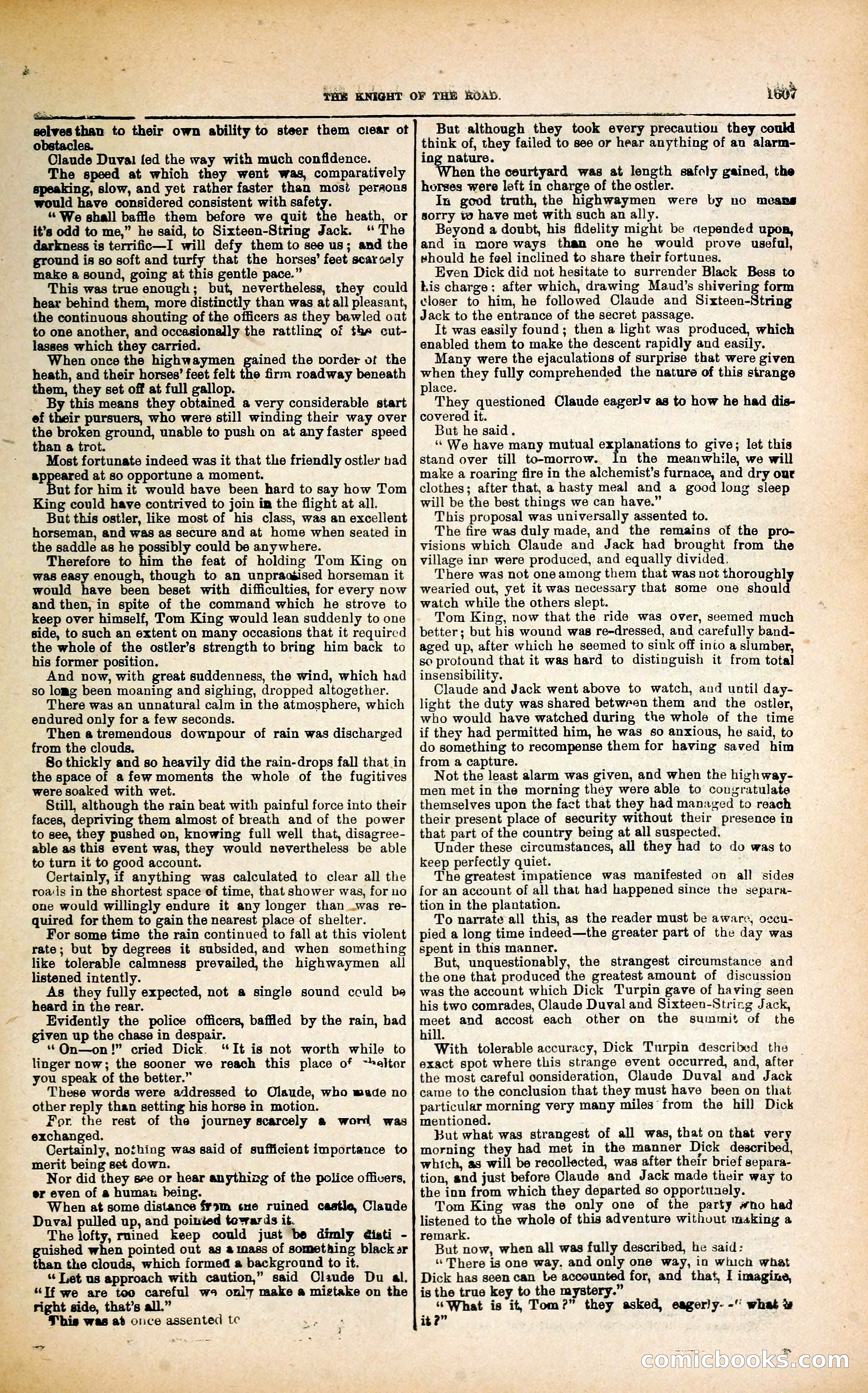
A restored page from Penny Dreadfuls, 1866. Page through the whole issue in the reader above.
📄 Transcribed text from this page (OCR, searchable)
Machine-transcribed from the original scan — historical spelling and the odd misread are preserved.
THe KNIGHT OF THE KOAD. oo selves than to their own ability to steer them clear of obstacles. Claude Duval fed the way with much confidence. The speed at which they went was, comparatively speaking, slow, and yet rather faster than most peraons would have considered consistent with safety. ‘We shall baffle them before we quit the heath, or it’s odd to me,” he said, to Sixteen-String Jack. ‘The darkness is terrific—I will defy them to see us; and the ground is so soft and turfy that the horses’ feet scarcely make a sound, going at this gentle pace.” This was true enough; but, nevertheless, they could hear behind them, more distinctly than was at all pleasant, the continuous shouting of the officers as they bawled oat to one another, and occasionally the rattling of t4a cut- lasses which they carried. When once the highwaymen heath, and their horses’ feet felt them, they set off at full gallop. _ By this means they obtained a very considerable start ef their pursuers, who were still winding their way over the broken ground, unable to push on at any faster speed than a trot. Most fortunate indeed was it that the friendly ostler bad appeared at so opportune a moment. ut for him it would have been hard to say how Tom King could have contrived to join im the flight at all. But this ostler, like most of his class, was an excellent horseman, and was as secure and at home when seated in the saddle as he possibly could be anywhere. Therefore to him the feat of holding Tom King on was easy enough, though to an unpraasised horseman it would have been beset with difficulties, for every now and then, in spite of the command which he strove to keep over himself, Tom King would lean suddenly to one side, to such an extent on many occasions that it requircd the whole of the ostler’s strength to bring him back to his former position. And now, with great suddenness, the wind, which had so lomg been moaning and sighing, dropped altogether. There was an unnatural calm in the atmosphere, which endured only for a few seconds. Then atremendous downpour of rain was discharged from the clouds. So thickly and so heavily did the rain-drops fall that in the space of a few moments the whole of the fugitives were soaked with wet. Still, although the rain beat with painful force into their faces, depriving them almost of breath and of the power to see, they pushed on, knowing full well that, disagree- able as this event was, they would nevertheless be able to turn it to good account. Certainly, if anything was calculated to clear all the roads in the shortest space of time, that shower was, for no one would willingly endure it any longer than was re- quired for them to gain the nearest place of shelter. For some time the rain continued to fall at this violent rate; but by degrees it subsided, and when something like tolerable calmness prevailed, the highwaymen all listened intently. As they fully expected, not a single sound cculd be heard in the rear. Evidently the police officers, baffled by the rain, bad given up the chase in despair. “ Qn—on!” cried Dick. “It is not worth while to linger now; the sooner we reach this place of ~elter you speak of the better.” These words were addressed to Olaude, who made no other reply than setting his horse in motion. For the rest of the journey scarcely a word was exchanged. Certainly, nothing was said of sufficient importance to merit being set down. Nor did they see or hear anythirg of the police offivers, er even of a human being. When at some distance from tne ruined castle, Claude Duval pulled up, and peinted torrards it. The lofty, ruined keep could just be dimly disti - guished when pointed out as a1ass of something black ar than the clouds, which formed a background to it. “Tet us approach with caution,” said Claude Du al. “If we are too careful we only make a mistake on the right side, that’s all.” This was ab once assented tc ained the pvorder of the e firm roadway beneath But although they took every precaution they could think of, they failed to see or hear anything of an alarm- ing nature. en the courtyard was at length safely geined, the horses were left in charge of the ostler. In good truth, the highwaymen were by no means sorry to have met with such an ally. Beyond a doubt, his fidelity might be depended upon, and in more ways than one he would prove useful, thould he feel inclined to share their fortunes. Even Dick did not hesitate to surrender Black Bess to his charge: after which, drawing Maud’s shivering form closer to him, he followed Claude and Sixtesu-Stride Jack to the entrance of the secret passage. It was easily found; then a light was produced, which enabled them to make the descent rapidly and easily. Many were the ejaculations of surprise that were given when they fully comprehended the nature of this strange place. They questioned Claude eager]v as to how he had dis- covered it. But he said. ‘‘We have many mutual explanations to give; let this stand over till to-morrow. In the meanwhile, we will make a roaring fire in the alchemist’s furnace, and dry out clothes; after that, a hasty meal and a good long sleep will be the best things we can have.” This proposal was universally assented to. The fire was duly made, and the remains of the pro- visions which Claude and Jack had brought from the village inn were produced, and equally divided. There was not one among them that was not thoroughly wearied out, yet it was necessary that some one should watch while the others slept. Tom King, now that the ride was over, seemed much better; but his wound was re-dressed, and carefully band- aged up, after which he seemed to sink off into a slumber, so protound that it was hard to distinguish it from total insensibility. Claude and Jack went above to watch, and until day- light the duty was shared betwren them and the ostler, who would have watched during the whole of the time if they had permitted him, he was so anxious, he said, to do something to recompense them for having saved him from a capture. Not the least alarm was given, and when the highway- men met in the morning they were able to congratulate themselves upon the fact that they had managed to reach their present place of security without their presence in that part of the country being at all suspected. Under these circumstances, all they had to do was to Keep perfectly quiet. The greatest impatience was manifested on all sides for an account of all that had happened since the separa- tion in the plantation. To narrate all this, as the reader must be aware, oscu- pied a long time indeed—the greater part of the day was spent in this manner. 3 | But, unquestionably, the strangest circumstance and the one that produced the greatest amount of discussion was the account which Dick Turpin gave of having seen his two comrades, Claude Duval and Sixteen-Strizg Jack, meet and accost each other on the summit of the hill. With tolerable accuracy, Dick Turpin described the exact spot where this strange event occurred, and, after — the most careful consideration, Claude Duval and Jack came to the conclusion that they must have been on that particular morning very many miles from the hill Dick mentioned. But what was strangest of all was, that on that very morning they had met in the manner Dick described, which, as will be recollected, was after their brief separa- tion, and just before Claude and Jack made their way to the inn from which they departed so opportunely. Tom King was the only one of the party who had listened to the whole of this adventure without making a remark. But now, when all was fully described, he said: “There is one way. and only one way, in which what Dick has seen can be accounted for, and that, I imagine, is the true key to the mystery.” ‘What is it, Tom?” they asked, eagerly--" what ¥ it 2” | Si GoOmicvoo C) (E(@)