
Penny Dreadfuls, 1866 · page 48 of 395
Black Bess; or, the Knight of the Road — page 48: what you’re looking at
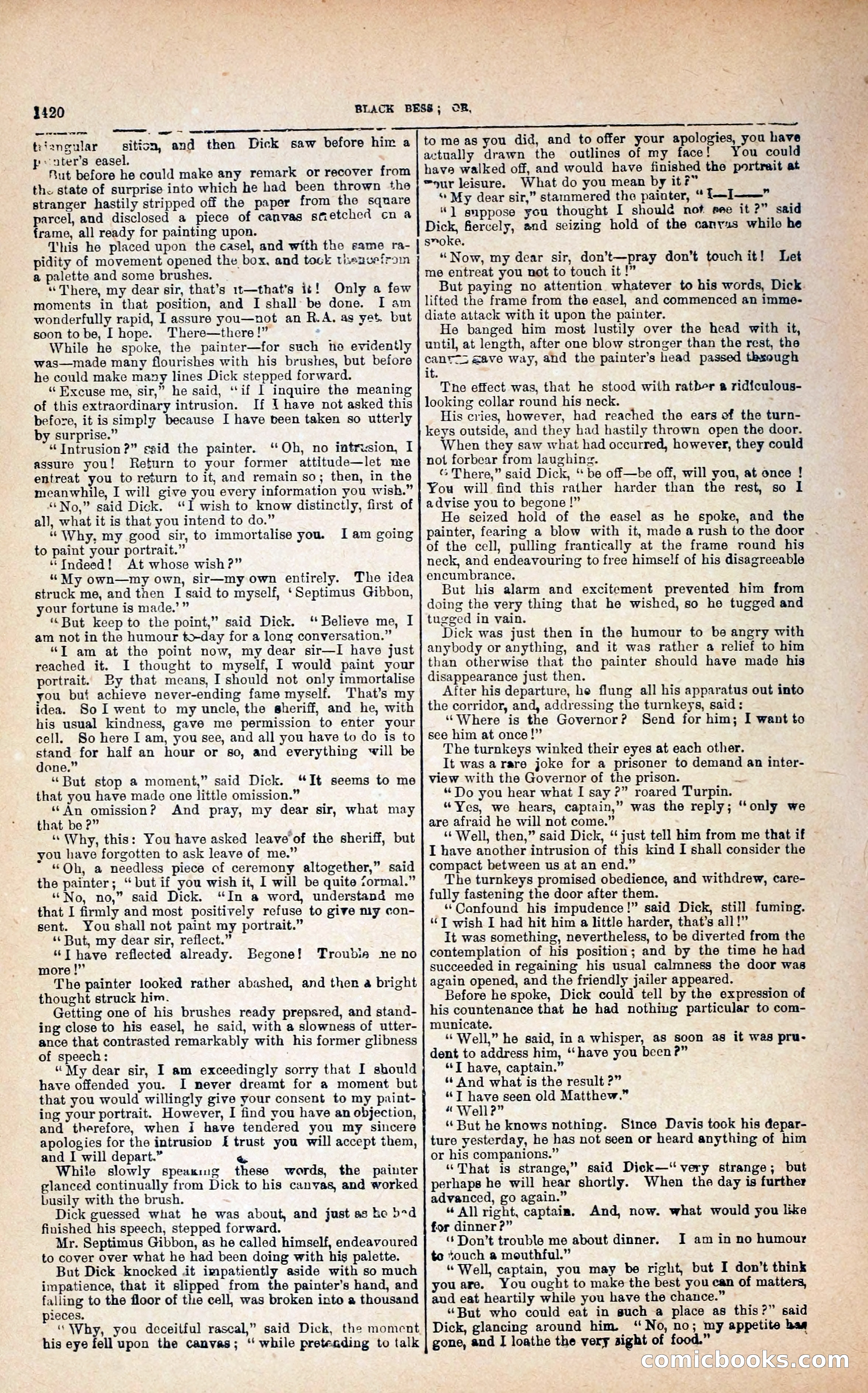
A restored page from Penny Dreadfuls, 1866. Page through the whole issue in the reader above.
📄 Transcribed text from this page (OCR, searchable)
Machine-transcribed from the original scan — historical spelling and the odd misread are preserved.
—_— triengular sition, and then Dick saw before him a pater’s easel. Rut before he could make any remark or recover from th. state of surprise into which he had been thrown the stranger hastily stripped off the paper from the square parcel, and disclosed a piece of canvas sfetched cna frame, all ready for painting upon. This he placed upon the easel, and with the eame ra- | pidity of movement opened the box, and tock tixezvefrom a palette and some brushes. “There, my dear sir, that’s 1t—that’s it! Only a few moments in that position, and I shall be done. I am wonderfully rapid, I assure you—not an R.A. as yet. but soon to be, I hope. There—there!” While he spoke, the painter—for such ho evidently was—made many flourishes with his brushes, but before he could make many lines Dick stepped forward. “ Excuse me, sir,” he said, “if 1 inquire the meaning of this extraordinary intrusion. If 1 have not asked this before, it is simply because I have been taken so utterly by surprise.” “Intrusion?” caid the painter. ‘Oh, no intrusion, I assure you! Return to your former attitude—let me entreat you to return to it, and remain so; then, in the meanwhile, I will give you every information you wish.” “No,” said Dick. “I wish to know distinctly, first of all, what it is that you intend to do.” “ Why. my good sir, to immortalise you. I am going to paint your portrait.” ‘Indeed! At whose wish ?” “ My own—my own, sir—my own entirely. The idea struck me, and then I said to myself, ‘Septimus Gibbon, your fortune is made.’” “But keep to the point,” said Dick. ‘Believe me, I am not in the humour t>day for a long conversation.” “T am at the point now, my dear sir—I have just reached it. I thought to myself, I would paint your portrait. By that means, I should not only immortalise you but achieve never-ending fame myself. That’s my idea. So I went to my uncle, the sheriff, and he, with his usual kindness, gave me permission to enter your cell. So here I am, you see, and all you have to do is to stand for half an hour or so, and everything will be done.” “But stop a moment,” said Dick. “It seems to me that you have made one little omission.” “An omission? And pray, my dear sir, what may that be ?” “Why, this: You have asked leave of the sheriff, but you have forgotten to ask leave of me.” “Oh, a needless piece of ceremony altogether,” said the painter; “but if you wish it, I will be quite sormal.” ‘No, no,” said Dick. “In a word, understand me that I firmly and most positively refuse to give my con- sent. You shall not paint my portrait.” ‘‘ But, my dear sir, reflect.” “JT have reflected already. Begone! more !”’ The painter looked rather abashed, and then a bright thought struck him. Getting one of his brushes ready prepsred, and stand- ing close to his easel, he said, with a slowness of utter- ance that contrasted remarkably with his former glibness of speech: “My dear sir, I am exceedingly sorry that I should have offended you. I never dreamt for a moment but that you would willingly give your consent to my paint- ing your portrait. However, I find you have an objection, and therefore, when I have tendered you my sincere apologies for the intrusion i trust you will accept them, and I will depart.” < While slowly speaxing these words, the painter glanced continually from Dick to his canvas, and worked busily with the brush. Dick guessed what he was about, and just as ke b-d finished his speech, stepped forward. Mr. Septimus Gibbon, as he called himself, endeavoured to cover over what he had been doing with his palette. But Dick knocked it impatiently aside with so much impatience, that it slipped from the painter’s hand, and falling to the floor of tle cell, was broken into a thousand reces. : ‘Why, you deceitful rascal,” said Dick, the moment his eye fell upon the canvas; ‘‘ while pretending to talk Troubia ne no BLACK BESS; O8, to me as you did, and to offer your apologies, you have actually drawn the outlines of my face! You could have walked off, and would have finished the portrait at =nur leisure. What do you mean by it?” ‘My dear sir,” stammered the painter, “ {—I——” “] suppose you thought I should not see it ?” said Dick, fercely, and seizing hold of the canvus whilo he s™oke. “Now, my dear sir, don’t—pray don’t touch it! Let me entreat you not to touch it !” 7 But paying no attention whatever to his words, Dick. lifted the frame from the easel, and commenced an imme- diate attack with it upon the painter. He banged him most lustily over the head with it, until, at length, after one blow stronger than the rest, the cant—s <ave way, and the painter’s head passed thxough it. The effect was, that he stood with ratber a ridiculous- looking collar round his neck. His cries, however, had reached the ears of the turn- keys outside, and they had hastily thrown open the door. When they saw what had occurred, however, they could not forbear from laughing. © There,” said Dick, ‘ be off—be off, will you, at once ! You will find this rather harder than the rest, so lL advise you to begone !” He seized hold of the easel as he spoke, and the painter, fearing a blow with it, made a rush to the door . of the cell, pulling frantically at the frame round his neck, and endeavouring to free himself of his disagreeable encumbrance. But his alarm and excitement prevented him from doing the very thing that he wished, so he tugged and tugged in vain. Dick was just then in the humour to be angry with anybody or anything, and it was rather a relief to him than otherwise that the painter should have made his disappearance just then. After his departure, he flung all his apparatus out into the corridor, and, addressing the turnkeys, said: ‘‘Where is the Governor? Send for him; I want to see him at once!” The turnkeys winked their eyes at each other. It was arare joke for a prisoner to demand an inter- view with the Governor of the prison. =. “Do you hear what I say ?” roared Turpin. “Yes, we hears, captain,” was the reply; “only we are afraid he will not come.” ‘‘ Well, then,” said Dick, “just tell him from me that if I have another intrusion of this kind I shall consider the compact between us at an end.” The turnkeys promised obedience, and withdrew, care- fully fastening the door after them. ‘‘Confound his impudence!” said Dick, still fuming. “‘T wish I had hit him a little harder, that’s all!” It was something, nevertheless, to be diverted from the contemplation of his position; and by the time he had succeeded in regaining his usual calmness the door was again opened, and the friendly jailer appeared. Before he spoke, Dick could tell by the expression of his countenance that he had nothiug particular to com- municate. ‘‘ Well,” he said, in a whisper, as soon as it was pru- dent to address him, “‘have you been ?” “T have, captain.” “‘ And what is the result ?” “T have seen old Matthew.” “ Well?” “ But he knows nothing. Since Davis took his depar- ture yesterday, he has not seen or heard anything of him or his companions.” “ “That is strange,” said Dick—‘ very strange; but perhaps he will hear shortly. When the day is further advanced, go again.” “ All right, captais. And, now. what would you like for dinner ?” ‘Don’t trouble me about dinner. to ‘ouch a mouthful.” “ Well, captain, you may be right, but I don’t think youare. You ought to make the best you can of matters, aud eat heartily while you have the chance.” “But who could eat in such a place as this?” said Dick, glancing around him. ‘No, no; my appetite haa gone, and J loathe the very aight of food.” I am in no humour Eomicboo <SiiG (0)