
Penny Dreadfuls, 1866 · page 354 of 395
Black Bess; or, the Knight of the Road — page 354: what you’re looking at
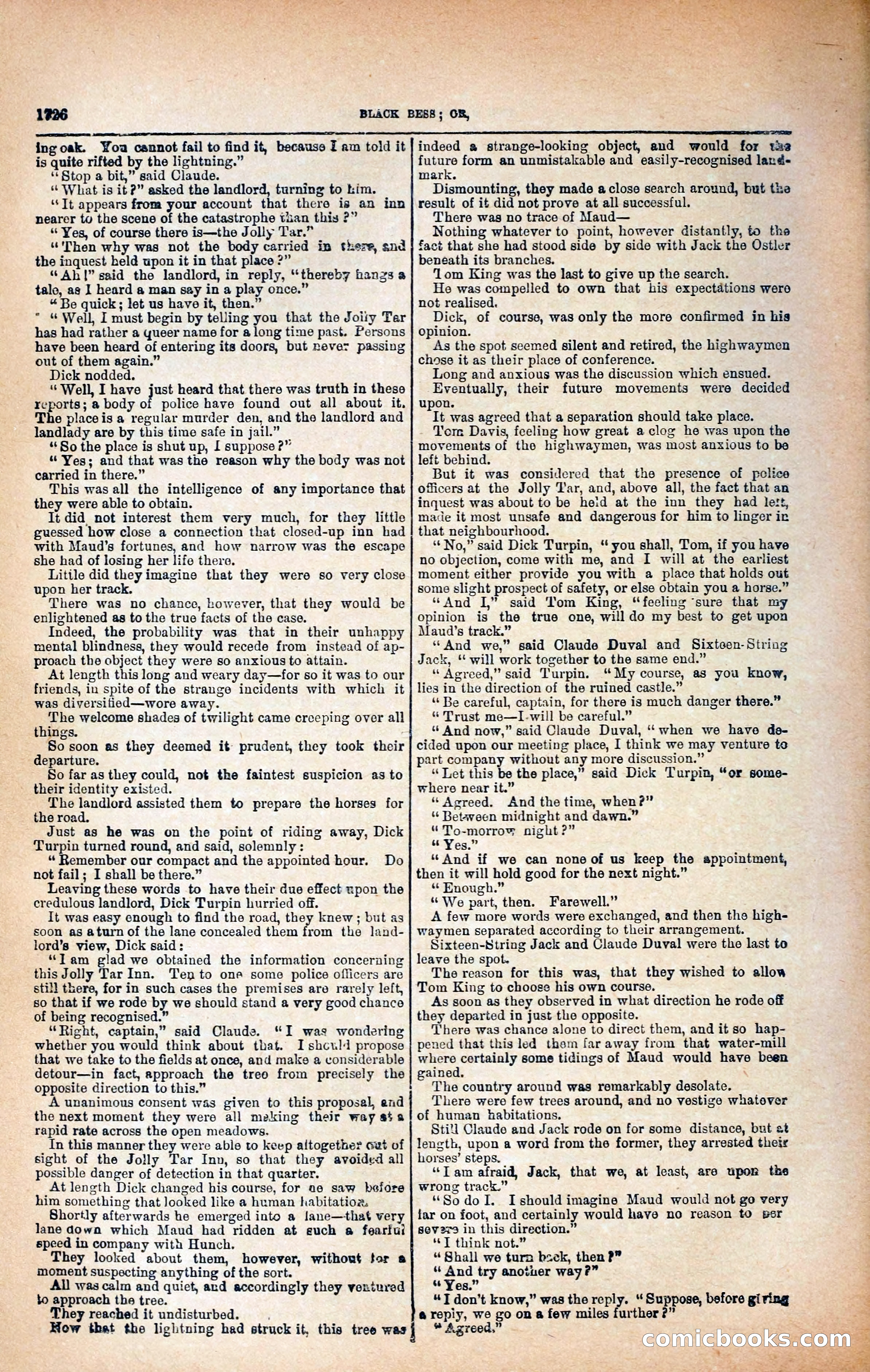
A restored page from Penny Dreadfuls, 1866. Page through the whole issue in the reader above.
📄 Transcribed text from this page (OCR, searchable)
Machine-transcribed from the original scan — historical spelling and the odd misread are preserved.
1726 BLACK BESS; O8, ing oak. Yoa cannot fail to find it, because I am told it is quite rifted by the lightning.” ‘Stop a bit,” said Claude. “ What is it?” asked the landlord, turning to kim. ‘‘Tt appears from your account that there is an inn nearer to the scene of the catastrophe tian this ?” “Yes, of course there is—the Jolly Tar.” “'Then why was not the body carried in there, snd the inquest held upon it in that place ?” “Ah!” said the landlord, in reply, “thereby hangs a tale, as | heard a man say in a play once.” “ Be quick; let us have it, then.” “ “ Well, I must begin by telling you that the Joliy Tar has had rather a queer name for a long time past. Persons have been heard of entering its doors, but Revez passing out of them again.” Dick nodded. “ Well, I have put heard that there was truth in these reports; a body of police have found out all about it. The placeis a regular murder den, and the landlord and landlady are by this time safe in jail.” ‘So the place is shut up, I suppose ?” “Yes; and that was the reason why the body was not carried in there.” This was all the intelligence of any importance that they were able to obtain. It did not interest them very much, for they little guessed how close a connection that closed-up inn had with Maud’s fortunes, and how narrow was the escape she had of losing her life there. Litile did they imagine that they were so very close upon her track. There was no chance, however, that they would be enlightened as to the true facts of the case. Indeed, the probability was that in their unhappy mental blindness, they would recede from instead of ap- proach the object they were so anxious to attain. At length this long and weary day—for so it was to our friends, in spite of the strange incidents with which it was diversified—wore away. ae welcome shades of twilight came creeping over all things. So soon as they deemed it prudent, they took their departure. So far as they could, not the faintest suspicion as to _ their identity existed. The landlord assisted them to prepare the horses for the road. Just as he was on the point of riding away, Dick Turpin turned round, and said, solemnly: “Remember our compact and the appointed hour. Do not fail; I shall be there.” Leaving these words to have their due effect npon the credulous landlord, Dick Turpin hurried off. It was easy enough to find the road, they knew; but as soon as aturn of the lane concealed them from the land- lord’s view, Dick said: “Tam glad we obtained the information conceraing this Jolly Tar Inn. Tento one some police officers are still there, for in such cases the premises are rarely left, so that if we rode by we should stand a very good chance of being recognised.” “Right, captain,” said Claude. “I was wondering whether you would think about that. I shculd propose that we take to the fields at once, and make a considerable detour—in fact, approach the tree from precisely the opposite direction to this.” A unanimous consent was given to this proposal, end the next moment they were all making their way sta rapid rate across the open meadows. In this manner they were able to keep altogether out of sight of the Jo!ly Tar Inn, so that they avoided all possible danger of detection in that quarter. At length Dick changed his course, for o¢6 saw belore him something that looked like a human habitatioa. Shortly afterwards he emerged into a lane—that very Jane down which Maud had ridden at euch a fearful speed in company with Hunch. They looked about them, however, withort tor s moment suspecting anything of the sort. All was calm and quiet, and accordingly they vexiured to approach the tree. They reached it undisturbed. How that the lightning had struck it, this tree was | indeed a strange-looking object, and would for t&e future form an unmistakable and easily-recognised land- mark. Dismounting, they made aclose search around, but the result of it did not prove at all successful. There was no trace of Maud— Nothing whatever to point, however distantly, to the fact that she had stood side by side with Jack the Ostler beneath its branches. ‘om King was the last to give up the search. He was compelled to own that his expectations were not realised. Dick, of course, was only the more confirmed in his Opinion. As the spot seemed silent and retired, the highwaymen chose it as their place of conference. Long and anxious was the discussion which ensued. Eventually, their future movements were decided upon. It was agreed that a separation should take place. Tom Davis, feeling how great a clog he was upon the movements of the highwaymen, was most anxious to be left behind. But it was considered that the presence of police officers at the Jolly Tar, and, above all, the fact that an inquest was about to be heid at the inn they had lett, made it most unsafe and dangerous for him to linger ir that neighbourhood. “No,” said Dick Turpin, “ you shall, Tom, if you have no objection, come with me, and I will at the earliest moment either provide you with a place that holds out some slight prospect of safety, or else obtain you a horse.” “And I,” said Tom King, “feeling ‘sure that my opinion is the true one, will do my best to get upon Maud’s track.” “And we,” said Claude Duval and Sixteen-String Jack, “ will work together to the same end.” “ Acreed,” said Turpin. “My course, as you Know, lies in the direction of the ruined castle.” ‘Be careful, captain, for there is much danger there.” “ Trust me—I-will be careful.” “ And now,” said Claude Duval, “when we have de- cided upon our meeting place, I think we may venture te part company without any more discussion.” “Let this be the place,” said Dick Turpin, “or some- where near it.” “ Acreed. And the time, when?” “ Betaveen midnight and dawn.” “To-morroy night ?” Yes.” “And if we can none of us keep the appointment, then it will hold good for the next night.” ** Enough.” “We part, then. Farewell.” A few more words were exchanged, and then the high- waymen separated according to their arrangement. Sixteen-String Jack and Claude Duval were the last to leave the spot. The reason for this was, that they wished to allow Tom King to choose his own course. As soon as they observed in what direction he rode off they departed in just the opposite. There was chance alone to direct them, and it so hap- pened that this led them faraway from that water-mill where certainly some tidings of Maud would have been ained. 4 The country around was remarkably desolate. There were few trees around, and no vestige whatover of human habitations. Still Claude and Jack rode on for some distance, but at length, upon a word from the former, they arrested their horses’ steps. ‘‘T am afraid, Jack, that we, at least, are upon the wrong track.” “SodolI. I should imagine Maud would not go very far on foot, and certainly would have no reason to per sev2r3 in this direction.” ‘*T think not.” “Shall we turn bsck, then ?” “ And try anotuer way?” “Yes.” “T don’t know,” was the reply. “Suppose, before giring @ repiy, we go on a few miles further ?” e a,” a Comic 5