
Penny Dreadfuls, 1866 · page 234 of 395
Black Bess; or, the Knight of the Road — page 234: what you’re looking at
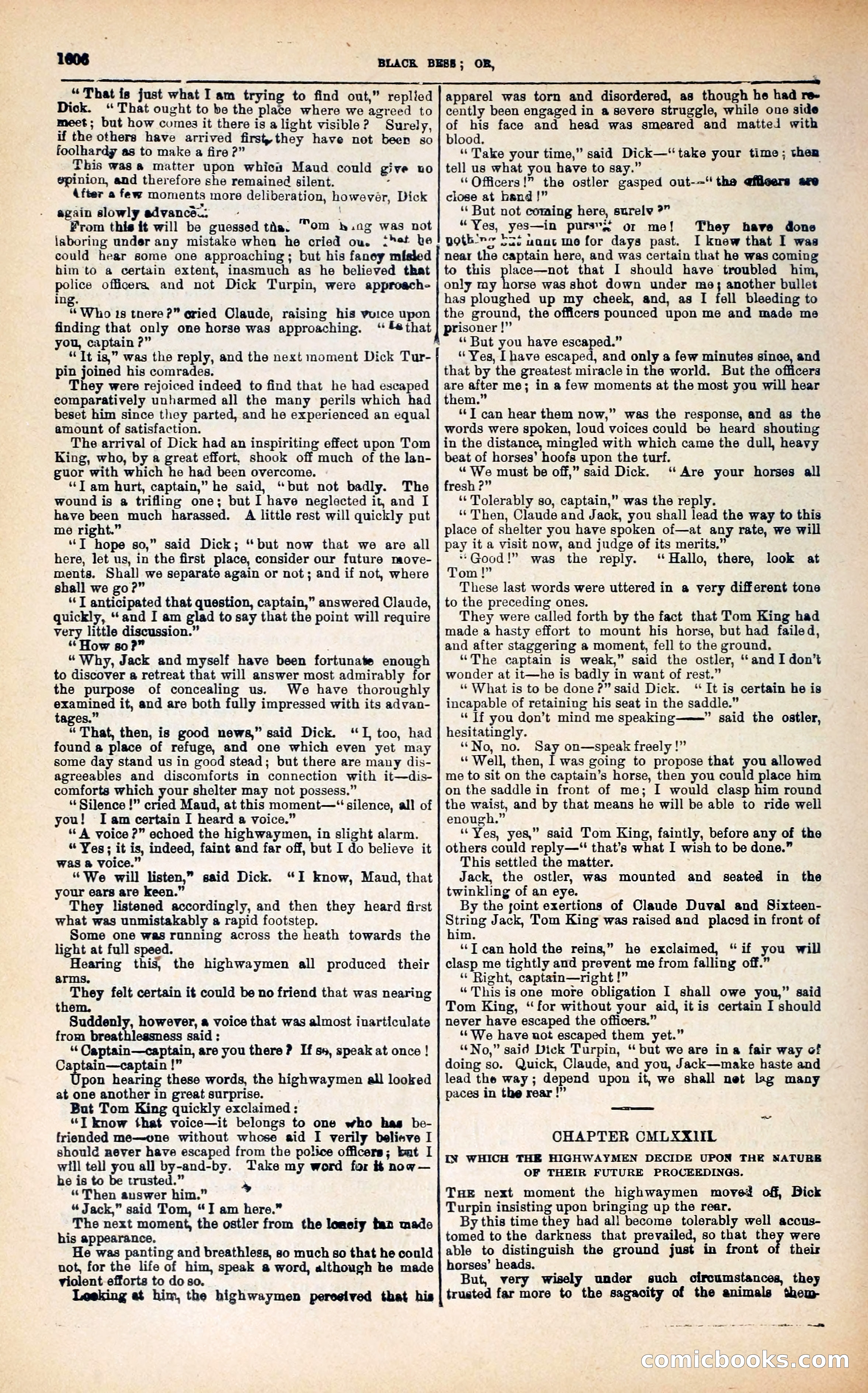
A restored page from Penny Dreadfuls, 1866. Page through the whole issue in the reader above.
📄 Transcribed text from this page (OCR, searchable)
Machine-transcribed from the original scan — historical spelling and the odd misread are preserved.
1606 “That is just what I am trying to find out,” replied Dick. ‘“ That ought to be the place where we agreed to meet; but how comes it there is a light visible ? Surely, if the others have arrived first-they have not been so foolhardy as to make a fire ?” This was a matter upon whica Maud could epinion, and therefore she remained silent. (fter a few moments more deliberation, however, Dick again slowly advance... From this it will be guessed tha. “om bh.ng was not give uo laboring under any mistake when he cried owe :** be! could hear some one approaching; but his faney misled him to a certain extent, inasmuch as he believed that police officera and not Dick Turpin, were approach- ing. “Who 1s tnere?” eried Olaude, raising his vuice upon finding that only one horse was approaching. “ "that you, captain ?” “It is,” was the reply, and the next moment Dick Tur- pin joined his comrades. They were rejoiced indeed to find that he had escaped comparatively unharmed all the many perils which had beset him since they parted, and he experienced an equal amount of satisfaction. The arrival of Dick had an inspiriting effect upon Tom King, who, by a great effort. shook off much of the lan- guor with which he had been overcome. ‘‘T am hurt, captain,” he said, “but not badly. The wound is a trifling one; but I have neglected it, and I have been much harassed. A little rest will quickly put me right.” “T hope so,” said Dick; “but now that we are all here, let us, in the first place, consider our future move- ments. Shall we separate again or not; and if not, where shall we go?” ‘**T anticipated that question, captain,” answered Claude, quickly, “‘and I am glad to say that the point will require very little discussion.” ‘How so?” “Why, Jack and myself have been fortunate enough to discover a retreat that will answer most admirably for the purpose of concealing us. We have thoroughly examined it, and are both fully impressed with its advan- tages. “ That, then, is good news,” said Dick. “TI too, had found a place of refuge, and one which even yet may some day stand us in good stead; but there are many dis- agreeables and discomforts in connection with it—dis- comforts which your shelter may not possess.” ‘' Silence !” cried Maud, at this moment—“ silence, all of you! Iam certain I heard a voice.” : ‘A voice ?” echoed the highwaymen, in slight alarm. “Yes; it is, indeed, faint and far off, but I do believe it was @ Voice.” “We will listen,” said Dick. your ears are keen.” They listened accordingly, and then they heard first what was unmistakably a rapid footstep. Some one was running across the heath towards the light at full speed. Hearing this, the highwaymen all produced their “]T Know, Maud, that arms. They felt certain it could be no friend that was nearing them. Suddenly, however, a voice that was almost inarticulate from breathlessness said : ‘“‘ Captain—captain, are you there? If ss, speak at once ! Captain—captain !” pon hearing these words, the highwaymen all looked at one another in great surprise. But Tom King quickly exclaimed: “T know that voice—it belongs to one who has be- friended me—one without whose aid I verily believe I should never have escaped from the police officers; kat I will tell you all by-and-by. Take my word for it now — he is to be trusted.” » “Then auswer him.” “ Jack,” said Tom, “I am here.” The next moment, the ostler from the loneiy tan mado his appearance. He was panting and breathless, so much so that he could not, for the life of him, speak a word, although he made violent efforts to do so. Leeking at him, the highwaymen perceived that his BLACK BESS; OB, eee ek a apparel was torn and disordered, as though he had re cently been engaged in a severe struggle, while one side of his face and head was smeared and matted with blood. ‘Take your time,” said Dick—‘‘take your time; them tell us what you have to say.” , ‘‘ Officers!” the ostler gasped out-="the @fileers are close at hand!” ‘‘ But not coming here, surely ?” “Yes, yes—in purse; or me! They have done goth’ bos want me for days past. I knew that I was near the captain here, and was certain that he was coming to this place—not that I should have troubled him, only my horse was shot down under me} another bullet has ploughed up my cheek, and, as I bl bleeding to the ground, the officers pounced upon me and made me prisoner !” ‘‘ But you have escaped.” “Yes, [have escaped, and only a few minutes sinee, and that by the greatest miracle in the world. But the officers are after me; in a few moments at the most you will hear them.” ‘‘T can hear them now,” was the response, and as the words were spoken, loud voices could be heard shouting in the distance, mingled with which came the dull, heavy beat of horses’ hoofs upon the turf. “We must be off,” said Dick. ‘Are your horses all fresh ?” ‘* Tolerably so, captain,” was the reply. ‘Then, Claude and Jack, you shall lead the way to this place of shelter you have spoken of—at any rate, we will pay it a visit now, and judge of its merits,” **Good!” was the reply. ‘Hallo, there, look at Tom!” These last words were uttered in a very different tone to the preceding ones. They were called forth by the fact that Tom King had made a hasty effort to mount his horse, but had failed, and after staggering a moment, fell to the ground, “The captain is weak,” said the ostler, ‘and I don’t wonder at it—he is badly in want of rest.” ‘‘ What is to be done ?” said Dick. “It is certain he is incapable of retaining his seat in the saddle.” “Tf you don’t mind me speaking ” said the ostler, hesitatingly. ‘““No, no. Say on—speak freely !” ‘‘ Well, then, I was going to propose that you allowed me to sit on the captain’s horse, then you could place him on the saddle in front of me; I would clasp him round the waist, and by that means he will be able to ride well enough.” ‘‘' Yes, yes,” said Tom King, faintly, before any of the others could reply—* that’s what I wish to be done.” This settled the matter. Jack, the ostler, was mounted and seated in the twinkling of an eye. By the soint exertions of Claude Duval and Sixteen- String Jack, Tom King was raised and placed in front of him. ‘‘T can hold the reins,” he exclaimed, “if you will clasp me tightly and prevent me from falling off.” “ Right, captain—right !” “This is one more obligation I shall owe you,” said Tom King, “for without your aid, itis certain I should never have escaped the officers.” ‘We have not escaped them yet.” “No,” said Dick Turpin, ‘but we are ina fair way of doing so. Quick, Claude, and you, Jack—make haste and lead the way; depend upon it, we shall net lag many paces in the rear !” OHAPTER COMLXXIIL IN WHICH THE HIGHWAYMEN DECIDE UPON THE NATURE OF THEIR FUTURE PROCEEDINGS. THE next moment the highwaymen moved off, Dick Turpin insisting upon bringing up the rear. By this time they had all become tolerably well accus- tomed to the darkness that prevailed, so that they were able to distinguish the ground just in front of their horses’ heads. But, very wisely under such circumstances, they trusted far more to the sagacity of the animals them at — ne — Eomichdoo (C “SA ele)